Free tools Windows power users keep installed
One-click scans. No signup required.
ThatPainter is reader-supported. When you buy through links on our site, we may earn an affiliate commission. Learn More
The most effective closet makeover starts before you buy anything: empty the closet, clean it, measure every constraint, and remove what you no longer use. Then assign each category a reachable home and capture wasted vertical, door, shelf, and hanging space. The ideas below work for a small reach-in closet, a walk-in, or a rental where permanent construction is off-limits.
As an Amazon Associate I earn from qualifying purchases.
Reset the closet before adding storage
1. Empty the closet completely
Take every garment, shoe, bag, and loose item out. Home-improvement organization guides recommend planning from a blank closet because an apparently full space often contains items that do not belong there. With the floor and shelves visible, you can see the actual structure, obstructions, and unused height.
2. Clean while the space is empty
Wipe shelves and walls, vacuum the floor, and remove dust from corners and the rod. Cleaning now gives you a reliable starting point and prevents you from sealing dirt behind bins or folded clothes. It also makes it easier to spot moisture, damaged shelving, or loose hardware that should be fixed first.
#1 Best Overall

- Simply Modern, Seamless Fit: The CUSTOS Collection pairs crisp right‑angled lines with handy open storage to create a minimalist look that fits easily into your home. Complete your space with matching storage furniture for a cohesive look
- Customize Your Walk-In Closet: The closet system expands from 4' to 9.6' wide to fit small to extra‑wide closets. Four 26"–49" telescoping hanging rods and a 6‑height adjustable shelf let you customize the layout and build your dream reach-in closet
- Spacious Layout: 5 hanging zones maximize vertical space, keeping dresses, shirts, pants, and jackets wrinkle-free and easy to access. 4 shelving storage areas hold hats and bags, including a bottom section for shoes, and a top shelf holds storage bins
- Flexible Installation: Set up the adjustable rods on one side or both to fit your space, or just use the middle tower alone. If you need a different rod height, you can drill new holes to fit your clothes and storage needs
- Built to Last, Easy to Clean: Made from particleboard with classic white finish and quality hardware, this closet organizer starter kit is sturdy and durable while giving a clean, modern, and timeless look. The smooth surface wipes clean in seconds
3. Sort into keep, donate, repair, and discard
Capacity gained by removing unused items costs nothing. Make four decisions for every piece: keep it, donate it, repair it, or discard it. Put donation and discard bags outside the closet immediately so they do not drift back into the “keep” pile. Set repair items in one labeled place with a deadline; otherwise they consume storage indefinitely.
4. Measure every constraint
Measure the usable width, depth, and height; note rod height and position, shelf thickness, baseboards, outlets, and the door’s swing and clearance. Measure with the closet empty, as recommended by Wayfair’s planning guidance. Record the narrowest point, not just the largest wall, and compare those figures with every organizer’s outside dimensions. A container that fits a shelf but blocks the door is not a space-saving solution.
Give each category a logical home
5. Create zones by category
Group tops, bottoms, dresses, shoes, bags, and accessories instead of scattering them wherever a gap appears. A zone can be a shelf section, a rod segment, a bin, or a hook row. Grouping reduces search time and shows exactly which category is creating pressure, so you can choose a targeted fix rather than adding random storage.
6. Keep daily-use items at eye or hand level
Place the clothes, shoes, and accessories you use most often where you can reach them without a step stool. The Container Store’s organizing guidance prioritizes easy access for frequently used items. Reserve high shelves and deep corners for low-frequency categories; accessibility is part of capacity because difficult storage quickly becomes a neglected pile.
7. Move seasonal items up or out
Coats in summer and heavy sweaters in warm weather do not need prime real estate. Put them on upper shelves or in another approved storage location. Vacuum-sealable bags can compress clothing that will not be needed for several months, but label each bag and avoid compressing items whose care instructions prohibit it. Keep the current season in the active zone.
Increase hanging capacity without crowding garments
8. Switch bulky hangers to slim velvet hangers
Replace mismatched plastic and padded hangers with a consistent slim style where garment care allows. This Old House reported in 2026 that slim velvet-covered hangers can save up to 30% of hanging space compared with bulkier alternatives. Treat that as an upper-end claim, not a guaranteed result: the gain depends on the original hangers and how tightly the rod is packed.
Rank #2
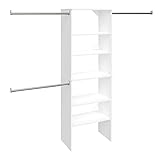
- ALL-IN-ONE CLOSET ORGANIZER: Wood closet organizer system kit includes tower, (3) expandable rods, (5) interior closet shelving (2 shelves are adjustable)
- FITS CLOSETS 5 – 10 FT. WIDE: Hang rods expand from 30 inches to 48 inches (Rods can be trimmed or installed on only one side of unit to accommodate smaller closets.)
- CUSTOMIZE CLOSET SYSTEM WITH ADD-ON UNITS: The SuiteSymphony Collection includes additional drawers, doors, shoe shelves, rods, top closet shelving and other compatible units to create a fully customizable closet (All add-on components sold separately)
- VERSATILE CLOSET INSERT FOR ALL HOME ORGANIZATION NEEDS: This closet storage system can be utilized in both reach-in and walk-in closets to store shirts, pants, jackets, sweaters, shoes, décor or other items; It can also be used in dens, bedrooms, play areas, offices, and other spaces where home organization is a necessity
- RODS OPTIONAL: Utilize the storage tower and closet shelving without attaching hang rods for alternative purposes or organization in spots where space is limited; Hang rods can be attached on both sides or along one single side as needed
9. Match hanger style to the garment
Use slim velvet hangers for most shirts, blouses, trousers, and everyday dresses. Keep sturdy wooden hangers for heavy coats and suits, and padded or shaped hangers for garments that need extra support. A consistent style within each category keeps the rod orderly while protecting fabrics that should not be squeezed onto a thin hanger.
What’s actually slowing this PC down?
Pick the symptom - the matching free tool is one click away.
10. Add a second hanging rod where clearance permits
A double-rod arrangement uses the vertical gap below a standard rod. Place shirts and jackets on the upper rod and shorter garments on the lower one. Before installing, measure the distance between rods, the floor, and the shelf above; verify that your longest item will not drag and that the lower rod will not obstruct drawers, shoes, or the door.
Turn shelves into organized, visible storage
11. Install shelf dividers
Vertical dividers keep stacks of sweaters, jeans, handbags, or linens from leaning into one another. Position them according to the width of each category rather than spacing them evenly. Dividers are especially useful on long fixed shelves where one collapsing pile can spread across the entire shelf.
12. File-fold clothing in bins or drawers
Fold shirts, workout wear, underwear, or pajamas into vertical rows instead of horizontal piles. File folding lets you see each item without excavating the stack. Choose bins or drawers that match the measured shelf depth and leave enough clearance to pull them out fully; an overdeep container turns visible rows into an inaccessible tunnel.
13. Use clear bins when identification speed matters
Clear containers work well for accessories, travel items, socks, or small seasonal pieces that you need to identify at a glance. Home Depot’s organization guidance pairs clear containers with labels for visibility. Even transparent bins benefit from a simple category label when several boxes look similar.
14. Choose opaque or fabric bins for visual calm
Use opaque plastic or fabric boxes for miscellaneous items or categories that look cluttered when exposed. Label the outside with the contents and, if useful, the season. This approach hides visual noise without sacrificing retrieval, provided labels face outward and bins are not stacked beyond safe reach.
Rank #3

- 【 4-in-1 Closet System, Custom/DIY as you like】- This Closet System sets includes 4 Separate closet Units: One Corner Closet system and 3 other Styles independent units with 6 Wooden Drawers and a lot of Adjustable Shelves and totally 8pieces hanging Rods. And you can customize it to be Dreamy Long or L Shape or U shape to fit your walk in Closet Perfectly for organizing (T shirt, Jackets, Coats, Outerwear, Dresses), shoes, Accessories, bags, suitcases, Toys, Bedding, and more. Say goodbye to clutter and enjoy a neat, easily accessible storage solution.
- 【4pcs extra side hanging rods, Enough Long Dresses Space 】- Besides the 4 pieces inner hanging rods, we offer 4pieces extra side hanging rods to connect between any of the independent closet system. And the hanging rod length can be adjusted from 22” to 39.4” . So if you add these 4pieces Hanging rods on, the size of this closet system can be expanded 157.6”more supreme luxury walk in closet. And this extra side hanging rods offer you enough places for your Long Dresses especially.
- 【Heavy duty, 2500lbs loading Capacity, Ultimate Storage】- This standing closet organization kit is made of reinforced engineered wood and extra thick hanging rod with solid construction which can fully guarantee a 2500lbs loading capacity for 4 sets. And this 4 in 1 closet system include: 4 pcs Inner Hanging Rods, 6 *wooden Drawers, 5* Adjustable Shelves, 4* extra hanging rods for hanging. So this closet system really expand your storage ultimately.
- 【Updated Extra thick 0.6mm Stainless Steel Hanging Rod, Never Bend 】-This closet system is with super sturdy Stainless Steel Expandable Rod which is with 0.6mmm thick stainless steel. Compared with the 0.2mm thick stainless steel used by others, ours is 3 times sturdy and more more heavy duty. Do not worry about the rod getting bent any more.
- 【Assembling easy as a freeze, step by step instruction】- This Closet System is with clear and detailed Step by Step instruction. All parts and accessories can be easily identified with Stickers for easy recognition. Note: Most thoughtful gift idea also for Christmas, New Year, Birthday etc.
15. Stack containers to use ceiling height safely
Stackable boxes convert unused upper air into storage. Keep heavy items in the lowest boxes, lighter items above them, and everyday categories below shoulder height. Check that the stack is stable, does not press against the ceiling, and leaves enough room to remove the top container without dismantling the entire column.
16. Add under-shelf baskets
An under-shelf basket hangs beneath an existing shelf and creates a second layer without taking floor area. Use it for lightweight scarves, clutches, folded thin garments, or small linens. Confirm the basket’s mounting style and load limit, and leave clearance so the items below are not crushed or snagged.
Use the door, walls, and floor
17. Put an organizer on the inside of the door
An over-the-door shoe organizer can hold shoes, belts, hair accessories, or small bags. Measure the door thickness, trim, hinges, and the gap to nearby shelves before buying. Close the door several times after installation; pockets that bulge into the room can prevent a proper latch or damage the frame.
18. Add hooks for accessories
Hooks on a side wall or another permitted surface keep belts, scarves, hats, and bags visible and off the floor. Group hooks by use—daily bags near hand level, occasional accessories higher up—and respect the wall material and the hardware’s load rating. In a rental, use only attachment methods allowed by the lease.
19. Use a shoe rack or cubbies
Stackable shoe racks and cubbies turn vertical floor space into accessible pairs. Place everyday shoes at the front or lowest level and less-used pairs higher. Leave enough width for the shoes you actually own, including boots; forcing pairs into undersized cubbies causes damage and defeats the purpose of the system.
20. Box rarely worn shoes
Store formal or seldom-used shoes in labeled boxes on upper shelves or another low-access zone. Keep pairs together, and use a label that states the type or occasion rather than relying on memory. This frees the most reachable shoe storage for the pairs you wear weekly.
Rank #4

- Aheaplus Closet System, 4-9FT Closet Organizer with 4 Wooden Drawers, Wood Closet Organizer System with Tower, Walk-in Closet Organizer Wardrobe Clothes Rack with 4 Hanging Rods, Garment Rack, White
Choose flexible solutions for seasons and rentals
21. Compress bulky seasonal clothing carefully
Vacuum-sealable bags reduce the volume of puffer coats, blankets, and other bulky items that can remain outside the active closet. Follow the garment’s care label, remove air only as directed, and store bags away from sharp edges and heat. Label the season and contents so the space-saving measure does not create a search problem later.
Windows Errors? Fix Them Before They Spread
Repair common Windows errors and clear accumulated junk for a smoother, more stable PC - no reinstall needed.Free scan · no reinstallOutdated Drivers Are Slowing You Down
One free scan finds every outdated or missing driver and matches the right update for your exact hardware.Free scan · exact hardware match22. Keep collapsible bins for changing capacity
Canvas or other collapsible bins fold flat when empty. They are useful for gloves, scarves, swimwear, and temporary overflow because the container itself does not occupy permanent space once the category shrinks. Do not use a soft bin as a substitute for structural support when stacking heavy items.
23. Install adjustable shelving where fixed shelves waste space
Shelf standards, brackets, and modular systems let you set shelf height around the items you own. Tall boots, folded sweaters, and small bins rarely need the same vertical clearance. Adjustable hardware costs more planning than a loose stack, but it prevents large dead zones and can be reconfigured when your wardrobe changes. IKEA notes that the best interior arrangement depends on each person’s clothing mix and storage needs.
24. Use removable or freestanding storage in a rental
Freestanding racks, tension solutions, bins, removable hooks allowed by the lease, and over-door organizers can add capacity without major construction. Confirm load limits, floor stability, wall protection, and door clearance before loading anything. Photograph the original condition and keep installation instructions so the closet can be returned to its prior state.
Make the system stay organized
25. Label every container and schedule a reset
Labels preserve the work after the initial sort. Put the label where it can be read without moving the bin, and use specific names such as “winter gloves” rather than “miscellaneous.” Add a short recurring reset—return shoes, hang worn garments, and put accessories back in their zones. Home Depot and the Container Store both emphasize labeling and returning items to a defined home as maintenance habits.
Recommended Free Tools
Match the solution to your closet and habits
| Option | Best use | Access and visibility | Installation and fit checks | Capacity or budget note |
|---|---|---|---|---|
| Slim hangers | More rod capacity for everyday garments | High access; garments remain visible | Check garment-care needs and rod load | Up to 30% hanging-space savings was reported by This Old House in 2026; actual gain varies |
| Second rod | Short garments in a tall hanging section | High access; open visibility | Measure vertical clearance, floor space, and door swing | Requires secure mounting or a stable freestanding frame |
| Dividers and bins | Folded clothing and small categories on existing shelves | Dividers are open; clear bins maximize visibility; opaque bins reduce visual clutter | Match outside width, depth, and shelf clearance | Usually uses existing shelving with little structural work |
| Door organizer | Shoes and lightweight accessories | Visible pockets; convenient for small items | Verify door thickness, hinges, latch, and closing clearance | Uses otherwise wasted surface; respect the organizer’s load limit |
| Shoe rack or cubbies | Frequently worn shoes and boots | Pairs visible and separated | Measure shoe width, boot height, and floor footprint | Stackable formats increase vertical floor capacity |
| Adjustable shelving or modular system | Changing wardrobes or mismatched item heights | Can combine open shelves, bins, and hanging zones | Requires accurate wall, stud, and clearance measurements | Higher planning and installation effort, with reconfiguration value |
| Vacuum bags and upper storage | Bulky, rarely used seasonal items | Low access; contents should be labeled | Check fabric-care instructions and shelf load | Moves volume out of the active zone rather than increasing daily reach |
| Freestanding or removable storage | Rentals or reversible changes | Varies by bin, rack, or hook type | Check stability, lease rules, wall protection, and door clearance | Avoids permanent construction but may sacrifice some usable width |
A practical decision sequence
- Measure first: record the narrowest width, usable depth, ceiling height, rod position, and door clearance.
- Protect prime reach: reserve eye- and hand-level space for daily clothing and shoes.
- Choose the least complicated fix: start with decluttering, slim hangers, dividers, or bins before installing a larger system.
- Capture overlooked surfaces: add a second rod, under-shelf basket, door organizer, hooks, or vertical shoe storage only after clearance checks.
- Move low-frequency items away: use upper shelves, labeled boxes, collapsible bins, or approved off-closet storage for seasonal categories.
- Test the loaded system: open the door, pull every bin, check rod and shelf stability, and confirm that heavy items remain low.
- Maintain the homes: return each item to its label or zone during the scheduled reset.
These changes can make clothing and accessories easier to find and access—the practical benefit described in Home Depot’s closet guidance. No qualifying published statistic establishes a clinical reduction in stress or a mental-health effect, so “sanity” is best understood as the everyday relief of fewer searches, safer storage, and a closet that remains usable.
Quick Recap

Product prices and availability are accurate as of the date/time indicated and are subject to change. Any price and availability information displayed on Amazon at the time of purchase will apply.

