Outdated Drivers Are Slowing You Down
Outbyte Driver Updater · freeOne free scan finds every outdated or missing driver and matches the right update for your exact hardware.
Scan My Drivers Free →ThatPainter is reader-supported. When you buy through links on our site, we may earn an affiliate commission. Learn More
Use this 27-point checklist to inspect and maintain the outside of a house without turning a routine check into an unsafe roof, ladder, electrical, or structural project. Start with water management: keep roof runoff moving through intact gutters and downspouts, keep soil from directing water toward the foundation, and treat flashing, cladding, windows, doors, and penetrations as connected drainage assemblies. Perform tasks seasonally, after severe weather, or when an inspection reveals a problem; no single interval fits every climate, material, or home.
Work from the ground whenever possible. Stop and arrange qualified help for persistent water intrusion, suspected structural movement, complex flashing, unsafe access, electrical work, or any repair beyond your skill. If exterior paint may contain lead, review current U.S. Environmental Protection Agency (EPA) lead-safe requirements before disturbing it.
As an Amazon Associate I earn from qualifying purchases.
Recommended Free Tools
How to use this checklist
These are practical homeowner tasks, not a canonical list that applies identically to every property. Weather, roof and wall materials, home age, local codes, manufacturer instructions, and what you observe should determine timing and method. A clean surface is not the same as a sound assembly: water can enter behind siding, trim, windows, or roof penetrations even when the visible finish looks acceptable.
| When you find an issue | Prefer this response | Avoid this mistake |
|---|---|---|
| Debris, leaves, or a reachable surface buildup | Clean it with a tool suited to the material and your safe access. | Climbing onto a roof or overreaching from a ladder to save time. |
| Water flowing toward the building | Trace the path, correct the source where practical, and reassess after rain. | Adding a cosmetic patch without changing the drainage path. |
| Gap at flashing, window, door, or penetration | Identify the assembly and use compatible repair materials; obtain an assessment if concealed damage is possible. | Assuming a bead of caulk replaces missing or incorrectly installed flashing. |
| Peeling coating on an older home | Check lead-safe rules and follow required containment and work practices. | Sanding, scraping, or power-washing without determining whether lead paint is present. |
| Persistent dampness, movement, or repeated leakage | Document it with dated photos and call a qualified professional. | Repeating temporary repairs while damage continues behind the finish. |
Water management: roof runoff, gutters, and grade
EPA heavy-rain guidance recommends keeping gutters clear and directing downspouts away from the house. EPA also identifies water flowing toward a home and missing gutters as possible contributors to basement moisture. DOE Building America describes runoff options that include discharge onto sloping final grade more than 5 feet from the foundation, or into a qualifying underground catchment more than 10 feet away. Those distances are examples in that guidance, not universal code requirements; local soil, lot shape, easements, and drainage rules still control.
#1 Best Overall

- LOW PROFILE RATCHET: Up to 25% thinner head* for access in tight spaces (as compared to CMMT81747 & CMMT81748)
- 90-TOOTH RATCHET: Delivers 5 degree arc swing
- CONVENIENCE: Comprehensive set of 1/4-in and 3/8-in drive mechanics tools and mixed hand tools
- DURABLE BLOW MOLD CASE: For mobility and easy storage
- Full Lifetime Warranty on Mechanics Tools; Limited Lifetime Warranty on Hand Tools
1. Walk the perimeter and make a condition map
Walk around the house after a dry-weather inspection and again after significant rain or wind. Note loose components, water staining, erosion, damaged paint, damp areas, fallen branches, and locations that deserve closer inspection. Take wide and close photographs from the same viewpoints so a new stain or crack can be distinguished from an old one.
2. Inspect gutters from a safe vantage
From the ground, a porch, or another stable location, look for leaves, packed sediment, sagging runs, separated joints, and visible leaks. Do not imply that a ladder or roof edge is risk-free; if the gutter cannot be viewed or reached safely, arrange professional service.
What’s actually slowing this PC down?
Pick the symptom - the matching free tool is one click away.
3. Clear reachable gutter debris
Use a gutter-cleaning scoop or another tool appropriate to the gutter material when debris is reachable without unsafe climbing. Keep hands clear of sharp edges, protect eyes from falling material, and follow the tool and ladder manufacturer’s instructions. A tool does not make roof walking or overreaching safe.
4. Check downspouts for blockage or separation
Look for crushed sections, disconnected elbows, visible nests, and water marks at joints. During rain, observe whether water exits the outlet rather than backing up or spilling from a seam. Clearing a blockage is a surface task; a concealed underground obstruction may require drainage equipment or a specialist.
5. Confirm downspouts discharge away from the foundation
Make sure outlets do not empty directly beside the wall or create a puddle at the footing. EPA recommends directing discharge away from the house. DOE Building America gives the context-specific examples of more than 5 feet from the foundation on sloping grade or more than 10 feet for the described underground catchment option; verify that any extension does not send water toward a neighbor, walkway, septic system, or other problem area.
Rank #2

- 【21V Power Cordless Drill with LED】 Sundpey 255 Pieces 21V Power Cordless Drill has a wide range of applications. The cordless drill combo kit can tighten screws and drill holes in plastic, wood, ceramics, and glass. The machine is equipped with built-in LED light and two gears, the 1st gear is 0-350rpm, the 2nd gear is 0-1350rpm, the maximum clamping range of the chuck is 3/8'' (10mm) and 18+1 torque adjustment (Max 34N.m). The hand drill driver weights only 1.5 kg including the battery, and it is easy to operate with one hand.
- 【2 Replacement Rechargeable Batteries】 This 21Volt power drill cordless has two 2.0Ah rechargeable Lithium-ion batteries, one battery quickly fully charged only 1.5 hours and can be used continuously for about 1 hour. Each battery is small and lightweight, whether you are using it indoors or outdoors, making it easy to carry and replace. When not using batteries, please retain power for the battery, so as to better protect the battery life.
- 【Multi-functional Accessories Set】 This household and auto repair tool kit combines general basic, practical and essential tool accessories in one package. The toolkit box includes Rip Claw Hammer, Adjustable Wrench, Sharp-nosed Pliers, Tape Measure, Hex Key Wrench Set, Screwdriver, Socket, Twist Drill Sets(1.5mm 2mm 2.5mm 3mm 3.5mm 4mm 4.5mm 5mm 5.5mm 6mm), Wood Drill Bits(5 mm 6 mm 8 mm), Flat Drills(10mm 12mm 16mm 18mm 20mm), Stainless Steel Ruler, Woodworking Pen, Extension Bar, 200mm Flexible Shaft, Expansion Screw sets(134pcs), Rechargeable Electric Drill(rechargeable batteries and charging adapter), etc.
- 【Portable Storage & Special Present Choice】 All the hand tools and Cordless tool are packed in a unique complete tool box set for storage and portability. Each hand tool fits snugly into its respective place to prevent moving around and scraping. All tools set are neatly stored in a sturdy case to keep tools secure, clean, organized and easy to find. This tool kit set is nice for Mother's Day, Father's Day and it is a nice option as tool present for Dad, Mom, Grandfather, Grandmother, Brothers, boyfriend and lover friends in Newyear, Easter Day, Thanksgiving Day, Christmas Day, Birthday, Anniversaries Days.
- 【100% Customer Service】 Sundpey tool kit with drill offers a 12-month product service and is committed to providing good quality tool sets and service to all customers. If you have any questions, please tell us in time, we will reply you within 24 hours.
6. Look for low spots and puddles
After rain, inspect soil, paving, and planting beds for standing water or a visible flow line toward the foundation. Record how long the water remains and whether it recurs in the same place. Persistent pooling can indicate a grading, downspout, or underground-drainage problem rather than a simple surface defect.
7. Correct minor surface grading issues carefully
Only adjust small, accessible areas when you can improve drainage without directing water toward a neighboring property or creating a new hazard. EPA remodeling guidance (page shown as published in 2015) describes ground sloping away from the house at 1/2 inch to 1 inch per linear foot in that remodeling context. Treat that range as cited guidance, not a universal requirement; obtain a qualified drainage assessment when pooling persists or the lot has complicated elevations.
8. Inspect visible roof edges from the ground
Use binoculars or a camera zoom to look for missing, lifted, cracked, or visibly damaged roofing material, exposed underlayment, and distorted edge metal. Do not make routine roof walking part of a DIY checklist. A roof professional can inspect areas that cannot be seen from a safe position.
9. Check roof-to-wall transitions
Look for displaced step flashing, open counterflashing, staining below a transition, or material pulled away from the wall. These junctions depend on layered drainage, so a visible gap may signal concealed damage. Escalate if you cannot identify how the existing assembly is intended to shed water.
10. Check roof penetrations and their flashing
From the ground, inspect around vents, chimneys, skylights, and other penetrations for lifted metal, cracked boots, dark staining, or missing pieces. Do not climb onto the roof to reach a penetration unless you are trained, equipped, and complying with applicable safety requirements; a qualified roofer is the safer choice for close inspection.
Rank #3
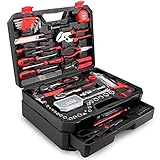
- [Toolbox Included] - Includes 1-Drawer storage box with independent sliding drawer to enlarge the capacity more than common toolbox. Assortment of necessary tools are in one tool chest, durable plastic case with internal molded compartments to keep each component protected and easily accessible. All tools meet or exceed ANSI standard.
- [High Quality Material] - Made of high-quality steel and finished in heat treated chrome, durable and corrosion resistance. Handles made of TPR material, comfortable for grip.
- [Muti-purpose Tools Kit] - 325Pcs tools set for most small repairs and DIY projects around the house. It is perfect for handyman, construction workers, mechanics, work shops etc. This tool set is also a good gift choice for family member, friends, partners, etc.
- [Complete Varieties] - Comprehensive assortment of professional-grade wrenches, a complete range of 1/4 inch and 3/8 inch metric-sized sockets and precision screwdrivers, hammer, tape measure, pliers etc. The 72-tooth ratchet. Variety of 1/4-inch screwdriver bits: Phillips, slotted, square, star and pozi. Soft-grip handle on screwdrivers, pliers, srtipper and hammer provides excellent comfort and control.
- [Great Gift Choice] -This tool kit is easy to carry and stock. It is a good gift choice for men and women. Also this tool set is perfect for Father's Day, and is a great option as gift for Dad, Boyfriend & Brothers when chrismas.
11. Inspect siding or cladding
Scan all elevations for loose boards or panels, impact damage, open seams, buckling, and water-stained areas. Touching a swollen or soft section can reveal deterioration, but do not pry it apart during a routine check. Mark the location and determine whether water could be entering behind the cladding.
12. Check exterior trim for deterioration or separation
Inspect corner boards, fascia, soffit edges, rake trim, and decorative details for rot, peeling coating, open joints, or separation from the wall. Trim that repeatedly fails may be exposing an end grain or flashing defect; replacing only the visible piece can leave the moisture path unchanged.
13. Examine window and door perimeters
Look for gaps, failed sealant, staining, swollen material, or peeling paint around frames and sills. Pay attention to the bottom corners, where water often becomes visible first. Photograph any interior-side staining as well, because an exterior symptom may have an entry point higher or farther away.
14. Understand window flashing before applying caulk
DOE installation details show that flashing and sealant are designed as a system. In the cited rough-opening detail, the top and sides are sealed while the bottom is not sealed in the same way, allowing drainage. Do not close a designed drainage path with an improvised bead of caulk. Match any repair to the window type, WRB, sill pan, cladding, and manufacturer’s instructions; concealed or widespread leakage warrants professional evaluation.
Do these 3 things before closing this tab:
1Fix the driver behind crashes, sound loss and screen glitches2Repair Windows errors before they cause bigger problems3Scan for outdated or missing drivers - takes under a minuteOpenings, sealants, and exterior penetrations
15. Inspect exterior door weather seals
Check the sweep, weatherstripping, threshold, frame joints, and visible signs of water entry. A damaged seal can cause drafts and wetting, but a stain at the head or side of a door may point to flashing above it. Replace a seal only when the substrate and door adjustment are sound; otherwise investigate the assembly.
Rank #4

- 🔨【High Quality & Sturdy】The tool kits for home is forged from high-grade steel and finished in high-polish chrome,sturdy and durable,high hardness,and resist corrosion,our home repair tool kit will last a lifetime without rust or abscission.
- 🔨【Essential Home Tool Kit with Case】It's an ideal home tool set gift for women mom or men,teacher appreciation,college students dorm essentials,craftsman,handyman,homeowners or starters on Birthday and Anniversary to do repairing,furniture assembling,woodworking and DIY projects around the house,The home basic tool kit for men can also be car hand tool kit under the emergency situations.
- 🔨【Portable Household Tool Sets】 Our home repair tool sets for men includes sturdy handy carrying case that keeps all the pieces in their place,the home tool kits for all purpose can be stored anywhere without taking up any space,convenient to carry outside.
- 🔨【Ergonomically Designed】All set of tools in the tool box set with tools are made of soft grip handle,lightweight and comfortable to hold,all the household tools for home meet or exceed the ANSI.It is not only a starter tool kit,but also an essential household tool kit for home.
- 🔨【Complete Tool Set for Home】The basic household tool kit contains all of the most necessary household tools for home essentials,maintenance and daily use,includes hacksaw,water pump pliers,adjustable wrench,claw hammer,pliers,ratchet wrench,hex key Allen wrench set,screwdrivers,utility knife,tape measure,voltage tester pen,insulation tape,hardware kits and screwdrivers bits connectors.
16. Check caulk joints for separation
Inspect joints at trim, siding transitions, windows, doors, and other interfaces for cracks, peeling, or loss of adhesion. Select a sealant compatible with the specific substrate, movement, exposure, and paint system. Remove failed material according to the product instructions and do not use caulk to conceal rot, missing flashing, or an active leak.
17. Inspect wall penetrations
Look at hose bibs, cable and pipe entries, vents, meters, and other service penetrations for open gaps, staining, or loose escutcheons. Water can follow a penetration into the wall even when the exterior opening is small. Electrical, gas, and utility components should be serviced by qualified tradespeople rather than altered as a cosmetic DIY repair.
18. Check visible foundation surfaces
Look for new cracks, dampness, efflorescence, peeling coating, or water stains. A hairline finish crack is not automatically a structural diagnosis, while repeated wetting, substantial movement, widening cracks, or water entry needs professional assessment. Record dates and weather conditions so a specialist can evaluate change over time.
Quick wins for a faster PC:
Repair Windows errors before they cause bigger problemsFix Now →Scan for outdated or missing drivers - takes under a minuteDriver Scan →Clear out junk files and repair common Windows errorsFree Scan →19. Look for moisture trapped against walls or foundations
Inspect soil, mulch, leaves, stored materials, and dense plant growth that touch or press against cladding and foundation surfaces. The available guidance supports moisture control but does not establish one clearance dimension for every wall system. Keep materials from bridging drainage details, and ask a qualified professional when the wall construction or waterproofing is unknown.
20. Inspect splash areas below roof edges
Check soil, mulch, paving, and siding below eaves and downspouts for erosion channels, recurring wetness, algae, or staining. Splashback can wet lower cladding even when gutters appear intact. Correct the source—outlet position, extension, grade, or surface protection—rather than repeatedly repainting the affected area.
Best Value

- 173-piece hand tool set for basic household repairs and everyday projects; includes 8 combination wrenches, 3/8-inch ratchet wrench, 22 hex keys, 6-inch slip-joint pliers, 6-inch long nose pliers, and more (scroll down to view complete list)
- Made of durable heat-treated and chrome-plated alloy steel for long-lasting, corrosion-resistant strength
- Plastic non-slip handles provide enhanced comfort and control
- Blow-molded case provides secure tool storage and convenient portability
- Measures 16.89 by 12.68 by 3.35 inches
21. Check exterior exhaust hoods
Inspect dryer, bath, and kitchen exhaust hoods for visible blockage, broken flaps, bird nests, or damage. EPA says clothes dryers should vent outdoors. Detailed cleaning intervals are not established here, so follow the appliance and duct manufacturer’s instructions and use qualified service when the duct is long, concealed, or difficult to access.
22. Check outdoor faucets and hose connections
Operate each faucet briefly and look for leaks at the handle, spout, wall connection, and hose fitting. Water dripping beside the foundation can create the same wetting pattern as a drainage defect. Repair or replace compatible washers, valves, or connectors as appropriate; shut off water and obtain help if the leak is inside the wall or the pipe is damaged.
Windows Errors? Fix Them Before They Spread
Repair common Windows errors and clear accumulated junk for a smoother, more stable PC - no reinstall needed.Free scan · no reinstallCrashes, No Sound, or Screen Glitches?
Random freezes, missing sound and display glitches usually trace back to one bad driver. Find and replace yours safely.Free scan · under a minute23. Clear visible drainage grates and channels
Where the property has surface drains, trench channels, or catch-basin grates, remove leaves and sediment that block flow. Confirm that water can move to its intended outlet without undermining paving or discharging against the house. Do not open or modify buried systems you cannot identify; obtain a drainage assessment for recurring backups.
Independent reader supportYour contribution helps us test, update, and keep practical guides available for everyone.Painted surfaces, fixtures, and outdoor structures
24. Inspect exterior lights and service penetrations
Look for loose fixtures, missing covers, cracked sealant, and gaps where wiring or conduit enters the wall. Turn off power before any work that is permitted for a competent homeowner, and use a qualified electrician for wiring, junction boxes, grounding, or uncertain conditions. Water-resistant appearance alone does not prove that an electrical installation is safe.
25. Check porches, decks, and stairs for obvious deterioration
Look for loose rails, visibly failed fasteners, split or rotted boards, movement, and pooling water. This visual check is not a structural inspection standard and cannot certify that a deck or stair is safe. Keep people off components that move or feel unsound until a qualified professional evaluates them.
26. Assess peeling or damaged paint with lead safety in mind
Before scraping, sanding, cutting, or power-washing an older painted surface, determine whether lead-safe requirements apply. EPA’s minor repair and maintenance FAQ describes a narrow situation in which work is outside Renovation, Repair and Painting requirements only when specified exterior surface-area limits, work practices, and activity restrictions are met. It is not a blanket exemption for DIY exterior work. Follow current EPA rules, contain dust and chips, and use trained help when the scope or coating history is uncertain.
27. Keep a maintenance record
Record the date, weather, location, observation, photographs, materials used, and whether the issue returned. EPA moisture-control guidance recommends routine inspection tools and maintenance records for roof and ceiling assemblies. A simple log can show that a stain is stable, reveal a leak that appears only after wind-driven rain, and give a contractor useful history.
When a DIY task should become a professional repair
- Water intrusion continues after the visible source has been corrected, or dampness appears inside finished walls, ceilings, or floors.
- You would need to walk on a roof, use a ladder at an unsafe angle or height, or work near overhead utilities.
- Flashing, window drainage, roofing penetrations, or concealed waterproofing must be reconstructed rather than merely cleaned.
- Foundation cracks show substantial movement, widening, displacement, or repeated water entry.
- A deck, porch, stair, guard, or railing moves, has significant rot, or cannot be evaluated from a stable position.
- The task involves electrical, gas, structural, or buried drainage work beyond your training.
- Paint may contain lead and the work will disturb more than a minor, clearly defined area or requires prohibited practices.
A practical decision sequence after every inspection
- Identify the water path. Ask where rain, splash, condensation, or plumbing water originates and where it ends up.
- Separate surface maintenance from assembly failure. Debris removal is different from a missing flashing layer, rotten substrate, or concealed leak.
- Choose the least hazardous access. Ground-level observation is preferable; do not trade a minor repair for a fall risk.
- Check compatibility. Confirm that a cleaner, sealant, coating, replacement piece, or fastener suits the existing roof, cladding, flashing, substrate, and paint system.
- Protect occupants and the property. Manage runoff, dust, chips, sharp edges, tools, and temporary openings.
- Verify after weather. Reinspect during or after rain when safe, then update the log rather than assuming a cosmetic repair solved the cause.
EPA summarizes the purpose of this work plainly: “Properly maintaining your home is an important part of making sure your fixtures and systems perform well, save water, and keep your utility costs down.”
Quick Recap

Product prices and availability are accurate as of the date/time indicated and are subject to change. Any price and availability information displayed on Amazon at the time of purchase will apply.

