Recommended Free Tools
PC Slower Than It Used to Be?
Free scan · Windows 10 & 11
Outdated Drivers Are Slowing You Down
The Tool Desk
Outbyte Driver Updater FREEScan for outdated or missing drivers - takes under a minuteDriver Scan →Outbyte PC Repair FREEClear out junk files and repair common Windows errorsFree Scan →Free scan · exact hardware match
Windows Errors? Fix Them Before They Spread
Free scan · no reinstall
ThatPainter is reader-supported. When you buy through links on our site, we may earn an affiliate commission. Learn More
Automated shades are motor-driven window coverings that move on command, on a schedule, or in response to conditions such as sunlight and temperature. In an architectural scheme, they are not merely a convenience: the shade fabric, air gap, mounting geometry, power system, and control logic together influence glare, privacy, solar heat, daylight, safety, and operating energy.
As an Amazon Associate I earn from qualifying purchases.
The right specification starts with the window and the room’s use. Choose a genuinely cordless product when children can reach the window, match the shade construction and fabric to the climate and orientation, and program controls around occupancy and sun exposure. Energy results are project-specific; no motorized shade guarantees a particular saving.
What automated shades are—and why the architecture matters
An automated shade is a window covering whose position is moved by a motor rather than by a user-operated pull cord. A wall control, handheld remote, app, timer, daylight sensor, thermostat signal, or building-management system can raise, lower, or tilt the covering. The U.S. Department of Energy (DOE) describes control strategies based on thermostat conditions, outside temperature, solar radiation, and proprietary algorithms (DOE window-attachment guidance). Location-aware systems can also adjust as the sun changes position, a feature described by manufacturers such as Lutron (Lutron automated window treatments).
#1 Best Overall

- EASY INSTALL BLINDS: The remote blinds have a simple and practical no-drill mechanism(suitable for inside mount). Attach the adhesive extension block to the groove of the upper rail (it is forbidden to put more than one block), and then push it into the window frame. There is a battery compartment at the top to supply power for the shades. If the batteries are low, just take them out and replace. A stylish valance is included to block the light from the gap between fabric and the top rail
- EXCELLENT SHADING EFFECT: The fabric is made of a three-layer blackout textured fabric, which is safe and durable. It is a great combination of UV and privacy protection,suitable for bedrooms, living rooms, kitchens and office areas, etc
- SMART IMPLEMENTATION: The AX290 motor requires a smart bridge for APP control/voice control, which requires a hub at home, and you may try our hub. All models of Alexa and Google Assistant can be used to control motorized window shades, and can set timers and other scenes
- CONVENIENT LIFESTYLE: Motorized blinds allow you to achieve a smart home at minimal cost. In the morning, when you are still asleep, the shades in the bedroom open automatically on time, and the warm sunlight spread into the room lightly to wake you up for a new day, and in the evening, when the sun sets, the shades fall on time, creating a private space for the family
- SERVICE: We focus on products and service, if the fabric or components are damaged in any way when you receive the items, please take a photo and send it to us within 60 days, we will replace. Hapadif provides 2-year warranty for motors and controllers
That automation turns a passive finish into an architectural system. A west-facing conference room may need glare control late in the day, while a north-facing bedroom may prioritize privacy and diffuse daylight. A living room in a cooling-dominated climate can benefit from blocking high summer sun, whereas a heating-dominated room may need winter solar gains. The shade, window, climate, interior lighting, and occupants must therefore be designed together.
How the control system works
Schedules and occupancy
Time schedules can open shades before occupants arrive, close them during the strongest solar period, and reopen them for evening views. Schedules are predictable and inexpensive to operate, but they should include seasonal or daylight adjustments so a fixed clock time does not close shades unnecessarily in winter.
Do these 3 things before closing this tab:
1Fix the driver behind crashes, sound loss and screen glitches2Repair Windows errors before they cause bigger problems3Scan for outdated or missing drivers - takes under a minuteSun and weather inputs
Solar sensors, outside-temperature signals, and sun-position calculations allow the system to respond to changing conditions. DOE modeling identifies thermostat-based strategies and schedules using external temperature and solar radiation; these are examples of possible algorithms, not proof that one algorithm is best for every building (DOE window-attachment guidance). Orientation, overhangs, glazing, local weather, and room use determine useful setpoints.
Manual override and fail-safe behavior
Every automated installation should provide a clear manual override. Decide what happens during a power or network failure: a battery shade may remain at its last position, while a wired system may require a local control independent of the internet. Document whether a command affects one opening, a room, a facade, or the whole building so occupants can correct an inappropriate scene without disabling automation.
Rank #2

- No Tools, No-Drill, Easy Install: Quick and easy to set up, these no drill blinds operate smoothly and preserve your window's clean look. Since you don't need to drill holes into your window frame or wall, these are a great option for renters or people who want to avoid causing damage to their living space.
- Solar Panel & Eco-Friendly: Each electric blinds comes with a dedicated solar panel that keeps your shades continuously powered. No more climbing ladders to replace batteries—ensuring safety and convenience while reducing waste.
- Smart Life: Each motorized blind includes a remote control to operate one shade. For whole-room convenience, upgrade to our 15-channel remote (Not included) to control up to 15 shades at once. Pair with the smart hub (Not included), open and close your roller shades from your smartphone or completely automate when they open and close with voice commands. Enjoy more easy living!
- Blackout Roller Shade: Constructed with four layers of premium fabric, these electric blinds completely block external light, creating an ideal dark sleep environment for bedrooms and ensuring enhanced privacy and better rest.
- Trusted After-sales Assistance: MUSCLEAREA indoor motorized automatic blinds are engineered to suit your smart home needs, and come with a 2-year After-sales Assistance! If you encounter any product issues, please don't hesitate to contact us—our dedicated after-sales team is prepared to provide prompt and effective solutions.
Cord safety: what families need to know
The U.S. Consumer Product Safety Commission (CPSC) states, “The safest option when young children are present is to go cordless” (CPSC window-covering cord guidance). CPSC advises choosing cordless coverings, installing them exactly as instructed, and inspecting existing coverings in rooms children can access. Moving furniture away from cords, shortening dangling pull cords, or anchoring continuous loops can reduce exposure but does not eliminate the hazard.
CPSC’s terminology is useful when reading specifications. Its FAQ explains that the ANSI/WCMA A100.1-2018 category “cordless operating system” means an operating system without an operating cord and includes motorized operating systems (CPSC 15(j) rule FAQ). That definition does not make every motorized product hazard-free, certify a particular model, or make an older corded covering safe merely by adding a motor or retrofit device. Ask the supplier for the exact operating-system description, inner-cord treatment, labels, and installation instructions.
Windows Errors? Fix Them Before They Spread
Repair common Windows errors and clear accumulated junk for a smoother, more stable PC - no reinstall needed.Free scan · no reinstallOutdated Drivers Are Slowing You Down
One free scan finds every outdated or missing driver and matches the right update for your exact hardware.Free scan · exact hardware matchCPSC’s voluntary-standards page reports on a historical review of 79 in-depth investigations distributed in 2004: 60% involved horizontal-type cord systems, 40% involved continuous-loop systems typical of vertical coverings and draperies, and 82% involved older products that did not conform to the voluntary standard (CPSC window-blind cord information). These are investigated cases from that review, not estimates of present-day product risk. CPSC also notes that a product meeting a voluntary standard can still pose a hazard if cords are tied up or loose cords become entangled.
A Federal Register proposal published September 24, 2026 (91 FR 60546) discusses accessible cords and potential amendments concerning the substantial-product-hazard list and cord-safety requirements, including ANSI/WCMA-2022 (Federal Register notice). It is a proposed rule, not a final requirement. Check its status and any applicable state, local, or project standards before ordering.
Rank #3
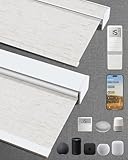
- Excellent Blackout Effect: Our motorized blinds achieve full blackout with 4-layer fabric that blocks light, noise, provides privacy control, insulation and UV protection; Motorized roller shades perfect for bedrooms, living rooms, offices, and more
- Smart Home Integration: Kincmo motorized blinds with remote feature a nearly silent operation, compatible with Apple HomeKit, Alexa, Google Home; Control your roller shades via voice commands or APP: timing, percentage, scene, offsite control, etc.
- Safe, Wireless & Advanced Tech: Powered by the latest Matter and Thread technology, our motorized blackout blinds ensure ultra-quiet, stable and efficient operation; The cordless blackout roller shades prioritizes safety for kids and pets
- Extensive Customization Options: Create your dream motorized window blinds, simply click the “Customize Now” button to design your perfect motorized shades for indoor windows by choosing motor type, appearance, solar panels, among other options
- Hassle-free Setup & Customer-focused: We will pair the smart electric blinds with the remote; You can easily locate the corresponding motorized blinds for installation and use the remote directly; Installation is very easy and takes only 1-3 minutes
Energy and sustainability: evidence with limits
Why construction and fabric matter
Cellular shades contain honeycomb cells that trap air. DOE says well-fitted cellular shades can provide insulation benefits, control daylight and glare, add privacy, reduce nighttime heat loss and drafts, and reduce unwanted solar heat gain (DOE cellular-shade fact sheet). Actual performance depends on cell geometry, fabric, edge gaps, installation, glazing, and whether the shade is deployed when it matters.
DOE’s 2021 fact sheet reports that installing window attachments can save 15% of a household’s annual HVAC energy use compared with vinyl blinds. That is the fact sheet’s comparison, not a guaranteed saving from an automated shade. The same document says nearly 80% of U.S. homes have inefficient single- or double-pane windows, a figure cited by DOE from earlier sources. Improving the window itself, sealing leaks, and commissioning controls may be more important than adding a motor to a poorly fitted covering.
Recommended Free Tools
Climate can reverse the result
DOE’s modeling report finds that shade deployment has large, different effects depending on climate, attachment properties, and operation (DOE Energy Savings from Window Attachments). In cooling-dominated climates, closing a shade can reduce solar gain and cooling demand. In northern and central climates, blocking winter sun or adding conductive resistance changes the balance; some attachment and control combinations can increase energy use. A schedule should therefore be tested against heating and cooling seasons rather than copied from another project.
What field and pilot results actually show
A DOE-recognized Baltimore Gas and Electric pilot offered automated shades to 15 residential customers. The shades followed a schedule developed with the Attachment Energy Rating Council (AERC) to minimize summer solar heat gain. Some participants reported utility-bill decreases of up to 14% (DOE recognized window-attachment programs). The sample was small, and “up to” identifies the highest reported result, not an expected or guaranteed outcome for every home.
Rank #4
- No Tools, No-Drill, Easy Install: Quick and easy to set up, these no drill blinds operate smoothly and preserve your window's clean look. Since you don't need to drill holes into your window frame or wall, these are a great option for renters or people who want to avoid causing damage to their living space.
- Solar Panel & Eco-Friendly: Each electric blinds comes with a dedicated solar panel that keeps your shades continuously powered. No more climbing ladders to replace batteries—ensuring safety and convenience while reducing waste.
- Smart Life: Each motorized blind includes a remote control to operate one shade. For whole-room convenience, upgrade to our 15-channel remote (Not included) to control up to 15 shades at once. Pair with the smart hub (Not included), open and close your roller shades from your smartphone or completely automate when they open and close with voice commands. Enjoy more easy living!
- Blackout Roller Shade: Constructed with four layers of premium fabric, these electric blinds completely block external light, creating an ideal dark sleep environment for bedrooms and ensuring enhanced privacy and better rest.
- Trusted After-sales Assistance: MUSCLEAREA indoor motorized automatic blinds are engineered to suit your smart home needs, and come with a 2-year After-sales Assistance! If you encounter any product issues, please don't hesitate to contact us—our dedicated after-sales team is prepared to provide prompt and effective solutions.
In a separate DOE Better Buildings case, Lawrence Berkeley National Laboratory research reported annual energy savings of up to 30% in controlled zones compared with a baseline lighting system when automated shading was integrated with lighting controls (DOE Better Buildings, Beyond Widgets). That figure applies to the project’s controlled zones and comparison; it is not a general household-shade prediction. The lesson is that shades can save lighting energy when they deliver useful daylight and the electric lights respond accordingly.
DOE reports that AERC-certified cellular shades were added to Minnesota’s Technical Reference Manual, which utilities use to calculate savings and evaluate conservation programs (DOE Minnesota AERC article). AERC is described as an independent evaluator of window-attachment performance established with DOE support. Check the current rating, climate relevance, and incentive rules; utility programs and eligible products can change.
Compare shade constructions before choosing a style
| Decision | Cellular shades | Roller shades | Questions to verify |
|---|---|---|---|
| Construction | Honeycomb cells create an air-trapping layer; cell count and fabric affect the result. | A single fabric panel rolls around a tube; thermal behavior depends strongly on fabric, backing, seals, and fit. | Is the quoted performance rated for this exact model and installation? |
| Daylight and glare | Light-filtering and room-darkening fabrics can diffuse or block daylight. | Sheer, light-filtering, room-darkening, and blackout fabrics offer a broad visual range. | What view, glare level, and screen visibility are acceptable? |
| Privacy and darkness | Opacity varies by fabric; side gaps can still admit light. | Blackout cloth does not guarantee a dark room if light leaks around the edges. | Do you need sleep darkness, projection quality, or daytime privacy? |
| Appearance | Soft pleats and visible cell structure suit a layered, architectural look. | Flat planes emphasize color, texture, and a clean roll. | How will headrails, fascia, and adjacent windows align? |
| Automation | Can be scheduled or grouped; confirm motor, battery, and control compatibility. | Can be scheduled or grouped; confirm tube size, weight limits, and control compatibility. | Will the system integrate with lighting, sensors, or a building-management platform? |
Specific product descriptions must be treated as manufacturer claims. For example, Lutron markets roller and cellular systems, including single- and double-cell styles, and describes automatic scheduling for its cellular shades (Lutron cellular shades). Its wire-free shade technology is described by the manufacturer as designed for three to five years of battery life. Verify the current model’s documentation, load, temperature, frequency of operation, and battery conditions before using that figure for maintenance planning.
Independent reader supportYour contribution helps us test, update, and keep practical guides available for everyone.A specification checklist for a real project
- Map every opening. Record width, height, depth, sill condition, frame type, glazing, operability, unusual angles, skylights, and access for service. A shade that fits one opening may not fit the adjacent one.
- Set the performance target. Define whether the priority is glare control, privacy, blackout, winter insulation, summer solar control, daylight, view preservation, or a combination. Rank conflicts instead of asking for every benefit at maximum strength.
- Study orientation and climate. Identify east, south, west, and north exposures, overhangs, nearby obstructions, heating and cooling seasons, and occupied hours. Use these conditions to create separate schedules rather than one building-wide rule.
- Select construction and fabric. Compare cellular and roller forms, cell configuration, openness, color, backing, edge channels, and headrail. Request AERC information where available and confirm that the rating applies to the selected size and climate.
- Choose power and controls. Decide among rechargeable or replaceable batteries, low-voltage wiring, line-voltage wiring, local remotes, wall stations, sensors, timers, and network integration. Provide a manual fallback and a documented recovery procedure.
- Verify safety documentation. Confirm that the operating system is described as cordless, review any accessible inner cords, read labels and installation instructions, and check the standards required by the jurisdiction and project. Do not infer compliance from a product photograph or a marketplace category.
- Coordinate installation. Confirm mounting depth, fastener type, structural support, clearance from handles and sprinklers, access to outlets, and safe routing of cables. Commission each shade at full travel and test group commands before handover.
- Program and document. Label rooms and openings, record normal scenes, seasonal schedules, sensor thresholds, battery dates, and who can change settings. Give occupants a short override guide so they do not defeat useful automation.
Programming for comfort instead of constant motion
Use the fewest moves that solve the problem. For a west-facing room, a solar or sun-position trigger can lower shades before late-afternoon glare, with a higher threshold or delayed action when the room is unoccupied. In winter, permit useful low-angle sun where heating demand and glare allow. In bedrooms, a privacy or darkness scene can run independently of daytime daylight scenes.
Best Value

- EASY INSTALL BLINDS: The remote blinds have a simple and practical no-drill mechanism(suitable for inside mount). Attach the adhesive extension block to the groove of the upper rail (it is forbidden to put more than one block), and then push it into the window frame. There is a battery compartment at the top to supply power for the shades. If the batteries are low, just take them out and replace. A stylish valance is included to block the light from the gap between fabric and the top rail
- EXCELLENT SHADING EFFECT: The fabric is made of a three-layer blackout textured fabric, which is safe and durable. It is a great combination of UV and privacy protection,suitable for bedrooms, living rooms, kitchens and office areas, etc
- SMART IMPLEMENTATION: The AX290 motor requires a smart bridge for APP control/voice control, which requires a hub at home, and you may try our hub. All models of Alexa and Google Assistant can be used to control motorized window shades, and can set timers and other scenes
- CONVENIENT LIFESTYLE: Motorized blinds allow you to achieve a smart home at minimal cost. In the morning, when you are still asleep, the shades in the bedroom open automatically on time, and the warm sunlight spread into the room lightly to wake you up for a new day, and in the evening, when the sun sets, the shades fall on time, creating a private space for the family
- SERVICE: We focus on products and service, if the fabric or components are damaged in any way when you receive the items, please take a photo and send it to us within 60 days, we will replace. Hapadif provides 2-year warranty for motors and controllers
Coordinate shades with electric lighting. If a daylight sensor closes shades while lights remain at full output, the building can lose both daylight and energy performance. The DOE Better Buildings case demonstrates why integrated shading and lighting controls must be evaluated as one system, not as two unrelated products.
Installation, maintenance, and troubleshooting
Shade stops short or moves unevenly
Check that the fabric is centered, brackets are level, and the limits were programmed for the actual opening. Excessive friction, an obstructed sill, or a shade that is too wide for its motor can cause stalls. Do not force the mechanism; follow the manufacturer’s reset and limit-setting procedure.
Battery life is shorter than expected
Frequent movement, heavy fabrics, cold conditions, weak wireless signals, and repeated retries can increase consumption. Reduce unnecessary cycles, improve signal placement, and replace or recharge batteries according to the model’s instructions. Treat any stated runtime, including a manufacturer’s three-to-five-year design claim, as conditional rather than guaranteed.
Schedules do not match the room
Check the time zone, daylight-saving setting, location, orientation assignment, and sensor calibration. A single schedule copied across elevations often causes premature closing on one facade and late glare on another. Split groups by orientation and occupancy, then observe them through a representative sunny and overcast week.
Privacy or blackout is incomplete
Inspect side and bottom gaps, frame irregularities, fabric openness, and the shade’s lowered position. A room-darkening fabric is not the same as a sealed blackout assembly. Add side channels or a secondary treatment only if the opening and ventilation requirements permit it.
Common specification mistakes
- Assuming motorized means universally safe. Motorization can remove the user-operated cord, but the product still needs appropriate design, installation, supervision, and compliance.
- Promising a fixed energy percentage. DOE figures come from defined comparisons, pilots, or controlled zones. Climate, glazing, fit, schedules, and occupant behavior determine the result.
- Ignoring winter operation. A summer cooling schedule can block beneficial winter sun and increase heating demand in some climates.
- Buying by fabric photograph alone. Color, openness, backing, cell geometry, edge gaps, and headrail dimensions affect both appearance and performance.
- Leaving integration until the end. Verify protocols, power, addressing, network requirements, and manual control before the shade order is released.
- Failing to plan service. Provide battery access, spare parts information, safe ladder access, and a record of settings for every opening.
When automated shades are the right fit
They are particularly useful where windows are numerous, high, difficult to reach, exposed to strong directional sun, or part of a daylighting and lighting-control strategy. They can also support privacy routines in bedrooms, bathrooms, healthcare spaces, and meeting rooms without leaving cords within reach. A manually operated, well-fitted shade may be the better choice for a small opening with simple needs, limited power access, or no tolerance for network dependence.
Evaluate the complete assembly: shade construction, fabric, window, climate, controls, installation, maintenance, and safety documentation. That systems view produces a design that is safer for children, more comfortable for occupants, and more defensible when energy claims are reviewed.
Quick Recap

Product prices and availability are accurate as of the date/time indicated and are subject to change. Any price and availability information displayed on Amazon at the time of purchase will apply.

