Quick wins for a faster PC:
What’s actually slowing this PC down?
Pick the symptom - the matching free tool is one click away.
Fix the driver behind crashes, sound loss and screen glitchesFind Drivers →Repair Windows errors before they cause bigger problemsFix Now →
ThatPainter is reader-supported. When you buy through links on our site, we may earn an affiliate commission. Learn More
Use the 15 minutes after a shower to remove moisture, not to chase a magic timer. Run the bathroom extractor during bathing and afterwards, open a window when that is safe and suitable, wipe water from shower surfaces, and leave the room able to dry. Clean small areas regularly, repair leaks, and investigate ventilation that cannot clear steam. Those actions address the conditions mould needs; no cited government guidance establishes that exactly 15 minutes each day is sufficient.
The routine below is a practical household target. The correct ventilation period depends on the size of the room, the fan, the weather, and how much moisture the bath or shower produces.
As an Amazon Associate I earn from qualifying purchases.
Do these 3 things before closing this tab:
1Fix the driver behind crashes, sound loss and screen glitches2Clear out junk files and repair common Windows errors3Scan for outdated or missing drivers - takes under a minuteYour practical 15-minute after-shower routine
Start while you are bathing if the room has an extractor: switch it on before or as the shower starts. If there is a window, use it when outdoor conditions, privacy and security allow. Keep the bathroom door closed during the shower if that prevents steam spreading into colder rooms, but provide the airflow your ventilation system requires.
- Ventilate immediately. Leave the extractor running during the shower and into the drying period. If the fan has a manufacturer-set overrun or humidity-control mode, allow that control to finish rather than switching it off at the light.
- Remove pooled water. Use a squeegee or clean, reusable cloth on shower walls, the screen, tiles and the edge of the bath. Concentrate on grout lines, corners and ledges where droplets remain longest.
- Spread out wet textiles. Hang towels so air reaches both sides. Do not leave a bath mat bunched on the floor; hang it to dry or wash it according to its care label.
- Check hidden wet spots. Wipe the underside of bottles, the silicone or flexible sealant around the bath, and the floor beside the shower. Persistent dampness in one location is a clue to a failed seal or leak, not a reason to wipe harder.
- Leave air moving. Keep the fan or suitable window ventilation operating for the remainder of your 15-minute block, then check whether condensation is clearing. If mirrors, walls or the ceiling are still wet, continue ventilation as the system and room require.
This sequence takes only a few minutes of active work. The rest of the quarter-hour is drying time. A cloth or squeegee helps because it removes liquid that ventilation would otherwise have to evaporate into the air.
#1 Best Overall
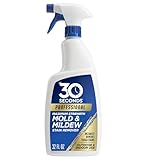
- BRIGHTER RESULTS INSTANTLY: Noticeably brightens indoor and outdoor surfaces, removing black mold and mildew stains as you watch, with no scrubbing or pressure washing required for fast, visible results
- NO SCRUBBING REQUIRED: Avoid the hassle and backbreaking work of scrubbing tough stains; the PRO formula lifts mold and mildew stains on contact so you simply apply, watch and rinse where needed
- 2X STRONGER FORMULA: The PRO formula is 2X stronger than the standard 30 SECONDS Outdoor Cleaner, made for your toughest black mold and mildew stains and messes on both indoor and outdoor surfaces
- OUTDOOR AND INDOOR USE: Use on siding, fences, decks, concrete floors, brick walls, drywall, wood, kitchen surfaces, bathroom tile and grout, bathtub soap scum and showers where mold and mildew can grow
- REMOVES BLACK MOLD STAINS & MORE: Targets stubborn black mold and mildew stains on a wide range of surfaces, giving a brighter, cleaner result indoors and outdoors without scrubbing or pressure washing
Why 15 minutes is a useful target, not a proven threshold
Showering and bathing add water vapour to indoor air. When that air meets a cooler mirror, ceiling, window or exterior wall, vapour can condense into liquid water. Repeated wetting keeps grout, sealant, paint and dust damp long enough for mould to establish. The goal is therefore to reduce moisture and dry surfaces, not to satisfy a universal countdown.
The official sources available for this guidance do not identify a bathroom-specific study showing that 15 minutes prevents mould, nor do they say that a fan must run for exactly that long. A small, well-ventilated bathroom may clear steam sooner; a windowless room, a weak fan, a long hot shower or cold weather may need longer. Treat 15 minutes as a prompt that makes the habit easy to remember. Use the condition of the room—falling condensation and dry surfaces—as the practical test.
Make sure ventilation is actually removing moisture
What effective ventilation looks like
England’s damp-and-mould guidance, updated 1 April 2026, says bathrooms need effective ventilation sufficient to remove moisture from showers and baths. It identifies humidity-controlled fans and fans with an overrun as possible options. England’s home ventilation guide, updated 24 March 2026, likewise explains that ordinary household activities such as showering add moisture that can condense if it remains indoors. These statements apply to England; other countries and local building rules may differ.
A fan that makes a noise is not automatically extracting enough air. During a shower, hold a small piece of toilet tissue near (not inside) the grille. It should be drawn towards the grille while the fan runs. This is only a basic indication that air is moving, not a measurement of extraction performance. Check that the grille is not clogged with dust and that furniture, towels or a closed vent are not blocking the intended airflow.
Use the controls you have
- Extractor with overrun: Switch it on with the light or separate control and let the timed run-on complete. Do not defeat the timer simply because the room looks clear.
- Humidity-controlled extractor: Leave its sensor and settings operating as designed. If it starts and stops repeatedly without drying the room, have the system assessed rather than adding a longer arbitrary timer.
- Window ventilation: Opening a window can release humid air, but do so only when safe and practical. Avoid creating a draught that sends moist air into another cold room; the objective is to exhaust moisture outdoors.
- No extractor or a persistently steamy room: Ask a competent ventilation professional to assess the system and the route to outside. Controlled ventilation installation work should be undertaken by a competent person and may have local compliance requirements.
Signs the system needs investigation
Take action if condensation remains on the ceiling after the drying period, mould returns quickly after cleaning, the fan has become noticeably weaker or noisier, or air is being pulled from an unexpected gap instead of exhausted outdoors. A blocked duct, failed back-draught shutter, undersized system, or fan that vents into a loft or wall cavity can leave moisture inside the building. Do not dismantle electrical equipment unless you are qualified to do so.
Rank #2

- Eliminates & Helps Prevent Mold: Targets existing mold at the source and leaves behind an invisible barrier that helps prevent future growth.
- EPA-Registered Solution: Registered with the U.S. Environmental Protection Agency for mold control when used as directed.
- Bleach-Free, Odorless, VOC-Free: Contains no bleach, ammonia, or volatile organic compounds, helping maintain healthy indoor air quality.
- Safe on Most Surfaces: Works on drywall, wood, tile, grout, concrete, fabric, and other common building materials.
- Versatile Use: Ideal for bathrooms, kitchens, basements, attics, laundry rooms, vehicles, and outdoor surfaces such as decks and patios.
Dry and clean the surfaces that get wet
The UK Drinking Water Inspectorate recommends cleaning and promptly drying surfaces that are regularly wetted or prone to condensation. In a bathroom, that means shower walls, the bath edge, taps, screens, window sills and the floor around the shower. Cleaning removes soap film and dust that can hold moisture; drying removes the water itself.
For routine care, use a detergent appropriate for the surface, rinse where the label requires it, and dry thoroughly with a clean cloth. Check compatibility before using any product on painted walls, natural stone, metal fittings, acrylic baths or silicone. Never mix cleaning chemicals. Keep bottles lifted or spaced so air can reach the wall behind them, and wash or replace damp shower curtains according to their care instructions.
Grout, sealant and painted surfaces
Mould staining that remains in grout or flexible sealant after cleaning may indicate that the material has been damaged. The Drinking Water Inspectorate notes that grout or flexible sealant may need replacement after mould damage. Remove and renew failed sealant only when the joint and surrounding surfaces can be cleaned and dried completely; otherwise the new bead can trap moisture again.
Do not paint over active mould, damp plaster or bubbling coating. Clean the contamination, correct the moisture source, allow the substrate to dry, and then follow the paint manufacturer’s preparation instructions. Paint is a finish, not a substitute for extraction or leak repair. If a wall remains damp, painting can conceal the problem while deterioration continues behind the coating.
How to handle mould that is already present
Small areas on sound, hard surfaces
For a small patch on a non-porous surface, the US Environmental Protection Agency advises scrubbing with detergent and water and drying completely. Wear the protective equipment recommended by your local guidance and the product label, provide ventilation, and avoid spreading contaminated water onto clean areas. Follow the cleaner’s label for contact time, rinsing and disposal. A cleaner may remove visible growth, but it cannot prevent regrowth if the room stays damp.
What’s actually slowing this PC down?
Pick the symptom - the matching free tool is one click away.
Rank #3

- GET RID OF STUBBORN MOLD AND MILDEW STAINS: Our instant spray cleaner removes the stains left behind from black mold and mildew. They tend to leave behind ugly staining that can go deep below the surface; Our professional-strength spray is specifically formulated to eliminate discoloration caused by mold and mildew
- USING RMR-86: To safely and conveniently eliminate indoor mold and mildew stains and odors using RMR-86, proper ventilation and PPE should be used for each application
- SAFE TO USE ON MULTIPLE SURFACES: Easily remove stubborn stains from decks, wood, vinyl siding, drywall, concrete floors, brick walls, kitchen surfaces, and other areas where mold and mildew tend to grow
- FAST-ACTING SPRAY: Our powerful, fast-acting mold stain remover spray begins working instantly to target deeply embedded stains that linger on surfaces and hard-to-reach areas
- NO SCRUBBING NEEDED: Simply spray our ready-to-use formula on the affected area and watch the stains disappear right before your eyes!
When ordinary cleaning is not enough
- Mould covers a large area, keeps returning soon after cleaning, or extends into plasterboard, insulation, carpet or other porous material.
- There is a persistent leak, musty odour, staining below a bathroom, or moisture inside a wall or ceiling.
- Someone in the household has asthma, severe allergies, a weakened immune system or symptoms that worsen in the room.
- You cannot safely reach the affected area or cannot keep the area isolated while cleaning.
England’s guidance says mould removal should use protective equipment and that larger areas can require professional removal. Arrange an appropriate building or remediation assessment for extensive or concealed growth, and seek medical advice for health concerns. Do not rely on bleach, fragrance or a quick coat of paint as a structural remedy.
Check humidity, leaks and cold surfaces
A small digital hygrometer can show whether the room stays humid between showers. The US EPA gives a general indoor relative-humidity target of 30–60 percent. That is household guidance, not a bathroom-specific guarantee and not proof that a reading inside that range rules out mould. Use the reading to spot patterns: a bathroom that remains near the top of the range for long periods deserves closer ventilation and leak checks.
The same EPA guidance recommends drying wet materials within 24–48 hours. That timeframe applies to general household moisture control, not as a special bathroom mould deadline. If a towel, bath mat, wall or ceiling remains wet for that long, find out why rather than repeatedly treating the stain.
Inspect silicone joints, pipe connections, the toilet supply and waste connections, the bath panel and the ceiling below the bathroom. Cold exterior walls and unheated corners can condense moisture even when the rest of the room feels comfortable. Improving heat distribution, keeping furniture from blocking airflow and repairing a failed seal can be more effective than extending a daily wiping routine.
PC Slower Than It Used to Be?
A free scan shows the junk files, broken settings and background clutter dragging Windows down - then fixes them in one click.Free scan · Windows 10 & 11Outdated Drivers Are Slowing You Down
One free scan finds every outdated or missing driver and matches the right update for your exact hardware.Free scan · exact hardware matchChoose the response that matches the symptom
| What you observe | Most useful next step | Escalate when |
|---|---|---|
| Steam clears and surfaces dry after the routine; no recurring spots | Keep the daily ventilation, wiping and regular cleaning habit. | Stop only if the room later develops persistent damp or staining. |
| Mirror and ceiling stay wet, but there is no visible leak | Check grille cleanliness, fan operation, airflow path and controls; use longer ventilation while arranging an assessment. | A competent person is needed to test or alter the ventilation installation. |
| Mould returns in the same corner or along one joint | Inspect the seal, pipework and cold-surface condensation; clean only after the source is addressed. | Call a building professional if moisture is inside a wall or ceiling. |
| Growth is widespread or on porous materials | Limit disturbance and arrange appropriate remediation advice. | Professional removal is appropriate, especially where health risks exist. |
A weekly and seasonal maintenance check
The daily routine controls moisture at its source; periodic checks prevent small failures becoming chronic damp.
Rank #4

- KILLS MOLD: EPA-registered formula kills mold and helps control mold and mildew on hard, nonporous surfaces when used as directed
- CLEANS AND DISINFECTS: Ready-to-use disinfectant cleaner provides non-acid cleaning performance while disinfecting treated hard, nonporous surfaces
- INHIBITS MILDEW GROWTH: Helps inhibit the growth of mold and mildew and the odors they cause when applied according to label directions.
- BLEACH-FREE FORMULA: Bleach-free cleaner deodorizes treated surfaces and leaves behind a fresh scent
- READY-TO-USE SPRAY: 32 fl oz trigger bottle is designed for household, commercial and industrial cleaning applications
- Clean the extractor grille and inspect the visible duct outlet according to the manufacturer’s instructions.
- Wash shower curtains, bath mats and towels before they develop a persistent musty smell.
- Examine grout and flexible sealant for cracks, lifting or darkening that returns after cleaning.
- Look behind removable bath panels and around pipe penetrations for drips or staining.
- Check that a window opens safely and that trickle vents or other designed air inlets have not been blocked.
- After decorating, watch the painted surface for blistering, flaking or a spreading stain; these are investigation clues, not merely cosmetic defects.
Common mistakes that allow mould to return
Turning the fan off with the light
This cuts off the drying period precisely when the room contains the most vapour. Use the overrun or humidity-control setting if fitted.
Relying on a mould spray alone
A treatment can remove visible contamination, but recurring moisture will produce recurring growth. Cleaning and drying must accompany any labelled product.
Closing every air path
Sealing a room completely can starve an extractor of replacement air. Follow the ventilation design and manufacturer’s instructions rather than blocking vents to reduce draughts.
Blaming normal bathing for a building defect
Bathing is an ordinary moisture source. Housing guidance cautions against treating routine household activity as the root cause when inadequate ventilation, leaks, cold surfaces or other building deficiencies are present. The remedy may be a repair or ventilation improvement, not a demand that residents stop using the bathroom normally.
The bottom line for the 15-minute habit
Use 15 minutes as a repeatable reminder: ventilate during and after bathing, wipe frequently wetted surfaces, hang textiles to dry, and check for leaks. Keep going longer whenever condensation remains. Clean small hard-surface patches safely, but treat recurring, extensive or concealed mould as evidence that the building or ventilation system needs attention. Moisture control—not the number on a timer—is what gives the routine its value.
Quick Recap

Product prices and availability are accurate as of the date/time indicated and are subject to change. Any price and availability information displayed on Amazon at the time of purchase will apply.

