Windows Errors? Fix Them Before They Spread
Repair common Windows errors and clear accumulated junk for a smoother, more stable PC - no reinstall needed.Free scan · no reinstall
Outdated Drivers Are Slowing You Down
One free scan finds every outdated or missing driver and matches the right update for your exact hardware.Free scan · exact hardware match
ThatPainter is reader-supported. When you buy through links on our site, we may earn an affiliate commission. Learn More
The strongest antique pencil sharpeners to collect are documented machines with identifiable makers, mechanisms, and production histories—not simply old-looking objects. Start with landmark designs such as the A. B. Dick Planetary, Guhl & Harbeck Jupiter, Olcott Climax, Gould & Cook Gem, and Perfect Pencil Pointer. Then judge each example by originality, condition, completeness, provenance, and the evidence that it was actually made and marketed.
What makes an antique pencil sharpener worth collecting?
A good collection can follow the evolution of the mechanism, the history of a maker, or the variety of commercial designs. The richest range of identifiable designs appeared from the 1880s through the 1910s. Within that period, a patent alone does not prove a machine reached the market: dated advertisements, maker marks, and surviving production examples help distinguish a commercial sharpener from a patented concept.
Recommended Free Tools
As an Amazon Associate I earn from qualifying purchases.
The Early Office Museum groups mechanical sharpeners into three broad mechanism types:
- Abrasive machines: sharpen with sandpaper or a file.
- Milling-cutter machines: use toothed disks, wheels, cones, or cylinders.
- Blade machines: cut with one or more knives.
For model identification and mechanism comparisons, consult the Early Office Museum’s mechanical pencil sharpener history and its 1860–1899 gallery.
#1 Best Overall
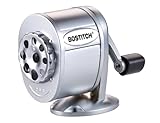
- Dual cutter technology for 6X longer life; replaceable cutters
- Comes with clams and screw to mount vertically or horizontally.
- Tip Saver prevents over sharpening
- 8-hole dial accomodates a variety of pencil sizes.
Which antique pencil sharpeners are the most compelling?
These examples stand out for their documented designs and place in the development of mechanical sharpening. Their appeal differs: some are useful milestones in mechanism design, while others are known for unusual construction or relative scarcity. Verify the model against museum documentation before relying on a seller’s description.
| Model | Documented design or history | Collector interest |
|---|---|---|
| Gould & Cook Gem | Patented in 1886; uses a rotating 5.75-inch sandpaper disk. | An early abrasive design with a distinctive, visible mechanism. |
| Perfect Pencil Pointer | Patented in 1890; uses a stationary steel file and is largely wooden. | A contrast to disk and cutter designs, with substantial wood construction. |
| A. B. Dick Planetary Pencil Pointer | Patented in 1896; holds the pencil stationary while two milling disks orbit its tip. | A clear example of planetary sharpening. |
| Guhl & Harbeck Jupiter | Patented in 1897; its reversible cutter disk has 34 cutting edges on each side. | A distinctive reversible cutter design. |
| Webster | Introduced in 1898; uses a single planetary disk cutter. | Another documented planetary approach for comparison with the A. B. Dick. |
| Babcock Duplex | Patented in 1900; uses six blades. | An early example of the blade-machine category. |
| Lakeside | Marketed from 1904 to 1911; its cylindrical wheel carries 60 diagonal cutting edges. | A documented commercial cylindrical-wheel design. |
| Olcott Climax | Introduced in 1904; its cylindrical cutter has spiral cutting edges. | A notable step toward the planetary cylindrical cutters that later became dominant. |
| APSCO U.S. Automatic | The Early Office Museum describes it as the best-selling U.S. sharpener during 1907–1914. | A historically significant mass-market model. |
| J. Dixon Crucible Co. 1885 Lamson | A rare hand-crank, cast-iron design documented in a 2023 specialist auction. | A potentially exceptional acquisition; assess the exact machine’s originality and condition carefully. |
How do the Gem, Planetary, Jupiter, and Climax differ?
These names do not describe interchangeable versions of one machine. They represent different ways to remove pencil wood and graphite, and their operating principles are useful both for building a themed collection and checking a model’s identity.
Rank #2

- Premium Pencil Sharpener Design :Professional-grade pencil sharpener engineered for superior sharpening performance with colored pencils, graphite pencils, and triangular shapes for classroom and professional use
- Manual Hand Crank Pencil Sharpener : Reliable mechanical pencil sharpener with smooth hand crank operation for consistent results, perfect for teachers classroom activities and professional desktop use
- Multi-Purpose Pencil Sharpener : Versatile pencil sharpener suitable for colored pencils, standard pencils, and triangular shapes, ideal for school supplies, office use, and teacher's handcraft activities
- Heavy-Duty Pencil Sharpener Construction : Robust desktop pencil sharpener built for frequent use in classrooms, offices, and homes with non-slip base for safe operation
- Safe & Stable Pencil Sharpener : Durable pencil sharpener with metal blade construction and portable design, perfect for teacher's classroom supervision and professional pencil maintenance
- Gem: rotates the pencil against a large sandpaper disk, an abrasive rather than a toothed cutting mechanism.
- A. B. Dick Planetary: keeps the pencil still while two milling disks orbit the point.
- Jupiter: uses a reversible milling cutter disk with 34 edges on each side.
- Climax: uses a cylindrical cutter with spiral blades. The Early Office Museum identifies the 1904 introduction as the first in its reference set to use this type of cutter, a form that later became dominant.
The Climax’s maker described its principle in 1905 as a cylindrical cutter with twelve spiral blades, cutting “from the point of the pencil, straight back.” That account appears in the Early Office Museum’s history, attributed to Beach, 1905. The detail helps explain why the model matters beyond its age: it marks a shift in cutter design.
How can you judge rarity, originality, and condition?
Rarity is not established by an old date or a seller’s adjective. Look for evidence that a model was produced, then assess the individual object rather than assuming every surviving example is equally scarce or valuable.
Rank #3

- Mobius + Ruppert Brass Pencil Sharpeners - MADE IN GERMANY
- All 4 shapes available! Thoughtfully designed, quality feel!
- Solid brass - well known German specialist manufacturer - finest available!
- Double sharpeners allow for thicker pencils and crayons
- Replacement blades are also available!
Confirm the model and its history
- Match the mechanism, shape, and construction to a museum or other reliable historical record.
- Check for a maker’s mark and patent date, but treat a patent as evidence of a design—not, by itself, proof of commercial production.
- Look for dated advertising or other evidence of sale when the distinction between a patented idea and a marketed machine matters.
Inspect originality and completeness
Ask for clear photographs of the cutter or abrasive surface, crank, screws, base, labels, and any repaired or replaced components. Compare those details with documented examples. Check whether the machine is complete and whether its finish, wood, and accessories appear consistent with the object’s history. A working mechanism is useful, but functionality alone does not establish originality.
Free tools Windows power users keep installed
One-click scans. No signup required.
Be precise about repairs and replacements. In Soulis Auctions’ December 28, 2023 listing for a J. Dixon Crucible Co. 1885 Lamson, the machine had original finish, hand-painted flourishes, pinstriping, and its original wood base, but a well-made replacement sharpening bit. That combination is more informative than calling the sharpener simply “all original.”
Rank #4
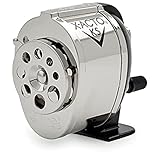
- Commercial grade pencil sharpener for high volume environments
- Dual helical cutters sharpen pencils with precision
- Mountable on wall, desk, or table with the included screws
- Adjustable to accommodate 8 pencil sizes
- Manual operation is easy for school children to use
Give provenance its due
A documented collection history or specialist-auction record can support an attribution and make an object easier to assess. An unsupported online description is weaker evidence. Provenance does not replace condition inspection, but it can help establish what the object is and how it has been represented over time.
Independent reader supportYour contribution helps us test, update, and keep practical guides available for everyone.Are antique crank pencil sharpeners valuable?
Some can command substantial prices, but one exceptional sale cannot establish a dependable price range for the category. Soulis Auctions estimated its J. Dixon Crucible Co. 1885 Lamson at $3,500–$5,000; it sold for $6,250 on December 28, 2023, excluding buyer’s premium. The auction described it as one of the rarest commercially made pencil sharpeners and noted the original finish and base alongside the replacement bit. This is evidence of demand for that particular documented example, not a typical price for antique sharpeners.
Best Value

- Dual cutter technology for 6X longer life; replaceable cutters
- Comes with clams and screw to mount vertically or horizontally.
- Tip Saver prevents over sharpening
- 8-hole dial accomodates a variety of pencil sizes.
When evaluating a prospective purchase, compare the exact model and its condition with documented examples and past specialist-auction records. Separate an original, identified machine from a reproduction, an incomplete example, or one with significant replaced parts. Ask for photographs and details before treating a listing’s rarity or value claims as established.
Quick wins for a faster PC:
Repair Windows errors before they cause bigger problemsFix Now →Scan for outdated or missing drivers - takes under a minuteDriver Scan →Clear out junk files and repair common Windows errorsFree Scan →How should a collector begin?
- Choose a collecting angle: for example, abrasive machines, planetary cutters, early blade designs, or products from a particular maker.
- Study documented models: use the Early Office Museum’s historical pages to learn each design’s mechanism and compare the claimed model with known examples.
- Request evidence before buying: ask for photographs of marks, cutters, bases, repairs, and included accessories, plus any available provenance.
- Record condition accurately: note original and replaced parts separately rather than reducing the assessment to “complete” or “all original.”
- Compare the venue and record: use specialist-auction descriptions as evidence for the specific objects they document, not as a price guide for every model.
Searches for “antique mechanical pencil sharpener” and model-specific names such as “A. B. Dick Planetary Pencil Pointer” or “J. Dixon 1885 pencil sharpener” can surface candidates. Listings change, so verify the object itself rather than assuming a marketplace description or photograph proves authenticity.
What museum records can tell you about less mechanical designs
Not every collectible pencil sharpener is a hand-crank machine. The Smithsonian National Museum of American History catalogs a Frederick W. Post Co. No. 3000 Pencil Pointer made in Chicago circa 1940: a wooden handle with a rectangular sandpaper pad, measuring 18 × 3.5 × 1 cm. The company sold it with 12 sheets of flint paper for 9¢ in the 1930s; by 1949, the flint paper had been replaced with sandpaper. The Smithsonian record gives useful context for collecting beyond the best-known crank models, while also showing why date and material claims should be tied to a specific object and source.
Quick Recap

Product prices and availability are accurate as of the date/time indicated and are subject to change. Any price and availability information displayed on Amazon at the time of purchase will apply.




