Do these 3 things before closing this tab:
1Repair Windows errors before they cause bigger problems2Fix the driver behind crashes, sound loss and screen glitches3Clear out junk files and repair common Windows errors
ThatPainter is reader-supported. When you buy through links on our site, we may earn an affiliate commission. Learn More
The best Canon FD lens for most photographers is the New FD 50mm f/1.4. It offers the most useful balance of speed, size, manual-focus feel and versatility. If budget matters more than aperture, choose the New FD 50mm f/1.8. Add the New FD 28mm f/2.8 for a compact two-lens kit, or the New FD 85mm f/1.8 for practical portraits.
Canon FD lenses remain compelling for film cameras and mirrorless digital bodies because they are mechanically satisfying, widely adaptable and often optically excellent. But the famous lenses are not automatically the best buys: a clean common lens is usually a wiser purchase than a rare f/1.2 optic with haze, fungus or oily aperture blades.
Quick recommendations
| Lens | Best for | Price category | Main warning |
|---|---|---|---|
| New FD 50mm f/1.4 | Best overall | Medium | Inspect carefully for haze and oily blades |
| New FD 50mm f/1.8 | Best value | Low | Less light and background separation than the f/1.4 |
| New FD 28mm f/2.8 | Travel and everyday wide angle | Low to medium | Not a low-light specialist |
| FD 35mm f/2 S.S.C. | Street and documentary photography | Medium to high | Exact optical revision affects desirability and price |
| New FD 85mm f/1.8 | Practical portraits | Medium | Manual focusing at f/1.8 still demands care |
| FD 100mm f/2 | Fast short telephoto | High to collector | Scarcity can make it poor value |
| FD 135mm f/2 | Low-light telephoto and video | High | Large, heavy and demanding to focus |
| FD 50mm f/3.5 Macro | Close-ups and product work | Low to medium | Short working distance |
| FD 100mm f/4 Macro | Macro with more working distance | Medium | Slow maximum aperture |
| 85mm f/1.2L or 55mm f/1.2 Aspherical | Prestige and maximum subject isolation | Collector | Expensive and unforgiving to focus |
These are recommendations by purpose, not a claim that one lens is objectively sharpest. “Best” might mean maximum resolution, low-light ability, smooth manual focus, compactness, flare character or collector appeal. Those priorities lead to different choices.
What Canon FD actually means
“Canon FD” describes a family of manual-focus lenses made for Canon’s FD-mount film system. The family includes several generations and designations that should not be treated as interchangeable labels.
#1 Best Overall
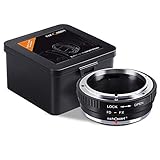
- Premium-grade K&F Concept adapter,high precision,good quality.
- Made of brass and aluminum (not plastic), anodized aluminum construction.
- Smooth surface for effortless mount,Infinity focus allowed, diaphragm control of the lens is set manually.
- Compatible Cameras (Including, but not limited to):Fujifilm X-A1, X-A2, X-A3, X-A5, X-A7, X-A10, X-A20, X-E1, X-E2, X-E2s, X-E3, X-H1, X-M1, X-Pro1, X-Pro2, X-Pro3, X-T1, X-T2, X-T3, X-T4, X-T10, X-T20, X-T30, X-T100, X-T200, X-S.
- Please note: It is not same between Canon FD mount and EF mount, this adapter ring is only for Canon FD mount lens, please contact us if you want to purchase for Canon EF mount lens.
- Original FD lenses use a rotating breech-lock collar. The lens is seated against the camera and the collar turns to secure it.
- New FD lenses use a more familiar bayonet-style mounting operation and are often easier for photographers accustomed to modern cameras.
- S.C. and S.S.C. identify Canon coating designations. They can matter to collectors, but “S.S.C.” is not a universal guarantee of better real-world pictures.
- Aspherical identifies particular optical designs, notably the New FD 55mm f/1.2 S.S.C. Aspherical.
- L marks premium Canon optics, including the FD 50mm f/1.2L, FD 85mm f/1.2L and FD 14mm f/2.8L.
- FL is an earlier Canon lens system. FL lenses may fit some FD bodies, but their aperture and metering operation is not identical to FD operation.
The mounting style alone does not determine image quality. Optical formula, coating, aperture used, flare, subject matter and—above all—condition matter more than whether a lens is breech-lock or New FD. Canon’s period documentation shows how broad the system became, from specialist ultra-wide lenses to fast telephotos and macrophoto optics: Canon’s A-1 brochure and the historical Canon Lens Wonderland specifications are useful references.
The best Canon FD lenses
New FD 50mm f/1.4: best overall
This is the safest recommendation for someone buying one FD lens. On a 35mm film camera it is a conventional normal lens, useful for family photographs, travel, street work, portraits and low-light scenes. On full-frame mirrorless it remains similarly versatile.
The f/1.4 aperture gives you more exposure flexibility and shallower depth of field than the 50mm f/1.8, without the size, price and focusing difficulty of an f/1.2 lens. It is fast enough to make the system feel special while remaining practical.
Crashes, No Sound, or Screen Glitches?
Random freezes, missing sound and display glitches usually trace back to one bad driver. Find and replace yours safely.Free scan · under a minuteWindows Errors? Fix Them Before They Spread
Repair common Windows errors and clear accumulated junk for a smoother, more stable PC - no reinstall needed.Free scan · no reinstallLook for clean glass, a smooth helicoid and a fast, dry aperture. A small amount of dust is usually less serious than haze, fungus, separation or oil on the blades.
New FD 50mm f/1.8: best value
The 50mm f/1.8 is the sensible entry point for a first Canon FD kit. It is compact, straightforward and capable of producing detailed images, particularly when stopped down. It also makes an inexpensive mirrorless adaptation lens.
Its limitations are simple: compared with the f/1.4, it gathers less light and offers less control over background separation. That does not make it inferior for every subject. For daylight film photography, travel and learning manual focus, it may be all the lens you need.
New FD 28mm f/2.8: best wide-angle value
The 28mm focal length is wide enough for travel, interiors, environmental portraits and street photography without the exaggerated perspective of an ultra-wide lens. The New FD version is compact and easy to carry.
Free tools Windows power users keep installed
One-click scans. No signup required.
The f/2.8 maximum aperture is the compromise. It is less suitable for dim interiors or strong subject isolation than the faster 28mm f/2 or the rare 24mm f/1.4L. On Micro Four Thirds, remember that a 28mm lens frames substantially narrower than it does on 35mm film or full-frame digital.
FD 35mm f/2 S.S.C.: best classic normal-wide
The 35mm f/2 occupies a particularly useful middle ground: wider than 50mm, but not so wide that composition becomes difficult. It is a strong choice for documentary work, street photography and low-light scenes.
Exact version identification matters. Certain early or concave optical revisions have strong enthusiast and collector appeal, but that reputation can push prices beyond the practical value of a common 28mm or 50mm. Do not assume every FD 35mm f/2 has the same rendering or collector status.
New FD 85mm f/1.8: best practical portrait lens
The 85mm f/1.8 is a more realistic portrait recommendation than the 85mm f/1.2L for most people. It gives a flattering working distance and useful subject separation while remaining easier to carry, focus and afford.
Recommended Free Tools
Rank #2

- Mounts Canon FD & FL 35mm SLR lenses to Canon RF Mount Mirrorless Camera Body
- Enhanced craftsmanship and high-tolerance construction for demanding professionals; infinity focus or beyond guaranteed
- Precise fit and solid connection; lens has no play, gap or wiggling when mounted on adapter and no adjustments required
- Precision all-metal construction with chrome plated brass mounts for secure and solid fit
- 24 Months Warranty
Manual focus is still unforgiving at f/1.8, especially on a digital camera with a high-resolution sensor. On APS-C it frames like a tighter portrait lens; on Micro Four Thirds it becomes tighter still.
FD 100mm f/2: best fast short telephoto
The FD 100mm f/2 is attractive when you specifically need a fast 100mm lens for portraits, events or low-light work. It provides more working distance than an 85mm and a useful compressed perspective.
This is a specialist purchase rather than an automatic upgrade. Scarcity and collector demand can make it expensive, while the 100mm f/2.8 or 85mm f/1.8 may deliver the more rational system. Buy the f/2 only when its aperture and focal length solve a real problem.
FD 135mm f/2: best low-light telephoto
The 135mm f/2 is a standout fast telephoto for portraits, stage photography and deliberate compressed-perspective images. It is also an appealing video lens because the focal length benefits from precise manual focus.
The Tool Desk
Outbyte Driver Updater FREEFix the driver behind crashes, sound loss and screen glitchesFind Drivers →Outbyte PC Repair FREEClear out junk files and repair common Windows errorsFree Scan →Its size, weight and price are the penalties. At 135mm, camera shake and focus errors are easier to see, and the narrow field of view can make moving subjects difficult. A 135mm f/3.5 or f/2.8 is often a better first telephoto for outdoor photography.
135mm f/3.5 or f/2.8: best budget telephoto
The slower 135mm lenses are among the most sensible ways to add reach to an FD kit. They work for portraits, landscapes, outdoor details and distant subjects without the collector-level cost of the f/2.
The trade-off is exposure. In low light you may need a faster shutter speed, a higher film speed or a tripod. They also provide less background separation than the faster lens.
FD 50mm f/3.5 Macro: best macro value
The 50mm Macro is compact and useful for close-ups, copying and product photography. It can also serve as a normal lens when you do not need a fast aperture.
Its short working distance can place the camera close to the subject and make lighting more difficult. Confirm which extension accessories are included if the seller’s claimed magnification depends on them.
FD 100mm f/4 Macro: best longer macro
The 100mm f/4 Macro gives more working distance than the 50mm Macro, which is valuable for flowers, insects and small products. It is often a more sensible purchase than a rare fast portrait lens.
Its f/4 aperture is not intended for low-light photography, and macro focusing is slow and deliberate. Prioritize clean optics and a functioning focusing mechanism over cosmetic rarity.
Rank #3

- FD Lens to E Mount Adapter, FD FE Adapter, allows FD Lens to fit on E-Mount Mirrorless Camera Body.
- Infinity Focus Guaranteed.
- There is no electrical contacts in the adapter ring. Exposure and focus has to be adjusted manually. Automatic diaphragm, auto-focusing, or any other functions will not operated with using this adapter
- Copper Lens Mount, Solid and Durable
- FE Mount FD Lens Adapter, compatible with Sony a7 a7r a7S II III IV a9 a9II a7c Alpha 1 NEX5T NEX-6 NEX-7 NEX-F3 a3000 a3500 a5000 a5100 a6000 a6300 a6400 a6500 a6600 ZV-E10
FD 50mm f/1.2L and New FD 55mm f/1.2 S.S.C. Aspherical: prestige choices
These lenses offer the appeal of a very fast aperture, shallow depth of field and distinctive vintage rendering. They are appropriate for collectors, experienced manual-focus photographers and users who specifically want the f/1.2 look.
What’s actually slowing this PC down?
Pick the symptom - the matching free tool is one click away.
They are not automatically better than the 50mm f/1.4. They are larger, more expensive and harder to focus accurately. Wide-open contrast, flare and bokeh are rendering characteristics, not universal guarantees of superior images. A clean f/1.4 is a better working lens than a damaged f/1.2.
FD 14mm f/2.8L and other specialist wide angles
The FD 14mm f/2.8L is a prestigious ultra-wide lens for architecture, interiors and deliberately exaggerated perspective. Canon’s historical lineup also included 17mm, 20mm and 24mm wide-angle options.
Ultra-wide lenses are difficult to use well, and the 14mm is not a sensible first FD purchase for most photographers. Rarity, front-element considerations and accessory requirements can complicate ownership. The 20mm f/2.8 or 24mm f/2.8 is usually easier to live with.
Choose by purpose
| Purpose | First choice | Sensible alternative |
|---|---|---|
| One-lens film kit | New FD 50mm f/1.4 | New FD 50mm f/1.8 |
| Street photography | FD 35mm f/2 | New FD 28mm f/2.8 |
| Travel | New FD 28mm f/2.8 | FD 35mm f/2 |
| Portraits | New FD 85mm f/1.8 | 100mm f/2.8 |
| Low-light telephoto | FD 135mm f/2 | FD 100mm f/2 |
| Budget telephoto | 135mm f/3.5 | 135mm f/2.8 |
| Macro | FD 50mm f/3.5 Macro | FD 100mm f/4 Macro |
| Video | 35mm f/2, 50mm f/1.4 or 85mm f/1.8 | 100mm f/2 or 135mm f/2 |
| Ultra-wide work | 20mm f/2.8 | 14mm f/2.8L |
Useful Canon FD kits
One-lens starter
Choose the New FD 50mm f/1.4 for the best all-round experience, or the 50mm f/1.8 for the lowest-cost route.
Compact two-lens kit
Pair the New FD 28mm f/2.8 with the 50mm f/1.4. This covers everyday wide-angle and normal perspectives without adding much weight.
Street and portrait kit
Pair the 35mm f/2 with the 85mm f/1.8. The combination covers environmental scenes and portraits while preserving useful low-light capability.
Budget general-purpose and telephoto kit
Use the 50mm f/1.4 with a 135mm f/3.5. This is a practical way to cover everyday subjects and distant details without chasing rare fast telephotos.
Three-lens kit
Start with a 24mm or 28mm wide angle, add a 50mm standard lens, then choose an 85mm, 100mm or 135mm telephoto according to your subjects.
Quick wins for a faster PC:
Fix the driver behind crashes, sound loss and screen glitchesFind Drivers →Clear out junk files and repair common Windows errorsFree Scan →Scan for outdated or missing drivers - takes under a minuteDriver Scan →Using FD lenses on mirrorless cameras
Mirrorless cameras are usually the easiest digital bodies on which to use FD glass. Their short register distances generally allow a simple mechanical adapter to achieve infinity focus. The adapter does not restore autofocus, electronic aperture control, image stabilization or lens-to-camera metadata.
- Buy an adapter for the exact destination mount: Sony E, Fujifilm X, Micro Four Thirds, Nikon Z, Canon RF or L-mount.
- Mount the FD lens to the adapter, then mount the adapter to the camera.
- Enable “shoot without lens” or the equivalent setting if the camera requires it.
- Focus with magnification or focus peaking.
- Use aperture priority or manual exposure.
- Meter through the stopped-down lens. The viewfinder may become darker as you close the aperture.
Adapter quality matters. Excessive play, poor alignment, light leaks, aperture-lever interference and failure to reach infinity focus can ruin the experience or stress the lens mount. Fotodiox documents manual FD adapters for Canon RF, Fujifilm X and Micro Four Thirds, including the loss of autofocus and electronic communication. Check the exact product specification before ordering.
Rank #4

- 【 Function】You can mount Canon FD screw mount lens to Fujifilm X-series X FX mount mirrorless cameras.
- 【 Material】All-metal design; hardened anodized aluminum construction,matting varnish inside to avoid light reflection.
- 【 Features】Supports manual control, manual focus, manual exposure and focus to infinity.
- 【 Cameras Compatibility】Designed for Fujifilm Fuji X-Series Mirrorless Camera Body: X-Pro1, X-Pro2, X-T1, X-T2, X-T10, X-T20, X-E1, X-E2, X-E2S, X-A1, X-A2, X-A3, X-A10, X-M1 etc.
- 【 Verify Your Lens and Camera Mount】You can find your lens/camera mount in the len's/ camera's original user manual. Or find your lens/camera on the manufacturers' website and under the product specifications look for “mount type”.
Crop factor changes the practical recommendation. On APS-C, a 50mm lens behaves more like a short telephoto, so 28mm or 35mm lenses may be better everyday choices. On Micro Four Thirds, the effect is stronger: a 28mm lens no longer gives a conventional 28mm field of view.
What about Canon EOS DSLRs?
FD lenses are a much more natural match for mirrorless cameras than Canon EF DSLRs. The registration distance of an EF DSLR makes simple FD adaptation problematic: a non-optical adapter may not focus to infinity, while a corrective-optics adapter can affect image quality, effective focal length and light transmission.
Do these 3 things before closing this tab:
1Scan for outdated or missing drivers - takes under a minute2Repair Windows errors before they cause bigger problems3Fix the driver behind crashes, sound loss and screen glitchesMechanical FD-to-EF adapters do exist. Fotodiox describes its FD-to-EF adapter as a manual adapter for Canon EOS EF and EF-S DSLR bodies with built-in aperture control. It does not provide native autofocus or modern electronic lens functions. Confirm infinity focus and the adapter’s optical design before using an expensive lens.
Are FD lenses still optically good?
Many are. Clean examples can produce detailed, contrasty photographs, especially when stopped down. But “still optically impressive” is not the same as “equal to a current autofocus lens in every measurable way.” Modern lenses usually offer better coatings, flare control, autofocus, stabilization and electronic aperture control.
Vintage rendering can be part of the attraction. Older coatings or optical formulas may produce veiling glare, lower contrast, flare or distinctive out-of-focus areas. Those effects vary by lens, version, aperture, light source and condition. A damaged or hazy lens should not be mistaken for desirable vintage character.
Film and digital sensors also reveal different behavior. On a digital camera, you may notice corner softness, edge smearing, color shifts or reflections that were less obvious on film. Results depend on sensor format and shooting conditions, so avoid treating a lens as universally “digital-ready.”
The Tool Desk
Outbyte PC Repair FREEClear out junk files and repair common Windows errorsFree Scan →Outbyte Driver Updater FREEFix the driver behind crashes, sound loss and screen glitchesFind Drivers →Buying a used Canon FD lens
Condition matters more than collector status. Before buying, request clear photographs of the front and rear elements, aperture, mount and lens barrel. Avoid relying solely on labels such as “S.S.C.,” “L” or “Aspherical.”
Optics checklist
- Inspect for fungus, haze and separation between cemented elements.
- Look for cleaning marks, deep scratches and damaged coatings.
- Distinguish a small amount of internal dust from fogging or fungus.
- Ask whether the lens has been opened, cleaned or repaired.
Mechanical checklist
- Turn the focus ring through its full range. It should feel smooth, not gritty or grinding.
- Check for excessive play in the helicoid.
- Move through every aperture stop and confirm that the blades close quickly and evenly.
- Look for oil on the aperture blades.
- Check the breech-lock or bayonet mechanism, rear mount and aperture lever for damage.
- Confirm that the lens is an original Canon FD or New FD model, not merely a third-party lens described as “FD mount.”
Version checklist
Ask the seller to identify the exact generation, maximum aperture and designation. For valuable lenses, confirm whether it is an original FD or New FD version, an S.C. or S.S.C. model, an Aspherical model, an L lens, or a particular concave or later optical revision.
Some vintage photographic lenses can show yellowing or discoloration associated with particular glass formulations, but this is model-specific and should not be assumed of every Canon FD lens. Treat visible color changes as a condition question and seek a specialist assessment where necessary.
FD lenses for video
FD lenses can work well for video because they provide physical aperture rings, manual focusing and a mechanical operating feel. Common focal lengths such as 35mm f/2, 50mm f/1.4 and 85mm f/1.8 are practical starting points; the 100mm f/2 and 135mm f/2 are useful when their size and price make sense.
Free tools Windows power users keep installed
One-click scans. No signup required.
Do not confuse a good stills lens with a production-ready cinema lens. Focus-throw length varies between versions, aperture clicks may need modification, internal focus noise can be recorded, and flare or sample condition may be problematic. Professional rehousing companies list selected FD lenses—including the 28mm f/2, 35mm f/2, 50mm f/1.4, 55mm f/1.2, 85mm f/1.2L, 100mm f/2 and 135mm f/2—as cine-conversion candidates, but that does not mean every unmodified copy is ready for professional production. See the P+S Technik FD rehousing specifications for the models covered.
Final verdict
Canon FD remains a worthwhile system when you buy for the way you shoot rather than for a famous badge. Choose the New FD 50mm f/1.4 as the best all-round lens, the New FD 50mm f/1.8 for value and the New FD 28mm f/2.8 as the most useful compact wide angle. The New FD 85mm f/1.8 is the practical portrait choice.
Only pursue the 85mm f/1.2L, 100mm f/2, 135mm f/2 or fast Aspherical lenses when their particular aperture, rendering or collector appeal justifies the extra cost and risk. In this system, clean glass, healthy mechanics and the right focal length beat rarity.
Quick Recap





