PC Slower Than It Used to Be?
Recommended Free Tools
A free scan shows the junk files, broken settings and background clutter dragging Windows down - then fixes them in one click.
Run a Free PC Scan →Free scan · Windows 10 & 11
ThatPainter is reader-supported. When you buy through links on our site, we may earn an affiliate commission. Learn More
As an Amazon Associate I earn from qualifying purchases.
For a long, straight drywall cut, use a sharp utility knife and a straightedge or drywall T-square to score the face paper, snap the supported panel, and cut the paper on the back. For an outlet box, circular opening, or irregular shape, mark the outline and use a keyhole/drywall saw or another cutter suited to that shape. Support the sheet throughout either method, then rasp or sand the edge square.
Free tools Windows power users keep installed
One-click scans. No signup required.
Choose the method by the shape of the cut
Drywall cutting is straightforward when the tool matches the geometry. Score-and-snap is the clean, controllable choice for a long straight line. A saw or specialty cutter is the practical choice when the line turns, closes into an opening, or follows a box or other obstruction.
#1 Best Overall

- Rigid blade delivers solid cut control.
- Bi-Ground teeth delivers fast, smooth cuts.
- Hardwood handle is comfortable and balanced.
- For roughing in drywall, cutting out HVAC, plumbing, and electrical openings or cutting ceiling tile openings.
| Cut you need | Best-fit method | Main tools | What controls the result |
|---|---|---|---|
| Long straight cut across a panel | Score and snap | Sharp utility knife and straightedge or drywall T-square | Accurate marks, a firmly held guide, and a supported sheet |
| Electrical-box opening or small wall penetration | Saw cut | Keyhole or drywall saw | Careful tracing and a controlled cut around the outline |
| Circle, rounded opening, or unusual outline | Shape-specific saw or cutter | Circular cutter, drywall router, keyhole saw, or a similar tool | Matching the cutter to the shape and following the panel instructions |
Neither method is a universal winner. Straight cuts are easiest to control with a knife and guide; openings and irregular shapes require a tool that can turn or start inside the panel. The available manufacturer guidance does not establish a measured speed, cost, or quality advantage for one method over the other.
Tools and protective equipment
For a straight score-and-snap cut
- Sharp utility knife
- Drywall T-square or another rigid straightedge
- Tape measure and pencil
- Stable support for the panel
- Drywall rasp, or sandpaper wrapped around a wood block, for finishing the edge
- Glove for the hand holding the panel, plus a dust mask when sanding
For openings and irregular shapes
- Keyhole or drywall saw for many small openings
- A circular cutter, drywall router, or another shape-specific tool when the outline demands it
- Tape measure and pencil
- Gloves, safety glasses, and a dust mask
- Stable support so the panel cannot bend while you mark or cut
A power saw is unnecessary for an ordinary straight drywall cut. Dust-collection guidance written for gypsum-fiber roof boards does not automatically apply to standard gypsum drywall, so consult the instructions for the exact panel before using a powered tool.
Before either cut: support, measure, and mark
Support the panel on a flat, stable surface
Place the sheet so the section being cut is supported rather than hanging in the air. Gypsum panels can bend or snap under their own weight. Poor support can move the score line, break the board away from the intended path, or damage the face paper before you are ready to install the piece.
Put the correct face up
For a score-and-snap cut, place the light-colored face paper upward. Measure the required width or length from a known panel edge and make clear pencil marks at both ends of the intended line. On a shaped opening, establish the reference edges first; measuring from the wrong side can put the opening in the wrong location even if the outline itself is neat.
Check the mark before cutting
Compare the mark with the installation location and with any edge that must remain intact. A second measurement is faster than repairing a panel cut on the wrong side. Keep the guide aligned with the actual marks, not with a nearby edge or a pencil line that has become difficult to see.
Method 1: score and snap a straight cut
This is the standard way to shorten a panel or remove a straight strip. The knife does not need to cut through the entire thickness. It creates a controlled break in the gypsum core, while the paper on the opposite side is cut last.
1. Measure and mark the intended cut
With the face paper up and the sheet supported, measure the required dimension and mark it at the ends of the cut. If the cut is long, add intermediate reference marks so the straightedge can be positioned confidently.
Quick wins for a faster PC:
Fix the driver behind crashes, sound loss and screen glitchesFind Drivers →Clear out junk files and repair common Windows errorsFree Scan →Scan for outdated or missing drivers - takes under a minuteDriver Scan →Rank #2

- Specification & Dimensions: Total length: 11-3/4 inch (299 mm); Handle length: 6-3/4 inch (172 mm); Saw blade length: 5.2 inch (132 mm); Saw blade hardness: HRC 66-68
- Faster Cutting: Precision triple-ground teeth deliver smooth, fast, and effortless cutting. 8 TPI bi-metal blade cuts in both directions (push and pull). Extra-secured blade-to-handle assembly ensures safety. Deep gullets between saw teeth keep the blade clear of debris. The jab saw features a sharpened tip that quickly punches through drywall or other similar materials
- Ergonomic Handle: Anti-slip super grip handle adds comfort and resists slipping. Designed to fit most hand sizes and helps lessen fatigue when cutting, allowing for a superior cutting angle
- Secure Lock & Portable Construction: The lock system prevents the blade from accidentally closing during use. Press the red button on the handle for safe opening and closing. Foldable design makes it easy to carry. Compact size for easy storage in your tool bag
- Applications: Designed for precise cutting of drywall, wallboard, plywood, plastic panels, and PVC. Ideal for home DIY projects, framers, general contractors, and woodworkers
2. Align and hold the guide
Set a drywall T-square or straightedge through the marks. Hold it firmly so it cannot creep as the knife travels. Keep the hand holding the panel or guide protected with a glove, and keep fingers clear of the blade path.
3. Score the face paper and lightly enter the core
Run the sharp utility knife along the guide in one controlled pass, cutting through the face paper and lightly into the gypsum core. Keep the blade against the guide rather than steering freehand. A sharp blade follows the line more predictably than a dull one; replace or reposition the blade if it drags instead of scoring cleanly.
4. Snap the panel along the score
Grasp the two sides of the score line. Make a quick, firm snap so the core breaks along the scored path. The manufacturer sequence describes snapping the panel back toward the face side, allowing the break to follow the weakened line instead of forcing a random fracture.
5. Cut the back paper
After the core has opened, fold the pieces enough to expose the uncut back paper and run the knife through that paper. Separate the pieces without tearing beyond the line.
Recommended Free Tools
6. Dress the edge
Inspect the cut. Remove loose paper and small projections with a drywall rasp, or use sandpaper wrapped around a wood block. Keep the edge square to the face rather than rounding it over. Wear a dust mask while sanding.
How to keep a score-and-snap cut straight
- Use a rigid guide: A drywall T-square or straightedge prevents the blade from wandering over a long distance.
- Keep the sheet supported: Movement under the score line makes the snap unpredictable.
- Score deliberately: The goal is a continuous cut through the face paper and a shallow entry into the core, not repeated uncontrolled sawing.
- Snap only after the line is complete: A partial score gives the gypsum no continuous path to follow.
- Finish instead of forcing perfection with the knife: A rasp or blocked sandpaper removes minor roughness while preserving a square edge.
Method 2: saw an opening or irregular shape
A saw cut is appropriate when a straight snap cannot follow the required outline. This includes an electrical box, a small penetration, a circle, a rounded opening, or an irregular shape. The essential sequence is the same in each case: mark the complete shape, select a tool that can follow it, cut under control, and clean the edge.
Electrical-box opening
Measure the box location from the appropriate panel edge and transfer those measurements to the face of the drywall. Trace the box outline clearly. A Canadian Gypsum Construction guide specifies cutting the opening with a keyhole saw about 1/8 inch larger than the traced outline. That allowance belongs to the cited box-cutting procedure; do not apply it automatically to every opening or every panel.
Rank #3

- Folding saw with durable carbon steel blade is as sturdy as fixed blade jab saws
- Hand saw has faster cutting blade with triple ground teeth and ability to cut in both directions
- Lockback mechanism secures the blade open at 125-degree and fully open at 180-degree
- Folded saw keeps the blade from piercing through tool pouches and bags
- Cushioned handle-end for easier palming of the saw
Start the keyhole saw where it can enter without damaging the part of the panel that will remain. Follow the traced sides rather than cutting well inside and enlarging the hole by guesswork. Once the piece is removed, check the fit and trim only the rough or interfering areas.
What’s actually slowing this PC down?
Pick the symptom - the matching free tool is one click away.
Round or unusual openings
For a circle or rounded shape, a circular cutter or drywall router may follow the outline more naturally than a straight-bladed saw. A keyhole saw can suit some small or accessible shapes. The construction guidance identifies these tool categories but does not claim that one is best for every diameter, panel, or location.
Mark the full perimeter before starting. Keep the panel supported, cut progressively around the outline, and remove loose paper or ragged gypsum after the piece comes out. Follow the instructions for the particular panel, especially if it is a specialty product rather than ordinary gypsum drywall.
Irregular or open-sided cuts
When the shape has several turns or meets a panel edge, break the job into the simplest manageable lines. Mark every corner, cut the accessible straight portions with the appropriate saw, and finish the inside corners carefully. A straight score-and-snap cut can still be used for any section that is genuinely straight; the saw is reserved for the portions that require turning or an interior start.
Finishing a saw-cut edge
After removing the waste piece, inspect both the face paper and the gypsum core. Pull away loose paper, knock down protruding crumbs, and use a rasp or blocked sandpaper where a clean, square edge is needed. Sanding creates dust, so wear a dust mask and avoid aggressive sanding that enlarges the opening unnecessarily.
The Tool Desk
Outbyte Driver Updater FREEScan for outdated or missing drivers - takes under a minuteDriver Scan →Outbyte PC Repair FREEClear out junk files and repair common Windows errorsFree Scan →If the opening is for a box, confirm that the box is not being forced against a damaged edge. A small, deliberate trim is easier to control than repeated scraping after the panel is installed.
Independent reader supportYour contribution helps us test, update, and keep practical guides available for everyone.Common mistakes and how to correct them
The score line wanders
Cause: The straightedge moved, the panel was unsupported, or the knife was guided freehand.
Rank #4
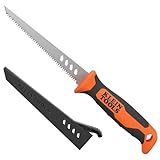
- VERSATILE CUTTING: Fixed blade jab saw cuts through drywall, wallboard, plywood, and plastic
- INTEGRATED RASPING HOLES: Designed for fast material removal, perfect for enlarging holes and smoothing edges
- DURABLE PROTECTIVE SHEATH: Protects other tools, ensures safe transport and storage, and securely locks the blade into the sheath for added safety
- WIDE, CUSHIONED HANDLE BASE: Offers comfort for punching through drywall, enhancing efficiency and reducing strain
- TRIPLE GROUND TEETH: Cuts smoothly in both push and pull directions for faster and cleaner cuts
Correction: Re-mark the line, secure the panel, and hold a rigid T-square or straightedge firmly. If the wandering has left a usable edge, true it with a rasp; if the error changes the required dimension, recut from a fresh panel edge rather than trying to disguise a large deviation with sanding.
The face paper tears beyond the line
Cause: The panel was snapped before the face score was continuous, or the break was forced while the sheet was bending.
PC Slower Than It Used to Be?
A free scan shows the junk files, broken settings and background clutter dragging Windows down - then fixes them in one click.Free scan · Windows 10 & 11Crashes, No Sound, or Screen Glitches?
Random freezes, missing sound and display glitches usually trace back to one bad driver. Find and replace yours safely.Free scan · under a minuteCorrection: Support both sides, complete the score, and make a quick, firm snap along that line. Cut the back paper with the knife instead of twisting the pieces apart.
The snapped edge is ragged
Cause: Small core fragments remained after the break.
Correction: Dress the edge with a drywall rasp or sandpaper on a wood block. Keep the tool square to the face and use a dust mask.
The opening is in the wrong place
Cause: Measurements were taken from the wrong panel edge or the box outline was transferred without checking orientation.
Do these 3 things before closing this tab:
1Repair Windows errors before they cause bigger problems2Scan for outdated or missing drivers - takes under a minute3Clear out junk files and repair common Windows errorsCorrection: Stop before cutting, identify the correct reference edge, and verify the location twice. Once an opening is oversized or misplaced, a new panel section may be the cleanest repair.
Best Value
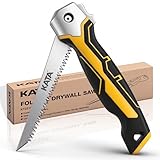
- Sharp Jab Saw Blade for Fast Starts: The 65Mn Steel 7TPI Triple Teeth pointed blade tip helps start cuts in drywall, while the aggressive tooth pattern supports controlled cutting for small openings and repair work
- Folding Drywall Saw for Easy Storage: The folding blade design helps reduce exposed edges when not in use, making it easier to store in a tool bag, drawer, garage shelf, or home repair kit
- Rubber Grip Handle for Better Control: The black and yellow handle combines a firm structure with a rubberized grip area, helping users hold the saw securely during short repair cuts or repeated DIY tasks
- Made for Drywall and Wallboard Jobs: Designed for cutting drywall, sheetrock, wallboard, and similar soft building panels during home repair, remodeling, outlet openings, pipe access, and DIY projects
- Useful for Homeowners and Handymen: A practical hand saw for drywall installers, homeowners, maintenance workers, and DIY users who need a compact cutting tool for wall repair and light remodeling jobs
The box opening is too tight
Cause: The outline was cut exactly to the box dimensions even though the installation procedure calls for clearance.
Correction: For the CGC procedure that specifies it, enlarge the opening to about 1/8 inch beyond the traced outline. Treat that figure as specific to that guidance, not a universal rule for every panel or fitting.
Dust becomes excessive
Cause: The edge was sanded more than necessary, or a powered tool was used without confirming the panel’s dust instructions.
Correction: Use a rasp or blocked sandpaper only to remove the remaining roughness, wear a dust mask, and check the exact panel manufacturer’s guidance before using a power saw. Instructions for gypsum-fiber roof boards should not be assumed to govern standard drywall.
A practical workflow for a clean installation
- Identify the geometry. Decide whether the required line is straight, an interior opening, circular, or irregular.
- Gather the matching tools. Use a knife and guide for a straight cut; use a keyhole/drywall saw or shape-specific cutter for an opening.
- Support the panel. Prevent bending and keep the waste piece from pulling on the cut.
- Measure from a known edge. Mark both endpoints for a straight cut or the complete outline for an opening.
- Protect yourself. Wear a glove on the holding hand, safety glasses for saw work, and a dust mask while sanding.
- Make the cut using the appropriate sequence. Score, snap, and cut the back paper for a straight line; saw around the marked shape for an opening.
- Clean and square the edge. Remove loose paper and use a rasp or blocked sandpaper sparingly.
- Check the fit before fastening the panel. Confirm that the opening and edges land where intended while adjustment is still possible.
What each method is—and is not—for
Use score-and-snap when
- The cut is a long, straight line.
- You want the simplest setup: knife, guide, measuring tools, and support.
- You can place the panel face-up and access both sides to finish the back-paper cut.
Use a saw or specialty cutter when
- The cut encloses an outlet box or another interior opening.
- The outline is circular, rounded, or irregular.
- The tool must start inside the panel or turn around corners instead of following one straight edge.
For a compound job, combine them: score and snap the straight portions, then saw the sections that require an interior opening or a change of direction.
Final checks before the panel goes up
- The cut edge is in the correct location and dimension.
- The edge is square enough for the intended joint or fitting.
- No loose paper is left where it could interfere with the fit.
- The panel has not been bent or cracked beyond the planned cut.
- Dust has been controlled and the area is ready for installation.
With a supported sheet and the right sequence, a sharp knife handles most straight drywall cuts, while a keyhole saw or shape-specific cutter handles openings that cannot be snapped. The cleanest results come from accurate marking first and light edge finishing afterward—not from forcing one tool to perform every kind of cut.
Quick Recap

Product prices and availability are accurate as of the date/time indicated and are subject to change. Any price and availability information displayed on Amazon at the time of purchase will apply.

