Quick wins for a faster PC:
What’s actually slowing this PC down?
Pick the symptom - the matching free tool is one click away.
Fix the driver behind crashes, sound loss and screen glitchesFind Drivers →Repair Windows errors before they cause bigger problemsFix Now →
ThatPainter is reader-supported. When you buy through links on our site, we may earn an affiliate commission. Learn More
Decker Design WPC decking could be a sensible environmental option, but the available brochure and catalog do not prove that it is the lowest-impact choice for every project. They describe a wood–polymer composite made with recycled wood and plastic, promoted for durability, low maintenance, design flexibility and recyclability. Those are manufacturer statements, not a Decker-specific, independently verified life-cycle comparison.
The practical answer is to treat Decker as a product to investigate rather than an automatic environmental winner. Compare the exact board, installation system and location with timber and other composites, and request evidence for recycled content, sourcing, expected service life, maintenance and end-of-life recovery.
As an Amazon Associate I earn from qualifying purchases.
Free tools Windows power users keep installed
One-click scans. No signup required.
What Decker decking is
Decker Design sells wood plastic composite (WPC) decking and screening. The Decker catalog describes wood composite as a blend of wood fibres or powder and polymer, and lists decking, pergolas, fences and other outdoor products. The Architecture & Design brochure focuses on the decking and screening range and presents environmental, durability and maintenance arguments for choosing it.
WPC is not a single recipe. The environmental result depends on the polymer used, the origin and proportion of wood fibre, recycled content, additives, manufacturing energy, transport distance, how long the boards last and what happens when they are removed. A claim about one composite range cannot automatically be transferred to every product in a catalog.
#1 Best Overall

- 【Superior Durability & Longevity】Unlike traditional wood that rots, warps, or splinters over time, our WPC decking is engineered to withstand the elements. It is 100% rot-proof, decay-resistant. The composite structure ensures it maintains its structural integrity for years, even under heavy foot traffic or extreme weather conditions, saving you money on long-term replacements.
- 【Zero Maintenance】Say goodbye to the annual chore of sanding, staining, or sealing your deck. Our boards feature a hard outer shell that resists stains and fading. To clean, all you need is soap and water. This "fit-and-forget" nature gives you more time to enjoy your outdoor space rather than working on it.
- 【Eco-Friendly & Safe Design】Made from a blend of recycled wood fibers and high-density polyethylene (HDPE), our decking is an environmentally responsible choice. Furthermore, the surface is engineered with a wood grain texture that provides a high slip-resistance, making it safer for children and pets compared to lumber wood.
- 【Beautiful Aesthetic Without the Flaws】Enjoy the luxurious look of natural hardwood without the imperfections. Using advanced cap stock technology, our decking offers rich, consistent color tones that resist UV rays and moisture. It won't crack or split like traditional lumber, ensuring your patio looks picture-perfect all season long.
- 【Advanced Safety: Flame-Retardant Protection】Safety meets peace of mind. Our decking is manufactured with added flame retardants, achieving an excellent non-combustible rating. This critical feature minimizes fire risks, making it a responsible choice for your home, especially in outdoor entertainment areas where grills or fire pits are present.
Nine reasons the Decker brochure presents it as an environmental choice
1. It uses a wood-and-polymer composite instead of solid timber alone
Decker’s stated material approach combines wood fibre or wood powder with polymer. That can turn two streams of material into a board with a consistent manufactured profile and appearance. The brochure positions this composite construction as a way to obtain decking performance while retaining a wood-like look.
Material substitution is not the same as a measured environmental advantage. Polymer production, additives and processing have impacts, while timber impacts depend on species, forestry practice, kiln drying and transport. To evaluate this reason, ask for the exact formulation and the declared material mass per square metre rather than relying on the word “composite.”
2. The manufacturer says it uses recycled wood and plastic
The Decker catalog says its wood composite uses recycled wood and plastic. Reusing those inputs can avoid some demand for virgin resources, but the catalog does not provide a Decker-specific percentage, a mass-balance method or a breakdown between pre-consumer and post-consumer material.
Ask whether the figure is calculated by mass, whether it applies to the particular decking profile you are buying, and whether it covers clips, caps and other components. A recycled-content claim is most useful when it is accompanied by a declaration, certification or audit that defines the calculation boundary.
3. Recyclability is part of the product claim
Decker describes the material as recyclable. In practice, recyclability depends on whether a collection route accepts the boards, whether wood fibre and polymer can be separated or processed together, and whether local facilities have the equipment to handle long, weathered profiles.
Before treating this as an end-of-life benefit, ask the supplier where used boards can be returned, whether the program is operating in your region and what contamination or dismantling conditions apply. “Recyclable” on a catalog page does not guarantee that a homeowner can recycle a deck through ordinary household collections.
What’s actually slowing this PC down?
Pick the symptom - the matching free tool is one click away.
Rank #2

- 【Superior Durability & Longevity】Unlike traditional wood that rots, warps, or splinters over time, our WPC decking is engineered to withstand the elements. It is 100% rot-proof, decay-resistant. The composite structure ensures it maintains its structural integrity for years, even under heavy foot traffic or extreme weather conditions, saving you money on long-term replacements.
- 【Zero Maintenance】Say goodbye to the annual chore of sanding, staining, or sealing your deck. Our boards feature a hard outer shell that resists stains and fading. To clean, all you need is soap and water. This "fit-and-forget" nature gives you more time to enjoy your outdoor space rather than working on it.
- 【Eco-Friendly & Safe Design】Made from a blend of recycled wood fibers and high-density polyethylene (HDPE), our decking is an environmentally responsible choice. Furthermore, the surface is engineered with a wood grain texture that provides a high slip-resistance, making it safer for children and pets compared to lumber wood.
- 【Beautiful Aesthetic Without the Flaws】Enjoy the luxurious look of natural hardwood without the imperfections. Using advanced cap stock technology, our decking offers rich, consistent color tones that resist UV rays and moisture. It won't crack or split like traditional lumber, ensuring your patio looks picture-perfect all season long.
- 【Advanced Safety: Flame-Retardant Protection】Safety meets peace of mind. Our decking is manufactured with added flame retardants, achieving an excellent non-combustible rating. This critical feature minimizes fire risks, making it a responsible choice for your home, especially in outdoor entertainment areas where grills or fire pits are present.
4. Durability could spread manufacturing impacts over a longer service period
The brochure promotes Decker WPC for durability and performance. A board that remains safe and attractive for many years may avoid the impacts of manufacturing and installing a replacement deck sooner. Service life is therefore a central part of any fair comparison.
No independently verified Decker service-life number is established in the available material. Request test methods, warranty terms, exposure conditions and examples of how weathering, moisture, heat and heavy use affect the boards. Compare those conditions with the expected life of the specific timber or composite alternative, not with a generic category average.
5. The range is described as needing no oiling for optimum performance
The Architecture & Design brochure states that the Decker range requires no oiling to maintain optimum performance. Eliminating periodic oil purchases, transport and application can reduce maintenance-related material use and labor.
“No oiling” does not mean “no care.” Decks still collect dirt, leaves and organic growth, and surface cleaning may be needed. Ask which cleaners are permitted, how often cleaning is recommended and whether pressure washing or solvents can damage the surface. Include those products and activities when comparing life-cycle impacts.
Recommended Free Tools
6. Painting is not required for the stated performance
The same brochure says the range requires no painting to maintain optimum performance. Avoiding primers, coatings, brushes, masking materials and repainting work can be an environmental and practical advantage over a finish that must be renewed regularly.
This claim should be read as a maintenance statement, not a promise that the colour will never change. Obtain the written care instructions and warranty language for the exact profile. If a homeowner chooses to paint for appearance, check whether the coating is compatible and whether doing so affects warranty coverage.
Rank #3
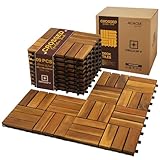
- Premium Acacia Wood 0.9 Thick: Solid acacia hardwood treated with a protective linseed oil finish that penetrates and guards the wood grain against moisture and wear; each tile measures a full 12 x 12 x 0.9 inches for a premium, substantial feel
- Safe Grip on Any Wet Surface with Grooved Slats and PPC Base: Deep-groove pattern keeps feet secure around pools, balconies, patios, and wet areas; supports up to 490 lbs
- Superior Drainage with Elevated Raised Base: Lifts tiles off the ground to channel water away underneath; promotes airflow and keeps surfaces dry — ideal for poolside, bathrooms, RV floors, and balconies
- Snaps Together in Minutes with No Tools Required: Precision interlocking clips lock all four sides by hand; tiles cut easily with a hand saw to fit edges and corners
- Built Tough for All-Weather Outdoor Use: Handles heat, UV exposure, and heavy use in all seasons; sweep or rinse with a hose to keep tiles looking their best
7. Lower maintenance can reduce disruption as well as material use
Decker’s environmental argument links reduced maintenance with lower ongoing resource use. Fewer recoating or oiling cycles can mean fewer deliveries, tools and disposal events over the deck’s life, while also reducing the time a deck is unavailable.
The size of that benefit depends on the alternative. A naturally durable, unfinished timber deck may require different care from a painted softwood deck; a competing composite may have similar cleaning needs. Compare a maintenance schedule over the same service period, including water, detergent, replacement fasteners and labor.
The Tool Desk
Outbyte Driver Updater FREEFix the driver behind crashes, sound loss and screen glitchesFind Drivers →Outbyte PC Repair FREERepair Windows errors before they cause bigger problemsFix Now →8. Design flexibility may help a project use one coordinated system
The brochure highlights design flexibility and discusses decking and screening. Matching boards, screens and related outdoor elements can help a designer meet visual and dimensional requirements without adding a separate material solely to solve a detailing problem.
That is a project-efficiency argument, not a quantified carbon reduction. A more flexible profile can still require more material if the design uses deeper framing, decorative screens or extensive offcuts. Request cutting guidance and layout drawings so you can estimate waste before ordering.
9. The brochure positions it for demanding outdoor locations, including pool and spa areas
Architecture & Design describes Decker as a better choice for decking around pools and spas and discusses reduced installation requirements. A product suited to wet, frequently used areas may avoid premature replacement or complex finishing systems when the installation is designed correctly.
Pool suitability is not an environmental certificate. Confirm slip-resistance data, drainage details, heat and chemical exposure limits, substructure requirements and the exact installation method. Reduced installation effort should be demonstrated for the particular board and site; it should not be assumed from the general WPC category.
Do these 3 things before closing this tab:
1Fix the driver behind crashes, sound loss and screen glitches2Clear out junk files and repair common Windows errors3Scan for outdated or missing drivers - takes under a minuteRank #4

- Authentic Wood Aesthetic - Expertly crafted texture that flawlessly mimics the richness and elegance of real wood, offering a breathtakingly natural and timeless look that transforms your outdoor space into a luxurious retreat.
- Effortless Installation - Enjoy hassle-free setup with our flexible installation options, complete with a FREE tool kit including stainless steel spiked clips, screws, and edge clips.
- Unmatched Durability - Engineered to withstand the toughest conditions, our boards offer supreme resistance to stains, fading, water, scratches, and wear, ensuring they remain as stunning as the day they were installed, no matter the weather.
- Low-Maintenance Luxury - Revolutionize your outdoor living with composite boards that demand almost no upkeep. Forget the endless sanding, staining, and sealing of traditional wood—our boards stay pristine and beautiful year after year with minimal effort.
- Eco-Friendly & Pest-Resistant - Designed with sustainability in mind, our boards are not only durable but also resistant to rodents and insects, offering a planet-friendly and worry-free solution for your outdoor oasis.
What is established, and what still needs proof
| Question | What the Decker material says | What is not established | Evidence to request |
|---|---|---|---|
| Material composition | Wood fibre or powder blended with polymer. | The precise recipe and mass of each input for the selected board. | Technical data sheet listing polymers, wood content, additives and board weight. |
| Recycled inputs | The catalog says recycled wood and plastic are used. | A product-specific recycled-content percentage and accounting method. | Declaration or certification defining pre-consumer and post-consumer content. |
| Maintenance | The brochure says no oiling or painting is needed for optimum performance. | Total cleaning frequency, approved products and maintenance impacts. | Current care guide, warranty and cleaning schedule. |
| Durability | The range is promoted for durability and performance. | An independently verified service-life result under stated conditions. | Test reports, exposure conditions, warranty period and replacement assumptions. |
| End of life | The catalog calls the material recyclable. | Whether a real take-back or recycling route exists where you live. | Named collection partner, preparation rules and geographic coverage. |
| Overall environmental impact | Environmental benefits are presented in marketing material. | A Decker-specific independent life-cycle assessment with a disclosed scope. | Product-specific LCA or environmental product declaration covering manufacture through end of life. |
Why competitor recycled-content figures cannot answer the Decker question
Other manufacturers publish recycled-content numbers, but those figures describe their own products and cannot be assigned to Decker. Trex states that its composite decking uses 95% recycled and reclaimed raw materials on its undated sustainability page. The AZEK Company’s FY2024 sustainability report states approximately 85% recycled content for TimberTech composite decking and describes the company’s life-cycle-assessment work.
| Product claim | Published figure | How to use it |
|---|---|---|
| Trex composite decking | 95% recycled and reclaimed raw materials, according to Trex. | Context for the type of disclosure a manufacturer may provide; it is not a Decker measurement. |
| TimberTech composite decking | Approximately 85% recycled content, according to the AZEK Company FY2024 report. | A separate company and product claim; it cannot establish Decker’s content or ranking. |
| Decker WPC decking | No named independent recycled-content statistic is established in the available material. | Request a product-specific percentage before making a comparison. |
How to make a fair environmental comparison
Use the same functional unit: for example, one square metre of installed deck providing the required safety and appearance for a defined period. Then compare the following dimensions for Decker, timber and any other composite under consideration.
- Define the products. Record the exact board profile, colour, cap, fasteners, joists, foundations and waste allowance. “Composite decking” is too broad for a meaningful result.
- Set the geography. Manufacturing location, delivery distance, electricity mix, building codes and available recycling routes vary by country and region.
- Set the service period. Use documented warranty and test information where possible. If assumptions are necessary, show them explicitly rather than presenting a single lifetime as fact.
- Count maintenance. Include cleaning water and products, recoating or oiling, replacement boards, access equipment and disposal of removed materials.
- Check installation. Compare framing, spacing, clips, screws, cutting waste and any special drainage or pool detailing. A board that uses less maintenance may require a different substructure.
- Map end of life. Identify reuse, take-back, mechanical recycling, energy recovery and landfill pathways available in the project location. State which pathway the calculation assumes.
- Read the boundary. A result covering factory-gate production is not equivalent to one covering transport, installation, use and disposal.
Questions to ask a supplier before ordering
- What is the recycled-content percentage for the exact decking profile and batch, and how is it calculated?
- Which wood species or fibre source is used, and what documentation covers responsible sourcing?
- Where are the boards and accessories manufactured, and what transport assumptions support the environmental claim?
- What independent tests support durability, colour stability, slip resistance and wet-area performance?
- What cleaning products and methods are allowed, and what maintenance schedule does the warranty assume?
- Is there a take-back or recycling route in my country or municipality, and how must boards be prepared?
- Does the installation system require proprietary clips, additional framing or special drainage that changes material quantities?
- Can you provide an environmental product declaration or life-cycle assessment for the selected product?
Installation, care and end-of-life decisions that affect the result
Follow the current Decker installation instructions for joist spacing, ventilation, drainage, fasteners, edge finishing and expansion gaps. Those details influence safety, water management and the likelihood of early replacement. Do not substitute a generic composite-decking method without confirming compatibility.
Keep offcuts and removed boards separate from ordinary household waste while you establish a recovery route. Reuse sound pieces for small screens or repairs where practical, and ask the supplier how weathered boards should be handled. If no local recycling program accepts WPC, the catalog’s recyclability statement should not be treated as a guaranteed outcome for your project.
Quick wins for a faster PC:
Fix the driver behind crashes, sound loss and screen glitchesFind Drivers →Clear out junk files and repair common Windows errorsFree Scan →Verdict: a candidate environmental choice, not a proven universal winner
Decker’s case rests on a coherent set of potential advantages: a wood–polymer construction, stated use of recycled wood and plastic, claimed recyclability, durability, no required oiling or painting, lower maintenance and flexible outdoor design applications. These points explain why the brochure calls it an environmental choice.
They do not, by themselves, show that Decker has a lower total impact than timber or another composite. Choose it when the exact product documentation supports your project’s service life, maintenance pattern, sourcing and end-of-life route. If the supplier cannot provide those details, describe Decker as a promising option with unverified environmental performance rather than as the definitive right choice.
Quick Recap

Product prices and availability are accurate as of the date/time indicated and are subject to change. Any price and availability information displayed on Amazon at the time of purchase will apply.

