Do these 3 things before closing this tab:
1Clear out junk files and repair common Windows errors2Scan for outdated or missing drivers - takes under a minute3Repair Windows errors before they cause bigger problemsThatPainter is reader-supported. When you buy through links on our site, we may earn an affiliate commission. Learn More
The pencil sharpener was not the work of one inventor. A historical overview reports an early device description in 1822, a French patent for a taille-crayon in 1828, and a handheld design attributed to Thierry des Estivaux in 1847. US patents from 1858 then document further mechanical refinements. Those milestones represent different stages—not a single, uncontested invention.
As an Amazon Associate I earn from qualifying purchases.
Before the familiar handheld sharpener
Pencils were sharpened before a dedicated sharpener was described. According to the Universidad de Sevilla’s Museo Pedagógico, a French publication in 1822 described an apparatus by French military engineer C. A. Boucher. The museum account says Boucher did not seek a patent, so this is best described as a reported early design, not proof of a patented or commercially established product.
The same overview identifies Bernard Lassimone, a geometer in Limoges, as the recipient of a five-year patent in 1828 for an instrument he called a taille-crayon, or pencil sharpener. The museum reproduces wording from a contemporary patent notice, but the original French patent record has not been independently examined here; the attribution and date should therefore be credited to that historical account.
#1 Best Overall

- It's a new way to twist. Comfortably grasp the smooth, curved hand held sharpener, and with easy back-and-forth (clockwise and counterclockwise) twisting of the Pencil, feel the ratchet mechanism perfect the point. With a simple turn of a knob, customize Pencil sharpening for a sharp or blunt Pencil tip. Tip Saver technology protects and extends the Pencil life by preventing over sharpening. Easy empty shavings tray quickly, and conveniently, opens from discreet side panel for fast, tidy disposal. Portable, compact size fits in purses, backpacks, pockets, drawers, and more. Comes in an assortment of exciting translucent colors
- PREMIUM RACHET TECHNOLOGY - Allows for comfortable and fast sharpening, unlike other pencil sharpeners
- ATTACHED DISPENSER DRAWERS - An attached shavings dispenser doors allows you to clean the shaving easily but never lose the door piece
- CUSTOMIZABLE SHARPENING – Center dial in center allow for sharp or blunt sharpening
- TIP SAVER TECHNOLOGY - Prevents over-sharpening, making your pencils last longer. This technology is exclusive to Bostitch Pencil Sharpener
When did the handheld pencil sharpener appear?
The Museo Pedagógico credits Thierry des Estivaux with creating a hand-held sharpener in 1847. This marks an important step toward the compact format many people recognize, but the date and attribution remain claims reported by the secondary account rather than independently verified here against the underlying 1847 patent record.
What did the 1858 US patents add?
US Patent Office records show that Walter K. Foster continued to refine sharpener construction in 1858. US Patent No. 20,056 describes a hollow conical body with a separate steel cutting blade. US Patent No. 20,262 documents further improvements, including a chamber and blade arrangement. These records establish later design development; they do not make Foster the first inventor of the pencil sharpener.
Rank #2

- DUAL-HOLE VERSATILITY – Two sharpening holes (approx. 8.2mm standard & 10.2mm large) fit most graphite and colored pencils. Ideal for #2 school pencils and slightly larger diameter pencils
- PRECISION STEEL BLADES – High-quality metal blades create clean, sharp points with reduced breakage when used properly. Designed for consistent sharpening results
- BUILT-IN SHAVINGS CONTAINER – Integrated tub collects shavings for mess-free use at school, home, or office. Empty frequently for best results
- SECURE PUSH-BUTTON LOCK – Lid helps prevent accidental opening and spills, keeping desks and bags clean during transport. Compact size fits easily in pencil cases and backpacks
- STAEDTLER - Leading manufacturer and supplier of writing, paint, drawing and modeling products that help people around the world realize and share their ideas
In the specification for No. 20,056, Foster described his subject as “a new or Improved Instrument for Sharpening or Pointing Lead-Pencilsg”. The spelling “Lead-Pencilsg” is reproduced as it appears in the patent transcription.
How the milestones differ
| Date | Milestone | What the evidence establishes |
|---|---|---|
| 1822 | Boucher device | A French publication reportedly described an apparatus for sharpening pencils; the Museo Pedagógico says Boucher did not seek a patent. |
| 1828 | Lassimone patent | The museum overview attributes a five-year patent for a taille-crayon to Lassimone. |
| 1847 | Des Estivaux handheld design | The museum overview credits des Estivaux with creating a hand-held sharpener. |
| 1858 | Foster US patents | US Patent Office specifications document a conical body, cutting blade, and later chamber-and-blade refinements. |
The early French milestones above are reported by the Museo Pedagógico overview; the 1858 details come from US Patent No. 20,056 and US Patent No. 20,262.
Rank #3

- ATTACHED DISPENSER DRAWERS - An attached shavings dispenser doors allows you to clean the shaving easily but never lose the door piece
- CUSTOMIZABLE SHARPENING – Center dial in center allow for sharp or blunt sharpening
- TIP SAVER TECHNOLOGY - Prevents over-sharpening, making your pencils last longer. This technology is exclusive to Bostitch Pencil Sharpener
- PREMIUM RACHET TECHNOLOGY - Allows for comfortable and fast sharpening, unlike other pencil sharpeners
So, who invented the pencil sharpener?
There is no single inventor to credit for every version. Boucher is associated with an early reported device, Lassimone with the 1828 patent milestone, des Estivaux with a later handheld form, and Foster with documented US design refinements in 1858. The distinction matters: a printed description, a patent, a compact form, and subsequent engineering improvements are related but not identical claims.
Quick Recap
Best Value
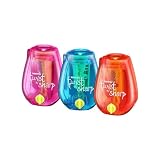
- Premium rachet technology - allows for comfortable and fast sharpening, Unlike other Pencil sharpeners
- Attached dispenser drawers - an attached shavings dispenser doors allows you to clean the shaving easily but never lose the door piece
- Customizable sharpening - center dial in center allow for Sharp or blunt sharpening
- Tip saver technology - prevents over-sharpening, making your pencils last longer. This technology is exclusive to Bostitch Pencil sharpener
- 3 colors - get all 3 colors in one pack!
Rank #4

- 【Double hole design】Pencil sharpeners with dual holes design, two holes of different sizes, can be used to sharpen pencils of different thickness. Suitable for sharpening large and small diameter pencils and crayons.
- 【High Quality Material】Pencil sharpener shell is made of durable transparent high-quality plastic, the internal blade is made of high-quality carbon steel blades, not easy to rust, non-toxic and tasteless, will not hurt the child's hands, can be used with confidence.
- 【Easy to carry】Plastic manual pencil sharpener is small and compact, so you can carry it with you or use it anytime and anywhere.
- 【Easy to clean】We just take out the box where the pencil shavings are stored and empty the shavings. Reduces children's exposure to pencil dust and doesn't mess up the work surface.
- 【Multi-colors & Multi-uses】 The small pencil sharpener is available in four different colors. It is suitable for schools, classrooms, offices, homes, art projects, studios, etc., providing essential stationery supplies for students, teachers and professionals.





