Free tools Windows power users keep installed
One-click scans. No signup required.
Windows Errors? Fix Them Before They Spread
Repair common Windows errors and clear accumulated junk for a smoother, more stable PC - no reinstall needed.Free scan · no reinstallOutdated Drivers Are Slowing You Down
One free scan finds every outdated or missing driver and matches the right update for your exact hardware.Free scan · exact hardware matchThatPainter is reader-supported. When you buy through links on our site, we may earn an affiliate commission. Learn More
The safest way to clean marble is simple: remove loose grit, use a pH-neutral stone cleaner or a small amount of mild dishwashing detergent diluted in warm water, rinse well, and dry with a soft cloth. Never use vinegar, lemon juice, acidic products, abrasive powders, or unapproved bleach. Those products can etch, scratch, dull, or discolor marble. Treat spills immediately, and identify a stain before choosing any stronger treatment.
As an Amazon Associate I earn from qualifying purchases.
Why marble needs a different cleaning method
Marble is a calcareous natural stone. Its mineral composition reacts with acids, so a product that is harmless on ceramic tile or glass can permanently change a marble finish. The visible damage may look like a stain, but an acid can actually dissolve or roughen the polished surface. This is called etching.
What’s actually slowing this PC down?
Pick the symptom - the matching free tool is one click away.
Cleaning and restoration are therefore separate jobs. Routine cleaning removes soil from the surface. Stain treatment targets material absorbed into the stone. Etching, scratches, chips, and permanently dulled areas affect the finish itself and may need honing or repolishing rather than another household cleaner.
#1 Best Overall

- New Disinfecting Formula - Kills 99.9% of germs & bacteria, Kills the following bacteria in 1 minutes on hard, non-porous surfaces
- Multi-Use - Superior performance on countertops, floors, shower stalls, kitchen sinks, bathroom sinks, tubs, floors & other hard, non-porous surfaces.Store in a dry, cool, and well-ventilated area
- Surface Safe - For Non-porous Sealed Granite, Sealed Marble, Sealed Limestone, Sealed Slate, and Glazed Tile in kitchens, bathrooms, and other household areas Cleans, Shines and Disinfects - Keep your home safe from harmful bacteria, germs, smells, and dirt
- #1 Trusted Brand - Weiman is a trusted cleaning brand for most of your home's delicate, difficult to care for surfaces; clean, protect and enjoy your home with Weiman
- Note-Causes moderate eye irritation. Harmful if swallowed or absorbed through the skin. Avoid contact with eyes, skin or clothing. Wash thoroughly with soap and water after handling and before eating, drinking, chewing gum, using tobacco or using the toilet. Remove contaminated clothing and wash clothing before reuse
The Natural Stone Institute recommends a neutral cleaner, stone soap, or mild liquid dishwashing detergent with warm water. Daltile likewise advises that stone cleaners should not contain acid or bleach. Marazzi USA warns that even a light vinegar-and-water solution can etch and eventually damage many natural stones.
Gather the right supplies before you start
- A clean, dry dust mop for floors or a soft dry cloth for counters and other surfaces.
- A vacuum only if its wheels and attachments are clean and unworn. A damaged wheel or hard edge can drag grit across polished marble.
- A pH-neutral cleaner labeled for marble or natural stone, or a mild liquid dishwashing detergent.
- Warm water and a clean bucket or basin.
- A soft microfiber or other non-abrasive cloth, sponge, or mop.
- A soft natural-fiber brush for textured areas or soil that a cloth cannot reach.
- Several clean rinse cloths and a separate soft drying cloth.
Read the cleaner label before mixing it. More product is not better: an over-concentrated solution can leave a film, streaks, or sticky residue that attracts more soil.
How to clean marble step by step
- Remove loose grit and dust. Dust-mop the floor or wipe the surface with a dry cloth before adding liquid. If you vacuum, confirm that the wheels and attachments are not worn. Grit is abrasive, and moving it under a mop or cloth can scratch polished marble.
- Prepare a diluted neutral solution. Mix a pH-neutral marble or natural-stone cleaner, stone soap, or mild liquid dishwashing detergent with warm water exactly as the label directs. Do not increase the concentration to deal with heavy soil.
- Apply gently. Use a soft cloth, sponge, or mop. On textured or heavily soiled sections, use a soft natural-fiber brush only where needed. Avoid aggressive scrubbing and any pad designed to scour.
- Rinse with clean water. Remove the cleaning solution rather than allowing it to dry on the stone. Change the rinse water frequently so you do not spread dirty water back over the surface.
- Dry completely. Buff the marble with a clean, soft cloth. Drying removes remaining moisture and cleaner residue and makes streaks easier to spot.
Work in manageable sections, especially on a large floor. Keep the solution, rinse water, and drying cloths separate. If the surface still feels tacky after drying, rinse again with clean water instead of adding more detergent.
What to do when something spills
Blot a spill as soon as you notice it. Do not wipe it across the marble, because wiping can spread the liquid and any grit in it.
- Press a clean, absorbent cloth onto the spill and lift it straight up.
- Flush the area with clean water and a small amount of mild soap.
- Rinse several times with clean water, changing the water as it becomes dirty.
- Dry with a soft cloth.
Prompt blotting is particularly important around food, beverages, cosmetics, and other colored liquids. A sealer can increase resistance to staining, but it does not make marble stain-proof.
Cleaner choices: what is safe and what is not
Use the following criteria when evaluating a ready-to-use product or concentrate. The product must be appropriate for the specific marble and any existing sealer; a generic “multi-surface” claim is not enough.
Rank #2

- Contains (1) 28 ounce bottle of granite cleaning spray
- Cleans to a sparkle without streaks or stress.
- Surface-safe on granite, marble and sealed stone.
- Cruelty free. Tested by people, not on animals.
- Bottle (minus nozzle) made from 100% recycled plastic (PCR).
| Cleaner or ingredient | Marble guidance | Reason |
|---|---|---|
| pH-neutral marble or natural-stone cleaner | Preferred when the label identifies marble or natural stone and gives clear dilution directions. | Designed to clean without the acid reaction associated with etching. |
| Mild liquid dishwashing detergent | Acceptable when diluted in warm water and thoroughly rinsed. | Recommended by the Natural Stone Institute as a mild cleaning option. |
| Stone soap | Acceptable when intended for natural stone and used at the labeled concentration. | Provides routine cleaning without abrasive action. |
| Vinegar or lemon juice | Do not use, even diluted. | Acids can etch and dull calcareous marble. |
| Acidic bathroom or rust products | Do not use unless a qualified stone professional has approved a specific product and method. | Acids can attack the stone; hydrofluoric acid is especially destructive to stone minerals. |
| Bleach-containing stone cleaner | Avoid unless the exact product and application are specifically approved. Daltile states that stone cleaners should never contain acid or bleach. | Bleach can be incompatible with stone-care systems and may create safety hazards when mixed with other cleaners. |
| Abrasive powder, cream, scouring pad, or steel wool | Do not use. | Abrasives can scratch or dull a polished finish. |
Never mix ammonia and bleach. The combination creates a toxic gas. Store products separately and rinse a cloth or bucket thoroughly before switching from one chemical to another.
Cleaning marble countertops, floors, and textured surfaces
Countertops and vanities
Remove crumbs and grit with a dry cloth first, then clean with the diluted neutral solution. Keep the working area small enough that you can rinse and dry before the solution evaporates. Blot food and drink spills immediately. In a food-preparation area, any impregnating sealer should be labeled non-toxic and safe for that use; cleaning does not replace that product-safety check.
Floors
Dust-mop before wet cleaning. Vacuum only with equipment whose wheels and attachments are not worn. Use a soft mop, rinse frequently, and dry where practical so dirty water is not left to evaporate into a film. Pay extra attention to entry areas where grit is tracked onto the floor.
Textured, honed, or heavily soiled marble
Start with the same neutral solution and a soft cloth or sponge. If soil remains in texture, use a soft natural-fiber brush with light pressure. A brush is for reaching recesses, not for aggressive scrubbing. Rinse repeatedly and dry so cleaner does not remain in the texture.
How to tell a stain from etching or surface damage
Do not choose a treatment until you have identified the problem. The Natural Stone Institute separates several common categories:
Rank #3

- SAFE ON GRANITE, MARBLE, QUARTZ & NATURAL STONE: Includes one 32oz spray bottle; pH-balanced formula cleans granite, limestone, marble, slate, travertine, quartz, and all other natural-stone countertops without the harsh chemicals in everyday cleaners that can dull or etch your stone
- STREAK-FREE, RESIDUE-FREE SHINE: Spray on and wipe off with a lint-free cloth for a fast, sparkling finish; No filmy buildup, no smudges, no dull haze left behind
- FOOD-SAFE FOR EVERYDAY USE: Safe around kitchen counters and food-prep areas; No ammonia, phosphates, or harsh fumes; Light, fresh citrus scent so daily cleaning never leaves a chemical smell
- BUILT FOR STONE CARE, NOT GENERIC CLEANING: Typical household sprays can damage natural stone and lead to costly repair or resealing; This is formulated specifically to protect your investment
- MADE IN THE USA BY STONE-CARE EXPERTS: Created by a third-generation family in stone manufacturing, installation, and restoration; Use with Granite Gold Polish and Sealer for a complete care routine for Natural Stone; Made in the USA
| Problem type | Typical source | What the distinction means |
|---|---|---|
| Oil-based | Grease or oily products | Material may have penetrated the stone and require a targeted stain treatment. |
| Organic | Food, beverages, leaves, or other organic material | Color can remain after the spill is removed; treatment depends on the specific substance. |
| Metallic | Rust or other metal deposits | Rust removers must be chosen with care; hydrofluoric-acid products can attack stone minerals. |
| Biological | Growth or biological residue | Identify the material before selecting a cleaner so the stone is not exposed to an incompatible chemical. |
| Ink | Pens, markers, or dyes | Colorant may need a specialized poultice or professional treatment. |
| Paint | Coatings or splashes | Mechanical removal and solvent choice must account for the marble finish. |
| Water ring or mineral deposit | Standing water or deposits left as water dries | Residue may sit on the surface, but a ring can also involve finish change; do not assume an acid is safe. |
| Acid etch | Vinegar, citrus, acidic foods, or acidic cleaners | This is a finish change, not a conventional stain. More washing will not restore the polish. |
A dull, lighter, or cloudy patch that follows the outline of a citrus slice, bottle, or acidic spill is more consistent with etching than with a removable stain. Scratches, nicks, and persistent dull areas similarly indicate physical or finish damage rather than ordinary soil.
Removing stains without making the damage worse
Begin with the least aggressive approach: blot any remaining material, flush with water and mild soap, rinse, and dry. If the mark remains, identify whether it is oil-based, organic, metallic, biological, ink, paint, a water ring, or an etch before escalating.
A poultice may be appropriate for some deep stains, but the absorbent material and active ingredient must match the stain and the marble. Because an incorrect poultice or solvent can spread discoloration, alter the finish, or react with a sealer, follow the stone supplier’s or treatment manufacturer’s instructions. Deep rust, scratches, nicks, stubborn stains, and etched or dull areas may require a professional stone restorer.
Do not try to remove a rust mark with a toilet-bowl cleaner or an unapproved rust remover. Hydrofluoric acid attacks stone minerals and can cause severe, irreversible damage.
Recommended Free Tools
Does marble need to be sealed?
“Sealing” products for natural stone are more accurately described by the Natural Stone Institute as impregnators. They penetrate the stone and act as repellents. They can make marble more resistant to staining, but they do not make it stain-proof and they do not prevent acid etching.
Rank #4

- Safe for All Natural Stone – Gently cleans marble, travertine, granite, slate, limestone, ceramic, and porcelain tile without damage or dulling the surface.
- Streak-Free, No-Rinse Formula – Leaves floors spotless with no residue or film. Enjoy a clean, natural shine after every mop.
- Highly Concentrated – Just 2–4 oz. per gallon delivers powerful results. One bottle goes a long way, saving time and money.
- Eco-Friendly & Family-Safe – Non-toxic and biodegradable. Safe for daily use around kids, pets, and food areas.
- pH Neutral for Stone Protection – Specially formulated to preserve natural stone beauty. Won’t etch, strip sealers, or cause surface damage.
Ask the stone supplier or sealer manufacturer whether your particular marble needs an impregnator and how often it should be reapplied. Marble varieties differ in absorption and finish, so a schedule suitable for one installation should not be assumed for another. In food-preparation areas, choose a product explicitly labeled non-toxic and safe for that use.
| Sealer decision | What to verify before use |
|---|---|
| Impregnating formulation | Confirm that it is intended for marble and is compatible with the stone’s finish. |
| Topical coating | Confirm that the manufacturer specifically approves it for marble; a coating can change appearance and maintenance requirements. |
| Food-preparation application | Check for an explicit non-toxic, food-area-safe label. |
| Reapplication | Follow the manufacturer’s interval for the specific marble and product rather than using a universal calendar. |
| Existing sealer | Verify compatibility before applying a new product; clean and rinse away residue first. |
Sealing is an optional stain-resistance measure, not permission to use vinegar, citrus, bleach, or abrasive cleaners. Continue to clean with a neutral product and blot spills promptly.
Independent reader supportYour contribution helps us test, update, and keep practical guides available for everyone.Historic, valuable, or highly polished marble
Managed restoration work uses controls that are excessive for ordinary household cleaning but important for historic or high-value stone. The U.S. General Services Administration specification calls for an inconspicuous test patch, low-pressure application, soft natural-fiber brushes, ventilation, product-appropriate personal protective equipment, potable-water rinsing, and pH checks until both the cleaner and surface are neutralized.
Do not improvise a strong chemical treatment from those restoration procedures. For a historic installation, a valuable slab, unknown stone, or damage that extends beyond surface soil, consult a qualified stone conservator or restoration firm. Document the test area and product used before treating the visible face of the marble.
Troubleshooting common cleaning mistakes
The marble looks cloudy or streaky
Cleaner residue is a common possibility when a solution was over-concentrated or not rinsed. Rinse with clean water, change the rinse water frequently, and dry with a soft cloth. If the cloudiness remains in a localized patch after an acidic spill, it may be etching rather than residue and may need repolishing.
Best Value
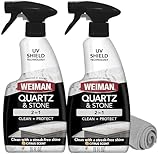
- SPECIALLY FORUMULATED CLEANER FOR QUARTZ: The #1 newly installed kitchen countertop surface. Our pH neutral formula safely removes grease, soil, surface stains, and watermarks. Using multi-purpose cleaners not formulated for quartz can result in streaking, and unsightly residue
- SUPERIOR PROTECTION: Helps protect the resins in quartz and other stones from fading or darkening from sunlight exposure
- FRESH CITRUS SCENT, SPOTLESS SHINE: Cleans, shines & protects quartz countertops & other sealed stone surfaces. Light and fresh citrus scent will leave your countertops glistening and your kitchen smelling amazing!
- CLEAN WITHOUT LEAVING STREAKS AND RESIDUE: Supreme polishing power brings out a whole new level of luster without damaging surface
- PROUDLY MADE IN THE USA: All Weiman products are manufactured in the United States of America. Trust Weiman with your most valued surfaces in your home!
New scratches appeared after vacuuming
Inspect the vacuum wheels and attachments. Worn or hard parts can drag grit across polished marble. Stop using the equipment until those parts are clean and undamaged; remove loose grit with a soft dry dust mop instead.
A water ring will not wash away
First remove surface residue with the neutral cleaning method and dry thoroughly. If the ring remains, determine whether it is a mineral deposit, absorbed stain, or finish change. Do not reach for vinegar: acid may enlarge an etched area.
Quick wins for a faster PC:
Fix the driver behind crashes, sound loss and screen glitchesFind Drivers →Clear out junk files and repair common Windows errorsFree Scan →Scan for outdated or missing drivers - takes under a minuteDriver Scan →A spot became dull after cleaning
That appearance is consistent with etching or abrasion, not ordinary dirt. Stop scrubbing and avoid additional chemicals. A stone professional can determine whether honing or repolishing is required.
The stain persists after several gentle cleanings
Repeated washing is unlikely to solve a deep, metallic, ink, paint, or other identified stain. A correctly selected poultice or professional restoration may be needed. Keep a record of every product already applied so the restorer can avoid incompatible treatments.
Quick Recap
A practical marble-care checklist
- Remove grit before adding moisture.
- Choose a pH-neutral marble or natural-stone cleaner, stone soap, or mild dish detergent.
- Follow the label dilution exactly; never over-concentrate.
- Use soft cloths, sponges, mops, and, when necessary, soft natural-fiber brushes.
- Rinse with clean water, changing it frequently.
- Dry the surface with a soft cloth.
- Blot spills immediately; do not spread them by wiping.
- Keep vinegar, lemon juice, acidic cleaners, unapproved bleach, abrasives, steel wool, and hydrofluoric-acid products away from marble.
- Never mix ammonia and bleach.
- Identify a stain before selecting a poultice or specialty treatment.
- Use an impregnating sealer only when the stone supplier or manufacturer confirms that the marble needs it.
- Call a qualified restorer for deep rust, persistent stains, scratches, nicks, etching, or valuable and historic surfaces.

Product prices and availability are accurate as of the date/time indicated and are subject to change. Any price and availability information displayed on Amazon at the time of purchase will apply.

