Crashes, No Sound, or Screen Glitches?
The Tool Desk
Outbyte Driver Updater FREEScan for outdated or missing drivers - takes under a minuteDriver Scan →Outbyte PC Repair FREEClear out junk files and repair common Windows errorsFree Scan →Outbyte Driver Updater · freeRandom freezes, missing sound and display glitches usually trace back to one bad driver. Find and replace yours safely.
Find the Right Drivers →ThatPainter is reader-supported. When you buy through links on our site, we may earn an affiliate commission. Learn More
Delivering clean, fresh and safe drinking water sustainably requires a managed system, not a single appliance. The dependable approach is to understand the source, control hazards through treatment, protect water in distribution and buildings, verify quality independently, and keep the service available when people need it. A household filter can be useful for a defined problem, but it cannot replace safe infrastructure, sound plumbing or ongoing risk management.
What “clean, fresh, safe and sustainable” actually means
These words describe different outcomes. Safe means water is protected against health hazards at a level appropriate to the local risk. Clean concerns the absence of unacceptable contamination, including microbial and chemical hazards. Fresh usually means water is available, palatable and not degraded by stagnation, odour or plumbing conditions. Sustainable adds a life-cycle test: the source, treatment, energy, materials, maintenance, waste and social access must remain viable over time.
As an Amazon Associate I earn from qualifying purchases.
Windows Errors? Fix Them Before They Spread
Repair common Windows errors and clear accumulated junk for a smoother, more stable PC - no reinstall needed.Free scan · no reinstallOutdated Drivers Are Slowing You Down
One free scan finds every outdated or missing driver and matches the right update for your exact hardware.Free scan · exact hardware matchThe World Health Organization (WHO) defines a safely managed drinking-water service by service conditions as well as quality. It must come from an improved source, be located on premises, be available when needed and be free from faecal and priority chemical contamination. A source label or a treatment device alone does not establish that status.
WHO’s global estimate found that 73% of people—about 6 billion—used a safely managed drinking-water service in 2022. The same 2023 fact sheet reported that 2.2 billion people did not. The statistic is global and describes 2022; it should not be read as a guarantee for a particular country, building or tap.
#1 Best Overall

- Less than $25.99 per replacement filter WD-RF10(Search " B085G66JTZ "on Amazon), save over 50% of cost on subsequent use.
- [After Sales Assistance] Waterdrop Backs the WD-10UA's high-end technical performance with a comprehensive prorated performance service; should a quality issue arise with the filter, you can contact us. It is specifically designed for municipal tap water and can only be used with cold water sources. It is not suitable for well water or hot water.
- [Innovative Design] Only a cold-water source should be used to power the filter. Its twist-and-lock construction and push-to-connect fittings enable installation in three minutes, three second replacement, and safety-assuring integration. This filter comes with a 3/8" line that connects directly to US sinks' standard 3/8" feed water valves. The system is connected to 1/2" and 3/8" cold water pipes and faucets with the use of the 3/8"-1/2" convertor fitting.
- [Solve Clogging Problem] By upgrading the filtration area, our filter now provides a 20X increase in dirt adhesion area, enhancing filtration capability while minimizing the risk of clogging.
- [Filter Replacement and Long Lifespan] This system may be upgraded with a UF or a MZ filter to meet your water needs. It is compatible with several filters with various functions. Each system has a maximum service life of 12 months when used with municipal water, which is sufficient to cover the needs of an entire household. Before going on vacation, please Put the filters in separate sealed plastic bags, and store the bags in your refrigerator (NOT the freezer) to keep it fresh in 30 days.
Use a catchment-to-consumer safety framework
WHO’s Guidelines for drinking-water quality: fourth edition incorporating the first, second and third addenda, published 17 June 2026, describes public-health protection as management of drinking-water risks from catchment to consumer. Its framework combines three controls:
- Health-based targets: define the level of protection the supply is intended to achieve.
- Water safety planning and operational control: identify hazards, assess risks and keep preventive barriers working.
- Independent surveillance: provide oversight separate from the day-to-day operator.
The 2026 update gives additional attention to small supplies, government support for suppliers, sanitary inspections and progressive improvement using microbial testing and risk-management assessments. These are international guidelines, not a substitute for the regulations, permits and standards that apply where a project is located.
What’s actually slowing this PC down?
Pick the symptom - the matching free tool is one click away.
WHO’s 2025 Compendium of drinking-water systems and technologies from source to consumer describes the same chain as source, treatment, distribution and household-level practice. Its central message is that “Safe and reliable drinking-water supply depends on effective risk management, appropriate regulation and support, and well-informed technology selection.”
How water gets from its source to the tap
1. Source and catchment
Begin with a description of the water source and the land or infrastructure that influences it. Surface water, groundwater, rainwater and supplied utility water can have very different hazards and reliability. A source assessment should consider seasonal changes, flooding, drought, nearby sanitation, agriculture, industry, storage and the condition of wells, intakes or tanks.
Microbial contamination is a major concern because faecally contaminated water can transmit diarrhoeal and other diseases. Chemical hazards can be less visible and still serious. WHO identifies naturally occurring arsenic and fluoride in groundwater, and lead that can leach from water-contact components, as examples. Clear water, pleasant taste or the absence of smell cannot rule these hazards out.
Rank #2

- PATENTED DESIGN – The top-mounted fastener allows for easy countertop installation entirely from above, eliminating the hassle of tightening the nut from underneath the sink.
- MINERAL BOOST – The patent-pending natural mineral AK stage delivers spring water with a balanced, healthy pH and multiple essential minerals.
- SEE WHAT’S CAUGHT – The transparent first-stage filter housing makes it easy to monitor contaminant buildup, ensuring timely filter changes.
- NSF 58 CERTIFIED RO SYSTEM – Unlike other brands that lack NSF certification or full system certification, our RCC7AK is certified to NSF/ANSI 58 standards for the entire water filtration system.
- EFFECTIVE FILTRATION – Reduces TDS (93-98%), PFAS (96-99%), Chlorine (95-99%), Asbestos (>99.7%), Barium (>98.4%), Cadmium (>98.8%), Chromium (>99.2%), Copper (>97.8%), Fluoride (>97.4%), Lead (>98.9%), Selenium (>99.0%), and over 1,000 other contaminants.
2. Treatment barriers
Treatment should be selected for the hazards actually present and for the operators, power supply, chemicals, spare parts and skills available locally. The objective is not to install the most complex process; it is to create reliable barriers that can be operated, monitored and repaired.
Recommended Free Tools
Possible barriers may include source protection, filtration, disinfection, managed storage or household treatment. Their suitability depends on the water-quality problem and the required health target. A process that addresses turbidity or microbes may not address dissolved chemicals, and a process that removes one contaminant may introduce waste, pressure, energy or maintenance demands of its own.
3. Distribution and storage
Water can become unsafe after treatment. Distribution design therefore needs attention to pipe materials, joints, tanks, pressure, cross-connections, backflow, dead legs and periods of low or no flow. Water-contact components should be selected and installed to limit leaching and contamination. Storage tanks need secure covers, access for inspection and a cleaning plan.
In a building, coordinate the water system with architecture and maintenance access. Keep potable lines identifiable, separate from non-potable systems, and protect them from flooding, heat and accidental connections. Provide isolation valves and sampling points where operators can reach them without dismantling finishes.
4. Household and point-of-use practice
At the final connection, users can protect or undermine the system. Containers should be clean and covered, taps should be kept hygienic, and treatment devices must be operated according to their instructions. A point-of-use device is one barrier in the chain, not proof that the upstream supply is safe.
Rank #3
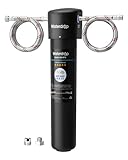
- Less than $35.99 per replacement filter WD-RF15 (Search "B085G78F7R" on Amazon), save over 50% of cost on subsequent use. This replacement filter is designed for long-term use with this under sink water filter system.
- 𝐔𝐥𝐭𝐫𝐚-𝐋𝐨𝐧𝐠 𝐒𝐞𝐫𝐯𝐢𝐜𝐞 𝐋𝐢𝐟𝐞: When used with municipal water, each under sink water filtration system has a maximum service life of 24 months.[1]Before going on vacation, please put the filters in separate sealed plastic bags, and store the bags in your refrigerator (NOT the freezer) to keep it fresh in 30 days. It is specifically designed for municipal tap water and can only be used with cold water sources.It is not suitable for well water or hot water.
- 𝐈𝐧𝐧𝐨𝐯𝐚𝐭𝐢𝐯𝐞 𝐌𝐮𝐥𝐭𝐢𝐬𝐭𝐚𝐠𝐞 𝐅𝐢𝐥𝐭𝐫𝐚𝐭𝐢𝐨𝐧: The Waterdrop Direct Connect under sink water filtration system uses innovative multistage filtration. It can effectively reduce PFAS, PFOA/PFOS, lead, chlorine, heavy metals, chemical iṁpurity, sediment and other large particles.[2] Enjoy pure water straight from your tap – no need to buy bottled water anymore.
- 𝐒𝐨𝐥𝐯𝐞 𝐂𝐥𝐨𝐠𝐠𝐢𝐧𝐠 𝐏𝐫𝐨𝐛𝐥𝐞𝐦:By upgrading the filtration area, our filter now provides a 20X increase in dirt adhesion area, enhancing filtration capability while minimizing the risk of clogging. This design is suitable for long-term use in undersink water filter systems.
- 𝐈𝐀𝐏𝐌𝐎 𝐂𝐞𝐫𝐭𝐢𝐟𝐢𝐞𝐝 𝐅𝐢𝐥𝐭𝐞𝐫: Made from premium BPA-free and lead-free materials, the under sink water filter is certified by IAPMO against NSF/ANSI 372 Standard. Certified by IAPMO against NSF/ANSI 42 Standard, the water filter can effectively reduce chlorine, taste and odor. Tested by a third-party laboratory against NSF/ANSI 53 Standard, it can reduce lead.To look over the 42 & 372 certification, please search "WD-15UA" on the IAPMO website.
A practical design sequence for a new or upgraded supply
- Define the service. Record who needs water, how much is required, when it must be available, whether it is for drinking and cooking, and what interruptions are acceptable. Include residents, visitors, maintenance staff and people with disabilities in the brief.
- Characterize the source. Obtain representative tests for microbial indicators and relevant chemicals, and document seasonal or event-driven changes. Review local sanitary conditions and the legal requirements for sampling and reporting.
- Map hazards from source to tap. Walk the entire route, including intakes, treatment, tanks, pumps, pipes, fixtures and household storage. Note where contamination, loss of pressure, stagnation, flooding or chemical contact could occur.
- Set health-based targets and control points. Decide which hazards must be prevented, removed or inactivated, then identify measurable operating limits for each barrier. Use local authorities’ requirements where they are stricter than international guidance.
- Select technology for the operating context. Compare performance against the identified hazards with energy demand, consumables, skills, spare parts, waste handling, capital cost and life-cycle durability. A technically effective process that cannot be maintained is not a reliable design.
- Protect distribution and building plumbing. Specify suitable water-contact materials, backflow protection, tank security, pressure control, drainage and access for inspection. Keep potable and non-potable networks physically distinguishable.
- Write operating and emergency procedures. Define who checks the system, how results are recorded, when filters or disinfectant systems are serviced, and what happens after a failed test, flood, pressure loss or contamination alert.
- Commission and verify. Flush and inspect new work, test at representative points and confirm that operating staff can perform the required tasks. Independent surveillance should be separate from routine operation.
- Review for resilience. Reassess the plan after climate events, source changes, occupancy changes, equipment failures or repeated complaints. Progressive improvement is preferable to a one-time installation that is never revisited.
Which system pattern fits the project?
No technology is universally the most sustainable. WHO’s comparison axes are more useful than a simple ranking: source hazards, treatment performance, reliability, local resources, distribution integrity, monitoring, life-cycle effects, inclusion, affordability and resilience.
| System pattern | Where it can fit | Decisions that must be verified | Common limitation |
|---|---|---|---|
| Managed public or community supply | Buildings connected to a regulated or organized network | Source protection, treatment controls, pressure, continuity, local compliance and the condition of the service connection | Building occupants cannot control upstream failures; internal plumbing can still introduce risk |
| Building-scale treatment | Projects with a defined source problem or a need for additional treatment before distribution | Design flow, target contaminants, operator skills, energy, residuals, maintenance access and verification sampling | Higher complexity can create failure points if staffing, parts or monitoring are inadequate |
| Household point-of-use treatment | A specific household risk or an additional barrier at the tap | Model-specific health performance, installation, correct use, replacement schedule and disposal of spent media | It treats only the water passing through the device and does not secure the source or building network |
| Rainwater or other supplemental source | Projects where an alternative source is lawful and technically suitable | Catchment hygiene, storage, treatment, drought reliability, cross-connection control and whether the water is potable or non-potable | Quality and availability can vary sharply with weather and maintenance |
The table describes design patterns, not endorsements. Comparative energy use, embodied impacts, service life and cost require project-specific data; the available global guidance does not establish a single “greenest” option.
Choosing a home filtration system without overpromising
Start with a verified water-quality problem. A consumer should obtain a credible test or an authoritative supply report, identify the contaminant of concern, and then check the exact model’s independently documented performance for that contaminant. “Improves taste” is not the same claim as removing a health-relevant chemical or controlling microbes.
An under-sink water filtration system can be practical when the treatment point, flow rate, installation and maintenance fit the kitchen. Check:
- Which contaminants the model has been evaluated to reduce, and under what test conditions.
- Whether the device treats every drinking-water outlet or only one tap.
- Replacement-filter availability, part compatibility, capacity and the manufacturer’s service interval.
- Pressure, drainage, electrical requirements and protection against leaks or backflow.
- How spent cartridges, membranes or other residuals are handled.
WHO’s household-treatment evaluation report, published 18 March 2026, presents laboratory microbial-performance results for 21 products evaluated in Rounds III and IV, bringing the total evaluated under that scheme to 51. Those results show that products can be assessed against defined health-based performance criteria; they are not a blanket recommendation for every product or every contaminant. The U.S. Environmental Protection Agency’s current consumer fact sheet on home drinking-water filtration is another reference for understanding household devices. Neither source endorses a particular commercial model.
Rank #4

- Easy Installation - Easy to install with clear instructions and video. ICEPURE Under Sink Water Filter with super simple plug-and-play install design. It takes less than 3 minutes for the installation and a 2-second filter change. No professional is required. High flow rate, The tested full flow rate is 2.5GPM at 60PSI.
- Authoritative Certifications - ICEPURE Under Sink Water Filter System bears major Authoritative Certifications on markets, such as NSF/ANSI 42 & 372. NSF/ANSI 42 tested reduces Chlorine, Taste, and Odor. 22000 Gallons filter capacity. Significantly improving the taste of drinking water to provide pure-tasting water, while retaining minerals beneficial to the human body. NSF/ANSI 372 Certification for Lead-Free.
- Long Service Life - Tested by NSF/ANSI 42 for large filtration capacity of 22000 Gallons when used municipal water. 3x longer life than other filters, the cheaper most bang for the buck. Recommend replacing the filter every 22000 gallons for 3 Years for better filtration. ICEPURE filters use advanced and precise measurement technology, combined with 3D multi-dimensional design technology to ensure that fully match and do not leak water.
- Premium Materials - BPA-free and Food-grade materials. This filter is made from advanced coconut shell carbon and is Certified by Authoritative Organizations for Materials. The Outer layer is 0.5 Micron, ensuring better filtration. The carbon blocks have been independently tested for heavy metals, large sediments, and all other impurities. With such a high level of filtration, you can be confident that you are drinking clean and clear water.
- Fit 1/2" 3/8" Cold Water Line - Only for cold water line. Directly connect to the original faucet without a countertop hole. Suitable for faucets with 1/2" or 3/8" FEMALENPT thread. For a different connection type, please contact us BEFORE purchase. It can be quickly installed in your kitchen, bathroom, bar, RV, or office to meet daily water needs. Ideal for drinking, cooking, making coffee, pet water, houseplants, humidifiers, skincare, cleaning, etc.
Make sustainability measurable rather than rhetorical
Resource and energy use
Account for pumping, heating, backwashing, replacement media, chemicals, membranes and treatment residuals over the system’s life. A low-energy device that fails frequently may consume more resources through premature replacement than a durable, repairable alternative. Conversely, a high-performance process may be justified where the untreated hazard is severe. The comparison must use the project’s actual flow, operating schedule and service life.
Water losses and residuals
Some treatment processes produce reject water, sludge or spent media. Specify where these streams go and whether disposal is safe and lawful. Repair leaks promptly, meter meaningful zones where practical, and avoid designing storage that encourages unnecessary overflow.
Inclusion and affordability
A system is not sustainable if only the best-resourced users can operate it. Provide understandable instructions, accessible controls, safe collection points and maintenance that does not require specialized travel or expensive proprietary parts. WHO’s compendium treats inclusion as a cross-cutting design concern, alongside life-cycle thinking and resilience.
Free tools Windows power users keep installed
One-click scans. No signup required.
Climate and continuity
Climate change, water scarcity, population growth and urbanization can affect both supply and demand. Design for likely interruptions, extreme rainfall, drought, heat, power loss and changing source quality. Keep emergency storage and communication procedures proportionate to the health risk and the consequences of failure.
Monitoring, maintenance and failure recovery
Monitoring should answer an operational question, not simply generate paperwork. Use routine checks for barrier performance, sanitary conditions and service continuity, supplemented by laboratory testing at points that represent what people actually consume. Independent surveillance provides a separate check on the operator’s records.
Best Value

- [Easy DIY Compatibility] Designed for standard under-sink cold-water connections and municipal tap water. This 3 stage under sink water filter system connects directly to most faucets with 1/2" or 3/8" FEMALE NPT threads. It does NOT reduce TDS and helps retain beneficial minerals. Not suitable for hot water; for well water, use with a pre-filtration system. Need to connect to a quick-connect faucet? Contact Waterdrop for free adapter fittings. No additional faucet is included.
- [Easy Filter Replacement] Replacement filters are easy to find and install. For WD-TSA / TSB 3 stage under sink water filtration system, search B0CM8MHWNT for WD-10PP, B0CM8KV1M9 for WD-10GC, and B0CM8SDWWD for WD-10CT
- [More Filters, Better Taste] This under sink water filter system comes with 3 filters and can realize 8-stage deep filtration to reduce PFAS, PFOA/PFOS, residual chlorine, fluorides, silt, rust, cyst, etc. Its resin reduces fluorides. The CT filter has passed IAPMO certification to reduce residual chlorine and improve taste, thereby ensuring every drop is pure and healthy
- [Note On Flow Rate For Deep Purification] After full 8-stage filtration, purified water flows more slowly than direct tap water. Upgraded in 2026, the PP filter uses larger outer pores and finer inner pores to capture particles step by step, helping reduce clogging and maintain a faster, steadier flow rate. This design ensures sufficient contact time for thorough reduction of PFAS, fluoride, and bad taste, while still delivering a steady stream (max flow 1.5 GPM) that fills a standard 12-oz glass in about 4 seconds
- [No Leaking Or Cracking With Highly Precised Technique] The under sink water filter adopts strong materials with an upgraded design. In addition, the age-resistant and freeze-resistant materials make the system twice thicker. The under counter water filter system for kitchen has also passed 400 psi burst pressure, 100,000+ pulse tests at 150 psi, and static tests at 300 psi. These tests prove that the durable integral design clears up worries about cracking cases and leaking issue
When a result or event indicates a problem, use a defined response:
- Loss of pressure or a suspected backflow: isolate the affected section, prevent use until the risk is assessed, inspect cross-connections and flush or disinfect only under an approved procedure.
- Microbial indicator failure: notify the responsible authority or operator, investigate the source and distribution barriers, and follow local public-health instructions before lifting any advisory.
- Unexpected chemical result: confirm the sample and method, identify the source and water-contact materials, and select treatment only after the contaminant and concentration are established.
- Filter clogging, taste change or reduced flow: check the service interval, installation and source conditions. Do not extend a cartridge’s life merely because water still looks clear.
- Flooding or a damaged tank: keep the affected water out of use, inspect for ingress and structural damage, clean and disinfect according to applicable requirements, and verify quality before return to service.
Design decisions that deserve documentation
For a building or community project, retain a concise water-safety file containing the source description, hazard assessment, drawings, materials schedule, treatment specifications, sampling plan, maintenance responsibilities, emergency contacts and records of corrective actions. Label valves, tanks, filters and sampling points in the finished building so another operator can understand the system years later.
Do these 3 things before closing this tab:
1Fix the driver behind crashes, sound loss and screen glitches2Repair Windows errors before they cause bigger problems3Scan for outdated or missing drivers - takes under a minuteRecord assumptions as well as results: the population served, expected demand, seasonal source conditions, treatment capacity, allowable interruptions and the regulations used. Revisit these assumptions when occupancy, climate conditions, source quality or building use changes.
What a defensible sustainable outcome looks like
The strongest design is one that can explain, in plain language, where the water comes from, which hazards were identified, which barriers control them, how quality is checked, who maintains each component and what happens during a failure. It protects water after treatment as carefully as it treats water before distribution, and it measures sustainability across the full life cycle rather than choosing a technology by marketing claims.
That approach aligns with WHO’s catchment-to-consumer framework while leaving room for local regulation, engineering constraints and community priorities. Clean appearance and a new filter are not substitutes for a protected source, competent operation and independent verification.
Quick Recap

Product prices and availability are accurate as of the date/time indicated and are subject to change. Any price and availability information displayed on Amazon at the time of purchase will apply.
Quick wins for a faster PC:
Scan for outdated or missing drivers - takes under a minuteDriver Scan →Repair Windows errors before they cause bigger problemsFix Now →Fix the driver behind crashes, sound loss and screen glitchesFind Drivers →
