Free tools Windows power users keep installed
One-click scans. No signup required.
ThatPainter is reader-supported. When you buy through links on our site, we may earn an affiliate commission. Learn More
Remove adhesive residue in stages, not with the strongest solvent you can find. First identify whether the surface is a household wall, painted furniture, or a vehicle, and confirm that the paint is cured and sound. Start with a clean, soft cloth lightly dampened with mild soapy water and very little pressure. Test any remover on a hidden spot before treating the visible residue. Stop immediately if color transfers to the cloth, the sheen changes, the paint softens, or the coating starts to lift.
As an Amazon Associate I earn from qualifying purchases.
There is no universal paint-safe solvent. Goo Gone Original lists painted surfaces as compatible but specifically excludes drywall; its instructions require a test, wiping with a clean white cloth, and washing with soap and water afterward. Automotive products have narrower claims: 3M describes its 08984 General Purpose Adhesive Cleaner for most thoroughly cured automotive paint when properly used, with professional-use and spot-test requirements. Those claims do not automatically apply to household wall paint.
Why the surface matters more than the adhesive remover
“Paint” can mean a porous drywall coating, a sealed wood finish, or a multilayer automotive system. A product that is compatible with one may soften, dull, or lift another. Before touching the residue, identify three things: the substrate, the paint’s condition, and the adhesive itself.
#1 Best Overall

- Thick Spray Gel for adhesives: Goo Gone Adhesive Remover Spray Gel, which won a 2026 Good Housekeeping Cleaning Award, clings to surfaces to dissolve tough sticky messes like glue, stickers, labels, tape residue, gum, grease, wax and decals. The gel formula & glue remover works quickly to loosen adhesives for easy wipe-away cleanup.
- Safe on multiple surfaces: Powered by a citrus-based formula, Goo Gone wax and grease remover safely removes adhesive residue from hard surfaces, carpets and fabrics without damaging finishes. Safe for finished wood, sealed stone, glass, metal, plastics, painted surfaces, ceramic and porcelain.
- Versatile home & auto use: Ideal for use throughout the home, kitchen, bathroom, garage, office, classroom, and car. Effectively removes sticky residue from walls, floors, tables, rugs, tools, glassware, upholstery and automotive surfaces.
- Drip-free & easy to use: Simply spray our silicone remover thick gel directly onto the sticky area, let it sit to break down adhesives, then wipe or scrape clean. The non-drip gel provides better control, less mess and targeted application on vertical and delicate surfaces.
- Trusted Goo Gone performance: From labels and glue to crayon, gum and grease, Goo Gone adhesive sprays help remove goo and gunk from surfaces. A trusted adhesive remover brand designed to tackle everyday sticky problems safely and effectively.
Identify the substrate
- Painted drywall or plaster: Treat as the most vulnerable common household surface. Drywall is porous, and Goo Gone Original’s manufacturer explicitly excludes it from the product’s compatible surfaces.
- Painted furniture or finished wood: The paint may be protected by a clear finish, or the apparent paint may be a thin coating over wood or laminate. Do not assume a “painted surfaces” label covers every furniture finish.
- Automotive paint: Compatibility statements from automotive-cleaner manufacturers are written for cured vehicle finishes and specified use conditions. They should not be transferred to walls or furniture.
- Unknown or mixed surfaces: Use the least aggressive method and obtain professional advice if the finish is valuable, historic, freshly applied, or already failing.
Check whether the paint is sound and cured
Look for chalking, flaking, bubbles, cracks, previous touch-ups, or an area that still feels soft or tacky. Fresh, damaged, or unknown paint has less tolerance for moisture, rubbing, and solvents. If the adhesive has pulled up paint, the problem is no longer only residue removal; additional cleaning can enlarge the damaged area.
Classify the residue
A thin film left by a removable label is different from a thick patch of mounting adhesive. Note whether the residue is loose at an edge, rubbery, hard, oily, or spread across a large area. Work on a tiny section first. A method that is manageable for a coin-sized spot may be unsafe over an entire panel.
Use a conservative sequence
The safest general strategy is to increase contact time and product strength only when the finish remains unchanged. The first step below is cautious practical guidance, not a universal manufacturer-certified recipe.
What’s actually slowing this PC down?
Pick the symptom - the matching free tool is one click away.
- Clear and inspect the area. Remove nearby objects and loose dust. Good lighting helps you see whether paint is already missing or whether the adhesive has bonded to a delicate edge.
- Gather clean materials. Use a soft, clean cloth, mild soap, water, a clean white cloth for wiping, and a separate dry cloth. Avoid reusing a cloth that contains grit or another chemical.
- Try a dry, gentle lift only where the residue is already loose. Roll or lift the edge with the cloth or a fingernail protected by the cloth. Do not force a dry scrape across the paint.
- Dampen the cloth with mild soapy water. It should be damp, not dripping. Work from the outer edge of a small spot toward the center with light passes. Do not flood drywall, seams, joints, or unsealed wood.
- Pause and reassess. If the residue is releasing and the finish looks unchanged, repeat short, gentle passes. If the cloth picks up paint, the surface becomes hazy, or rubbing starts to generate heat, stop.
- Spot-test any dedicated remover. Choose an inconspicuous area made from the same finish. Follow the product label exactly, then wait long enough to observe color, gloss, and hardness changes before proceeding.
- Treat only a small section. Keep the product on the adhesive rather than spreading it over clean paint. Use the label’s stated contact time; do not extend it because the residue is stubborn.
- Wipe and complete the required cleanup. Use a clean white cloth to remove loosened residue and product. If the label calls for washing with soap and water, do that with minimal moisture and dry the area.
- Inspect after drying. Solvent-wet surfaces can look temporarily different. Recheck when dry for dulling, softening, color transfer, tackiness, or lifted edges before deciding whether any further work is justified.
What to use on each type of painted surface
| Surface or situation | Most conservative starting point | Documented product route | Important limits |
|---|---|---|---|
| Household painted wall | Soft cloth and mild soapy water, with minimal pressure and moisture | Only a product whose current label explicitly covers the exact wall finish; test first | Do not generalize automotive claims. Goo Gone Original excludes drywall. |
| Vertical painted hard surface | Small-area gentle wipe, keeping moisture controlled | Goo Gone Spray Gel is formulated to cling to vertical surfaces and lists painted surfaces among compatible surfaces; follow its label | Compatibility still requires a hidden-area test and does not establish safety for every wall coating. |
| Painted furniture or finished wood | Dry, soft-cloth lift followed by a barely damp soapy cloth if the finish is sound | Use a remover only when its label covers the specific finish | “Painted surface” is not proof that every clear coat, laminate, or aged finish is compatible. |
| Thoroughly cured automotive paint | Follow an automotive product’s instructions and test an inconspicuous area | 3M 08984 General Purpose Adhesive Cleaner is described for most thoroughly cured automotive paint when properly used | 3M’s technical sheet marks it professional use only and requires compatibility testing. The claim is not for household walls. |
Using Goo Gone products without overextending their claims
Goo Gone Original
The manufacturer’s Goo Gone Original product page lists painted surfaces as safe and says the cleaner is designed not to remove paint. That statement belongs with the page’s conditions: pre-test an inconspicuous area, use a clean white cloth, and wash the area with soap and water after wiping. The same page explicitly says not to use the product on drywall.
For an extra-gooey mess, the directions state that the product may be allowed to sit for 5–10 minutes. Treat that as a label instruction for the product and situation described, not as permission to leave it on an unknown coating for longer. Apply only to a small test area first, keep the product localized, and stop if the finish changes.
Rank #2
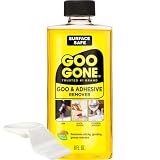
- #1 TRUSTED BRAND FOR REMOVING GOOEY MESSES: Try it on stickers, wax, markers, crayons, glue, tar, window decals, glitter, gum, labels and so much more
- SAFELY RESTORE YOUR SURFACES: The surface-safe formula removes the goo without harming your surface. Formulated with citrus cleaning agents and a pleasant citrus scent
- MULTIPLE USES AROUND THE HOUSE: Everything from wine glass label remover, scuff eraser, windowsill cleaner, adhesive remover, tar cleaner, crayon drawing eraser, to glue remover
- PERFECT FOR TEACHERS AND PARENTS: Use this to remove gum, tape, crayon, and sticker residue left behind by kids
- GREAT FOR COLLECTORS AND THRIFTERS: Safely remove price stickers from gifts, wine glasses, clothing, drinking glasses, vintage collectables and more!
Goo Gone Spray Gel on a vertical surface
The Goo Gone Spray Gel manufacturer page says the gel is designed to cling to vertical surfaces and lists painted surfaces among compatible surfaces. “Painted surfaces” is a broad label category, not a guarantee for every paint chemistry, age, or substrate. Follow the current package directions, test out of sight, and remove the product completely according to the label.
Automotive paint requires a separate decision
For vehicles, use only an automotive product whose instructions match the finish and the residue. 3M’s 08984 General Purpose Adhesive Cleaner technical data sheet says the product will not harm most thoroughly cured automotive paint when properly used. The same February 2019 technical sheet states: “Note: test in an inconspicuous area prior to full application to confirm compatibility.” It also identifies the product as professional use only and not for retail sale.
3M’s Adhesive Remover product page describes a wipe-on, wipe-off formula safe for nearly all cured automotive paint and carries an industrial/professional-use notice. “Nearly all cured automotive paint” is still narrower than “all paint”: it does not cover fresh, failing, unknown, or household coatings. Follow the current label and technical information available in your region.
Spot-testing that actually protects the finish
A spot test is not a quick swipe on the most visible part of the job. Select a hidden area with the same paint and, if possible, the same age and exposure. Put a small amount of the proposed product on a clean white cloth or as directed by the label. Use the intended contact time and wiping motion on an area no larger than necessary. Then remove the product as directed and let the spot dry.
Compare the test area with adjacent paint under the same light. Stop if you see any of the following:
Rank #3
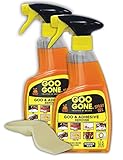
- TRUSTED #1 BRAND FOR REMOVING STICKY MESSES: Try it on gum, crayon, tape residue, glue, pen and much, much more. Removes price tags and product stickers with ease!!
- SAFELY REMOVES GOO FROM YOUR SURFACES: The surface-safe formula removes the goo without harming your surface, so you don't lose the finish, strip away the paint or incur damage while removing a sticky mess
- EASY TO USE CLINGING GEL SPRAY FORUMLA: For adhesive removal specifically formulated to cling to goo and gunk on vertical surfaces giving the product time to break down the adhesive. Let the product sit on the area for a short time, and use a scraper tool or cloth to get rid of your goo
- DRIP-FREE IS THE WAY TO BE: Goo Gone Spray Gel clings to stains and sticky messes while protecting the surface below. This product is thicker than original Goo Gone.
- NATURAL CITRUS CLEANING POWER: Formulated with citrus cleaning agents and a pleasant citrus scent
- Paint color on the cloth beyond the adhesive itself.
- A lighter, darker, cloudy, or uneven patch.
- Loss of gloss or an unexpected shiny spot.
- Softness, tackiness, wrinkling, swelling, or a fingerprint that remains.
- Edges lifting, bubbling, or flaking.
- A spreading stain or residue that is harder to remove than before.
A passing test means only that the tested amount, time, motion, and location produced no visible change. It does not justify soaking the whole surface or using a stronger product without another test.
Do these 3 things before closing this tab:
1Scan for outdated or missing drivers - takes under a minute2Repair Windows errors before they cause bigger problems3Fix the driver behind crashes, sound loss and screen glitchesHow paint condition changes the risk
Fresh paint
Fresh coatings may not have reached their final hardness. Avoid solvent experimentation and vigorous rubbing. If the adhesive is not urgent to remove, ask the painter or coating manufacturer how long the finish should cure before cleaning. If removal is urgent, a painting professional can judge whether touching up is safer than escalating chemicals.
Chalking or weathered paint
Chalking can transfer pigment even with mild wiping. Use a clean white cloth so transfer is visible, keep pressure low, and stop at the first sign that the coating is coming away. A residue-free surface is not worth creating a larger repainting area.
Previously repaired or unknown paint
Patchwork can react differently from the surrounding wall. Test each visibly different coating rather than assuming one test covers the entire surface. If you cannot identify the finish, use only the gentlest approach and consider professional assessment.
Common mistakes and how to recover
Scraping with a blade
Knives, razor blades, and hard scrapers can scratch the coating or catch an edge and lift paint. If you have already made a mark, stop scraping, clean only with a barely damp soft cloth, and assess the damage after drying. Do not try to polish a painted wall with an abrasive pad.
Free tools Windows power users keep installed
One-click scans. No signup required.
Rank #4

- Safely Restore Your Surfaces - The surface-safe formula removes the goo without harming your surface. Formulated with citrus cleaning agents and a pleasant citrus scent
- Trusted #1 Brand For Removing Gooey Messes - Try it on stickers, wax, markers, crayons, glue, tar, window decals, glitter, gum, labels and so much more
- Multiple Uses Around The House - Everything from wine glass label remover, scuff eraser, window sill cleaner, adhesive remover, tar cleaner, crayon drawing eraser, to glue remover.
- Perfect For Collectors and Thrifters - Safely remove price stickers from gifts, wine glasses, clothing, drinking glasses, used video games and much more
Using a rough pad or excessive pressure
Scouring pads and hard scrubbing can change sheen even when they remove the adhesive. Switch to a clean soft cloth and shorter passes. Pressure is not a substitute for a compatible product or adequate label contact time.
Flooding a wall
Liquid can spread beyond the residue, enter seams, or leave a tide mark. Apply moisture to the cloth rather than pouring it onto the wall. Work in small sections and dry promptly.
Leaving a remover on “until it works”
Longer contact is not automatically safer or more effective. Use only the product’s stated dwell time, especially on an unknown coating. If the label does not specify the surface or procedure you need, do not improvise a stronger treatment.
Combining products
Do not mix removers, cleaners, or household chemicals. Residual chemistry can change how the next product affects paint, and mixing makes the reaction impossible to evaluate. Remove one product completely and let the area dry before any separate, label-approved step.
When residue removal should stop
Stop immediately when paint begins lifting, the sheen changes, color transfers, or the coating softens. Blot or wipe away remaining product according to its label; do not add another solvent to “neutralize” it unless the manufacturer specifically instructs you to do so. Photograph the area after it dries so a painter can see the original extent of the problem.
Best Value

- Works On - Stickers, candle wax, permanent marker, crayon, glue, gum, tape residue, adhesive, paint, tree sap, tar and more
- Removes Stickers - Great for removing stickers from your surfaces
- Quick Clean - Perfect for quickly cleaning surfaces without damaging them
- Picks Up Gum - Quickly and easily removes gum and other sticky residues from carpet
- Safe To Use - On carpet, clothing, painted surfaces, plastics, ceramic/porcelain, glass, finished wood, fabric, sealed stone and metals
Get professional help when the adhesive covers a large panel, the finish is historic or expensive, the paint is freshly applied, the substrate is drywall and the residue is extensive, or removal has already exposed the underlying surface. A professional may recommend controlled removal followed by localized preparation and repainting instead of repeated solvent applications.
Cleanup and inspection after the adhesive is gone
Residue can remain as a thin, glossy film even when the obvious lump has disappeared. Follow the selected product’s cleanup instructions exactly. Goo Gone Original directs users to wash the area with soap and water after wiping; use controlled moisture and dry the surface without rubbing aggressively.
Inspect from several angles after the surface is fully dry. Check the boundary between cleaned and uncleaned paint for a halo, uneven gloss, tackiness, or a difference in texture. If the area looks unchanged and feels hard and clean, leave it alone rather than pursuing an invisible trace with a stronger chemical.
Choosing between methods without relying on “strongest”
There is no independent head-to-head test or quantitative damage rate in the manufacturer information used here, so no product can be called objectively safest or most effective for every paint type. Compare an option on the axes that affect your actual surface:
- Surface match: Does the label specifically address your wall, furniture finish, or cured automotive paint?
- Paint condition: Is the coating fully cured and sound, or fresh, chalking, damaged, or unknown?
- Removal control: Can you keep the treatment localized and use a stated contact time?
- Restrictions: Does the product exclude drywall, require professional use, or carry regional label limits?
- Cleanup: Does the label require washing or another final step?
- Reversibility: If the method fails, can you stop without spreading damage?
Use the option that satisfies all six criteria, not the one marketed as the most powerful. If no option clearly matches, gentle removal and professional advice are safer than guessing.
Preventing a repeat residue problem
When replacing labels, hooks, or tape, follow the manufacturer’s removal direction and pull slowly rather than snapping the adhesive away from the paint. Keep a record of the paint brand, sheen, and application date for future repairs. On a rental or recently painted wall, photograph the condition before attaching anything. These steps do not guarantee residue-free removal, but they make a compatible cleanup decision easier and limit the chance that an unknown coating is treated as if it were automotive paint.
Product information can change
Formulas, labels, sale eligibility, and local restrictions can change. The 3M 08984 technical data sheet cited here is dated February 2019; check the current technical sheet and package directions before use. Treat every compatibility statement as limited to the surface, condition, and procedure the manufacturer names.
Quick wins for a faster PC:
Clear out junk files and repair common Windows errorsFree Scan →Scan for outdated or missing drivers - takes under a minuteDriver Scan →Quick Recap

Product prices and availability are accurate as of the date/time indicated and are subject to change. Any price and availability information displayed on Amazon at the time of purchase will apply.

