The Tool Desk
Outbyte PC Repair FREERepair Windows errors before they cause bigger problemsFix Now →Outbyte Driver Updater FREEScan for outdated or missing drivers - takes under a minuteDriver Scan →
ThatPainter is reader-supported. When you buy through links on our site, we may earn an affiliate commission. Learn More
A surprisingly low natural-stone quote is not proof that the stone is bad—and it is not proof that it is a bargain. The only defensible answer comes from matching the identified material to its intended use, exposure, specification, fabrication and installation, then checking evidence for the properties that matter. Ask for representative, reasonably current test reports; evaluate the surrounding wall, floor or anchoring assembly; and obtain project-specific testing when the documentation is missing.
This guide uses US ASTM references and Natural Stone Institute guidance. Building codes, accepted test methods and procurement rules can differ elsewhere, so confirm the requirements that govern your project.
As an Amazon Associate I earn from qualifying purchases.
What a low price can—and cannot—tell you
Price is a commercial number, not a performance test. Two quotes may cover different stone varieties, finishes, thicknesses, fabrication tolerances, packaging, freight, wastage, installation or warranty terms. A lower number may therefore reflect a different scope rather than an inferior product. Conversely, a low quote should not be accepted on trust when the supplier cannot identify the material or substantiate its performance.
Evaluate the exact stone being offered, not a photograph or a generic species name. Color and pattern can vary within a quarry and between lots. Your decision should be based on documented properties and the demands of the finished assembly. ASTM’s active selection guide states that “Natural stone is only one component of a building’s construction. All related materials and assemblies need to be evaluated to ensure compatible interactive behavior with the stone product.” (ASTM C1528/C1528M-26, section 4.1.)
#1 Best Overall
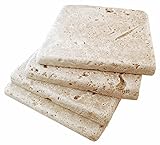
- Tile Dimensions and Construction: 4x4 Tumbled Travertine tile with rounded edges and 3/8 inches thickness
- Natural Stone Characteristics: Rustic look with porous texture and naturally occurring holes, every piece is unique in coloring with inherent variations in color and veining patterns
- Versatile Application: Suitable for walls, trim, and floors in hallways, kitchens, baths, and showers
- Usage Flexibility: Designed for both residential and commercial use
- Premium Quality Selection: Hand selected premium quality natural stone tile
Define the application before asking for tests
There is no universal checklist that certifies every stone for every job. Start by writing down the conditions the material will face. Include whether it is interior or exterior, horizontal or vertical, wet or dry, exposed to weather or de-icing salts, subject to foot or vehicle traffic, carrying loads, or attached with anchors. Include the project specification, required thickness, finish, joint design and installation method.
| Application | Questions to answer | Evidence that may be pertinent |
|---|---|---|
| Exterior cladding | Will the stone face freeze-thaw cycles, driving rain, wind loads, thermal movement or pollution? How will it be anchored? | Absorption and density, strength, anchorage-related information, environmental durability and compatibility of the wall assembly. |
| Interior floor | How much pedestrian traffic, rolling load, dirt and cleaning will occur? Will the surface become wet? | Abrasion resistance, flexural or compressive strength as specified, absorption, finish suitability and slip resistance where people walk. |
| Wet-area floor or stair | Will water, oils or cleaning chemicals reach the walking surface? What finish and drainage are planned? | Slip-resistance testing appropriate to the project, absorption, abrasion and strength. The test method must match the actual finish and use. |
| Interior wall or feature | Is the surface purely decorative, or will panels be large, heavy or mechanically fixed? | Strength, dimensional and anchorage information where relevant. Slip testing is generally not pertinent to a vertical surface that will never receive foot traffic. |
| Counter, hearth or heavily loaded element | What spans, concentrated loads, heat, staining or impact are expected? | Strength, absorption, thermal or chemical considerations and fabrication details required by the design. |
The table identifies questions, not automatic pass/fail requirements. A competent specifier should select the tests from the actual exposure and the governing specification.
Quick wins for a faster PC:
Fix the driver behind crashes, sound loss and screen glitchesFind Drivers →Repair Windows errors before they cause bigger problemsFix Now →Identify the material and collect its documentation
Get a precise material description
Request the commercial and geological name used by the supplier, quarry or processor; quarry location; finish; thickness; lot or shipment identification; and any permitted color or veining range. Ask whether the samples and reports refer to the same source and finish as the offered stone. If the supplier is substituting a similar-looking material, treat it as a new product requiring its own evidence.
Request the reports, not just the numbers
A useful report identifies the laboratory, test method and edition, specimen condition, sample source, test date, individual results and any stated variability. The Natural Stone Institute lists commonly used methods including ASTM C97 for absorption and bulk specific gravity, C170 for compressive strength, C880 for flexural strength, C1353 for abrasion and relevant slip-resistance methods. Its standards page also lists C99 for modulus of rupture, C241 for abrasion resistance and C1354 for anchorage strength; not every method applies to every stone or installation. Review the current project specification and confirm the applicable edition at the Institute’s ASTM standards page.
Rank #2

- 3" x 6" Tumbled natural stone travertine, Creamy light tones, each piece is different from each other
- Aged Surface and edges evoke a simpler time with more depth less fuss
- Real materials last longer and age better
- Perfect for modern farmhouse look or your arts and crafts projects
- 1pc covers 0.125 sqft, 8 pcs cover 1 sqft, 40 pcs cover 5 sqft. Worry free ordering from Squarefeet Depot, if any damage we replace it
Do not treat a single favorable value as a certification of overall quality. Absorption, strength, abrasion, slip and durability answer different questions. A stone can meet one criterion while failing another that matters more for your installation.
Match each test to the risk
| Property or concern | Method named by the Natural Stone Institute | Why it may matter | Limit of the result |
|---|---|---|---|
| Water absorption and bulk specific gravity | ASTM C97 | Helps characterize porosity and density for specified uses and exposure. | It does not by itself establish freeze-thaw, stain, sealant or installation performance. |
| Compressive strength | ASTM C170 | Relevant where the design places compressive loads on the stone. | A compressive value does not predict flexural, anchorage or surface-wear behavior. |
| Flexural strength | ASTM C880 | Important for slabs, panels or pieces that span or experience bending. | Use the specimen orientation, thickness and design conditions specified for the project. |
| Modulus of rupture | ASTM C99 | Another listed strength measure for applicable stone categories. | Confirm that the method and category are required for your stone and assembly. |
| Abrasion resistance | ASTM C241 or C1353 | Helps assess wear on traffic-bearing surfaces. | Results depend on the method and do not replace a review of finish, dirt, maintenance and traffic. |
| Anchorage strength | ASTM C1354 | Relevant to mechanically anchored dimension-stone panels. | Anchor design, edge distances, substrate and installation workmanship remain separate checks. |
| Slip resistance | Project-appropriate slip-resistance method | Important where people walk on a surface that may be wet or contaminated. | Do not order it solely because the stone is natural; it is not needed for a vertical surface with no foot traffic, according to the Institute. |
Ask the architect, engineer or specifier to state the acceptance criteria and test methods in writing. If the project specification names a different or newer edition, that requirement controls the procurement decision.
Windows Errors? Fix Them Before They Spread
Repair common Windows errors and clear accumulated junk for a smoother, more stable PC - no reinstall needed.Free scan · no reinstallOutdated Drivers Are Slowing You Down
One free scan finds every outdated or missing driver and matches the right update for your exact hardware.Free scan · exact hardware matchCheck whether the reports represent the stone you will receive
Verify provenance and sampling
Testing is meaningful only when the specimens represent the offered material. Compare the report’s quarry, lot, finish, thickness and sample description with the purchase quotation. ASTM C1799/C1799M-22 addresses selection, sampling, preparation and conditioning of dimension-stone specimens; its existence underscores why sample provenance and preparation matter. See the official guide at ASTM C1799/C1799M-22.
Check the date without inventing a hard expiration rule
The Natural Stone Institute’s testing-services information says data more than three years old is a reason to consider new testing. That is guidance, not a universal legal expiration date or a guarantee that newer data is automatically representative. Ask what changed since the test: quarry face, processing, finish, supplier, lot or specification. Read the Institute’s description of testing services and its current offerings at Natural Stone Testing Services.
Rank #3

- Easy DIY, Just Peel & stick, cut with tin snip , utility knives or hand saws, saving large amount on labor.
- 3"x6" individual subway tile, plans the layout freely to your imagination
- Waterproof, heat resistant, stain resistant, anti-scratch, high impact, color fadeless, easy to clean, durable
- Suitable surfaces: painted gypsum/dry wall, ceramic tile, linoleum, glass, marble/granite, metal/steel, sealed/polished/painted wood
- Unsuitable surfaces: brick wall, oily glossy painted wall, textured wall and any uneven rough surfaces
Examine laboratory competence
The Institute describes its laboratory as ISO 17025 accredited and says it can perform project-specific testing and provide reports. Treat that as the Institute’s description of its service. For any laboratory, confirm its current scope, the exact method used and whether the accreditation covers that method and material.
A practical due-diligence sequence
- Write the use case. Record location, orientation, wetness, traffic, loads, weather, cleaning exposure, finish, thickness, anchorage and the governing specification.
- Identify the offered stone. Obtain quarry or source, commercial name, finish, lot, sample range and fabrication scope in the quotation.
- Request technical evidence. Ask for complete reports and data sheets, including method editions, specimen details, dates and laboratory identity—not marketing statements alone.
- Map evidence to requirements. Make a line-by-line schedule: each project criterion, the report that addresses it, the result, the acceptance limit and any gap. Mark tests that are irrelevant rather than ordering every possible test.
- Confirm representative sampling. Check that specimens came from the same source and comparable finish and that sampling and conditioning follow the applicable procedure.
- Review age and change history. Use the Institute’s three-year point as a prompt to investigate and retest when appropriate, especially after a source, process or finish change.
- Evaluate the assembly. Review substrate, mortar or adhesive, membranes, joints, fasteners, anchors, drainage, movement accommodation, flashing and workmanship with the design team. Stone performance cannot be separated from these interfaces.
- Resolve gaps before purchase. Have the quarry or representative commission the required tests, use a capable independent laboratory, or select a product with adequate evidence. Put the agreed material identity and acceptance criteria into the purchase documents.
What to do when information is missing
Ask the supplier to identify exactly which required data is unavailable and whether it can obtain new project-specific testing. The Natural Stone Institute describes both testing services and independent laboratory reporting as options. A report commissioned for your project should still be checked for method, sampling, laboratory scope and acceptance criteria.
What’s actually slowing this PC down?
Pick the symptom - the matching free tool is one click away.
If the supplier refuses to identify the source, will not provide representative samples or reports, or offers only an unrelated test, pause the order. The alternative is not to label the stone defective; it is to recognize that suitability has not been demonstrated for an application where evidence is required. For a low-risk decorative use, the design professional may document a different level of verification. For a safety-critical, exposed or code-regulated use, use a material with the necessary evidence.
Independent reader supportYour contribution helps us test, update, and keep practical guides available for everyone.Evaluate the whole project cost without assuming a lifecycle result
Compare quotes on the same basis: stone quantity and thickness, finish, fabrication, edge work, cutouts, crates, freight, breakage allowance, installation, sealers, accessories, testing, warranty and maintenance responsibilities. A lower stone price may disappear when omitted scope is added, but there is no established evidence here that cheaper stone always costs more over its life. Make that a project-specific calculation rather than a slogan.
Rank #4

- The rock plate can let the reptile grind the nail easily.It can be used as a basking platform.
- This Reptile Basking Platform made of high quality rock,which is with hard texture, natural color,the rough edges polished by hand.
- The bottom of the rock slab is designed with four EVA pads to prevent slip .
- The Reptile Basking Platform will absorb water and then slowly volatile, which can improve the humidity of the turtle box.
- Size: 40cm x 25cm
| Decision question | If the answer is clear | If the answer is unclear |
|---|---|---|
| Is the source and lot identified? | Proceed to checking representative reports. | Request identification and matching samples before comparing prices. |
| Do reports address every stated project criterion? | Have the design professional review values against limits. | List the missing tests and obtain them or change products. |
| Are reports representative and suitably current? | Document provenance and dates in the submittal. | Investigate source changes and consider new testing. |
| Are fabrication and installation scopes comparable? | Compare total installed proposals. | Re-price on a common scope; do not compare stone-only numbers. |
| Does the assembly work with the stone? | Coordinate materials, movement and drainage. | Obtain an architect or engineer’s compatibility and detailing review. |
Standards, codes and location
ASTM’s official page lists C1528/C1528M-26, Standard Guide for Selection of Dimension Stone, as active and updated July 15, 2026. Its intended users include architects, engineers, specifiers, contractors and suppliers involved in selecting, specifying, purchasing, fabricating and installing stone. The guide is a US ASTM reference; it does not replace the building code, contract documents or regulations in your jurisdiction.
Confirm current editions and local requirements with the project’s design professional and authority having jurisdiction. Do not assume that a test listed by a US trade organization is mandatory in every country, or that passing an ASTM test automatically satisfies a local code or warranty condition.
Warning signs and constructive questions
Warning signs
- The quote uses only a broad color or trade name and omits quarry, finish, thickness or lot.
- Reports are presented without method, date, specimen description or laboratory identity.
- A report covers a different quarry, finish or product than the offered material.
- The supplier claims one strength or absorption number proves suitability for every use.
- Tests are proposed without reference to the project’s exposure, traffic or specification.
- Missing information is dismissed as proof that testing is never necessary.
Questions that move the review forward
- “Which quarry and lot do these reports represent, and will that source be shipped to this project?”
- “Which acceptance limits and test editions are written into the specification?”
- “What changed since this report was issued?”
- “Which tests address wet traffic, abrasion, anchorage or environmental exposure in this design?”
- “Who will commission and pay for any missing project-specific tests?”
- “What fabrication, installation and maintenance assumptions are included in this price?”
Bottom line for a cheap natural-stone quote
Keep the low quote in contention, but make it earn approval. Identify the material, define the exposure, request complete and representative evidence, choose tests that answer the project’s actual risks, and review the stone together with its anchors, adhesives, substrate, joints and drainage. If required evidence cannot be produced or independently obtained, the responsible choice is to change the product or limit its use—not to infer quality from price alone.
Quick Recap

Product prices and availability are accurate as of the date/time indicated and are subject to change. Any price and availability information displayed on Amazon at the time of purchase will apply.

