Outdated Drivers Are Slowing You Down
Free tools Windows power users keep installed
One-click scans. No signup required.
Outbyte Driver Updater · freeOne free scan finds every outdated or missing driver and matches the right update for your exact hardware.
Scan My Drivers Free →ThatPainter is reader-supported. When you buy through links on our site, we may earn an affiliate commission. Learn More
Wiring an electrical outlet safely is not a matter of matching a universal color diagram. You must identify the circuit, determine whether an equipment grounding conductor is present, choose a receptacle and protection method that fit the installation, de-energize the circuit, and follow the exact device instructions. If the wiring arrangement, grounding status, circuit identification, or instructions are unclear, stop and contact a qualified electrician.
This guide explains the decisions and safety boundaries around outlet replacement in U.S. installations. It is not a complete residential electrical code or a substitute for product instructions, local requirements, training, or professional help.
As an Amazon Associate I earn from qualifying purchases.
Quick wins for a faster PC:
Repair Windows errors before they cause bigger problemsFix Now →Fix the driver behind crashes, sound loss and screen glitchesFind Drivers →Clear out junk files and repair common Windows errorsFree Scan →Why there is no single safe outlet-wiring diagram
Receptacle installations differ. A replacement may be on a grounded branch circuit, an older circuit with no equipment grounding conductor, or a branch that needs ground-fault circuit-interrupter (GFCI) protection. A receptacle-type GFCI may also be intended to protect outlets farther downstream. Those conditions change which device is permitted and how it must be connected.
Wire colors and a generic diagram cannot establish a safe, code-compliant installation by themselves. The function of each conductor must be established from the circuit and the device instructions. OSHA states in 29 CFR 1910.304 that “No grounded conductor may be attached to any terminal or lead so as to reverse designated polarity.” The same standard says, “The grounding contacts of receptacles and cord connectors shall be grounded by connection to the equipment grounding conductor of the circuit supplying the receptacle or cord connector.”
#1 Best Overall
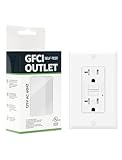
- Certified Safety with US Patent Protection. This GFCI outlet is UL 943 & UL 498 Certified, Class A Rated, ensuring the highest level of ground fault protection. With a 20A/125V/60Hz rating, it’s perfect for both residential and commercial use. Additionally, its US Patent Protected design guarantees unmatched reliability and safety.
- Smart LED for Real-Time Status Monitoring. Featuring a Multi-State LED Display, this outlet provides clear indicators for self-test status, normal operation, fault warnings, and end-of-life alerts. The integrated Test & Reset Buttons allow users to easily check wiring correctness and ensure proper functionality, making it a user-friendly and safety-focused choice.
- Tamper-Resistant and Weather-Resistant Design. Designed with TR & WR Ratings, this outlet protects children from electrical hazards and performs reliably in harsh environments. It has passed the UL Salt Spray Test, ensuring corrosion resistance for outdoor, bathroom, and kitchen use. With an operating range of -30°F to 150°F and up to 95% humidity, it’s built for durability in any condition.
- Advanced Chip for Enhanced Performance. Equipped with an Advanced Chip, this GFCI outlet delivers superior stability, fewer false trips, and faster response times. It detects ground faults at a threshold of less than 6mA and cuts power in under 25ms, providing reliable and efficient protection for your home or workplace.
- Premium Materials for Long-Lasting Reliability. Built with 0.81mm Thick Copper and 0.4mm Silver-Plated Contacts, this outlet ensures efficient current transmission and reduced heat buildup. Its robust construction minimizes plug failure and enhances durability, making it a safer and more reliable choice for everyday use.
Those statements come from a workplace standard, not a complete residential wiring code. Local requirements, the existing installation, and the receptacle manufacturer’s instructions still control the work.
Know what you are deciding before touching the receptacle
Is this a replacement or a new circuit?
Replacing an existing receptacle and creating a new branch circuit are different tasks. A replacement requires you to understand the existing circuit, grounding method, protection, and device arrangement. A new circuit adds questions about circuit design, panel capacity, conductor selection, routing, boxes, and permits that are outside the evidence covered here. Do not treat a replacement explanation as authorization to build a new circuit.
Quick wins for a faster PC:
Repair Windows errors before they cause bigger problemsFix Now →Fix the driver behind crashes, sound loss and screen glitchesFind Drivers →Clear out junk files and repair common Windows errorsFree Scan →Is an equipment grounding conductor present?
A grounding-type receptacle is not made safe merely by having a grounding terminal. Where a grounding means is present, the grounding contacts must connect to the circuit’s equipment grounding conductor. If no grounding means exists in the receptacle enclosure, the permitted replacement choices depend on the applicable rules and installation conditions.
Does the location require GFCI protection?
GFCI requirements depend on the adopted code and location. OSHA’s covered-workplace rule requires GFCI protection for specified 125-volt, single-phase, 15- and 20-ampere receptacles in bathrooms or on rooftops. That is not a complete list of residential locations that may require GFCI protection. Check the rules adopted where the work is located.
Can you identify the circuit and verify it is de-energized?
Do not begin conductor work if you cannot confidently identify the circuit and use a suitable method to verify that power is off. A GFCI is not a substitute for de-energizing and careful work practices. If you cannot make that determination, stop and call a qualified electrician.
Rank #2

- 15 amp Non-Tamper Resistant Ground Fault Circuit Interrupter (GFCI) outlet receptacle for indoor use. Please kindly check if the depth of electrical box can fit our GFCI outlets before purchasing.
- The indicator light will turn On GREEN once the power is ON. Press the RESET button to restore power to the GFCI outlet. The LED indicator keeps GREEN no matter you press the RESET or TEST button.
- The ETL certification is a sign of a better quality product. This product has gone through many test procedures before getting its approval which makes it the safest GFCI.
- Back and side wired for easy installation. Decorator wall plate and screws included. Caution: Do not unscrew the terminal screws too far or with excessive force. Do not use power tools to loosen the terminal screws.
- 15A/125V/1875W. Wallplate Included, ETL Listed
When a qualified electrician is the right next step
The U.S. Consumer Product Safety Commission (CPSC) says installation of a receptacle-type GFCI is for people with adequate knowledge and skill who follow the device instructions. Its consumer fact sheet states: “When in doubt about the proper procedure, contact a qualified electrician; do not attempt to install it yourself.”
- The circuit cannot be identified or safely de-energized.
- You do not know whether an equipment grounding conductor reaches the box.
- The existing wiring does not match the device instructions.
- You are unsure whether the receptacle is the first device or a downstream device on the branch.
- You are considering a GFCI replacement where the grounding means is absent.
- The receptacle is in a location with requirements you cannot verify.
- A GFCI test produces an unexpected result, will not reset, or repeatedly trips.
- You discover conditions that require work in the service panel or changes to the branch circuit.
A safety-first workflow for an outlet replacement
The sequence below is a decision process, not a universal terminal-by-terminal wiring recipe. Do not skip a step simply because the receptacle appears familiar.
- Classify the job. Decide whether you are replacing an existing receptacle or proposing a new circuit. Record the receptacle’s voltage and ampere information, the room or outdoor location, and whether the device is ordinary or GFCI-protected.
- Read the exact device instructions. Use the instructions supplied for the receptacle. They identify the permitted wiring arrangement, terminal designations, testing method, and any limitations. A Schneider Electric X Series GFCI receptacle, for example, has a product-family-specific installation and testing sheet identified as document GDE77951, version 05, dated August 7, 2026. That document applies to that product family, not to every receptacle.
- Establish the circuit and grounding status. Determine which branch circuit supplies the box and whether an equipment grounding conductor is present. Do not infer this solely from insulation color or from the presence of a ground-shaped opening on the face of the receptacle. If the status is uncertain, stop.
- Plan de-energization and verification. De-energize the circuit using a method appropriate to your training and installation, then verify the absence of voltage with suitable equipment before touching conductors. A simple receptacle tester or a GFCI indicator cannot by itself prove that every conductor is safe to touch. If you cannot verify the condition, obtain qualified help.
- Compare the existing arrangement with the new device. Count the conductors, note how the existing receptacle is supplied and whether other outlets may be downstream, and compare those facts with the instructions. Do not disconnect conductors until you understand which device terminals and arrangement the instructions require.
- Resolve grounding before making connections. If an equipment grounding conductor is present, the grounding contacts of a grounding-type receptacle must connect to it. If no grounding means exists, do not improvise a connection to a neutral conductor or another object. The applicable replacement options must be checked against local rules and the actual installation.
- Make connections exactly as the instructions show. Use the device’s terminal designations and arrangement. For a GFCI receptacle, an incorrect supply or downstream arrangement can leave the intended outlets unprotected or prevent the device from operating correctly. Do not rely on memory, a color-only diagram, or a receptacle that looks similar.
- Reassemble and test as directed. Restore power only after the device is installed according to its instructions. Perform the manufacturer’s required test and any GFCI test described below. If the result is not what the instructions predict, de-energize the circuit and contact a qualified electrician.
Grounding and replacement choices
When an equipment grounding conductor is present
For a grounding-type receptacle, the grounding contacts must be connected to the equipment grounding conductor of the circuit supplying the receptacle. This is the grounding path the OSHA rule addresses. A receptacle’s grounding contact does not create a grounding path on its own.
When no grounding means is present
OSHA’s 29 CFR 1910.304 describes limited replacement options for covered workplace installations where no grounding means exists in the receptacle enclosure. Depending on the applicable case, those options include another nongrounding receptacle or a GFCI-related replacement with the required “No Equipment Ground” and “GFCI Protected” markings.
Do not generalize those workplace provisions into a complete residential code guide. Whether an option is permitted depends on the jurisdiction, the circuit, the receptacle location, and the exact replacement. A GFCI can provide ground-fault protection, but it does not create an equipment grounding conductor. If you cannot establish which option applies, stop and seek qualified help.
The Tool Desk
Outbyte PC Repair FREEClear out junk files and repair common Windows errorsFree Scan →Outbyte Driver Updater FREEScan for outdated or missing drivers - takes under a minuteDriver Scan →Rank #3

- ✅1. Smart Protection, Anywhere You Need It Keep your home safe from electrical hazards with our GFCI outlet 20 amp WR TR white. Instantly detects ground faults to prevent shocks and fire risk. Tamper resistant outlet and weather resistant outlet for secure indoor and outdoor use—ideal for kitchens, bathroom GFCI outlet upgrades, garages, and patios. Designed for NEC code compliance, UL listed, and comes with a matching wall plate—offering reliable protection where it matters most.
- ✅2. Built to Fix What Others Get Wrong No more defective outlets or confusing installs. Our self test GFCI is pre-wired for clarity, features spacious terminals, and ships fully quality-checked—eliminating the #1 issue in competitor reviews. Durable WR/TR housing resists moisture and cracking. Trusted by electricians, designed for homeowners, and built to perform from day one as a dependable GFI electrical outlet.
- ✅3. DIY-Friendly Install with Peace of Mind Hate wiring frustration? We've simplified it. Includes labeled terminals, easy-to-follow instructions, and mounting hardware for a seamless install—no electrician required. Whether you're replacing one outlet or doing a home upgrade, this 20 amp GFCI outlet fits 20A circuits, supports back and side wiring, and is perfect for tight or older outlet boxes. A top choice for any GFI outlet install.
- ✅4. Answers Built Into Every Feature This GFCI outlet includes a test/reset button, 125V rating, safety shutoff, and LED indicator so you always know it’s working. Fully tamper resistant for child safety and approved for wet locations like bathrooms or garages. Whether you're a homeowner or first-time installer, this GFCI outlet 20 amp is designed for both safety and clarity. Made of high-impact thermoplastic and ideal as an outdoor GFCI outlet.
- ✅5. TR & WR Explained—Why It Matters TR means tamper-resistant: it protects little fingers from accidental shocks. WR means weather-resistant: it guards components from rain, humidity, and corrosion. These are required for GFCI outlets in outdoor or wet areas. Our GFI electrical outlet 20 amp white includes both—giving you peace of mind indoors and out, and helping you pass inspections with confidence.
Polarity matters
Correct polarity is part of a safe installation. OSHA expressly prohibits attaching a grounded conductor to a terminal or lead in a way that reverses designated polarity. Treat terminal identification in the device instructions as controlling, and do not assume a conductor’s insulation color proves its function.
What GFCI protection does—and does not do
A ground-fault circuit interrupter compares the current flowing to equipment with the current returning from it. OSHA describes interruption when the difference is approximately 5 milliamperes and says the device is designed to shut off power from a ground fault within as little as 1/40 of a second.
That protection is valuable, but it is limited. OSHA also explains that a GFCI does not protect against every line-contact hazard, such as holding two energized wires or contacting an overhead power line. It is not permission to work on an energized circuit and not a substitute for de-energizing, verification, and careful work practices.
Receptacle-type GFCI
A receptacle-type GFCI can protect the receptacle itself and may protect a series of outlets downstream on the same branch when it is installed in the appropriate arrangement. The device instructions determine how the supply and any downstream conductors are to be connected. An incorrect arrangement can defeat the intended downstream protection or prevent proper operation.
Circuit-breaker-type GFCI
CPSC distinguishes a GFCI circuit breaker by describing it as protecting the branch circuit supplied by that breaker. Choosing between a receptacle device and a breaker device requires checking the existing panel and wiring, the protection scope needed, the instructions for the specific product, and whether qualified installation is required.
Rank #4

- 20 amp Non-Tamper Resistant Ground Fault Circuit Interrupter (GFCI) outlet receptacle for indoor use. Please kindly check if the depth of electrical box can fit our GFCI outlets before purchasing.
- Ultra slim design profile easily fits in electrical box and wall plate. Easy Installation with back or side wiring. Standard wall plate, screws and installation instructions included.
- The ETL certification is a sign of a better quality product. This product has gone through many test procedures before getting its approval which makes it the safest GFCI.
- The indicator light will turn On GREEN once the power is ON. Press the RESET button to restore power to the GFCI outlet.
- 20A/125V/2500W. Wallplate Included, ETL Listed. Caution: Do not unscrew the terminal screws too far or with excessive force. Do not use power tools to loosen the terminal screws.
| Protection type | Protection scope described by CPSC | Decision points |
|---|---|---|
| Receptacle-type GFCI | The receptacle itself and, when installed in the appropriate arrangement, outlets downstream on the same branch | Confirm the device instructions, supply and downstream arrangement, grounding status, and local requirements |
| GFCI circuit breaker | The branch circuit supplied by the breaker | Confirm compatibility with the existing panel and wiring, follow the breaker instructions, and use qualified help when the panel work or circuit arrangement is uncertain |
How to handle GFCI testing
Test after installation
CPSC’s GFCI fact sheet recommends testing after installation. Use the test procedure specified by the manufacturer. The expected response for a receptacle-type GFCI is that the device indicates an off condition and disconnects power from the protected circuit.
Test monthly
CPSC’s home wiring guide recommends pressing the GFCI TEST button monthly. The unit should indicate that it has tripped and should disconnect power from the protected circuit. Reset it only as directed by the manufacturer after the test.
Test after a power failure and as instructed
The CPSC fact sheet also recommends testing after a power failure and according to the manufacturer’s instructions. The manufacturer’s directions take priority for the exact product, including any indicator behavior, reset sequence, or additional test requirement.
When a test fails
If pressing TEST does not produce the expected result, CPSC advises contacting a qualified electrician to correct wiring or replace a defective device. Do not keep using an outlet merely because it still supplies power; failure to trip is an indication that the protective function has not been demonstrated.
Common mistakes and why they are dangerous
Using a color-only diagram
Color conventions do not identify every condition in an existing installation. A conductor may be misidentified, the box may have no equipment grounding conductor, or the receptacle may be part of a downstream GFCI arrangement. Use the circuit information and the device instructions, not color alone.
Best Value

- Designed to improve immunity for reduced High Frequency (HF) nuisance tripping. providing increased compatibility with appliances and other electronics
- Continuously protects against electric shock & electrocution by interrupting power if a ground-fault is detected
- Required by the NEC for areas around the home within a close proximity to a water source (kitchen, bathroom, laundry room, basement, garage/carport, pool area)
- Patented reset/lockout feature prevents reset if the GFCI is unable to respond to a ground-fault or if it isn't wired properly. Regularly conducts an automatic self-test to ensure safety
- LED indicator provides simple, intuitive feedback on power and protection status
Assuming a GFCI creates a ground
A GFCI detects a current imbalance and interrupts power; it does not add an equipment grounding conductor. Where the grounding means is absent, required markings and replacement rules still matter.
Connecting a GFCI without identifying the supply and downstream conductors
Receptacle-type GFCIs can extend protection to downstream outlets only when installed in the appropriate arrangement. If the supply and downstream conductors are not identified, stop rather than guessing.
Windows Errors? Fix Them Before They Spread
Repair common Windows errors and clear accumulated junk for a smoother, more stable PC - no reinstall needed.Free scan · no reinstallOutdated Drivers Are Slowing You Down
One free scan finds every outdated or missing driver and matches the right update for your exact hardware.Free scan · exact hardware matchTreating a receptacle tester as proof of safe contact
The reviewed safety material does not establish a complete de-energization procedure or endorse a particular tester. A voltage tester may be a useful tool category, but a simple receptacle indication does not by itself prove that all conductors are safe to touch. Follow a verification method appropriate to your training, or use a qualified electrician.
Relying on the GFCI while working energized
GFCI protection is designed for a ground-fault condition and does not cover every line-contact hazard. De-energize and verify before handling conductors.
Location and code limits you must check locally
OSHA’s 29 CFR 1910.304 is a workplace standard. It addresses grounding-type receptacles on covered 15- and 20-ampere branch circuits and specifies GFCI protection for certain 125-volt, single-phase receptacles in bathrooms or on rooftops within that workplace context. It is not a complete residential installation code, and it does not establish every permit, inspection, licensing, or location requirement in every U.S. jurisdiction.
Before replacing a receptacle, check the requirements adopted by the authority having jurisdiction and the instructions for the exact device. If the location, circuit rating, grounding method, or required protection is unclear, qualified local help is the safe choice.
What’s actually slowing this PC down?
Pick the symptom - the matching free tool is one click away.
A practical stop-and-check decision tree
- Known circuit and known device? If you cannot identify the branch circuit, receptacle type, or circuit rating, stop.
- Known grounding status? If you cannot establish whether an equipment grounding conductor is present, stop.
- Known protection requirement? If the location may require GFCI protection and you cannot determine the applicable rule, stop.
- Instructions match the installation? If the conductor arrangement does not match the device instructions, stop.
- Power verified off? If you cannot verify de-energization with a suitable method, stop.
- Test result correct? If the installed device does not test and reset as instructed, de-energize and call a qualified electrician.
What to record for an electrician
If you stop, provide the electrician with the receptacle location, the device type and markings, the branch-circuit information you can identify, whether other outlets lose power when the circuit is switched off, the presence or absence of an equipment grounding conductor if known, and any GFCI test behavior. Do not remove additional devices or alter the panel to gather information.
Final safety perspective
A correctly wired outlet is the result of matching the receptacle, grounding method, protection, circuit arrangement, and local requirements—not of copying a generic diagram. Grounding contacts must use the equipment grounding conductor when one is present; GFCI protection must be installed in the arrangement specified for the device; and testing must produce the expected result. When any of those facts is uncertain, the safest and most code-conscious action is to stop and contact a qualified electrician.
Quick Recap

Product prices and availability are accurate as of the date/time indicated and are subject to change. Any price and availability information displayed on Amazon at the time of purchase will apply.

