Windows Errors? Fix Them Before They Spread
Repair common Windows errors and clear accumulated junk for a smoother, more stable PC - no reinstall needed.Free scan · no reinstall
Outdated Drivers Are Slowing You Down
One free scan finds every outdated or missing driver and matches the right update for your exact hardware.Free scan · exact hardware match
ThatPainter is reader-supported. When you buy through links on our site, we may earn an affiliate commission. Learn More
Electroplating jewelry uses electric current to deposit a thin layer of metal from a prepared solution onto an existing piece. The finished object remains a base material with a metal coating—not solid gold or silver throughout. A good result depends on choosing compatible chemistry, preparing the surface carefully, and controlling how current reaches the piece.
What electroplating does—and what it does not
In electroplating, the jewelry is connected as the negatively charged cathode and placed in an electrolyte containing ions of the metal to be deposited. A positively charged anode completes the circuit. A battery or rectifier supplies direct current; metal ions gain electrons at the workpiece and form a coating on its surface. Some baths contain additives intended to improve smoothness or brightness. The Electrochemistry Encyclopedia’s explanation of electrodeposition describes this basic mechanism.
Quick wins for a faster PC:
Clear out junk files and repair common Windows errorsFree Scan →Scan for outdated or missing drivers - takes under a minuteDriver Scan →As an Amazon Associate I earn from qualifying purchases.
Electroplating coats an existing object. Electroforming is related but serves a different purpose: it builds a metal shell over a mandrel or model, which can then be removed to leave a hollow form. The distinction matters when choosing a process for a design; electroforming is not simply another name for plating a finished piece. See the jewelry-sector training handbook.
Why plate jewelry, and what finish to expect
Plating can change a piece’s surface color, provide a decorative finish, add a surface layer intended to protect or improve appearance, or cover solder seams and similar flaws. Rio Grande describes these uses in its April 18, 2021 jewelry-plating guide, including applications in bridal work and repair.
#1 Best Overall

- 【Pen Plating Machine】The gold plating machine adopts a professional pen design, which can conveniently carry out local plating operations, and pays more attention to the control of details.
- 【Strong Conductivity】Conductive connecting wire is made of quality material, strong conductivity, 3A output current, 2.0-13.0v output voltage, stable performance.
- 【Partial Plating】The output current of the machine can be controlled, repair surface restoration, Can be used for gold, silver, copper plating decoration, easy to learn and practical, reduce waste.
- 【What Can You Get】The gold plating kit contains 1 host (with 3 cups), 1 power cord, 1 anode and cathode connection wires (with 2 accessories), 2 connection wires (with clips), 1 cup container (with 4 cups), an English instruction manual.
- 【Service Guarantee】We trust our products and provide satisfactory support, if you have any problems or questions, please contact us, we are happy to help you within 24 hours!
A coating is not a substitute for sound surface preparation or repair. Plating is not a dependable way to hide scratches, pits, or dents; those defects remain visible through the finish. The coating’s thickness and uniformity also depend on more than time in the bath: the piece’s shape and the distribution of current matter. Sharp corners tend to collect more deposit, while recessed areas may receive less, according to the electrochemistry reference.
The Tool Desk
Outbyte Driver Updater FREEScan for outdated or missing drivers - takes under a minuteDriver Scan →Outbyte PC Repair FREEClear out junk files and repair common Windows errorsFree Scan →Choose chemistry for the substrate
The base metal affects whether a desired coating can be applied directly or needs an intermediate layer. Compatibility is specific to the bath formulation; a supplier’s compatibility statement should not be treated as a rule for every plating solution.
Rank #2

- Contains Pure Silver
- Permanent results - no chips or flakes
- Easy to use and includes an anti-tarnish agent
- Leaves a brilliant shine
- Water based, biodegradable, non-toxic, phosphates, nitrates and solvent free
For example, Caswell’s current catalog says its 24 ct gold solution plates directly onto tin, copper, brass, bronze, nickel, silver, and most lead-free solders. It says some alloys need copper or nickel first, and steel needs nickel first. Those statements apply to that named product, not to gold plating in general. Check the relevant solution’s instructions for the exact alloy and preparation requirements. Caswell lists its products in its electroplating kits catalog.
Prepare the piece before plating
Jewelry can carry skin oils, cosmetics, dust, oxidation, and polishing residues that interfere with adhesion or finish. Clean thoroughly before plating and follow the preparation sequence specified for the substrate and bath system. Heimerle + Meule’s jewelry gold-plating guide identifies ultrasonic cleaning as an effective approach and discusses electrolytic degreasing as an early process stage.
Rank #3

- 【EFFICIENT OPERATION】This is an efficient jewellery electroplating instrument that can effectively perform jewellery plating work, gold plating/silver plating, and surface repair work, and multi-purpose instruments.Package includes 1*15V2A plating machine,1*Titanium mesh ,1*Waterline,2*Alligator clip.
- 【Technical Parameter】Positive (+): Titanium mesh negative (-): Jewelry,Maximum adjustable voltage: 20V,Maximum adjustable current: 2.0A,Temperature: 30-40.C,Gold plating time: 90-120 seconds,(Note)Electroplating items need to be shaken at the beginning.
- 【Precise & Adjustable Gauge】The front has a clear dial display that clearly reflects the current voltage and current, easy to read and use, and stabilizes the output voltage.
- 【Easy-to-operate Panel】The voltage is adjustable, you can adjust the according to your need. Large displacement cooling port on the side, porous heat dissipation is not hot.
- 【HIGH QUALITY MATERIALS】Conductive connecting wire is made of quality material, feel comfortable, strong conductivity. Human contact will not cause electric shock, and it is safe and reliable.
Preparation is system-dependent: a sequence suitable for one metal or bath may not be suitable for another. Follow the supplier’s full process instructions rather than assuming that cleaning alone is enough.
Do these 3 things before closing this tab:
1Scan for outdated or missing drivers - takes under a minute2Repair Windows errors before they cause bigger problems3Fix the driver behind crashes, sound loss and screen glitchesSet up and run the process carefully
A typical tank arrangement includes a compatible electrolyte, an anode, the workpiece connected as the cathode, and a controlled DC supply. Depending on the system, jewelry work may also call for racks or fixtures, clean nonmetal tanks, rinse containers, and preparation solutions. Correct anode selection, a dependable electrical contact, and a clean working area all matter. Keep plating work separate from polishing equipment and debris, as advised in the Heimerle + Meule guide.
Rank #4

- Material: The conductive connection line of the gilding machine is made of high quality material with strong conductivity and comfortable feel. With a dial display, easy to read and use, you can adjust the voltage as needed.
- Parameters: Adjustable as required: adjustable voltage 20v, adjustable current 2.0A. Temperature 30-40℃, plating time 90-120 seconds, positive (+): titanium net negative (-) frequency: 50/60hz
- Electroplating items need to be shaken at the beginning, the recommended gold-plating time :90-120 seconds
- Compact design: Jewelry gilding machine is small in size, light in weight, easy to carry and easy to use.
- Note: All silver salt, electrolytic cleaning salt, beaker cleaning must use pure distilled water.
Do not treat a generic voltage or plating time as a universal recipe. Deposition time influences thickness, but bath chemistry, substrate, geometry, current distribution, and the product’s operating directions also affect the result. Use the kit’s specified bath description, sequence, and settings. A jewelry electroplating kit is one possible way to obtain a matched set of components; check its contents and substrate compatibility rather than assuming every kit suits every piece or scale. Caswell’s catalog provides one example of a specialized tank-plating setup.
- Identify the base metal. Confirm the alloy as closely as possible, then check whether the chosen bath supports direct plating or calls for an intermediate layer.
- Read the product directions and safety data sheet. Confirm preparation steps, equipment, operating sequence, required PPE, ventilation, rinsing, and spent-solution handling before opening or using the bath.
- Prepare and clean the workpiece. Remove residues using the method appropriate to the piece and the supplier’s process.
- Connect and position the piece as directed. Establish reliable electrical contact and arrange the anode and workpiece so the shape can receive the intended coverage.
- Plate, rinse, and inspect. Follow the product’s operating directions and rinse thoroughly after each operation. Inspect the result, paying particular attention to corners and recessed areas where coverage may differ.
Safety, rinsing, and spent solutions
Plating baths and rinse water should be treated as process chemicals, not ordinary household liquids. Indiana’s Department of Environmental Management warns that electroplating wastewater can contain highly toxic cyanide, cyanide complexes, and metal ions. California’s Department of Toxic Substances Control likewise notes that spent jewelry-manufacturing solutions may be corrosive and may contain dissolved metals or cyanide. See the agencies’ guidance on plating compliance and waste and jewelry-manufacturing waste.
Best Value
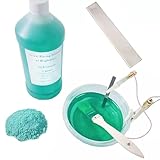
- Nickel electroplating involves depositing a layer of nickel onto a metal part. It serves various purposes, including decoration, corrosion resistance, wear resistance, and salvaging worn or undersized parts
- The part to be plated must be clean and free of dirt, corrosion, and defects
- Cleaning, masking, pickling, and etching are used to prepare the part
- The piece is immersed in an electrolyte solution and serves as the cathode
- Nickel ions (Ni²⁺) are dissolved from the nickel anode and deposit onto the cathode
- Use the PPE and ventilation specified for the actual product; work in a well-ventilated area or under an extractor hood when directed.
- Keep solutions identified and controlled, follow the product’s rinsing instructions, and prevent spills.
- Consult the safety data sheet and local hazardous-waste authority about disposal. Do not assume any bath or rinse can go down a drain; chemistry, quantity, and local rules determine the appropriate route.
Industrial regulatory guidance is not automatically a household disposal guide. The U.S. EPA’s electroplating effluent guidelines address regulated facilities and wastewater rules, not every home-studio situation. NIOSH’s electroplating-shop guidance focuses on industrial chrome-plating hazards and is dated 1975, last reviewed March 30, 2017; it should not be generalized to every jewelry bath or substituted for current, product-specific controls.
Quick Recap
How to decide whether plating fits the job
- Substrate: Verify direct compatibility and any required underlayer for the specific solution.
- Purpose: Decide whether you want a changed surface color or finish on an existing piece, or a hollow form built over a removable model.
- Geometry: Consider how corners, recesses, anode placement, and current distribution may affect even coverage.
- Setup: Match the bath, power supply, anode, fixtures, and handling steps to the product’s instructions and the scale of the work.
- Safety and waste: Make sure you can meet the product’s PPE, ventilation, rinsing, and disposal requirements before starting.

Product prices and availability are accurate as of the date/time indicated and are subject to change. Any price and availability information displayed on Amazon at the time of purchase will apply.




