What’s actually slowing this PC down?
Pick the symptom - the matching free tool is one click away.
ThatPainter is reader-supported. When you buy through links on our site, we may earn an affiliate commission. Learn More
As an Amazon Associate I earn from qualifying purchases.
For recurring puddles, soggy grass, erosion, or runoff moving toward your house, start with a qualified residential drainage or grading contractor—often a landscape contractor who routinely designs and installs drainage systems. Ask for a site diagnosis, a written scope, the proposed discharge point, maintenance requirements, and examples of similar work. Bring in a civil engineer when regrading is extensive, slopes are complicated, runoff crosses properties, or the outlet and system design are difficult. If the area stays wet for months or regardless of rain, investigate a leaking pipe, irrigation fault, spring, pond, pool, or high groundwater before paying for a drain.
Quick wins for a faster PC:
Clear out junk files and repair common Windows errorsFree Scan →Scan for outdated or missing drivers - takes under a minuteDriver Scan →Which expert fixes a yard drainage problem?
The right professional depends on the water’s source and the scale of the work. A drainage contractor can diagnose common residential problems and install grading, swales, catch basins, French drains, or other systems. A civil engineer is appropriate when the project changes substantial site drainage or involves complex grades, soil stability, shared runoff, or a difficult legal discharge. A plumber or leak-detection specialist is the better first call when wetness does not follow rainfall and a supply line, fixture, irrigation pipe, or outdoor faucet may be leaking. For basement seepage, foundation cracks, or persistent dampness, contact a foundation-drainage or waterproofing professional, with engineering input if structural or site conditions are complex.
#1 Best Overall

- Low-Profile Drainage System: This trench drain is designed for lawns, gardens, farms, patios, pool sides, offices, driveways, and indoor factory areas, helping keep channels aligned during concrete pouring without the need for additional anchoring
- Quick Installation: The channel drain sections connect to extend the length as needed, with an interlocking design keeps joints tight to reduce leakage. The detachable grate installs by hand without screws, allowing easy access when clearing debris
- Multiple Outlet Connection Options: Each drainage trench features multiple bottom outlet sizes, allowing you to select that fits your setup. The built-in outlet connector reduces the need for extra accessories and connects directly to your piping system
- Strong Build With Smooth Flow: Constructed from sturdy HDPE plastic, this system includes a sturdy drainage grate with a smooth inner surface that helps water flow efficiently for faster drainage while supporting a A125 load rating
- Complete Package Content: This drainage grate kit includes 6 channels with built-in bottom outlets, 6 plastic grates, and 6 end caps, with built-in outlet connectors included so all the parts you may need are in the box
Oklahoma State University Extension’s guidance says a qualified landscape contractor, including one who specializes in grading land surfaces, may be needed for urban drainage work. Its publication also advises homeowners to compare proposed solutions, costs, effectiveness, completion time, maintenance, and examples of comparable projects.
Call a drainage or grading contractor first when
- Puddles remain for several days after ordinary rain.
- A lawn is muddy, eroding, or visibly lower than surrounding ground.
- Surface water flows toward the house, garage, patio, or retaining wall.
- A downspout concentrates water in one problem area.
- You need a French drain, swale, catch basin, regrading, or other residential stormwater work.
Call a civil engineer when
- Large areas must be regraded or a major slope will change.
- Runoff crosses a property line or several structures share one drainage route.
- The site has unstable soil, retaining walls, steep grades, or no obvious outlet.
- A contractor cannot show how the proposed system was sized or where it will discharge.
- Local officials require engineered plans, or the project affects a public roadway or storm system.
Call a plumber or leak specialist when
- The wet spot is present in dry weather or stays wet for months.
- Water use or a utility meter rises unexpectedly.
- The location is near an irrigation line, pool, pond, outdoor faucet, sewer, or water-service route.
- The wet patch is uphill or separated from the apparent source; underground leaks can travel before surfacing.
Call a foundation professional when
- Water enters a basement or crawlspace.
- You see foundation cracks, efflorescence, peeling finishes, leaks, or a persistent musty odor.
- Surface drainage improvements have not stopped water at the foundation.
Why a wet yard does not identify the cause
The same symptom can come from very different conditions. A low spot may collect rain because the finished grade has settled. Dense or compacted soil may absorb water slowly. A downspout may discharge onto already saturated ground. A blocked inlet or culvert may back water up. Those are surface-drainage problems, but a constantly wet patch can instead indicate a broken water line, leaking irrigation, a spring, a pond or pool leak, or naturally high groundwater.
Rank #2
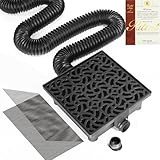
- 🏆【US Patented Design】 Patent No. D1018796.
- 🏆【Material Introduction】Catch basin and "Flexible/ Shapeable Pipe" is made of premium PP To ensure high strength while maintaining high shrinkage, Pipe can extension from 2 .5ft to 8ft. Can be spliced for longer length. Durable, antifreeze explosion proof and no creases, no hole, won't be damaged, andUV resistant to withstand all outdoor elements. Buried underground will not corrode.
- 🏆【NAACOO Unique Design】①Catch basin has double drain holes, improves efficiency. 8Ft Pipe can be cut into two use for drainage on both sides. If you only need one side drain, the other side can be blocked with provided Blockage. ②Catch Basin Special Slope Design - Won't accumulate water and dirt. and Blocked side will not leak water. ③Flexible pipe can be extended and shortened flexibly according to your needs. easily divert rainwater where you want.
- 🏆【Other Advanced Design】①No digging required, Different from traditional catch basin. ②Low profile design can be hidden by covering with mulch. ③Pipe install on catch basin never fall off. ④Debris Catcher Included:GRATE - filter large leaves or some other debris to prevent the block to the pipe, GIFT SCREEN - use for smaller imperities. meet your more needs. ⑤Flexible pipe holds its shape to Adapt more complex environment, and pipe can be spliced for longer length.
- 🏆【Widely Used】High compatibility can be suitable for 2X3 inch, 3x4 inch and 3x3 inch downspout(all standard residential downspouts). This flexible gutter pipe can extension and holds its shape and can be extended from 2.5feet to 8feet. So as to meet any environment needs. prevents foundation damage by diverting rain water around landscaping, Solve difficult irrigating garden and so on.
Duration is a useful clue, not a diagnosis. Fairfax County and the Northern Virginia Soil and Water Conservation District describe a yard that dries within a day or two after rain as generally normal; wet areas lasting several days warrant investigation. Wetness that continues for months or appears regardless of rainfall is more consistent with a leak or high groundwater. The visible patch may be downstream from the origin, so digging where water appears can miss the actual failure.
Before approving construction, note when the water appears, how long it remains, whether it follows a particular storm, and whether nearby fixtures or irrigation are running. Photographs after rain and during dry weather help a contractor distinguish runoff from groundwater or a pressurized leak.
Rank #3

- HIGH QUALITY: 39.4x6.1x5.5" channel drain with grate is made of high density polyethylene (HDPE) which has higher hardness and tensile strength than ordinary polyethylene. Make sure the trench drain system will not damaged when human pass by. A15 load capacity. Bottom outlet diameter is 3" & 4-5/16"; Outlet adapter diameter is 1-7/8" & 3-1/8"; Side outlet diameter is 1-5/8" & 2-15/16".
- PERFORATED DESIGN: Our trench drain system for yard adopts perforated design. It ensures fast drainage and prevents leaves and small objects from entering the trench bottom. Moreover, the grate and the trench adopt sliding connection without screws or clasps. Easy to clean.
- DOT DESIGN: The surface of the trench drain grate is designed with dots. Increased friction to prevent you from slipping when you install it next to the swimming pool.
- BACK REINFORCING RIB: The back of the drain channel grate has been reinforced to prevent damage. The base has a stable design to prevent damage caused by uneven force of trench drain. Application for sideway, pool, downspout, yard fence, houseside and garden.
- PACKAGE INCLUDES: What you currently see consists of 12 grates, 6 trench drain and 2 outlet adapters. 236.22 in. total length. You can slide this yard drainage systems directly together for extra length. Please allocate sufficient time for your project to prevent the occurrence of project delays due to delivery delays.
What the contractor should diagnose before proposing a drain
- Map the grades and flow. The professional should inspect high and low points, roof downspouts, paved surfaces, neighboring runoff, soil, swales, retaining walls, and the foundation. A laser level, survey, or other elevation check may be needed for complicated sites.
- Rule out leaks and groundwater. Ask how the contractor will separate a leaking pipe or irrigation line from rainfall runoff. A plumber or leak specialist may need to test water lines before excavation.
- Identify a lawful outlet. Every collection system needs somewhere for water to go: an approved storm connection, daylight outlet, infiltration area, storage feature, or other site-appropriate destination. If no workable outlet exists, a buried pipe alone cannot solve the problem.
- Match the system to the water. Surface runoff from a driveway calls for a different approach from groundwater around a foundation. Soil infiltration, rainfall intensity, available fall, and maintenance access all affect the design.
- Check local requirements. The Government of Canada advises consulting local government about permits or inspections and consulting a professional before installing French drains, trench drains, or weeping tiles. Requirements vary by jurisdiction, so do not rely on an old permit threshold from another city.
Drainage options and their limits
| Site clue | Option to discuss | Limit or caution |
|---|---|---|
| One small depression holds rainwater | Regrade or fill the low spot; water-tolerant planting may also be suitable. | Final grades must direct water away from the foundation, and added soil must not bury siding or vents. |
| One downspout creates a wet strip | Extend the downspout or redirect runoff to a suitable discharge area. | A flexible downspout extension helps only when the downspout is the source and a safe outlet exists; it does not correct groundwater or broad grading problems. |
| Broad wet area or a defined surface-flow path | A swale, French drain, catch basin, or capture-and-storage approach, selected for the soil and outlet. | These are not interchangeable prescriptions. A professional must determine whether water is on the surface or below it. |
| Driveway slopes toward a garage or house | A grated trench or channel drain can collect surface runoff at the low edge. | The federal guidance notes that a trench drain cannot prevent flooding from exceptionally severe rainfall. |
| Damp basement or water at the foundation | Foundation perimeter drainage, often called weeping tile, possible sump-pump connection, grading repairs, and targeted waterproofing. | Excavation depth, structural conditions, discharge, and local rules require a site-specific assessment. |
Know the terminology
A French drain is generally a gravel-filled trench containing a buried perforated pipe that collects and conveys subsurface or near-surface water. The Government of Canada describes typical French-drain trenches as about 20 to 30 centimetres (8 to 12 inches) below ground, but that is a general guide, not a universal specification. A trench drain is a grated surface channel, commonly used across paved areas such as driveways. A foundation weeping tile is perimeter drainage installed around a foundation; the same Canadian guide describes systems about 1.8 to 2.5 metres (6 to 8 feet) below ground in its general explanation. These terms are not synonyms, and selecting one by name alone is not a design.
How a sound drainage project should proceed
- Document the symptom. Record dates, rainfall, duration, photographs, flow direction, and any basement or foundation effects.
- Interview the contractor. Explain previous grading, buried utilities, old drains, landscaping changes, and any neighbor work that may have altered runoff.
- Request a written diagnosis. It should identify the suspected source, evidence, proposed remedy, outlet, materials, restoration, schedule, and maintenance.
- Confirm utilities and approvals. Ask who will arrange utility locating, permits, inspections, and any engineer’s plan required by the local authority.
- Review alternatives. A proposal should explain why grading, a swale, downspout redirection, a catch basin, a French drain, a trench drain, or foundation drainage is—or is not—appropriate.
- Install and protect the system. The crew should maintain safe excavation, use suitable pipe and aggregate, preserve required slopes, and protect the foundation and utilities.
- Test the outlet and restore the site. Confirm that water reaches the intended destination without ponding, erosion, or discharge onto a downhill neighbor. Clarify soil replacement, seed, sod, paving, and cleanup.
- Obtain maintenance instructions. Ask how often to clear grates, inspect cleanouts, flush pipes, manage sediment, and check the outlet after storms.
Questions to ask before hiring
- Do you regularly diagnose and install residential drainage and grading systems, or is this occasional work?
- Can you show before-and-after examples from sites with similar soil, slope, and water symptoms?
- What do you believe is the water’s source, and what observations or tests support that conclusion?
- Where exactly will collected water discharge, and is that outlet lawful and suitable for this property?
- Could the proposal increase erosion, flooding, or nuisance flow for a downhill neighbor?
- Why is this system preferable to regrading, a swale, a downspout extension, a catch basin, or another option?
- What components can clog or fail, and what maintenance will I have to perform?
- What is included in the estimate: excavation, utility locating, permits, engineering, disposal, planting, paving, and restoration?
- How long will work take, what weather conditions could delay it, and who handles repairs if the outlet settles or blocks?
Compare written proposals on diagnosis, expected effectiveness, total scope, maintenance, and completion time—not just the lowest initial price. A low bid that omits outlet work or restoration may not solve the problem.
Rank #4

- Low-profile Drain System: Dimensions of each channel: 5.9" W x 5.1" H x 39.4" L. Commercial water drainage systems allow safe and efficient drainage for grassed areas, gardens, farms, patio areas, pool sides, office buildings, driveways, or factory interiors. The anti-flotation design prevents floating and doesn’t require staking when setting in concrete.
- Easy & Quick Installation: You can connect these trench drains together for extra length. The interlocking design connects the drains tightly with no potential leak of water. Detachable grate can be manually installed and detached easily, needs no screws or bolts. It also provides a convenient way to clean the drain if it is bunged up.
- Various Outlet Connections: Each trench drain provides a bottom outlet with multiple sizes(3.1 inch/ 3.6 inch), and a side outlet(2.2 inch). You can choose the size you need. No outlet connector is required because it is already built-in; thus, the pipe can be connected directly. Kind Reminder: The 3.1" outlet fits standard 3" pipes. For 3.6" and 2.2" outlets, choose pipes accordingly
- Durability & High Performance: Sturdy HDPE plastic creates a hard and durable structure. The load capacity is A125. The HDPE plastic provides a smooth interior surface, which allows faster water intake.
- Complete Packing List: This trench drain kit comes with six drains with built-in bottom outlets, six plastic grates, and six end caps. Plus, the outlet connector is already built-in. All the accessories that you may need are included.
When runoff affects a neighbor or public area
Do not send concentrated water onto a neighboring lot, sidewalk, road, or drainage easement without confirming that the discharge is allowed and designed for that location. A new pipe can shift erosion or flooding downhill even when it removes water from your lawn. Photograph the flow, keep records of dates and changes, and contact your local stormwater or building department if runoff crosses property lines or a neighbor’s project appears to have redirected it. Legal duties and remedies are jurisdiction-specific; there is no universal rule that assigns responsibility for every drainage dispute.
Foundation warning signs need more than lawn drainage
Surface grading can reduce rainwater against a wall, but it cannot repair a cracked foundation, failed waterproofing, or a leaking utility. Basement dampness, musty odors, efflorescence, standing water, or new cracks justify prompt professional assessment. Foundation perimeter drains may connect to a sump pump or an approved storm system, depending on site conditions and local rules. Excavating beside a foundation can be hazardous and can affect structural stability, so use a qualified professional rather than treating a generic French-drain diagram as an installation plan.
Best Value
- Low-Profile Drainage System: This trench drain is designed for lawns, gardens, farms, patios, pool sides, offices, driveways, and indoor factory areas, helping keep channels aligned during concrete pouring without the need for additional anchoring
- Quick Installation: The channel drain sections connect to extend the length as needed, with an interlocking design keeps joints tight to reduce leakage. The detachable grate installs by hand without screws, allowing easy access when clearing debris
- Multiple Outlet Connection Options: Each drainage trench features multiple bottom outlet sizes, allowing you to select that fits your setup. The built-in outlet connector reduces the need for extra accessories and connects directly to your piping system
- Strong Build With Smooth Flow: Constructed from sturdy HDPE plastic, includes a sturdy drainage grate helps water flow efficiently for faster drainage. The load capacity is A15-B123 (For B123 load, the edges must be fixed to support the drainage channel)
- Complete Package Content: This drainage grate kit includes 3 drains with built-in bottom outlets, 3 plastic grates, and 3 end caps. Plus, the outlet connector is already built-in. All the accessories that you may need are included
What the published guidance actually establishes
The Government of Canada page titled French drains, trench drains and weeping tiles is dated March 23, 2026. It explains the differences among these systems and says to consult a professional before taking action. Its dimensions are general descriptions for Canadian homeowners, not specifications for every property or jurisdiction.
Oklahoma State University Extension’s Addressing Drainage Issues in the Urban Landscape (BAE-1542) recommends a qualified landscape contractor, examples of similar work, a maintenance explanation, and comparison of cost, effectiveness, and completion time. The publication date is not established in the available material, so treat its role guidance as general rather than current local code.
The City of Redmond’s Solving Drainage Problems at Home guide is from 2005. It is useful for distinguishing soil-engineering and civil-engineering roles, but its permit thresholds are city-specific and outdated for decisions elsewhere. Fairfax County and the Northern Virginia Soil and Water Conservation District provide the symptom distinction between a yard that dries in a day or two and wet areas that persist for several days; the captured page does not establish a publication date.
Do these 3 things before closing this tab:
1Repair Windows errors before they cause bigger problems2Fix the driver behind crashes, sound loss and screen glitches3Clear out junk files and repair common Windows errorsBottom line for choosing your first call
For ordinary post-rain puddles, muddy lawn, erosion, or runoff toward the house, interview a drainage-focused grading or landscape contractor. For major regrading, complex slopes, shared runoff, or an engineered outlet, add a civil engineer. For wetness unrelated to rain, investigate plumbing, irrigation, leaks, springs, or groundwater first. Require a written diagnosis and discharge plan, verify local permits and utility locating, and do not approve a drain until you know where the water will go and how the system will be maintained.
Quick Recap

Product prices and availability are accurate as of the date/time indicated and are subject to change. Any price and availability information displayed on Amazon at the time of purchase will apply.

