Do these 3 things before closing this tab:
Quick wins for a faster PC:
Fix the driver behind crashes, sound loss and screen glitchesFind Drivers →Clear out junk files and repair common Windows errorsFree Scan →1Clear out junk files and repair common Windows errors2Scan for outdated or missing drivers - takes under a minute3Repair Windows errors before they cause bigger problems
ThatPainter is reader-supported. When you buy through links on our site, we may earn an affiliate commission. Learn More
The right nail depends on the job, the material, the load, the environment, and how visible the fastener may be. Common and framing nails handle general construction; finish nails, brads, and pins are for progressively lighter trim; roofing, masonry, flooring, connector, and other specialty nails solve specific installation problems. The 25 names below follow a practical inventory rather than a universal engineering taxonomy—some describe an application, while others describe a head or shank feature.
Use this guide to identify a nail, select a suitable length, diameter, shank and finish, and avoid common failures such as splitting wood, corrosion, pull-out, or using a connector nail that does not meet the hardware specification.
As an Amazon Associate I earn from qualifying purchases.
What type of nail should I use?
Start with the connection rather than the nail’s name. Determine what you are fastening, the expected load, whether it is indoors or exposed to weather, how much head visibility is acceptable, and whether a manufacturer or building code specifies a fastener. A thin box nail, brad, or pin may prevent splitting and leave a smaller mark, but it cannot replace a structural fastener simply because it fits the hole.
For a broad overview of names and photographs, see the 25-type inventory from Bob Vila. The practical descriptions below add material, corrosion, connector and tool guidance from the Lowe’s nail guide, The Home Depot’s nail guide, and technical carpentry references.
Popular on Amazon

- Great Value Paint Brush Set: Soucolor 20 acrylic paint brushes come in 10 different sizes, making them ideal for fine detailing, model painting, rock painting, nail art, face painting, DIY crafts, and general art projects. The varied brush sizes give you better control for both delicate lines and broader color coverage, while the soft bristles deliver smooth, consistent results on acrylic, oil, watercolor, canvas, wood, ceramic, and more.
- Awesome Set of Paint brushes: Professional paint brushes can cover all of your needs. The multi-purposed brushes are ideal for Watercolor, Oil, Gouache, enamel, Acrylic Painting, Body, Nail, Face Painting, Miniature, Model, Wood, Glass, Cup, Ceramic, Fine work, Art class, Craft Art Painting, DIY Art Crafts etc.
- Soft and long-lasting: The bristles are soft and strong, with nickel metal ferrules and blue wooden handles. After cleaning, the bristles will become soft and fluffy again and will not fall off.
- Easy to clean: it’s very convenient to Wash well in soap and water. Retain shape after drying. the brushes hold up very well. Nice selection to beginners and professionals. Keep them clean and they last a long time.
- Perfect for All Painters & Occasions: Suitable for art beginners, hobbyists and professional artists. Great for art class, home creation, travel painting and DIY handmade projects. A practical art gift for students, teachers, family and craft lovers.
25 types of nails and how to use them
1. Common nail
A common nail has a sturdy shank and a prominent, usually round head. Use it for rough framing, blocking, crates and general construction where holding power matters more than a concealed head. Bright (uncoated) common nails are intended for general interior construction; do not assume they will resist outdoor corrosion or prevent staining.
2. Box nail
Box nails have a thinner shank than common nails. That smaller diameter is less likely to split thin boards, boxes and light trim, but it also provides less strength. Choose a box nail only when the connection’s load allows the reduced holding power; it is not a structural substitute for a framing nail.
Recommended Free Tools
3. Duplex nail
A duplex nail has two heads on one shank. Drive it until the lower head bears on the work, leaving the upper head exposed so the nail can be pulled later. This makes it useful for temporary staging, concrete forms and scaffolding, not permanent framing.
4. Framing nail
“Framing nail” is a broad construction category covering nails used to assemble studs, joists, sheathing and similar components. Select the diameter, length, coating and shank for the actual connection and local requirements. If you use a nailer, the nail’s collation angle, strip or coil format and head style must match the tool.
5. Deck nail
Deck nails are selected for attaching exterior decking boards to a supporting frame. Exterior exposure and treated lumber make corrosion resistance critical; choose a finish compatible with the preservative and decking species. A nail that works for interior framing may corrode, stain the boards or lose section in a deck.
6. Finishing nail
Finishing nails have a relatively small head that can be driven slightly below the wood surface with a nail set and filled. They suit baseboard, casing, furniture and other trim where a discreet hole is preferred. Their smaller section means you must place enough nails in sound material without treating them as heavy structural fasteners.
Free tools Windows power users keep installed
One-click scans. No signup required.
7. Casing nail
Casing nails are a little larger than finish nails and therefore provide more holding power. Use them for window and door casing or heavier trim that needs a stronger mechanical connection while still allowing the head to be set and filled. Match the length to the thickness of the casing and the amount of framing behind it.
8. Brad
A brad is a small-diameter finish fastener for paneling, molding, light cabinet work and delicate trim. Its narrow shaft reduces the chance of splitting and its small head is easy to conceal. Use adhesive or a larger fastener when the assembly will see substantial withdrawal or impact loads; brads are not framing nails.
Also popular on Amazon

- COMPLETE 5-PIECE BRUSH SET FOR EVERY PAINTING TASK — Includes 1 Inch Flat, 1.5 Inch Angle, 2 Inch Flat, 2 Inch Angle Stubby, and 2.5 Inch Angle brush giving you every size professional painters use daily. Get all 5 for less than the price of a single brush from hardware store brands — professional grade performance at a fraction of the cost. Perfect for walls, trim, cabinets, doors, furniture, and detailed cutting-in work on any project.
- ZERO BRISTLE LOSS — GUARANTEED BY PRECISION ADHESIVE BONDING — Every bristle is locked in place with precision-set adhesive that keeps them in the brush — not in your paint job. The coated steel ferrule provides structural support while the adhesive bond ensures clean performance on every stroke. Premium SRT synthetic filaments load more paint and release it evenly for a smooth streak-free finish on walls, ceilings, and trim. Works with latex, oil-based paint, primer, sealer, and wood stain.
- INCLUDES THE ANGLE STUBBY MOST SETS LEAVE OUT — Professional painters know the 2 Inch Angle Stubby is the go-to brush for tight cabinet interiors, window sashes, inside corners, and detailed trim where standard angle brushes are too long. Combined with the 1.5 and 2.5 inch angle sash brushes you have precision cutting-in covered at every scale — baseboards, crown molding, door casings, and ceiling lines.
- FLAT BRUSHES FOR BROAD SMOOTH COVERAGE ON ANY SURFACE — The 1 and 2 inch flat brushes deliver even coverage on walls, furniture, shelving, doors, fences, decks, and wood surfaces. Ideal for applying primers, stains, varnishes, polyurethane, and specialty coatings. Solid wood handles provide all-day comfort and control for both professional contractors and weekend DIY homeowners tackling interior or exterior painting projects.
- TRUSTED BY PROFESSIONAL PAINTERS AND CONTRACTORS NATIONWIDE — Pro Grade delivers professional-grade results at a price that makes sense for crews who go through brushes on every job. Ideal for property managers, remodeling contractors, apartment turnover crews, maintenance teams, and commercial painting operations. Backed by thousands of verified reviews from working painters. Washable and reusable for multiple projects.
9. Cut flooring nail
Cut flooring nails are tapered, four-sided fasteners associated with traditional wood flooring. Their geometry and blunt point can reduce splitting in flooring boards, and the visible head can provide a period-appropriate appearance. Use the nail size and spacing recommended for the flooring system, and predrill when the species or edge distance makes splitting likely.
10. Landscape spike
A landscape spike is a long, stout ground-driven fastener for edging, flower beds and landscape timbers. It is an outdoor landscape product rather than a conventional finish or framing nail. Select a length that reaches securely into the soil or timber and a material suited to persistent ground moisture.
Outdated Drivers Are Slowing You Down
One free scan finds every outdated or missing driver and matches the right update for your exact hardware.Free scan · exact hardware matchWindows Errors? Fix Them Before They Spread
Repair common Windows errors and clear accumulated junk for a smoother, more stable PC - no reinstall needed.Free scan · no reinstall11. Sinker
A sinker is a coated framing nail designed to drive easily and finish flush. The coating may reduce driving friction, but it does not automatically mean the nail is corrosion-resistant for exterior use. Confirm the coating and substrate compatibility before using sinkers in treated lumber or weather-exposed framing.
12. Joist-hanger nail
Joist-hanger nails are short, thick structural fasteners made for the holes in a particular hanger or connector. Use every hole and the exact length specified by the hanger manufacturer or engineered plans. Some hanger nails are too short for beam or truss hangers, so never substitute a convenient general-purpose nail.
13. Pole-barn nail
Pole-barn nails are long, heavy fasteners used in timber posts, girts and other heavy-duty exterior connections. The name describes a common application, not one universal size or grade. Follow the structure’s drawings and the fastener specification for diameter, length, coating and spacing.
14. Connector nail
Connector nail is another application label for short, thick nails used with metal hardware such as joist hangers, hurricane ties and straps. The connector’s approved fastener is part of the load-rated system. Read the stamped instructions or engineering schedule rather than replacing it with a longer or thinner nail that merely fits.
15. Trim nail
Trim nail is a general term that overlaps with finish nail. It is used to install molding and other interior or exterior trim where the head should be inconspicuous. Choose a casing or finish size according to the trim’s thickness and the holding power required; “trim” alone does not specify a diameter or coating.
16. Pin nail
A pin nail is an extremely thin, usually headless fastener fired from a pin nailer. It leaves a tiny mark and is useful for delicate molding, picture frames and small miters, often while adhesive cures. Because it offers little holding strength, use it only where the parts fit closely and the joint does not carry a structural load.
Also popular on Amazon

- 【All sizes of art brushes】: The 10 sizes of multi-functional brushes have various shapes, making the mixing color easier, which is very suitable for artists, students, teenagers, children and painters at all levels. Wonderful Present ideas for friends and family who like painting!
- 【general brush set】: Professional paint brush can meet all your needs. Multifunctional brush is very suitable for watercolor, oil, gouache, acrylic painting, body, nail, face painting, miniature, model, ceramics, arts and crafts painting, etc.
- 【high quality process】: It is designed with anti falling bristles, anti-rust nickel ferrule and solid wood handle. You can use the brush to focus on the painting and always be creative.
- 【easy to maintain】: After using the brush, it is very convenient to clean the brush with warm soapy water and reshape the tip of the brush. Air dry the brush and place it on top of the top for long use.
- 【100% satisfaction guarantee - buy now】1 packs of set brushes, you can also get friendly customer service, any questions feel free to contact us, within 24 hours to help you! There is no risk in buying our paint brush kit.
17. Spiral-shank nail
A spiral, or twisted, shank rotates as it enters wood and resists withdrawal better than a smooth shank in suitable applications. British Columbia carpentry training reports 50–200% greater holding power than a smooth-shank nail for Ardox/spiral nails, but that is the training material’s range, not a universal result for every wood, diameter or connection. Use spiral-shank nails for framing, subfloor and other specified high-grip work.
18. Roofing nail
Roofing nails have a broad head that bears on shingles, felt or other roofing material without tearing through it. Use the corrosion-resistant material and length specified by the roofing manufacturer and local code; exposed roofing fasteners face rain, condensation and temperature changes. A nail that is acceptable for dry interior work may rust under a roof covering.
19. Masonry nail
Masonry nails are hardened for approved fastening into materials such as brick or concrete. Confirm that the nail is rated for the specific masonry and that the application does not require an anchor or drilled fastener instead. Wear eye protection when driving into masonry because chips can break loose from both the nail and the wall.
20. Annular-ring nail
An annular-ring nail has raised rings around the shank that mechanically lock into wood and improve pull-out resistance. It is common in siding, shingles and other work where a smooth shank might back out. The increased grip also makes removal harder and can cause more damage, so place it accurately the first time.
21. Drywall nail
Drywall nails have a broad head and a coating intended for drywall installation to wood framing. Drive them just below the paper without breaking it, then finish the surface with compound. For ceilings, high-traffic areas or assemblies covered by current code, follow the board and framing manufacturer’s fastening schedule rather than relying on a generic nail count.
22. Siding nail
Siding nails commonly combine a wide head with a ringed or spiral shank to hold boards against sheathing. Select the metal and coating for the siding species and exposure: guidance for face-nailed clapboard, for example, distinguishes stainless steel for cedar from galvanized options used in other situations. Leave the clearance and penetration required by the siding manufacturer so boards can move without splitting.
The Tool Desk
Outbyte Driver Updater FREEScan for outdated or missing drivers - takes under a minuteDriver Scan →Outbyte PC Repair FREEClear out junk files and repair common Windows errorsFree Scan →23. Cap nail
A cap nail has a broad plastic cap or washer under the head. The cap spreads pressure over house wrap, roofing underlayment and similar sheet goods so the nail does not tear through. Use the cap diameter, nail length and spacing specified for the membrane; an ordinary roofing or framing nail may puncture the sheet.
24. Panel-board nail
Panel-board nails are small fasteners, often ring-shanked, for hardboard or decorative paneling over studs or furring strips. Painted heads can blend with the panel. Choose a length that penetrates the support without striking wiring or plumbing, and avoid overdriving, which can crush the panel face.
Also popular on Amazon

- 【KIDS PAINT BRUSHES SET】Anezus paint brushes for kids come with 10 pcs paint brushes of 5pcs round paintbrushes and 5 flat paint brushes with colorful handles, good for the young artist to explore their creativity in painting and crafting
- 【HIGH QUALITY PAINT BRUSHES FOR KIDS】These toddler paint brushes made of soft hog bristle, bright colored handles and rust proof ferrules. The bristles are firmly fixed in the kids paint brushes and no shedding. Each children paint brush measure 6 1/4 inches (16cm) in length and ferrules 1/2"(1.3cm) diameter, large enough for the little hand to grip and control
- 【WIDE APPLICATIONS】With combination of round and flat craft paint brushes for kids, work great with washable paint, tempera paint and acrylic paint. Great for arts and craft, rock, leather, gesso and ceramic, or body, nail and face art painting.
- 【EASY TO CLEAN 】After using paint brushes for acrylic, oil or watercolor painting, it’s very convenient to clean them with warm soapy water and reshape the paint brush tips. Keep these craft paint brushes clean and they last a long time.
- 【GREAT GIFT IDEA】Perfect for students, teens, kids, children and painters of all levels. Wonderful gift idea for girls, boys and kids who love painting! These all-purpose paint brushes for kids are ideal for kids' school projects, birthday parties, painting parties, art parties, back to school supplies, classroom decoration and more.
25. Furniture nail
Furniture nails have a wide, decorative head. They can secure upholstery to wood or create the visual effect of individually attached material. Treat them as finish hardware unless the furniture design specifies a structural connection; the attractive head does not indicate a particular shank strength or corrosion rating.
How do head, shank and point change a nail’s performance?
The head supplies the striking surface and bears against the attached material. Broad heads spread force over roofing, drywall, siding or membranes; small heads are easier to hide in trim; a second head on a duplex nail enables later removal.
What’s actually slowing this PC down?
Pick the symptom - the matching free tool is one click away.
The shank carries the load and controls withdrawal. Smooth shanks drive easily. Ringed and spiral shanks generally grip wood more strongly, but they also require more force to remove and can damage the work. A thin shank can reduce splitting while sacrificing holding capacity.
The point initiates the hole and affects splitting. For hard wood, narrow stock or end-grain work, a pilot hole can be safer than forcing a large nail. A blunt or intentionally shaped point may reduce splitting in some flooring applications, but it does not make an unsuitable nail appropriate.
How should I choose nail material and finish?
Match the finish to moisture, treated wood and the wood species. Bright steel is generally for dry, general construction. Hot-dip galvanized coatings provide improved exterior corrosion resistance, while unprotected steel can rust and stain wood; the Canadian Wood Council’s nail guidance explains these general distinctions.
Galvanized coatings can react with cedar and redwood, so check the nail maker’s compatibility guidance and the siding or decking instructions before installation. Stainless steel is often specified for cedar siding and severe exposure, but the correct grade and size still depend on the product system. Never infer outdoor suitability from a coating name alone.
What nail length and diameter do I need?
The nail must penetrate the supporting member far enough to develop the required capacity without emerging on the far side or striking hidden services. Thickness of the attached piece, spacing, grain direction, load and the connector manufacturer’s schedule all matter. The Canadian Wood Council describes nails made in Canada from 13 to 150 mm (1/2 to 6 inches) long; spikes are generally longer and heavier, with a stated range of 100 to 350 mm (4 to 14 inches). Those are manufacturing ranges, not a design rule.
In the penny system, the Canadian Wood Council gives 20d as a four-inch nail. Penny size is only a length convention; diameter, shank style, coating and approved use must still match the connection. For engineered framing, decks, roof assemblies and metal connectors, use the schedule or code rather than choosing by penny size alone.
Also popular on Amazon
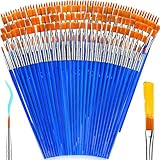
- 【162-Piece Bulk Set | Dual Brush System】Maximize versatility with 81 flat brushes (0.59 inch edge for bold strokes) and 81 round brushes (0.39 inch tips for details) – 3X more tools than standard kits! Pre-sorted in labeled compartments for instant access during painting sessions. Ideal for art classrooms, mural projects, and multi-artist households.
- 【Pro-Grade Durability | Zero Shedding Guarantee】 "Engineered with triple-crimped nylon bristles (43% higher resilience vs. standard) and aerospace aluminum ferrules tested for 10,000+ flex cycles. Lab-verified 0.01% shedding rate even with heavy impasto techniques – outperforms flimsy bristles in budget brushes."
- 【Multi-Scenario Readiness | Event & Daily Use】 Optimized for: Thanksgiving/Christmas face designs classroom projects ceramic decorating fabric printing and model painting; Lightweight plastic handles each reduce hand fatigue during prolonged sessions
- 【Effortless Maintenance | Long-Term Durability】 Clean with warm soapy water in 10 seconds; Reshape tips and air-dry vertically to preserve bristle integrity,After use, air-dry brushes thoroughly and store upright in the provided case to preserve bristle shape. The premium nylon filaments naturally regain their original form after each stroke. For cleaning, simply rinse in warm soapy water and gently reshape bristles with fingertips."
- 【Multiple Application】These acrylic paint brushes can be applied for most occasions,such as:watercolor,oil, gouache paint,face paint, acrylic paint, suitable for Thanks Giving Day, Christimas, Halloween face and body painting, canvas painting, fabric, rock, miniature, model, ceramics, arts and crafts painting, etc.
How do I prevent splitting and installation damage?
- Keep adequate edge distance. Do not place a large nail close to an end or edge, especially in hardwood or narrow trim.
- Drill a pilot hole when needed. The Home Depot recommends a pilot hole for hard wood or end-grain nailing. Size it to guide the shank without eliminating the wood’s grip.
- Use the right nail for the thickness. A box nail, brad or pin may be appropriate for thin stock; a larger common or framing nail can wedge it apart.
- Drive straight and flush. Angled or overdriven heads can crush fibers, break a membrane or reduce the bearing area.
- Set finish heads carefully. Use a nail set below the surface only far enough for filler; deep craters weaken delicate trim and require more patching.
Can I use these nails in a nail gun?
Only if the fastener is made for that tool. Nail-gun nails are collated in strips or coils, and the nailer requires a specific collation angle, shank diameter, head style and length. A loose hand-drive nail or a strip with the wrong angle can jam the tool, misfire or leave an unsafe connection. Consult the nailer manual and the fastener packaging before loading.
What safety and code checks matter?
Wear eye protection for all driving operations and especially when driving masonry nails. Keep hands clear of the striking line, secure the work, and inspect for hidden electrical, plumbing or gas services before penetrating walls, floors or posts.
For structural connectors, decks, roofs, siding systems and treated lumber, follow the approved schedule and product instructions. Lowe’s summarizes the governing principle this way: “Always follow code specifications and the fastener or structural hardware manufacturer’s instructions.” Local terminology, available sizes and code requirements can differ from the North American references used here.
How we picked these 25 nail types
The inventory follows the exact-title editorial list while grouping overlapping terms honestly. Selection criteria were the nail’s intended application, base material, head visibility and bearing area, shank and withdrawal behavior, available length and diameter, metal or corrosion-resistant finish, compatibility with treated wood or species such as cedar, hand-driving versus nailer use, and any connector or code specification. Because “25 types” is a useful field guide rather than a universal taxonomy, labels such as framing, trim, connector and siding can describe overlapping categories.
What is the practical rule for choosing among them?
Choose the smallest fastener that meets the specified load and penetration, then verify its finish for the environment and its compatibility with the material. Use common or framing nails for permitted general construction, ring or spiral shanks when the specification calls for greater withdrawal resistance, broad heads for sheet goods, and finish nails, brads or pins only when their lower capacity is acceptable. When a connector, roofing system or siding manufacturer names a fastener, that instruction outranks a generic type name.
Frequently Asked Questions
Can galvanized nails be used with cedar or redwood?
Not automatically. Galvanized coatings can react with cedar and redwood, so check the fastener maker’s compatibility information and the cladding or deck manufacturer’s instructions; stainless steel may be specified for some cedar applications.
Free tools Windows power users keep installed
One-click scans. No signup required.
What does 20d mean on a nail package?
It is a penny-size designation that the Canadian Wood Council illustrates as a four-inch nail. It does not tell you the nail’s diameter, coating, shank pattern or structural approval, so those details still have to match the connection.
Are ring-shank nails removable?
They can be removed, but the rings grip wood more strongly than a smooth shank and usually cause more damage during extraction. Annular-ring and spiral nails are therefore best placed accurately and left where the application expects permanent fastening.
Why can’t I substitute a longer nail in a joist hanger?
A connector is engineered around a specified fastener diameter, length and head bearing. A longer or different nail may miss the intended load path, interfere with another member or fail to develop the tested capacity; use only the hanger manufacturer’s approved nails.
When should I use a pilot hole instead of driving directly?
Pilot holes are especially useful in hard wood, near an edge, or when nailing into end grain. They reduce wedging forces and splitting, but the hole must still leave enough surrounding wood for the selected nail to grip.
The Tool Desk
Outbyte Driver Updater FREEScan for outdated or missing drivers - takes under a minuteDriver Scan →Outbyte PC Repair FREERepair Windows errors before they cause bigger problemsFix Now →Quick Recap


