Do these 3 things before closing this tab:
The Tool Desk
Outbyte PC Repair FREERepair Windows errors before they cause bigger problemsFix Now →Outbyte Driver Updater FREEFix the driver behind crashes, sound loss and screen glitchesFind Drivers →1Scan for outdated or missing drivers - takes under a minute2Clear out junk files and repair common Windows errors3Fix the driver behind crashes, sound loss and screen glitches
ThatPainter is reader-supported. When you buy through links on our site, we may earn an affiliate commission. Learn More
Nature rarely produces perfect mathematical fractals. Instead, it produces finite, approximate, or statistical fractal patterns: branches, boundaries, crystals, and networks that repeat a broad structural rule across a limited range of scales.
Romanesco cauliflower, fern fronds, trees, river basins, lightning, snow crystals, clouds, lungs, and coastlines all show versions of this idea. They do not repeat forever or look exactly identical at every magnification. Their fractal-like appearance emerges from growth, erosion, diffusion, turbulence, electrical breakdown, transport, and other natural processes.
As an Amazon Associate I earn from qualifying purchases.
For painters, these patterns offer more than attractive textures. They show how a simple visual rule can create complexity—provided that the rule includes variation, irregularity, and a natural stopping point.
What makes a pattern a fractal?
A fractal is a pattern whose structure changes with scale in a way that can be described by repeated rules. The most familiar characteristic is self-similarity: a smaller part resembles the larger form that contains it.
#1 Best Overall
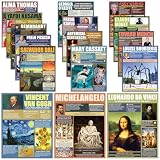
- 【16 FAMOUS ART POSTERS · 5 CENTURIES · MASTERPIECES】 Da Vinci, Michelangelo, Rembrandt, Van Gogh, Monet, Munch, Picasso, Dalí, Warhol, Cassatt, Gentileschi, Kahlo, Alma Thomas, Kusama, Bourgeois — 16 masterpieces from Renaissance to contemporary art
- 【PREMIUM MATTE-LAMINATED 250 GSM】 Matte-laminated art classroom posters kill projector glare during art history lessons and resist tearing unlike thin flimsy prints — 250 gsm cardstock stays flat year after year, no curled corners or bent edges
- 【INCLUSIVE ART HISTORY · 6 WOMEN + DIVERSE】 A classroom set beyond the Euro-male canon — 6 women artists (Cassatt, Gentileschi, Kahlo, Alma Thomas, Kusama, Bourgeois) + Mexican · African American · Japanese · European voices your K-12 art class deserves
- 【SHIPS FLAT IN OPP BAG · READY TO HANG】 Packed flat in a protective OPP sleeve so famous art prints arrive crease-free — solves the #1 hanging complaint in competitor art poster listings — use poster putty, washi tape, or slide into 11x14 frames
- 【ART TEACHER GIFT · BACK-TO-SCHOOL 2026】 Thoughtful gift for art teachers, homeschool art starter kit, or B2S 2026 classroom wall decor — pair with KING PRINT History Posters to build a complete curriculum wall that inspires students every morning
A branch may resemble the tree, a tributary system may resemble a river basin, and a small Romanesco cone may resemble the whole head. The resemblance is not always exact, but the same broad organization appears more than once.
Fractals are also described using fractal dimension. This is not necessarily a dimension in the ordinary sense of length, width, and height. It measures how a structure fills space or how its apparent complexity changes as the scale of measurement changes.
Free tools Windows power users keep installed
One-click scans. No signup required.
- A smooth line has a conventional dimension of 1.
- A filled surface has a conventional dimension of 2.
- A rough boundary, such as a coastline, can behave as though its effective dimension lies between 1 and 2.
There are two important kinds of self-similarity:
- Exact self-similarity: smaller sections are mathematically identical copies of the whole. The Koch snowflake is an ideal example, but it is a mathematical construction rather than a natural snow crystal.
- Statistical self-similarity: smaller sections are not identical, but they follow similar statistical rules. Most natural examples belong here.
Every physical object also has a scale window. A tree may show branching patterns from trunk to twigs, but the pattern ends at leaves, cells, or tissues. A coastline may become more detailed as the measuring unit gets smaller, but grains of sediment, rocks, and the definition of the shoreline eventually limit the comparison.
So the useful question is not simply, Does this look complicated? Complexity alone does not make something a fractal. Ask instead:
- Does a similar structural rule appear at several scales?
- Can that resemblance be measured rather than merely imagined?
- Over what range of scales does it hold?
- What physical or biological process creates it?
- Are researchers measuring an outline, a surface, a mass distribution, or a branching network?
With that distinction in mind, here are nine of nature’s most compelling fractal-like patterns.
1. Romanesco cauliflower: a vegetable built from nested cones
Romanesco is arguably the clearest edible example of a finite, fractal-like biological structure. Its head is made of pointed cones arranged in spiraling rows. Each cone contains smaller cones, which in turn contain still smaller points.
Do these 3 things before closing this tab:
1Fix the driver behind crashes, sound loss and screen glitches2Repair Windows errors before they cause bigger problems3Scan for outdated or missing drivers - takes under a minuteRomanesco belongs to Brassica oleracea. It is best described as a distinctive cultivar rather than casually labeled a broccoli–cauliflower hybrid. The University of Wisconsin horticulture guide describes its characteristic cones as products of branched meristems arranged in a spiral. The USDA also lists names including Romanesco broccoli and Romanesco cauliflower.
What repeats?
The recognizable conical form appears at several levels:
Whole head → cone cluster → individual cone → smaller cone.
The spiral arrangement is related to phyllotaxis, the study of how plant organs are positioned around a growing stem or meristem. But the nested cone structure is the feature that makes Romanesco particularly fractal-like. A spiral by itself is not enough to establish fractality.
How does it form?
A 2021 study reported by the John Innes Centre concluded that cauliflower-like forms arise when meristems fail to complete their transition into flowers while retaining aspects of a floral developmental state. Further changes in meristem growth can produce the more sharply conical Romanesco form.
In other words, a change in the developmental program of the plant turns what might have become flowers into a repeating field of growing shoots.
How strong is the fractal claim?
Strong—but only within limits. One review estimated a two-dimensional outline fractal dimension of approximately 1.26 for Romanesco. That number applies to the particular feature and measurement method used; it is not a universal dimension for every Romanesco head.
Romanesco is not an infinite mathematical fractal. Eventually, the cones end in ordinary plant tissue, cells, and molecules. Its pattern is better described as a finite biological fractal or an approximately self-similar structure. Scientific American discusses this distinction in relation to the vegetable’s limited scale range.
For painters: Romanesco demonstrates how repetition becomes more convincing when each repeated form is slightly different. Copying one cone again and again produces a diagram. Varying its size, tilt, brightness, and partial concealment produces a living surface.
2. Fern fronds: a leaf made of smaller leaves
Fern fronds offer one of the most familiar visual examples of approximate self-similarity. A central rachis supports side branches, those branches carry smaller leaflets, and the whole frond can look like a large leaf assembled from progressively smaller leaves.
What repeats?
The hierarchy is easy to see:
Main rachis → pinnae → pinnules → smaller divisions.
Rank #2

- Size Options: Yayoi kusama wall art–Choose from a range of sizes to suit your specific space. Whether you're decorating a cozy corner or a large wall, this japanese poster is available in multiple sizes to perfectly match your needs and enhance any room or location
- High-Quality Materials: Nature wall art printed on premium, fade-resistant paper, are made to last. The high-resolution artwork ensures vibrant colors and crisp details, green wall art providing a stunning visual experience that adorn any wall
- Versatile Decor Solution: This botanical print by Yayoi Kusama is a modern Japanese floral poster that perfectly showcases her unique artistic style. Suitable for home décor, whether hung in the living room, bedroom, or art studio, it adds endless charm and personality to any space
- A THOUGHTFUL GIFT: This botanical print is more than just a decorative piece; it embodies a lifestyle. Give your loved ones, this floral wall art is perfect for Birthday, Housewarming, Graduation, Christmas, or any special occasion
- After Sale Service: We value your satisfaction! If you have any questions or issues with your purchase, please contact us and we will solve any questions you may have
This repeated division creates the characteristic feathery silhouette. When a fern is photographed from a distance, its overall outline can resemble the shape of an individual side branch.
Quick wins for a faster PC:
Scan for outdated or missing drivers - takes under a minuteDriver Scan →Repair Windows errors before they cause bigger problemsFix Now →Fix the driver behind crashes, sound loss and screen glitchesFind Drivers →How does it form?
Fern leaves develop through growing meristems and repeated branching rather than by applying an exact geometric copying rule. The branching pattern reflects species-specific development, vascular organization, available space, light, and the mechanics of supporting the leaf.
A botanical review of fern leaf architecture documents the repeated divisions that create this strong visual resemblance. However, a separate peer-reviewed critique of the “fern fractal” idea points out that mature fern leaves are not true self-similar fractals. Their vascular structures differ across branching orders, and their development does not consist of endlessly repeating one identical geometric transformation.
The Barnsley fern is not a literal fern
The famous Barnsley fern is a computer-generated mathematical fractal inspired by the overall geometry of fern leaves. It is not a complete mathematical description of every real fern. A real species may have different branching angles, leaflet sizes, asymmetries, and internal anatomy.
Fractal status: Ferns are excellent examples of hierarchical branching and visual self-similarity, but they are not exact botanical fractals.
For painters: Start with the main gesture of the frond, then divide it into branches, then smaller leaflets. Keep the rule consistent but let the divisions become less regular toward the edges. Natural repetition is structured, not mechanically identical.
3. Trees and root systems: branching networks that occupy space
Trees display fractal-like branching on a scale most people recognize immediately. A trunk divides into limbs, limbs divide into branches, branches divide into twigs, and twigs support leaves. Below ground, roots create another branching network for anchorage and transport.
What repeats?
The repeated pattern is a dendritic, or tree-like, division. The review of natural branching systems notes that dendritic configurations occur widely in plants, lungs, and river basins and are often analyzed using self-similarity and scaling.
Branching lets a tree reach a broad volume without filling that entire volume with solid wood. Above ground, the network helps position leaves over a large area. Within the plant, it supports transport of water and sugars. Roots use branching to explore soil and connect the plant to a wider underground volume.
What’s actually slowing this PC down?
Pick the symptom - the matching free tool is one click away.
Why is a tree not a perfect fractal?
Real tree architecture is shaped by light competition, gravity, wind, available water, mechanical stability, species-specific growth, age, and damage. A branch exposed to strong wind may grow differently from one sheltered inside the canopy. A shaded branch may die, while a well-lit shoot continues developing.
Research on plant form and metabolic scaling has found that tree mass can be distributed in a broadly self-similar manner across trunks and branches. But this does not mean that every tree follows one fixed fractal dimension or a perfect binary branching rule. Plant-scaling research and studies of real tree architecture emphasize that natural branching is variable and constrained.
Fractal status: Trees and roots are approximate, functional branching networks. Their fractal-like structure helps with space filling and distribution, but geometry alone does not explain all of their efficiency.
For painters: Avoid dividing every branch evenly. Use a hierarchy: a few dominant limbs, more secondary branches, and many fine twigs. Vary the spacing and allow some branches to disappear behind foliage. This creates the statistical irregularity that makes a painted tree feel observed rather than diagrammed.
4. River networks and deltas: erosion’s branching geometry
Seen from above, a river basin often looks like a giant tree drawn across the landscape. The main channel divides into tributaries, which divide into smaller streams, rills, and temporary channels.
What repeats?
The pattern is a branching drainage hierarchy:
Main river → tributaries → smaller tributaries → gullies and rills.
River networks commonly show power-law relationships and Horton-style scaling laws, in which the number and length of channels change systematically with stream order. This is why river basins are often described as statistically self-similar rather than exact fractals. A study of river-network scaling discusses these recurring relationships.
How does it form?
Rainfall, runoff, slope, soil, sediment, and bedrock interact to carve channels. Water does not simply flow through a pre-existing tree-shaped drawing. Field and laboratory research shows that external flow fields and seepage erosion can help generate branching stream geometry. In one Florida seepage-stream system, researchers measured a mean bifurcation angle of 71.9° ± 0.8° across nearly 5,000 bifurcations—but that is a result for that particular geological and hydrological setting, not a universal river angle.
Windows Errors? Fix Them Before They Spread
Repair common Windows errors and clear accumulated junk for a smoother, more stable PC - no reinstall needed.Free scan · no reinstallCrashes, No Sound, or Screen Glitches?
Random freezes, missing sound and display glitches usually trace back to one bad driver. Find and replace yours safely.Free scan · under a minuteRank #3

- 【Size】3 wall prints in 8x10 Inch/4 wall prints in 5x7inch/5 wall prints in 4x6inch - total 12 Pieces in different size. Please measure your wall before purchase to make sure you pick the right size.
- 【Classic Claude Monet Art Prints】This Monet oil paintings collection is a unique opportunity to travel back to the 19th century and immerse yourself in Monet's gardens, with their vibrant green and blue hues and the lightness of the days. These famous art posters and prints of famous painting is ideal impressionist wall art decor for your home.
- 【Premium Quality】The vintage aesthetic art prints are made of high-quality canvas material to ensure durability, and we print with high-quality inks, never fade over time. All Process and Materials are created with only the highest standards. (Please note that our Monet artwork for walls do not contain picture frames!)
- 【Perfect Gift for Your Loved One】 The vintage gallery wall art set can be also as gift for the one who love Monet items, adore famous artwork and art reproduction posters, French country wall decor or eclectic wall art.
- AESTHETIC POSTERS to GIFT for COLLEGE GIRLS: KBKBART wall collage kit aesthetic pictures are great gifts for anyone who wants to create aesthetic room decor. You can gift this wall collage kit to teens, kids, girls, women. We pack these with double-sided tape and also put into specially designed box which is ready to gift. Also, we add some special gifts for every package!
The mechanisms behind stream branching are discussed in the Florida seepage-stream study. River networks also affect living systems: research on river ecosystems found that scale-invariant branching complexity can help stabilize watershed metapopulation dynamics. See the study of branching complexity and river ecosystems.
Important variation
Not every river network is dendritic. Some are trellis-like, braided, rectangular, or radial, depending on geology, slope, sediment, faulting, and other controls. Rivers do not all obey one fractal law or branch at one fixed angle.
Fractal status: Many drainage basins show measurable statistical scaling, but the exact pattern depends strongly on landscape and geology.
For painters: A convincing river landscape needs more than one branching line. Begin with the main channel, add fewer but longer tributaries, then introduce many short channels only where the terrain supports them. Keep the largest divisions visible; excessive detail everywhere destroys the hierarchy.
Recommended Free Tools
5. Lightning: fractal branching through electrical breakdown
Lightning produces a dramatic fractal-like form without any biological growth. A flash advances through branching electrical channels, with some branches becoming dominant while many faint branches stop before traveling far.
What repeats?
The visible pattern is a hierarchy of branching paths. A major channel divides into smaller leaders, which may divide again. The result resembles a tree, but the cause is electrical breakdown rather than plant development or erosion.
How does it form?
Ionization creates a conducting path through air. Local electric-field conditions influence where the discharge advances, and small irregularities can be amplified into branching channels. The dielectric-breakdown model developed by Niemeyer, Pietronero, and Wiesmann showed how a stochastic electrical-discharge process can naturally generate fractal structures.
High-speed observations have added detail to this picture. One study recorded natural lightning at 180,000 frames per second and analyzed 96 leader steps. It linked leader branching to multiple space leaders forming near the advancing channel tip. The observations are described in this high-speed lightning study.
Why lightning does not have one fractal dimension
Published lightning dimensions vary because researchers may analyze photographs, projected channels, radio-source data, or computer models. Reported values include approximately 1.3 to 1.75 in different contexts. A value cannot be interpreted without knowing the flash type, image resolution, projection, thresholding method, and part of the discharge being measured. The lightning-fractal analysis discusses this dependence.
A photograph also turns a three-dimensional flash into a two-dimensional image, which can change the measured geometry.
Fractal status: Lightning is a stochastic, fractal-like electrical-discharge pattern, supported by both modeling and observation, but not a single exact geometric object.
For painters: The most believable lightning is not a perfectly balanced tree. Use a dominant path, uneven branching, many interrupted secondary channels, and a strong contrast between the illuminated channel and the dark sky.
6. Snowflakes and dendritic ice crystals: crystals that grow like trees
Some snow crystals form delicate, branching structures that resemble miniature trees, ferns, or coral. These are called dendritic crystals, from a Greek root meaning tree-like.
What repeats?
A main ice arm develops side branches, and those side branches may develop smaller branches. The repeating detail is especially visible in stellar dendrites, the familiar six-armed snow crystals often shown in photographs.
How does it form?
Ice crystals grow as water molecules diffuse through the air and attach to the crystal surface. Growth is not equally easy in every direction. The molecular structure of ordinary ice produces sixfold symmetry, while temperature, humidity, supersaturation, and the crystal’s growth history determine whether the arms become plates, needles, columns, or elaborate dendrites.
Research on dendritic ice growth describes how diffusion and anisotropic attachment create these branching forms. Studies of crystal growth also distinguish dendritic and fractal growth regimes and relate their appearance to the balance between directional bias and random fluctuations; see the crystal-growth research.
Recommended Free Tools
Three snowflake cautions
- Not every snowflake is dendritic. Snow crystals can be plates, columns, needles, irregular crystals, or aggregates.
- The Koch snowflake is not a snow crystal. It is an ideal mathematical construction inspired by the visual idea of a snowflake.
- Large flakes may be aggregates. Several crystals can collide and stick together. A 2026 arXiv preprint emphasizes the irregular aggregate geometry of many large snowflakes; because it is a preprint, it should not be treated as settled consensus.
Fractal status: Certain dendritic crystals show fractal-like nonequilibrium growth over a limited range. Snowflakes as a category are not all fractal.
Rank #4

- Japanese Wall Art: Japanese poster size is 12X16 inch, not include frames. You to choose your preferred frames to showcase them. Assemble and install by yourself, Fully enjoy the fun of DIY
- Durable & High Quality Posters: Abstract painting use high quality environmentally protection ink, not easy to fade, vivid color, waterproof, Uv resistant, no odor. Unique wall art will add a touch of style and personality to your walls
- Blue Wall Art: This captivating poster features dynamic, swirling waves rendered in deep indigo and cerulean hues. Aesthetic posters provide decoration for kitchen, dining room, bar, dorm, living room, bedroom, apartment, hotel
- Christian Gift: The minimalist yet intricate design pays homage to ukiyo-e woodblock prints, blending classical artistry with modern decorative appeal. Whether given as a birthday, christmas, holiday gift, house warming or any other special occasion, blue canvas wall art will surprise and delight the recipient
- After-sales Service: We cherish your purchase experience very much, if you have any problems with this wabi sabi wall art. You can contact us by email at the first time. We hope to resolve any issues you may encounter quickly and efficiently
For painters: Preserve the sixfold organizing symmetry first, then introduce unequal arm lengths, gaps, and branching. A perfectly mirrored snow crystal looks designed; a nearly symmetrical one looks natural.
7. Clouds: soft forms with measurable scaling
Clouds appear soft and formless, but cloud fields and their boundaries can show statistical fractal scaling. Their irregular edges arise from structure at many sizes, from large convective formations down to smaller turbulent eddies.
How does it form?
Atmospheric turbulence creates eddies and variations across multiple scales. Condensation and evaporation sharpen the boundary between cloudy and clear air, while convection and wind continually reshape the cloud field.
NASA’s summary of research on cloud fields reports power-law behavior in cloud areas and perimeters. It also notes that a double power law often describes cloud fields better than a single scale-free relationship. In practical terms, the scaling changes around a characteristic size rather than continuing unchanged across every possible scale. See the NASA research summary.
A frequently cited image-based estimate places the fractal dimension of some cloud patterns near 1.3. That is not a universal property of clouds. The measured value changes with cloud type, image resolution, the threshold used to define the cloud edge, and the feature being analyzed. A discussion of these image-based measurements appears in this cloud-pattern study.
Two-dimensional image, three-dimensional object
Clouds are three-dimensional volumes, but many fractal measurements use two-dimensional satellite images or photographs. The dimension of a visible boundary should not automatically be treated as the dimension of the entire cloud.
Fractal status: Cloud fields offer a strong example of statistical scaling, especially in turbulent conditions, but their scaling is dynamic, measurement-dependent, and often limited to particular size ranges.
The Tool Desk
Outbyte PC Repair FREERepair Windows errors before they cause bigger problemsFix Now →Outbyte Driver Updater FREEScan for outdated or missing drivers - takes under a minuteDriver Scan →For painters: Build clouds with several overlapping scales. Start with the broad mass, add medium-sized lobes, and reserve the smallest broken edges for selected areas. If every edge receives equal detail, the cloud loses depth and atmosphere.
Independent reader supportYour contribution helps us test, update, and keep practical guides available for everyone.8. The human lung: a space-filling network inside the chest
The human lung contains one of biology’s most important branching systems. The trachea divides into bronchi, bronchi divide into bronchioles, and the network continues toward acinar ducts and alveolar regions where gas exchange occurs.
What repeats?
The lung uses repeated branching to distribute air through a compact volume. The pulmonary blood vessels form a related branching network that distributes blood near the gas-exchange surfaces.
One model describes approximately 14 generations of conducting bronchial ducts followed by approximately nine generations of acinar ducts leading toward alveoli. This model is described in research on pulmonary transport and branching.
A review of pulmonary vasculature describes vessels branching through as many as 28 generations, while emphasizing that actual lungs are asymmetric and heterogeneous rather than perfect geometric trees. See the review of pulmonary vascular structure.
Why does this architecture matter?
Repeated branching allows the lung to distribute air and blood through a relatively small body cavity while supporting a large gas-exchange interface. The network’s function is therefore more than visual resemblance: its geometry is connected to transport and exchange.
That does not prove that every part of the lung obeys one identical fractal rule. Real lungs contain asymmetry, irregular branching, different airway sizes, and different transport regimes at different scales. Idealized fractal trees are useful models, not complete anatomical descriptions. A further review of lung structure and fractal models explains these limitations.
Fractal status: The bronchial and pulmonary networks are strong examples of approximately fractal, space-filling biological systems over parts of their branching hierarchy.
Free tools Windows power users keep installed
One-click scans. No signup required.
For painters: The lung is a useful reminder that branching can be functional rather than decorative. In an anatomical or abstract painting, vary the branching order and density instead of making every division symmetrical.
9. Coastlines: the boundary changes when the ruler changes
Coastlines are the classic mathematical example of natural scale-dependent roughness. A coastline may appear smooth on a map of a continent, but bays and peninsulas emerge on a regional map. At still smaller scales, rocks, inlets, tidal channels, and beach contours add more detail.
Best Value

- 【Japanese Wall Art Poster】Available in a variety of sizes - 8x10" 11x14" 12x16" 16x24" 20x30" 24x36" - and in three formats: frameless wood frame and black aluminum frame, offering multiple options to match any decor.
- 【High-Quality Canvas Print】High quality canvas and high quality healthy pigment are used to make every hanging picture product. Clear colors and rich details. Waterproof, colorfast, non-toxic, harmless, healthy.
- 【The Perfect Gift for any Occasion】Housewarming, Birthday, Father's Day, Mother's day, Christmas, Valentines, Anniversary, Wedding, Halloween, Thanksgiving, New Year, etc
- 【Traditional Japanese Art Wall Decor】The Japanese contemporary art is ideal as Japanese decor for bedroom, living rooms, home office, etc.
- 【After-sales service】We cherish your purchase experience very much, if you have any problems with the purchased Japanese room decor poster, You can contact us by email at the first time. We hope to resolve any issues you may encounter quickly and efficiently.
Why does measured length change?
Imagine measuring a shoreline with a long ruler. The ruler skips over small coves and indentations, producing a relatively short result. Replace it with a shorter ruler and it follows more of the boundary, producing a longer result.
This does not mean that a physical coastline has literally infinite length. It means that the measured length changes with scale, and that extrapolating a mathematical relationship toward ever-smaller rulers can produce an apparent divergence. In the physical world, sediment grains, rocks, tides, shoreline definitions, and measurement resolution provide practical limits. This scale-dependence is discussed in the historical research on fractal coastlines.
Quick wins for a faster PC:
Fix the driver behind crashes, sound loss and screen glitchesFind Drivers →Clear out junk files and repair common Windows errorsFree Scan →How is it measured?
Many cited measurements place coastline fractal dimensions roughly between 1.1 and 1.3, although geography, map resolution, shoreline definition, and method all matter. The USGS material on coastline measurement documents this range and its limitations.
A study of certain rocky shorelines found behavior consistent with a dimension near 4/3. That result applies to the class of shorelines examined, not to every coast on Earth. See the rocky-shoreline study.
Fractal status: Coastlines are strong examples of statistical self-similarity and scale-dependent roughness, but their dimension is not a universal number and their physical length is not literally infinite.
For painters: Change the character of the edge as the scene moves closer. A distant coastline can be a broad, quiet contour; a foreground shore can contain rocks, foam, channels, and broken reflections. Detail should increase with perceptual scale, not be distributed uniformly.
Crashes, No Sound, or Screen Glitches?
Random freezes, missing sound and display glitches usually trace back to one bad driver. Find and replace yours safely.Free scan · under a minuteWindows Errors? Fix Them Before They Spread
Repair common Windows errors and clear accumulated junk for a smoother, more stable PC - no reinstall needed.Free scan · no reinstallNot every beautiful spiral is a fractal
Natural spirals are often included in lists of fractals, but a spiral and a fractal are not interchangeable concepts.
Pinecones, sunflowers, succulents, and many leaves display phyllotaxis—rules governing the placement of plant organs. Seashells may grow in an approximately logarithmic or equiangular spiral. These patterns can be mathematically elegant and may show a form of spiral self-similarity, but a spiral does not automatically have fractal geometry.
The same caution applies to the Fibonacci sequence and the golden ratio. They can help describe some plant-arrangement patterns, but Fibonacci numbers are not a synonym for fractals, and the golden ratio does not explain every natural spiral. The mathematical distinctions are outlined in this Plus Maths discussion of golden-ratio myths.
Romanesco is more complicated than a simple spiral example: it combines spiral phyllotaxis with nested, repeated cone development. That is why it belongs on a list of natural fractal-like patterns, while a pinecone should more cautiously be described as a phyllotactic spiral.
What’s actually slowing this PC down?
Pick the symptom - the matching free tool is one click away.
How the nine patterns compare
| Example | Main pattern | Type of similarity | Underlying process | Important limitation |
|---|---|---|---|---|
| Romanesco | Nested cones and spirals | Approximate biological self-similarity | Meristem and floral-development dynamics | Finite and feature-dependent |
| Fern frond | Repeated leaf divisions | Visual and approximate | Plant growth and branching | Branching orders are not identical |
| Tree and roots | Dendritic branching | Statistical and functional | Growth, transport, light, gravity, and mechanics | Species and environment alter the form |
| River network | Tributary hierarchy | Statistical scaling | Erosion, runoff, seepage, and topography | Network types vary with geology |
| Lightning | Branched electrical channels | Stochastic fractal-like structure | Electrical breakdown and leader dynamics | Measurements depend on projection and method |
| Snow crystal | Dendritic arms | Fractal-like growth | Diffusion and anisotropic crystallization | Not all snow crystals are dendritic |
| Cloud | Rough boundaries and fields | Statistical scaling | Turbulence, condensation, and evaporation | Scaling changes with cloud type and threshold |
| Human lung | Space-filling airway and vessel trees | Approximate functional fractal | Transport and gas exchange | Actual anatomy is asymmetric |
| Coastline | Rough, indented boundary | Statistical self-similarity | Erosion, geology, tides, and sediment | Length depends on measurement scale |
The larger lesson: simple rules can create complex images
These examples come from very different parts of nature, but they share a broad principle. Local interactions can generate large-scale structure without a central designer drawing the final pattern.
- A plant repeatedly adds branches or shoots.
- A river erodes channels through a landscape.
- Water vapor deposits unevenly on an ice crystal.
- Turbulence transfers structure across atmospheric scales.
- An electrical discharge follows changing conditions in a nonuniform field.
- A developing organ branches to distribute material through a limited volume.
That does not mean nature is deliberately “using fractals.” It means that branching, transport, erosion, aggregation, instability, and growth can produce forms that are well described by fractal ideas.
For a painter, the most useful principle is not to copy a mathematical fractal literally. Instead, identify the visual rule, apply it at more than one scale, introduce controlled irregularity, and stop the repetition where the subject’s physical scale would stop it. That combination produces the difference between a decorative pattern and a believable natural form.
Frequently Asked Questions
Are natural objects true fractals?
Usually not in the strict mathematical sense. Most natural examples are finite and approximately or statistically self-similar. They resemble the same structural rule across a limited range of scales, but the pattern eventually stops or changes.
Do these 3 things before closing this tab:
1Fix the driver behind crashes, sound loss and screen glitches2Repair Windows errors before they cause bigger problems3Scan for outdated or missing drivers - takes under a minuteIs Romanesco cauliflower a fractal?
Romanesco is a strong finite, fractal-like biological structure. Its cones are nested and arranged in spirals, but they are not infinite or mathematically identical at every level. Its form results from the development of plant meristems.
Are snowflakes and the Koch snowflake the same thing?
No. Some dendritic snow crystals have fractal-like branching, while the Koch snowflake is an ideal mathematical construction. Natural snow crystals also vary widely in shape and may consist of several crystals joined together.
Does the golden ratio make a natural pattern fractal?
No. The golden ratio and Fibonacci numbers can describe some phyllotactic arrangements, such as the placement of seeds or leaves, but a spiral or Fibonacci pattern is not automatically a fractal.
What is the best natural fractal to paint?
Romanesco, fern fronds, trees, lightning, snow crystals, clouds, river networks, lungs, and coastlines each offer different challenges. Trees and ferns are accessible subjects for practicing hierarchical branching; clouds and coastlines are useful for practicing scale-dependent edges; Romanesco is ideal for studying repeated form with controlled variation.
The Bottom Line
Nature’s fractals are usually not perfect copies repeating forever. They are natural systems that develop similar structure across a limited range of scales. Romanesco grows nested cones, trees and lungs branch to distribute material, rivers and coastlines are shaped by erosion, snow crystals grow through diffusion, clouds are structured by turbulence, and lightning branches through electrical breakdown. Fractal geometry helps us describe these patterns—but the real science lies in understanding the processes that create them.
Quick Recap

Product prices and availability are accurate as of the date/time indicated and are subject to change. Any price and availability information displayed on Amazon at the time of purchase will apply.




