Windows Errors? Fix Them Before They Spread
Outbyte PC Repair · freeRepair common Windows errors and clear accumulated junk for a smoother, more stable PC - no reinstall needed.
Fix My PC Now →ThatPainter is reader-supported. When you buy through links on our site, we may earn an affiliate commission. Learn More
Different hammer types are designed to balance force, control and surface protection for different jobs. For painting and renovation work, a curved-claw hammer is the everyday choice for driving or removing nails; a mallet or soft-face hammer is often a better fit when the workpiece could be dented. This guide covers 25 commonly named hammer types and variants, but they are not 25 universally standardized, unrelated designs: some are overlapping forms, features or categories that different guides group differently.
What are the different types of hammers and their uses?
Start with the material and task, not the hammer’s name: wood and nails usually call for a claw hammer, metal shaping for a peen hammer, masonry for a brick or drilling hammer, demolition for a club or sledgehammer, and more delicate assembly for a mallet, soft-face or dead-blow hammer. The 25 entries below include both distinct tools and familiar variants. Manufacturer and retailer guides do not all classify them the same way; for example, framing hammers are a heavy-duty form of claw hammer, and club and lump hammers are often grouped together.
As an Amazon Associate I earn from qualifying purchases.
- Curved-claw hammer. The general carpentry choice for driving nails into wood and pulling them back out. Its curved claw gives leverage when removing a nail. For household repair, trim work or paint-preparation carpentry, it is the most versatile starting point when nails are the main task.
- Rip-claw hammer. A claw hammer with a straighter claw, suited to pulling nails and prying or ripping material. It is useful when removal matters as much as driving; the straighter claw changes the leverage and access available compared with the more curved claw. It is still a carpentry tool, not a substitute for a purpose-built demolition bar in every situation.
- Framing hammer. A larger, heavier claw-hammer form intended for heavy carpentry and framing. It can drive larger nails with more force than a typical general-purpose hammer, but the additional weight can make precise, light strikes harder to control. Choose it for substantial framing work rather than delicate finish work.
- Ball-peen hammer. A metalworking hammer with a flat striking face and a rounded peen on the opposite end. It is used for shaping metal, riveting, and striking punches or chisels. It is not a general-purpose nail hammer: its head shape is designed around metalworking tasks.
- Cross-peen hammer. This hammer has a narrow, wedge-shaped peen set across the handle’s direction. That shape supports precision shaping and can help start small tacks or panel pins. The narrow end concentrates the strike, so careful control matters around finished or fragile surfaces.
- Straight-peen hammer. A named ball-peen variant whose peen orientation differs from a cross-peen. It is best understood as a design variation within peen hammers, rather than as an entirely separate universal category with a single distinct job.
- Club hammer. A short-handled hammer with a striking face at each end, made for powerful, controlled one-handed blows. It can suit compact heavy-striking work where a long handle is awkward. It is not the same scale of tool as a full sledgehammer.
- Lump hammer. Commonly grouped with club hammers, this is another short-handled, two-faced tool for controlled heavy blows and some masonry tasks. Naming conventions vary by guide, so the label alone does not always define a separate class from a club hammer.
- Sledgehammer. A heavy hammer for demolition and for driving stakes, pins or wedges. Its weight and longer handle can deliver more force than a club hammer, but also demand more space and control. It is a poor choice for a small, precise strike or for work near surfaces you need to preserve.
- Mallet. A broad family of hammers with heads made from materials such as wood, rubber, plastic or rawhide. Mallets are used for woodworking, assembly and other tasks where a steel hammer face could cause unwanted damage. The exact material and hardness affect how a mallet behaves; “mallet” alone does not guarantee a mark-free result.
- Rubber mallet. A rubber-headed mallet often used to fit or assemble parts when a conventional steel hammer could dent the work. Rubber formulations and head colors vary, and some can still mark a surface. If the finish matters, test on an inconspicuous area or use a protective block where appropriate.
- Dead-blow hammer. A hammer with a filled head designed to reduce rebound, commonly used for assembly or fabrication. Its reduced bounce can help keep a strike controlled, but the effect and surface contact depend on the particular head construction and covering. It is not a promise that the workpiece cannot be marked.
- Soft-face hammer. A hammer with softer or replaceable striking faces intended to help reduce marring and surface damage. It can be useful when fitting or adjusting parts with a finish that a steel face might harm. Face material, hardness and condition matter; choose an appropriate face for the work rather than assuming all soft-face hammers behave alike.
- Brick or bricklayer’s hammer. A masonry tool for setting, cutting, splitting or scoring brick and similar material. It is shaped for masonry work rather than ordinary carpentry. Keep it for masonry tasks; striking it against an unsuitable material or on the side of its head can damage the tool and create a hazard.
- Engineer’s hammer. Stanley lists this compact, heavy-striking type for striking wood, metal or stone. It offers a more concentrated, manageable form of heavy striking than a full sledgehammer, but it is not simply another name for a sledge. Match its size to the task and the amount of control the work requires.
- Drilling hammer. A heavy hammer for striking chisels, punches and similar tools, including where working space is limited. Its compact form can deliver a strong blow without the handle length of a sledgehammer. Use it with a suitable striking tool and keep the strike square.
- Engineering/drilling hammer. Some buying guides combine engineering and drilling hammers into one category for heavy hammering or demolition. That combined label reflects a guide’s grouping, not a universal agreement that the terms mean exactly the same tool. Check the specific tool’s design and intended use rather than relying on its category name alone.
- Drywall hammer. A specialized hammer for installing drywall. Some designs have a hatchet-shaped end for scoring or cutting board, and the striking face may be milled. Its specific shape distinguishes it from a standard claw hammer; use it for drywall tasks rather than as a general hammer for finished trim.
- Shingler’s or roofing hammer. Intended for roofing-material installation. Some designs combine a cutting end with a nail-removal notch. Roofing hammers vary, so check the design before using it for a particular roofing task; do not assume every model has the same features.
- Tack hammer. A small hammer for holding and driving tacks or brads, including delicate upholstery work. Its scale and purpose suit small fasteners better than a heavy carpentry hammer. Use it where a light, controlled strike is more important than delivering a large blow.
- Carpenter’s hammer. Stanley describes this specialty hammer for cutting or splitting wood, driving stakes and striking unhardened nails. The name can be confusing because a curved-claw hammer is also commonly used for carpentry. Look at the head’s intended function instead of assuming every “carpenter’s hammer” is the same as a standard claw hammer.
- Blacksmith’s hammer. Stanley lists this type for striking unhardened metals. It belongs to metalworking rather than ordinary nail driving. Use the appropriate hammer for the material and task, and avoid striking a hammer against a harder material or another hammer face.
- Tapered-pin hammer. A specialist tool for driving tapered pins and other small objects. Its purpose is narrower than a general-purpose hammer, so it makes sense when that particular kind of small, controlled striking is needed—not as a replacement for a claw hammer around the house.
- Welder’s chipping hammer. A specialist chipping tool. Sealey mentions it in guidance about inspecting hammer handles; the available guidance does not establish a wider list of uses, so treat the name as a specialist category rather than inferring additional applications.
- Claw hammer with a magnetic nail starter. This is a feature variant, not a separate head family. Some claw hammers include a magnetic feature that helps start a nail. It can be useful when placing a nail is awkward, but the underlying tool remains a claw hammer for carpentry and nail removal.
How do I choose the right hammer?
Match the hammer to the job, the material and the finish you need to preserve. Then consider how much force and precision the strike requires, the tool’s weight and handle length, and whether its grip lets you control it comfortably.
| Job | Typical choice | Material being struck | Force and control | Marking risk | Weight and handle | Grip and comfort |
|---|---|---|---|---|---|---|
| Drive or pull carpentry nails | Curved-claw hammer | Wood and nails | Versatile; moderate strikes are easier to control than heavy demolition blows | Steel can dent or mar finished work if it misses the nail | Choose a size suited to the fastener and your control | A secure, comfortable grip supports accurate strikes |
| Pull nails or rip material | Rip-claw hammer | Wood and nails | Useful for levering and removal as well as striking | Levering can damage nearby material | Handle length and leverage affect access | Control the pull as well as the strike |
| Heavy framing | Framing hammer | Wood and larger nails | More weight for heavier carpentry; less suited to fine, light work | Greater impact can damage adjacent finished surfaces | Often heavier than a general claw hammer | Choose a weight you can manage repeatedly |
| Shape metal or strike a punch | Ball-peen or cross-peen | Metal, punches or chisels | Peen shape supports metalworking or more concentrated strikes | Steel-on-metal contact can damage the work if misdirected | Sizes vary substantially by task | Prioritize a secure grip and controlled aim |
| Masonry | Brick hammer or drilling hammer | Brick, masonry, chisels or punches | Choose for the particular material and whether the task is cutting, setting or striking a tool | Hard strikes can chip material | Use a size suited to the confined space and required force | Maintain a secure grip and strike squarely |
| Demolition or driving stakes | Club hammer for controlled one-handed blows; sledgehammer for heavier work | Material being demolished, or stakes, pins and wedges | Scale the tool to the force and space available | High force raises the risk of collateral damage | Club is short-handled; sledge is heavier and longer | Do not choose more weight than you can control safely |
| Assembly where a steel face may damage the work | Mallet, rubber mallet, soft-face or dead-blow | Wood or assembled parts | Soft faces help limit damage; dead-blow heads are designed to reduce rebound | Lower does not mean zero; face materials can still mark | Pick a head size and weight suitable for the part | A controlled grip matters, especially for repeated adjustment |
For example, when painting trim, choosing a hammer is usually a carpentry decision: use a claw hammer to set or remove nails, but switch to a mallet or soft-face option if a steel strike could damage a surface that must remain intact. For masonry around a renovation, use a hammer intended for masonry rather than a heavier general-purpose hammer simply because it is available.
Popular on Amazon

- Great Value Paint Brush Set: Soucolor 20 acrylic paint brushes come in 10 different sizes, making them ideal for fine detailing, model painting, rock painting, nail art, face painting, DIY crafts, and general art projects. The varied brush sizes give you better control for both delicate lines and broader color coverage, while the soft bristles deliver smooth, consistent results on acrylic, oil, watercolor, canvas, wood, ceramic, and more.
- Awesome Set of Paint brushes: Professional paint brushes can cover all of your needs. The multi-purposed brushes are ideal for Watercolor, Oil, Gouache, enamel, Acrylic Painting, Body, Nail, Face Painting, Miniature, Model, Wood, Glass, Cup, Ceramic, Fine work, Art class, Craft Art Painting, DIY Art Crafts etc.
- Soft and long-lasting: The bristles are soft and strong, with nickel metal ferrules and blue wooden handles. After cleaning, the bristles will become soft and fluffy again and will not fall off.
- Easy to clean: it’s very convenient to Wash well in soap and water. Retain shape after drying. the brushes hold up very well. Nice selection to beginners and professionals. Keep them clean and they last a long time.
- Perfect for All Painters & Occasions: Suitable for art beginners, hobbyists and professional artists. Great for art class, home creation, travel painting and DIY handmade projects. A practical art gift for students, teachers, family and craft lovers.
What weight should I choose?
Weight is a trade-off: a heavier hammer can deliver more force, while a lighter one may be easier to control for small fasteners or repeated, accurate strikes. Lowe’s 2022 buying guide gives these example ranges: curved-claw hammers, 12–20 ounces; rip-claw hammers, 16–25 ounces; framing hammers, 22–32 ounces; ball-peen hammers, 4–32 ounces; engineering/drilling hammers, 2–4 pounds; and sledgehammers, 8–16 pounds. These are examples from that guide, not universal standards or a requirement for every job. See the Lowe’s hammer buying guide for its stated categories and ranges.
Do not pick by weight alone. A hammer that feels manageable for one strike may be tiring or difficult to control over repeated work. Handle length also affects access and leverage: a short-handled club hammer can suit a compact striking space, while a sledgehammer needs more room to swing. The right choice is the lightest tool that can do the required task while remaining controllable—not simply the heaviest hammer available.
Do these 3 things before closing this tab:
1Fix the driver behind crashes, sound loss and screen glitches2Repair Windows errors before they cause bigger problems3Scan for outdated or missing drivers - takes under a minuteAlso popular on Amazon

- COMPLETE 5-PIECE BRUSH SET FOR EVERY PAINTING TASK — Includes 1 Inch Flat, 1.5 Inch Angle, 2 Inch Flat, 2 Inch Angle Stubby, and 2.5 Inch Angle brush giving you every size professional painters use daily. Get all 5 for less than the price of a single brush from hardware store brands — professional grade performance at a fraction of the cost. Perfect for walls, trim, cabinets, doors, furniture, and detailed cutting-in work on any project.
- ZERO BRISTLE LOSS — GUARANTEED BY PRECISION ADHESIVE BONDING — Every bristle is locked in place with precision-set adhesive that keeps them in the brush — not in your paint job. The coated steel ferrule provides structural support while the adhesive bond ensures clean performance on every stroke. Premium SRT synthetic filaments load more paint and release it evenly for a smooth streak-free finish on walls, ceilings, and trim. Works with latex, oil-based paint, primer, sealer, and wood stain.
- INCLUDES THE ANGLE STUBBY MOST SETS LEAVE OUT — Professional painters know the 2 Inch Angle Stubby is the go-to brush for tight cabinet interiors, window sashes, inside corners, and detailed trim where standard angle brushes are too long. Combined with the 1.5 and 2.5 inch angle sash brushes you have precision cutting-in covered at every scale — baseboards, crown molding, door casings, and ceiling lines.
- FLAT BRUSHES FOR BROAD SMOOTH COVERAGE ON ANY SURFACE — The 1 and 2 inch flat brushes deliver even coverage on walls, furniture, shelving, doors, fences, decks, and wood surfaces. Ideal for applying primers, stains, varnishes, polyurethane, and specialty coatings. Solid wood handles provide all-day comfort and control for both professional contractors and weekend DIY homeowners tackling interior or exterior painting projects.
- TRUSTED BY PROFESSIONAL PAINTERS AND CONTRACTORS NATIONWIDE — Pro Grade delivers professional-grade results at a price that makes sense for crews who go through brushes on every job. Ideal for property managers, remodeling contractors, apartment turnover crews, maintenance teams, and commercial painting operations. Backed by thousands of verified reviews from working painters. Washable and reusable for multiple projects.
What is the difference between a ball-peen hammer and a claw hammer?
A claw hammer is primarily for carpentry nails, with a face for driving and a claw for pulling. A ball-peen hammer is for metalworking and striking punches or chisels, with a rounded peen opposite its face rather than a nail-pulling claw.
They are not interchangeable just because both have a flat striking face. Use the claw hammer for nails in wood; choose the ball-peen or cross-peen for metalworking tasks that call for that head shape. For a small, concentrated strike, the cross-peen’s narrow wedge-shaped end is a defining feature, while a straight-peen is an orientation variant of the ball-peen family. For how guides classify these and other hammers, see Lowe’s guide and the Stanley hammer selection guide.
Also popular on Amazon

- 【All sizes of art brushes】: The 10 sizes of multi-functional brushes have various shapes, making the mixing color easier, which is very suitable for artists, students, teenagers, children and painters at all levels. Wonderful Present ideas for friends and family who like painting!
- 【general brush set】: Professional paint brush can meet all your needs. Multifunctional brush is very suitable for watercolor, oil, gouache, acrylic painting, body, nail, face painting, miniature, model, ceramics, arts and crafts painting, etc.
- 【high quality process】: It is designed with anti falling bristles, anti-rust nickel ferrule and solid wood handle. You can use the brush to focus on the painting and always be creative.
- 【easy to maintain】: After using the brush, it is very convenient to clean the brush with warm soapy water and reshape the tip of the brush. Air dry the brush and place it on top of the top for long use.
- 【100% satisfaction guarantee - buy now】1 packs of set brushes, you can also get friendly customer service, any questions feel free to contact us, within 24 hours to help you! There is no risk in buying our paint brush kit.
Can I use a claw hammer for demolition work?
A claw hammer can remove nails and help with light carpentry removal, but it is not the right default for heavy demolition. For stronger controlled blows, a club or lump hammer may suit compact work; for heavier demolition or driving stakes, pins and wedges, a sledgehammer is designed for that scale of task.
Use the tool that matches the demolition material and the force required, and consider what lies behind or beside the part being removed. A high-force strike can damage adjacent work. If the task involves pulling nails or prying wood, a rip-claw hammer may be more suitable than repeatedly striking with a standard claw hammer. If the work requires substantial force, do not treat a small carpentry hammer as a safer substitute; choose an appropriately sized tool and maintain control.
Also popular on Amazon

- 【KIDS PAINT BRUSHES SET】Anezus paint brushes for kids come with 10 pcs paint brushes of 5pcs round paintbrushes and 5 flat paint brushes with colorful handles, good for the young artist to explore their creativity in painting and crafting
- 【HIGH QUALITY PAINT BRUSHES FOR KIDS】These toddler paint brushes made of soft hog bristle, bright colored handles and rust proof ferrules. The bristles are firmly fixed in the kids paint brushes and no shedding. Each children paint brush measure 6 1/4 inches (16cm) in length and ferrules 1/2"(1.3cm) diameter, large enough for the little hand to grip and control
- 【WIDE APPLICATIONS】With combination of round and flat craft paint brushes for kids, work great with washable paint, tempera paint and acrylic paint. Great for arts and craft, rock, leather, gesso and ceramic, or body, nail and face art painting.
- 【EASY TO CLEAN 】After using paint brushes for acrylic, oil or watercolor painting, it’s very convenient to clean them with warm soapy water and reshape the paint brush tips. Keep these craft paint brushes clean and they last a long time.
- 【GREAT GIFT IDEA】Perfect for students, teens, kids, children and painters of all levels. Wonderful gift idea for girls, boys and kids who love painting! These all-purpose paint brushes for kids are ideal for kids' school projects, birthday parties, painting parties, art parties, back to school supplies, classroom decoration and more.
How should I use and inspect a hammer safely?
Wear eye protection, choose a hammer of suitable type and weight, and make a square, controlled strike. Sealey’s official instructions state, “Always wear safety goggles when using a hammer.” Its hammer safety instructions also advise against striking harder materials, the side of a hammer head, or two hammer faces together.
- Check the tool before work. Inspect the head and handle. Do not use a hammer with a loose or damaged handle, or a head showing excessive wear, mushrooming, chipping or dents; Sealey advises discarding such tools.
- Use the right striking surface. Strike with the intended face, not the side of the head. Avoid using a hammer against a material harder than the tool is intended to strike, and never strike two hammer faces together.
- Use a suitable size and weight. A tool too heavy for the task can undermine control; a tool too light may not suit a heavy-striking job. Select for the work rather than trying to compensate for a mismatch with an uncontrolled swing.
- Account for the workpiece finish. A steel face can dent wood or finished surfaces; softer faces reduce the risk but do not eliminate marking. Keep strikes away from finished areas or use a suitable protective approach when the surface must remain clean.
- Stop if the tool is damaged. A compromised handle or worn, chipped or deformed head can make a strike unpredictable. Replace the hammer rather than continuing to use it.
How we organized the 25 types
This is a practical guide to commonly named hammers and variants found in manufacturer and retailer material, not a claim that there is one official list of exactly 25 types. The Screwfix hammer guide, Toolstation buying guide, Lowe’s guide and Stanley catalog use overlapping labels and groupings. The list includes distinct task-specific designs alongside named forms, combined categories and a magnetic nail-starting feature variant so readers can identify tools they may encounter and choose by task rather than by label alone.
Also popular on Amazon
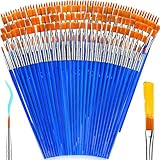
- 【162-Piece Bulk Set | Dual Brush System】Maximize versatility with 81 flat brushes (0.59 inch edge for bold strokes) and 81 round brushes (0.39 inch tips for details) – 3X more tools than standard kits! Pre-sorted in labeled compartments for instant access during painting sessions. Ideal for art classrooms, mural projects, and multi-artist households.
- 【Pro-Grade Durability | Zero Shedding Guarantee】 "Engineered with triple-crimped nylon bristles (43% higher resilience vs. standard) and aerospace aluminum ferrules tested for 10,000+ flex cycles. Lab-verified 0.01% shedding rate even with heavy impasto techniques – outperforms flimsy bristles in budget brushes."
- 【Multi-Scenario Readiness | Event & Daily Use】 Optimized for: Thanksgiving/Christmas face designs classroom projects ceramic decorating fabric printing and model painting; Lightweight plastic handles each reduce hand fatigue during prolonged sessions
- 【Effortless Maintenance | Long-Term Durability】 Clean with warm soapy water in 10 seconds; Reshape tips and air-dry vertically to preserve bristle integrity,After use, air-dry brushes thoroughly and store upright in the provided case to preserve bristle shape. The premium nylon filaments naturally regain their original form after each stroke. For cleaning, simply rinse in warm soapy water and gently reshape bristles with fingertips."
- 【Multiple Application】These acrylic paint brushes can be applied for most occasions,such as:watercolor,oil, gouache paint,face paint, acrylic paint, suitable for Thanks Giving Day, Christimas, Halloween face and body painting, canvas painting, fabric, rock, miniature, model, ceramics, arts and crafts painting, etc.
Frequently Asked Questions
Are hammer types a standardized list of 25?
No. The number here is a practical way to cover commonly named tools and variants, not an official classification. Manufacturer and retailer guides differ in how they group related designs, so compare a hammer’s head and intended task rather than relying on the count or label.
What does “peen” mean on a hammer?
It refers to the shaped end opposite the hammer’s striking face. On a ball-peen hammer that end is rounded; cross-peen and straight-peen names describe variations in its shape or orientation.
Recommended Free Tools
Can a soft-face or rubber hammer guarantee a surface will not be marked?
No. Face materials, hardness and color vary, and some can still leave marks. If a finish is important, try the contact on a hidden area first or use a protective block where suitable.
Why do some guides say “engineering hammer” and others “drilling hammer”?
Some guides list them separately, while others combine them as an engineering/drilling category for heavy striking. The names are not grouped consistently, so check the particular hammer’s design and stated use before choosing it.
Quick Recap


