What’s actually slowing this PC down?
PC Slower Than It Used to Be?
A free scan shows the junk files, broken settings and background clutter dragging Windows down - then fixes them in one click.Free scan · Windows 10 & 11Outdated Drivers Are Slowing You Down
One free scan finds every outdated or missing driver and matches the right update for your exact hardware.Free scan · exact hardware matchPick the symptom - the matching free tool is one click away.
ThatPainter is reader-supported. When you buy through links on our site, we may earn an affiliate commission. Learn More
As an Amazon Associate I earn from qualifying purchases.
Do not wallpaper directly over a textured or popcorn ceiling. The texture can prevent full adhesion, telegraph through the paper, and create a failure that is difficult to repair overhead. Wallpaper manufacturers generally require a smooth, clean, dry and sound substrate. Before disturbing an older ceiling, establish whether the texture could contain asbestos; if that possibility has not been ruled out, stop and arrange testing under your local rules. For a confirmed non-asbestos ceiling, remove or level the texture, repair and sand the surface, apply a compatible primer, and use a wallcovering and adhesive whose instructions allow ceiling installation.
The workable sequence is therefore test first, make the ceiling planar, prime it, then install with adequate support—not “paste over the popcorn and hope.”
Popular on Amazon

- All-In-One - Popcorn Ceiling Scraper Tool Kit with 1-Gallon Pump Sprayer – Softens popcorn texture for effortless scraping, delivers smooth results, and keeps your DIY ceiling renovation clean, fast, and hassle-free with less mess and more control.
- Durability – Built from heavy-duty stainless steel, this scraper won’t bend, warp, or break under pressure. Stronger and longer-lasting than other flimsy drywall tools, it’s designed to handle project after project with reliable performance.
- Spray Quality – Featuring an adjustable nozzle, the 1-Gallon Pump Sprayer delivers a consistent, fine mist that softens popcorn ceiling texture for effortless scraping. Its versatile design also works for walls, ceilings, and outdoor lawn or garden projects year-round.
- Ease of Use – This lightweight scraper and sprayer combo is made for DIY homeowners. Simply spray to soften, scrape to remove, and patch for a smooth finish. Get professional-looking results quickly and affordably—no need to hire contractors.
- Value – This complete popcorn ceiling removal kit saves you money by replacing multiple tools in one package. Skip buying drywall knife sets, putty knives, or expensive popcorn ceiling remover vacuums—get everything you need in one simple solution.
Can you wallpaper directly over a textured or popcorn ceiling?
Direct application is unreliable and is not recommended by major wallcovering suppliers. Spoonflower says installation is not recommended on textured walls, explicitly including orange-peel, knockdown and popcorn finishes. Rifle Paper Co. says it cannot guarantee adhesion over textured walls and warns that the texture may show through. Astek Home similarly says its material does not stick well to heavily textured, rough, uneven or porous surfaces.
Ceiling paper is exposed to gravity across its entire area. A few high points may hold while valleys remain poorly bonded, leaving blisters, open seams or sagging sections. Even if the paper initially appears flat, the texture can become visible as light moves across the ceiling. A smooth substrate is the basic condition for a durable installation, not a cosmetic extra.
Why does popcorn texture cause wallpaper to fail?
Wallpaper needs broad, continuous contact with a stable surface. Popcorn and other stippled finishes interrupt that contact in several ways:
Recommended Free Tools
- Reduced contact area: adhesive touches the tops of the texture instead of forming a continuous bond.
- Telegraphing: bumps and ridges can print through thin paper, especially with side lighting.
- Uneven drying: thick and thin adhesive zones can dry at different rates, stressing seams.
- Mechanical movement: weakly bonded texture may release from the ceiling when it becomes damp or loaded.
- Harder repairs: a loose patch under wallpaper cannot be sanded or reattached without removing the covering around it.
Adding a heavier wallcovering over an irregular surface also increases the demand on the adhesive and on whatever is holding the texture to the ceiling. Sherwin-Williams cautions that adding material over texture can add weight and create adhesion problems when the preparation is inadequate.
What condition must the ceiling be in before wallpapering?
DESARDI’s ceiling instructions call for a surface that is “smooth, solid, dry and free of mold or algae.” The Wallcoverings Association likewise describes the substrate as clean, dry and structurally sound, with textured surfaces receiving suitable preparation first.
In practical terms, the finished plane should have no loose texture, powdery residue, active dampness, mold growth, grease, ridges or unfilled gouges. Joints, cracks and fastener depressions must be repaired so that they cannot telegraph through the paper. A surface that looks acceptable from the floor can still reveal defects when a ceiling light washes across it, so inspect with strong, angled light before priming.
How does asbestos change the project?
Asbestos status comes before scraping, sanding, wetting, drilling or any other disturbance. Popcorn ceilings installed in older buildings can contain asbestos, and the exact risk depends on the building’s age, materials and local history. Home Depot and PPG both advise testing before removing a popcorn finish; confirmed asbestos work should be handled by a certified abatement contractor in accordance with local requirements.
Free tools Windows power users keep installed
One-click scans. No signup required.
Also popular on Amazon

- 0.6mm STIFF Blade ›› With a 3.5” deep blade, this STIFF version is ideal for applying/smoothing joint compound on walls and ceilings, as well as for filling joints and outside corner beads. This sturdy blade also works great for scraping applications, such as removing popcorn ceilings. Features a square-edge stainless steel blade.
- Handle offset slightly from the blade edge. This design enables you to lay the blade flatter against the wall for a smoother, tighter finish. Produce a top notch finish easier and more efficiently, while simultaneously reducing wrist and hand fatigue.
- Ergonomic handle design that enables you to mount the knife to a standard painter’s pole or a LEVEL5 extendable skimming blade handle (using the included adapter with 180+ degrees of angle adjustment for perfect comfort).
- Threaded, removable die-cast zinc hammer end can be used to reset drywall screws. Also protects from mud accumulation inside handle when angle adapter is not used.
- LIFETIME GUARANTEE ›› LEVEL5 Offset Finishing Knives come with the company’s legendary Lifetime Guarantee against defects in materials and workmanship.
If asbestos is possible:
- Stop work and do not scrape, sand, drill, wet or break the texture.
- Check your local authority’s rules for sampling, laboratories, contractor licensing and disposal.
- Arrange a properly collected test or a qualified inspection. A consumer kit does not replace compliance with local sampling and abatement rules.
- Use a licensed abatement professional if asbestos is confirmed or if regulations require one.
Wallpaper, liner or a new board layer does not make an untested ceiling safe to disturb. If the existing finish must remain in place, a qualified professional must determine whether an approved encapsulation or overboarding system is appropriate; do not improvise one beneath wallpaper.
Which preparation method is best for a textured ceiling?
There is no universal fix. Choose after checking texture depth, how firmly it is bonded, the condition of the underlying ceiling, the amount of dust and mess you can manage, access for ladders or platforms, and how much ceiling height can change.
| Preparation route | Best fit | Main trade-offs |
|---|---|---|
| Remove texture, then patch, sand and prime | Verified non-asbestos texture that is loose or shallow and can be removed without damaging the substrate | Dust, debris and overhead work; scraping can reveal extensive joints or imperfections that then need repair |
| Skim-coat or level over sound texture | Firmly bonded texture where a competent finisher can create a continuous plane | Adds material and weight; poor bonding, movement or an incomplete coat can cause later failure. A test area and professional assessment are prudent. |
| Overboard with plasterboard, then finish | Deep or difficult texture, or a room where covering is cleaner than removal | Lowers the ceiling, adds weight and finishing work, and can affect coving, light fittings, fans, smoke alarms and other details. |
| Use wallpaper liner after smoothing | Minor residual irregularities after the ceiling is safe, stable and substantially flat | A liner is not a substitute for asbestos testing, structural repair or removal of heavy popcorn. Its own seams and adhesive still require careful management. |
Compare the routes on safety, texture depth, substrate condition, dust, access, final smoothness, adhesion reliability, ceiling-height changes and disposal rules. If the texture is painted, removal may require a different method from unpainted texture; follow the chosen product’s instructions and local guidance rather than forcing a wet-scrape technique.
How do you prepare a confirmed non-asbestos ceiling?
Once testing and local requirements have cleared the work, use this order. Each stage protects the next one.
The Tool Desk
Outbyte Driver Updater FREEScan for outdated or missing drivers - takes under a minuteDriver Scan →Outbyte PC Repair FREERepair Windows errors before they cause bigger problemsFix Now →1. Document the ceiling and protect the room
Identify previous leaks, repairs, paint layers and any areas that sound hollow or move. Turn off and protect light fixtures, fans and smoke alarms as appropriate, and cover floors, furniture and wall edges. Plan safe access: an overhead job is not a reason to stand on the top step of a ladder or reach beyond a stable position.
2. Remove or level the texture
For approved non-asbestos removal, follow the material and tool instructions. Unpainted texture may be lightly wetted when the guidance permits, then scraped carefully and contained. Painted texture can resist wetting and may need another approach. Avoid gouging the gypsum or plaster; every gouge becomes a repair that must be flattened before wallpapering.
If you skim-coat or overboard instead, the new layer must be bonded and fastened as the system requires, with joints fully finished. Do not assume that a thick coat automatically locks down a weak, moving texture.
Also popular on Amazon
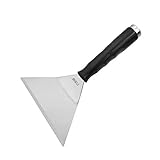
- 【Wide Usage】: Special for overhead and hard-to-reach scraping jobs. Comfortable ABS threaded handle fit CHILI long extension poles for overhead or hard-to-reach scraping work.
- 【Premium Material】: Made by Japanese stainless steel 420J2, with the features of corrosion-resistant, hardened, and tempered blades, suitable for any heavy-duty scraping jobs.
- 【Extra Thickness & Width】: Rigid stainless steel blade with 1.8MM thickness for superior strength and durability. 7" large blade enhance work efficiency, save your time.
- 【Bent Chisel Blade】: Rigid Bent Blade ensures easy scraping of paint, glue, and removing putty and wallpaper for refinishing jobs.
- 【Manufacture 】: Specialized grind technology ensure that the edge of blades are resistant to bending / breaking. Manufacturing by CHILI. High-quality assurance.
3. Repair, fill and sand
Fill scraper marks, cracks, joints and fastener depressions with a compatible repair compound. Sand high spots and feather edges until the ceiling reads as one continuous plane under angled light. Remove all sanding dust; residual powder can interfere with primer and adhesive.
Do these 3 things before closing this tab:
1Clear out junk files and repair common Windows errors2Scan for outdated or missing drivers - takes under a minute3Repair Windows errors before they cause bigger problems4. Confirm dryness and cleanliness
Resolve leaks or condensation before covering the ceiling. Do not paper over mold, algae, damp patches, friable plaster or a surface that is still shedding dust. DESARDI’s requirement for a dry, solid surface is especially important overhead, where a small failure can spread across a large sheet.
5. Prime the prepared surface
Use a compatible wallpaper or pre-wallcovering primer over repairs and absorbent gypsum or plasterboard. Sherwin-Williams specifies priming repaired areas before wallcovering. Primer helps regulate absorption, improves slip during positioning and can make future removal less damaging, but it cannot compensate for ridges, loose texture or moisture.
6. Test a small area
The Wallcoverings Association recommends a test installation when surface suitability is uncertain. Choose an inconspicuous section, use the proposed primer, adhesive and paper, and observe whether the paper bonds evenly without the substrate moving or showing through. A small test is a suitability check, not proof that an unprepared popcorn ceiling is acceptable.
How should wallpaper be installed on a ceiling?
Use a wallcovering whose manufacturer expressly permits ceiling installation and follow its exact acclimation, paste, booking, seam and support instructions. Ceiling work is a two-person, overhead operation: one person supports and aligns the sheet while the other manages the free length and smoothing.
- Plan the layout. Establish a reference line and decide where seams will fall in relation to lights and the room’s sight lines. Account for the pattern repeat before cutting.
- Prepare the adhesive. Use the adhesive specified for the wallcovering and ceiling substrate. DESARDI recommends a premixed PVA-based adhesive for its ceiling application; that is product-specific guidance, not a universal substitute for the paper manufacturer’s instructions.
- Apply evenly. Spread adhesive at the rate and with the tool specified by the product. DESARDI gives roughly 200 grams per square metre as an application rule of thumb for its guidance; it is not a universal coverage rate.
- Position with support. Keep the sheet supported while it is aligned. Do not let a long, adhesive-coated length hang unsupported, which can stretch the paper or overload a still-wet bond.
- Smooth without damaging the face. Work from the centre outward with the recommended brush or roller, pressing out air without forcing adhesive into seams or abrading the print.
- Manage seams and edges. Keep joins tight as directed—some products require butt seams rather than overlaps. Wipe excess adhesive promptly with the method approved for the paper.
- Allow the system to cure. Protect the room from impact, steam and disturbance for the period stated by the product instructions. Do not judge adhesion while the adhesive is still wet.
Protect floors and fixtures throughout. Wear eye protection when scraping or sanding overhead, contain debris, and keep ladders or platforms on a stable, unobstructed surface.
Independent reader supportYour contribution helps us test, update, and keep practical guides available for everyone.What tools and materials are normally required?
The exact list depends on the chosen preparation route, but a typical non-asbestos project may require:
Also popular on Amazon

- 0.6mm STIFF Blade ›› With a 3.5” deep blade, this STIFF version is ideal for applying/smoothing joint compound on walls and ceilings, as well as for filling joints and outside corner beads. This sturdy blade also works great for scraping applications, such as removing popcorn ceilings. Features a square-edge stainless steel blade.
- Handle offset slightly from the blade edge. This design enables you to lay the blade flatter against the wall for a smoother, tighter finish. Produce a top notch finish easier and more efficiently, while simultaneously reducing wrist and hand fatigue.
- Ergonomic handle design that enables you to mount the knife to a standard painter’s pole or a LEVEL5 extendable skimming blade handle (using the included adapter with 180+ degrees of angle adjustment for perfect comfort).
- Threaded, removable die-cast zinc hammer end can be used to reset drywall screws. Also protects from mud accumulation inside handle when angle adapter is not used.
- LIFETIME GUARANTEE ›› LEVEL5 Offset Finishing Knives come with the company’s legendary Lifetime Guarantee against defects in materials and workmanship.
- Approved popcorn-ceiling scraper and debris-containment materials
- Repair compound, joint tape where needed, sanding tools and dust-control equipment
- Compatible wallpaper or pre-wallcovering primer
- Ceiling-rated wallpaper, pattern-layout tools and a sharp cutting knife
- The manufacturer-specified ceiling adhesive, brush or roller, seam roller if permitted, and smoothing brush
- Stable ladder or platform, drop cloths, masking materials and eye protection
A “popcorn ceiling scraper” is suitable only for a cleared, non-asbestos removal project. An asbestos test kit, wallpaper liner, wallpaper primer and ceiling adhesive are supporting categories, not substitutes for a safe substrate.
What mistakes should you avoid?
- Skipping asbestos screening: age or appearance alone cannot clear a ceiling for disturbance.
- Papering over visible bumps: paper does not flatten popcorn; it records the profile and makes repairs harder.
- Using ordinary wall adhesive by assumption: ceiling load and the paper’s backing may require a specified product.
- Covering dampness or mold: wallpaper can hide the symptom while the substrate continues to deteriorate.
- Ignoring added weight: skim coats, liners and board all add load; weak texture or poor bonding can let the system fail.
- Working alone: long sheets are difficult to support and align safely overhead.
- Relying on a liner to hide heavy texture: liner may help with minor residual irregularities only after the ceiling is sound and substantially smooth.
- Failing to check fixtures: a lowered or overboarded ceiling can change the fit of lights, fans, coving and alarms.
When should you hire a professional?
Bring in a qualified contractor when asbestos is possible or confirmed, the ceiling has multiple paint layers, the texture is deeply bonded, the substrate moves or has water damage, or the room cannot be safely accessed from a stable platform. Professional finishing is also sensible when a skim coat must be perfectly flat: wallpaper will reveal broad waves that ordinary ceiling paint may disguise.
Ask the contractor to explain the preparation system, how the substrate will be verified as sound, which primer and adhesive are specified, how fixtures will be handled, and how debris will be disposed of. For asbestos work, verify the required certification and local compliance before any disturbance.
Is wallpaper on a prepared ceiling worth it?
It can be, when the ceiling is legally safe to prepare, genuinely flat and dry, and the chosen wallcovering is approved for overhead use. The visual result depends more on preparation and adhesive compatibility than on the paper alone. If achieving that substrate requires extensive repair, overboarding or specialist abatement, compare the labor, dust, lost ceiling height and future repair implications with other finishes before committing.
Frequently Asked Questions
Can I wallpaper a painted popcorn ceiling without scraping it?
Not as a routine shortcut. Paint can change how texture absorbs moisture and how a skim coat or adhesive bonds, while the underlying popcorn may still be weak or asbestos-containing. Have the ceiling assessed and cleared first, then use a preparation system designed for that specific surface.
Will a wallpaper liner hide every ceiling imperfection?
No. A liner can reduce the appearance of minor, residual irregularities after the ceiling has been repaired and leveled, but it will not make heavy popcorn disappear or stabilize a moving substrate. Its seams and adhesive also remain part of the ceiling system.
Quick wins for a faster PC:
Fix the driver behind crashes, sound loss and screen glitchesFind Drivers →Repair Windows errors before they cause bigger problemsFix Now →Scan for outdated or missing drivers - takes under a minuteDriver Scan →Can I install ceiling wallpaper by myself?
Manufacturers such as DESARDI recommend two people because a long adhesive-coated sheet must be supported while it is aligned and smoothed. Working alone increases the chance of stretched paper, misplaced seams and unsafe ladder movements.
Does overboarding change the position of lights and fans?
It can. Plasterboard adds thickness and weight, so junction boxes, downlights, fan housings, coving and alarms may need compatible extensions or repositioning. Have electrical and fire-safety details checked as part of the overboarding plan, rather than trimming the finished wallpaper around an unsuitable fitting.
Quick Recap


