Outdated Drivers Are Slowing You Down
Outbyte Driver Updater · freeOne free scan finds every outdated or missing driver and matches the right update for your exact hardware.
Scan My Drivers Free →ThatPainter is reader-supported. When you buy through links on our site, we may earn an affiliate commission. Learn More
Verdict: The eufyMake E1 is a capable desktop UV printer for premium, personalized products that need full color, white underlayers, gloss effects or raised texture. It can print directly on many flat and cylindrical objects, but it is not a conventional 3D printer, an inexpensive home printer or a fast production press. Buy it when tactile decoration and short-run customization can support premium prices; skip it if you need low-cost, high-volume output or cannot provide ventilated workspace and regular maintenance.
At the time checked, eufyMake’s US pages showed prices from $2,199 for a printer-only/no-ink configuration to $3,299 for a deluxe bundle. Displayed prices vary by page, bundle and coupon, and ink is required but sold separately in the no-ink configuration. See the current E1 product page before ordering.
As an Amazon Associate I earn from qualifying purchases.
Quick wins for a faster PC:
Fix the driver behind crashes, sound loss and screen glitchesFind Drivers →Repair Windows errors before they cause bigger problemsFix Now →Scan for outdated or missing drivers - takes under a minuteDriver Scan →What the E1 is—and is not
The E1 is a piezoelectric UV-curable inkjet printer. It lays down cyan, magenta, yellow and black ink, with white and gloss channels for opaque undercoats, highlights and shine. UV light cures each deposited layer. By stacking layers, its Amass3D workflow creates raised relief rather than merely printing a flat image.
That makes it sit between a 2D inkjet and a resin 3D printer, as Tom’s Hardware explains. It decorates an existing object; it does not build a freestanding plastic part. Its modes are:
#1 Best Overall

- PERFECT CUSTOM FIT: Custom-designed for the eufyMake E1 3D Printer, this dust cover fits precisely over the machine to provide reliable protection when not in use. Please confirm your printer model before purchase.
- DUSTPROOF & SPLASH-RESISTANT: Effectively protects your 3D printer from dust accumulation and accidental splashes in indoor environments. Keeps your machine clean and ready for the next print.
- SECURE & STABLE FIT: Elastic drawstring hem ensures a snug, secure fit that stays in place. Helps prevent dust from entering through gaps while maintaining a clean, organized workspace.
- EASY TO USE & STORE: Designed for quick on and off with a reinforced top handle. When printing, the cover folds compactly and can be neatly stored using the elastic strap or hanging loop.
- DURABLE PREMIUM FABRIC: Made from thick, high-quality textured fabric that resists wear and deformation. More durable than ordinary dust covers for long-term indoor use.
- Flat UV printing: full-color graphics on a prepared surface.
- 3D-texture printing: repeated white and gloss layers create tactile relief, advertised up to 5 mm.
- Rotary printing: an optional attachment turns hard cylindrical items such as mugs and tumblers.
- UV DTF: an optional laminator applies printed transfer film to objects that cannot be positioned conveniently in the printer.
The six 100-ml cartridges reported by Notebookcheck are cyan, magenta, yellow, black, white and gloss. A separate cleaning cartridge handles cleaning, moisturizing and waste-ink collection; the manual specifies original ink and cleaning cartridges rather than third-party replacements (manual).
Key specifications and physical requirements
| Specification | Reported value |
|---|---|
| Printer type | Piezo inkjet with UV-curable CMYK, white and gloss |
| Standard flatbed area | 330 × 420 mm |
| Mini flatbed area | 330 × 90 mm |
| Advertised resolution | 1,440 DPI |
| Advertised maximum raised texture | 5 mm |
| Reported maximum object height | 60 mm (Notebookcheck; different from texture height) |
| Dimensions | 590 × 250 × 407 mm |
| Weight | 20 kg / 44 lb |
| US power | 110 V, 60 Hz; maximum output 66 W |
| Software | eufyMake Studio for desktop and mobile |
| Reported camera | 8 MP (Notebookcheck) |
The 5-mm figure describes raised ink relief. It is not the same as the 60-mm object-height figure or the approximately 5-mm surface-height variance discussed for positioning. The nominal 250-mm depth is also misleading for installation: the manual calls for roughly 40 cm clearance front and back and 30 cm on each side. Plan for the printer, blanks, ink storage and access space on a stable, level surface.
Materials: broad compatibility, specific preparation
eufyMake advertises compatibility with more than 300 materials, including metal, wood, acrylic, ceramic, stone, glass, canvas, leather, fabric, film and plastic (official list). That is a compatibility claim, not a promise that every substrate will have the same adhesion, appearance or durability.
- Rigid coated surfaces: metal, ceramic, acrylic, wood and stone can produce crisp graphics when clean, level and properly prepared.
- Canvas, leather and fabric: texture can be attractive, but flexing may crack or distort thick relief. Flexible materials may need flexible white ink, as Tom’s Hardware notes.
- Plastic blanks: thin PLA pieces can warp during printing or curing; Tom’s Hardware obtained better results from PETG or ASA with suitable jigs.
- Glass and transparent acrylic: reflections, refraction and background interference can confuse automatic contour detection. The manual therefore qualifies the otherwise broad transparent-material positioning claim; expect manual alignment and test prints.
- Cylinders: the rotary module is intended for hard, round objects, not every tapered, soft or irregular product.
Surface color, porosity, coating, flexibility, height variation and cleaning all affect results. Test adhesion and abrasion on the actual blank and follow the ink and substrate manufacturer’s cleaning instructions. Do not assume dishwasher, outdoor or industrial durability without product-specific testing.
Print quality and texture in practice
Independent reviews describe the E1’s output as excellent, with saturated color, strong detail, opaque white and convincing gloss on substrates including canvas, metal, ceramic and plastic (WIRED; Tom’s Hardware). White is especially useful on dark or transparent blanks because it separates the color image from the substrate. Painting a surface white can reduce white-ink use in some workflows, but changes the finish and must be tested.
Rank #2

- Overall structure: This is a desktop UV DTF crystal marking printer. The printer measures 90*65*53 cmin size print the max width is 33cm (13inch)and weighs 38 kg. It is an all-in-one machine with a white and blue casing and automatic laminating at both the front and back.
- North American Power Compatibility: Uses 110v power supply, compatible for direct use in USA, Mexico, and Canada without additional converters.
- System device: printer installed One DX7 printhead , 8 colors,( KCMY WW VV ) .each hour can print 1.5 to 2Square meters, the print accuracy upto 1440dpi, very colorful and smoothly.UV DTF printer software is English language , it is easy to to use and install , software support the windows system , such as windows 7, windows 10 , windows 11 . we offer the technical support to setup by videos. step by step , make sure it can work smoothly.
- Application:It is used to produce crystal label transfer stickers that can be adhered to surfaces of materials such as metal, glass, plastic, ceramic, Customized stickers made of materials such as wood boxes and leather. After printing, simply press it and the transfer will be completed.
- Printer is easy to maintenance , the machine can do cleaning automatic by software, and do cleaning automatic ,so, you no need to clean the hand by hand. We offer one year warranty for the printer parts, but the printhead we offer three month warranty.
Relief is both visual and tactile. Fine lettering and logos can feel raised, while a large image may read mostly as a glossy or matte surface until touched. Sharpness depends on layer height, artwork, substrate flatness and curing. A 5-mm maximum is a capability ceiling, not an economical setting for routine work.
Recommended Free Tools
Durability is conditional. Ink stack, pretreatment, curing, flexing and handling determine whether a print scratches, washes or cracks. Validate a production recipe on each material before selling it as washable or outdoor-safe.
How much time and ink does texture use?
Raised work is where the E1’s economics change. In Tom’s Hardware’s test, a 2-mm textured canvas took 6 hours 55 minutes and consumed approximately 46.27 mL of ink; white and gloss accounted for most of the usage. The reviewer estimated about $19.89 of ink for that print, plus roughly $2 for the canvas. A smaller 0.4-mm phone-case texture used 4.5 mL and took 1 hour 12 minutes. These are individual tests, not universal job estimates.
Higher relief, larger area, repeated layers and failed attempts increase consumption. White and gloss can empty far faster than CMYK, so a nominal six-cartridge set is not a balanced production allowance. Notebookcheck reported $43 per cartridge at review time; verify current pricing and subscription terms before calculating margins.
Build a realistic unit-cost model
- Printer and selected bundle.
- CMYK, white, gloss and cleaning cartridges.
- Air filters, sticky mats and replacement bed materials.
- Blanks, jigs, test pieces and failed prints.
- Electricity, ventilation and workspace upgrades.
- Labor, design time, calibration and packing.
- Marketplace fees, shipping, refunds and customer-service time.
- Rotary, DTF or future roll-to-film accessories.
- Provision for printhead service or replacement.
eufyMake’s sample profit calculations use average Etsy selling prices and average Amazon material costs; they do not establish your net profit. Price each product from your own selling price, labor, failure rate and ink measurement.
Rank #3

- ❤️Two Year Ink Supply - With your printer purchase, you’ll receive a two-year supply of ink-6 bottles (500ml each) ! Get a new set every two months, and you only need to cover the shipping.
- 2025 Upgraded White Ink Circulation & Auto-Cleaning - Equipped with a built-in white ink circulation system, the DXZ A3 UV printer keeps white ink from settling and prevents nozzle clogging. Its intelligent auto-cleaning function significantly reduces manual maintenance and extends printhead lifespan—ideal for consistent, high-volume printing without interruption. Compared to other brands that require frequent manual flushing, DXZ ensures smoother, worry-free operation.
- High-Definition 6-Color Printing with L805 Head - Featuring the L805 6-color printhead (CMYK+WW), this UV printer achieves ultra-sharp 2880 x 1440 DPI resolution with vibrant, layered color output. It prints embossed textures for a professional finish and supports a wide range of materials like phone cases, acrylic, crystal, leather, metal, glass, PVC, ABS, and more—perfect for both personal crafts and commercial applications.
- Built-in Vacuum Suction Platform for Perfect Alignment -The integrated vacuum platform keeps printing materials firmly in place during the entire print cycle, ensuring precise positioning without shifting or warping. Whether printing on light films or heavy boards, you get accurate, repeatable results with minimal adjustment—outperforming machines that rely on manual alignment or tape.
- Complete Starter Package – All-in-One Value - Each unit comes with everything you need to start printing right away: A3 UV printer, 6 × 500ml UV inks, bottle holder, printing software, cleaning accessories, and a USB flash drive with setup guides and video tutorials. Unlike other brands that sell basic bundles, DXZ offers a true all-in-one printing solution—excellent value with no hidden costs.
Setup, calibration and daily workflow
The machine arrives largely assembled, and Tom’s Hardware found initial connection relatively quick. A practical first setup is:
- Place the E1 level in a well-ventilated area with the manual’s clearance.
- Remove shipping restraints and install the six ink cartridges, cleaning cartridge and air filter.
- Connect power and install eufyMake Studio from the official software page.
- Run initial calibration and firmware updates.
- Load the mini or standard flatbed; recalibrate when changing platforms if prompted.
- Place a clean, stable substrate and use the camera and laser measurements to position artwork.
- Import or create the design, then select flat or textured settings.
- Review the estimated time and ink use, send the job and press the physical Start button unless the applicable software setting bypasses it.
The E1 has only two physical buttons and no built-in display, so software and a connected device are central to operation. Follow the current shutdown and cleaning procedure every time. Tom’s Hardware reported a terminal clog after an improper shutdown on an early test unit; that is a reviewer-reported incident, not a published failure rate. The self-cleaning system reduces routine work but does not make maintenance-free operation.
eufyMake Studio and AI features
Studio handles artwork import, positioning, camera-based substrate recognition, job estimates, firmware and printing from desktop or mobile. eufyMake promotes more than 20,000 templates, AI texture generation, background removal and style transfer (product page).
These design aids are optional; core printing does not require generative AI. Tom’s Hardware found some AI effects unpredictable and reported token charges for certain generations. Treat previews as starting points, inspect the actual relief and color, and confirm whether a feature uses tokens, a subscription or a free allowance before building a workflow around it.
Recommended Free Tools
Ventilation, safety and ownership burden
UV-curable ink and intense UV light make ventilation a practical requirement. The manual calls for good air circulation, and WIRED lists dedicated space and ventilation among the E1’s principal drawbacks. The built-in filter should not be treated as proof that an unventilated room is safe. Consult the current manual, safety data sheets, local requirements and the manufacturer’s operating instructions; store ink securely and keep the work area suitable for UV equipment.
Rank #4
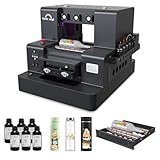
- 【Upgraded UV Printer】The Rainbowdgt UV Printer Upgrade Edition features a white ink circulation and agitation mixing system, effectively preventing sediment buildup from clogging nozzles. The infrared auto-height adjustment system and self-cleaning printhead mechanism significantly reduce manual maintenance requirements. Supports printing with a glossy finish, offering waterproof, UV-resistant, and scratch-resistant properties to add a professional touch to your printed works.
- 2-Year Ink Supply - With your printer purchase, you’ll receive a two-year supply of ink-6 bottles (500ml each) ! Get a new set every two months, and you only need to cover the shipping.Minimize your production costs with our exclusive two-year ink supply service
- 【360° Versatile Cylindrical Printing 】 Equipped with a professional rotary bottle holder for high-precision 360° printing. Easily customize water bottles, tumblers, and glassware with professional-grade wrap-around graphics and exceptional accuracy
- 【Professional Stickers 】 Optimized for high-resolution stickers and realistic 3D effects. Create durable, waterproof, and UV-resistant custom stickers and labels that stand out with professional texture and vibrant colors
- 【Stable Integrated Vacuum Platform 】The built-in vacuum suction bed keeps thin films, stickers, and lightweight materials perfectly flat and secure during the printing process. Eliminates the risk of shifting for crisp, accurate details every time
Expect proprietary consumables, periodic cleaning, cartridge management and careful shutdown. Edge-to-edge jobs can leave overspray on the platform; Tom’s Hardware reported that protective coverings were useful while replacement-mat pricing was unclear. Check current accessory availability before committing to a production volume.
Rotary, DTF and roll-to-film options
| Option | Best use | Important qualification |
|---|---|---|
| Rotary attachment | Direct printing on hard mugs, tumblers and jars | WIRED reported about $400; suited to round rigid objects, not every shape |
| UV DTF laminator | Transfer stickers to objects unsuitable for direct placement | WIRED reported about $400; more versatile for irregular products but adds film and lamination steps |
| Roll-to-film attachment | Batch stickers, posters and signs | eufyMake describes up to 10 m of textured printing; availability and shipping timing must be verified |
The deluxe bundle is materially different from the base printer because it includes rotary and UV DTF equipment according to the official presentation and independent coverage. Compare the included ink, accessories and warranty terms rather than comparing bundle names alone.
Business fit: where the E1 earns its space
Strong fits
- Premium personalized gifts, phone cases, magnets and patches.
- Short runs of textured logos and promotional products.
- Custom ceramic, metal, wood or leather goods at craft fairs.
- Art reproductions and raised signage.
- Mug and tumbler decoration with the rotary attachment.
- Add-on personalization for an existing laser-cutting or 3D-printing business.
Weak fits
- Commodity mugs competing mainly on price.
- Hundreds of units per day or unattended production.
- Large-format signage.
- Occasional use that cannot justify maintenance and ink waste.
- Products needing guaranteed outdoor or industrial durability without substrate testing.
- Buyers seeking open consumables or one machine to replace a laser, sublimation, textile DTF and 3D printer.
Tom’s Hardware’s conclusion is the useful distinction: the E1 is a strong creative tool, but not a substitute for a high-throughput print shop.
How it compares with other workflows
- Sublimation: less expensive for compatible polyester and coated products, but no direct printing across the E1’s material range and no raised ink relief.
- UV DTF outsourcing: avoids capital cost for occasional transfers, while sacrificing the E1’s rapid iteration and direct-print control.
- Laser engraving: excellent for durable single-color marks and cutting, but not photographic full color or tactile ink layers; it can complement the E1.
- Conventional 3D printing: better for freestanding prototypes and parts, not direct decoration of finished mugs, metal, ceramic or wood.
- Commercial UV flatbeds: faster and more production-oriented, but generally require much more capital, space, installation and service. The E1’s appeal is its smaller-business entry point, not commercial speed.
- xTool O1/O1 Omni: a broader cutting and engraving platform for multifunctional makers (official site), but not a one-for-one replacement for UV texture.
- Bambu Lab H2D: centered on 3D fabrication and prototyping (official site), not direct full-color object printing.
Price, warranty and support checks
US price displays have included $2,199 printer-only/no-ink, $2,409 on another rendering, $2,499 basic and $3,299 deluxe; WIRED reviewed a $2,299 discounted price. Confirm the exact country, ink inclusion, accessory list and coupon at checkout. eufyMake’s product page states a one-year E1 warranty, three-month printhead coverage, a 24-hour response target and lifetime support on one rendering. These are manufacturer policy claims, not unconditional guarantees; read the current warranty and return terms. Optional eufyMake Care advertises a free first printhead replacement and 30% off later replacements.
Decision checklist
Buy when all of these are true:
- Your products need direct UV color or raised texture.
- You can charge a premium and print regularly enough to use consumables.
- You have ventilated space, clearance and safe ink storage.
- You accept proprietary software, cartridges and maintenance.
- Your volume is made-to-order or short-run rather than industrial.
- You can test each substrate for adhesion and durability.
Skip it when you mainly need ordinary paper printing, inexpensive flat decals, a few prints per month, open consumables, hundreds of daily units or a compact unventilated home-office appliance.
The Bottom Line
The E1’s differentiator is tactile, full-color UV decoration on finished objects. Its premium price, white-and-gloss ink use, slow relief jobs, ventilation needs and maintenance make it a specialist business tool—not a general-purpose printer. For a maker with premium products, reliable volume and a suitable workspace, it can add capabilities that sublimation, laser engraving or a conventional 3D printer cannot. For everyone else, outsourcing UV DTF or choosing a simpler process is likely the better value.
Quick Recap

Product prices and availability are accurate as of the date/time indicated and are subject to change. Any price and availability information displayed on Amazon at the time of purchase will apply.
Quick wins for a faster PC:
Fix the driver behind crashes, sound loss and screen glitchesFind Drivers →Repair Windows errors before they cause bigger problemsFix Now →Scan for outdated or missing drivers - takes under a minuteDriver Scan →



