What’s actually slowing this PC down?
Free tools Windows power users keep installed
One-click scans. No signup required.
Pick the symptom - the matching free tool is one click away.
ThatPainter is reader-supported. When you buy through links on our site, we may earn an affiliate commission. Learn More
As an Amazon Associate I earn from qualifying purchases.
Comic strip criticism is the close reading of a strip’s images, words, timing, production conditions, and cultural assumptions. A strong critique does more than decide whether a strip is funny or well drawn: it explains how the page creates an effect, what readers must infer, and how publication history and social context shape that meaning. The practical method below begins with visible evidence—panels, gutters, lettering, composition and comic timing—then moves outward to newspapers, syndication, audiences, ideology and reception.
What is comic strip criticism?
Comic strip criticism treats a strip as both an artwork and a historical document. You describe what happens on the page, analyze the formal devices that make it happen, and then ask what the strip reveals about the culture and publishing system that produced it. The order matters: context should clarify observable choices, not replace close reading.
Popular on Amazon

- Great Value Paint Brush Set: Soucolor 20 acrylic paint brushes come in 10 different sizes, making them ideal for fine detailing, model painting, rock painting, nail art, face painting, DIY crafts, and general art projects. The varied brush sizes give you better control for both delicate lines and broader color coverage, while the soft bristles deliver smooth, consistent results on acrylic, oil, watercolor, canvas, wood, ceramic, and more.
- Awesome Set of Paint brushes: Professional paint brushes can cover all of your needs. The multi-purposed brushes are ideal for Watercolor, Oil, Gouache, enamel, Acrylic Painting, Body, Nail, Face Painting, Miniature, Model, Wood, Glass, Cup, Ceramic, Fine work, Art class, Craft Art Painting, DIY Art Crafts etc.
- Soft and long-lasting: The bristles are soft and strong, with nickel metal ferrules and blue wooden handles. After cleaning, the bristles will become soft and fluffy again and will not fall off.
- Easy to clean: it’s very convenient to Wash well in soap and water. Retain shape after drying. the brushes hold up very well. Nice selection to beginners and professionals. Keep them clean and they last a long time.
- Perfect for All Painters & Occasions: Suitable for art beginners, hobbyists and professional artists. Great for art class, home creation, travel painting and DIY handmade projects. A practical art gift for students, teachers, family and craft lovers.
There is no universally accepted definition of comic strip. The scholarly debate collected in “Defining Comics?” tests definitions based on sequences of images, mass publication, narrative, image predominance and image-text balance. David Kunzle’s influential account, Will Eisner’s idea of “sequential art,” and Scott McCloud’s definition based on juxtaposed images each illuminate part of the medium, but none works as an exhaustive boundary. Word balloons are common, not mandatory; some strips are continuous stories, while others reset each day. State your working scope at the beginning of an essay instead of treating a disputed category as a fact.
Criticism also has a contested history. Early journalism often dismissed newspaper funnies as slangy, coarse mass entertainment. In the 1920s, modernist writers such as Gilbert Seldes argued that distinctive strips could have democratic and aesthetic value; by the 1960s, substantial criticism had been gathered in David Manning White and Robert H. Abel’s 1963 anthology The Funnies: An American Idiom. The Columbia Journalism Review’s history shows changing standards and institutions, not a simple march from contempt to universal acceptance.
How do you critique a comic strip?
Use the following sequence. Keep notes that separate description (what is visible), interpretation (what it means), and historical evidence (what can be documented).
Recommended Free Tools
- Define the object and edition. Record the strip’s title, creator, date, newspaper or collection, and whether it is a daily, Sunday, reprint or digital presentation. Note cropping, color, scale and missing panels. A reproduction can alter lettering, line weight and pacing, so describe the version you actually read.
- Map the page before interpreting it. Count panels and mark their reading order. Describe panel shape, size, gutters, borders, margins and any break from a regular grid. Ask where your eye is directed first and what is withheld until later. A single large panel may deliver a visual punch line; a sequence of narrow panels can stretch a pause or accelerate action.
- Track framing, scale and composition. Identify long shots, medium views, close-ups, high or low angles, repeated backgrounds and changes in perspective. Follow figures, speech balloons, captions and sound effects as compositional elements, not merely as containers for dialogue. Balloon placement can establish who speaks first, while a caption crossing a border can make narration feel outside the depicted time.
- Describe the line, lettering and visual texture. Consider contour, hatching, filled blacks, color contrasts, lettering style and the treatment of bodies, clothing, architecture and weather. Is the line stable or agitated? Do oversized letters turn a sound into a visual event? Distinguish a deliberate stylistic pattern from a reproduction flaw.
- Reconstruct the time between panels. The gutter is not empty. Readers connect separated moments, infer movement and supply causes. Jared Gardner describes comics as a form that “invites and even requires the reader to become active agents in meaning making” in a 2025 study of Peanuts (Journal of Cultural Analytics). Explain exactly what inference a transition requires: a character’s action, an elapsed night, an off-panel reply or a change from reality to fantasy.
- Locate the comic mechanism. Mark the setup, delay, reversal, incongruity, repetition, misunderstanding, visual gag or deadpan ending. Ask whether the final panel changes the meaning of earlier panels or simply confirms it. If the strip is not primarily comic, identify its suspense, pathos, lyric rhythm or serial cliffhanger instead of forcing a joke structure.
- Compare words and pictures. Do image and text repeat one another, divide information, contradict one another or leave a gap? A caption may claim calm while the drawing shows panic; a balloon may be technically accurate but socially evasive. Explain how the two channels cooperate to produce irony, ambiguity or emotional force.
- Test your interpretation against alternatives. Write one plausible reading based on formal evidence, then ask what another reader could infer from a different panel emphasis, historical position or cultural identity. This step prevents a critic from presenting a personal reaction as the strip’s only meaning.
How do panels and words create meaning?
Panel sequence controls attention and duration. Repeated views can make a routine feel oppressive or establish a visual pattern that a final variation breaks. A sudden change in scale can expose a character’s vulnerability; a silent panel can function as a pause, a refusal to answer or a delayed punch line. Gutters invite closure, but the amount of closure varies: some strips show every stage of an action, while others make the reader invent the crucial middle.
Composition can make social relations visible. A character placed at the edge of a crowded panel may appear excluded; a balloon that occupies another character’s space can turn speech into pressure. Borders may contain a domestic interior, separate parallel actions or be ignored when a figure breaks the frame. Analyze these effects with precise references—“the third panel shifts the speaker behind the doorway” is stronger than “the layout feels dynamic.”
Also popular on Amazon

- COMPLETE 5-PIECE BRUSH SET FOR EVERY PAINTING TASK — Includes 1 Inch Flat, 1.5 Inch Angle, 2 Inch Flat, 2 Inch Angle Stubby, and 2.5 Inch Angle brush giving you every size professional painters use daily. Get all 5 for less than the price of a single brush from hardware store brands — professional grade performance at a fraction of the cost. Perfect for walls, trim, cabinets, doors, furniture, and detailed cutting-in work on any project.
- ZERO BRISTLE LOSS — GUARANTEED BY PRECISION ADHESIVE BONDING — Every bristle is locked in place with precision-set adhesive that keeps them in the brush — not in your paint job. The coated steel ferrule provides structural support while the adhesive bond ensures clean performance on every stroke. Premium SRT synthetic filaments load more paint and release it evenly for a smooth streak-free finish on walls, ceilings, and trim. Works with latex, oil-based paint, primer, sealer, and wood stain.
- INCLUDES THE ANGLE STUBBY MOST SETS LEAVE OUT — Professional painters know the 2 Inch Angle Stubby is the go-to brush for tight cabinet interiors, window sashes, inside corners, and detailed trim where standard angle brushes are too long. Combined with the 1.5 and 2.5 inch angle sash brushes you have precision cutting-in covered at every scale — baseboards, crown molding, door casings, and ceiling lines.
- FLAT BRUSHES FOR BROAD SMOOTH COVERAGE ON ANY SURFACE — The 1 and 2 inch flat brushes deliver even coverage on walls, furniture, shelving, doors, fences, decks, and wood surfaces. Ideal for applying primers, stains, varnishes, polyurethane, and specialty coatings. Solid wood handles provide all-day comfort and control for both professional contractors and weekend DIY homeowners tackling interior or exterior painting projects.
- TRUSTED BY PROFESSIONAL PAINTERS AND CONTRACTORS NATIONWIDE — Pro Grade delivers professional-grade results at a price that makes sense for crews who go through brushes on every job. Ideal for property managers, remodeling contractors, apartment turnover crews, maintenance teams, and commercial painting operations. Backed by thousands of verified reviews from working painters. Washable and reusable for multiple projects.
Lettering has a voice. Hand-drawn capitals, cramped dialogue, ornate display type, wavy baselines and changing balloon shapes signal volume, hesitation, accent, speed or authority. Captions can locate a scene in time, supply an unreliable narrator or create a second register of commentary. Sound effects may imitate noise, but they can also turn an invisible force into a graphic object.
Humor often depends on a mismatch between channels or between expectation and outcome. A verbal setup may direct attention to one object while the drawing quietly prepares another; a repeated gag may establish a rule that the last panel violates. Name the mechanism and its timing. Saying that a strip is “relatable” does not explain why a particular pause, expression or reversal produces recognition.
What historical and material context should you include?
Newspaper production shaped what artists could draw. Daily strips commonly worked within narrow, adaptable grids, while Sunday pages offered more area, color and opportunities for elaborate composition. Layout departments, reproduction technology, deadlines, syndication and the need to fit changing newspaper designs encouraged recurring characters, economical backgrounds and instantly legible action. A strip’s form is therefore partly an industrial solution, not only an individual artist’s style.
Ask where the strip appeared, how much space it received, whether it was sold through a syndicate, and what neighboring material surrounded it. A gag beside an advertisement, editorial or headline entered a different reading environment than the same panel in a modern anthology. Distinguish documented production arrangements from speculation about an artist’s intention. The Roy Rosenzweig Center for History and New Media’s essay on early strips connects economic production, urban marketplace culture and spectatorship to the period’s formal choices (About This Essay).
Early newspaper strips also negotiated realism and fantasy. An essay on the marketplace culture of early comics argues that depictions of urban life could puncture social illusions while offering wish fulfillment; treat that as an interpretation to assess, not a universal law (Culture of the Marketplace). Isabel Ermida’s study of The Yellow Kid proposes moving among structural modes, social functions and semantic mechanisms, a useful model for linking page design to the strip’s role in the press and its humor (John Benjamins study).
Also popular on Amazon

- 【All sizes of art brushes】: The 10 sizes of multi-functional brushes have various shapes, making the mixing color easier, which is very suitable for artists, students, teenagers, children and painters at all levels. Wonderful Present ideas for friends and family who like painting!
- 【general brush set】: Professional paint brush can meet all your needs. Multifunctional brush is very suitable for watercolor, oil, gouache, acrylic painting, body, nail, face painting, miniature, model, ceramics, arts and crafts painting, etc.
- 【high quality process】: It is designed with anti falling bristles, anti-rust nickel ferrule and solid wood handle. You can use the brush to focus on the painting and always be creative.
- 【easy to maintain】: After using the brush, it is very convenient to clean the brush with warm soapy water and reshape the tip of the brush. Air dry the brush and place it on top of the top for long use.
- 【100% satisfaction guarantee - buy now】1 packs of set brushes, you can also get friendly customer service, any questions feel free to contact us, within 24 hours to help you! There is no risk in buying our paint brush kit.
How should you analyze a strip’s social and ideological meaning?
Begin with the strip’s visible and verbal evidence, then connect it to period conditions. Ask what assumptions it makes about work, family, class, race, gender, commerce, authority, disability, national identity or urban life. Who gets to speak, who is watched, whose body becomes the joke, and who is treated as the normal reader? Look for recurring patterns rather than inferring an ideology from one isolated prop.
Humor can reproduce a stereotype, expose it, or do both at once. Describe the target of the joke and the distribution of consequences: does embarrassment fall on a powerful character, a subordinate, a stranger or an unnamed group? A strip may invite sympathy for a marginalized figure while still relying on caricature. Historical context can explain why an image was legible to its first audience without excusing its effects or assuming that all readers responded identically.
Keep formal and cultural readings connected. If you argue that a workplace gag naturalizes hierarchy, point to who occupies the largest panel, whose speech is captioned as objective, and how the final reversal assigns blame. If you argue that fantasy offers an escape from urban constraints, identify the visual transition that suspends ordinary perspective. Context should sharpen the question: it should not become a substitute for looking.
Why does reception history matter?
Critics judge strips according to standards that change over time. Early attacks by Ralph Bergengren and Sidney Fairfield used genteel ideas of language and taste. Gilbert Seldes’s 1924 defense of the strip called it “more violent, more dishonest, more tricky and roguish, than America usually permits its serious arts to be”—a provocative claim about social realism, not a neutral description of every comic (historical essay). Later modernist advocacy, popular histories and university scholarship each gave the medium different kinds of legitimacy.
When you cite reception, identify the critic’s criteria: morality, refinement, realism, formal innovation, democratic vitality, commercial popularity or cultural significance. Do not equate circulation with artistic quality, or academic attention with representativeness. The CJR account also distinguishes readable popular histories, such as Jerry Robinson’s work, from the methods and claims of academic studies (CJR historical account).
Quick wins for a faster PC:
Fix the driver behind crashes, sound loss and screen glitchesFind Drivers →Clear out junk files and repair common Windows errorsFree Scan →Also popular on Amazon

- 【KIDS PAINT BRUSHES SET】Anezus paint brushes for kids come with 10 pcs paint brushes of 5pcs round paintbrushes and 5 flat paint brushes with colorful handles, good for the young artist to explore their creativity in painting and crafting
- 【HIGH QUALITY PAINT BRUSHES FOR KIDS】These toddler paint brushes made of soft hog bristle, bright colored handles and rust proof ferrules. The bristles are firmly fixed in the kids paint brushes and no shedding. Each children paint brush measure 6 1/4 inches (16cm) in length and ferrules 1/2"(1.3cm) diameter, large enough for the little hand to grip and control
- 【WIDE APPLICATIONS】With combination of round and flat craft paint brushes for kids, work great with washable paint, tempera paint and acrylic paint. Great for arts and craft, rock, leather, gesso and ceramic, or body, nail and face art painting.
- 【EASY TO CLEAN 】After using paint brushes for acrylic, oil or watercolor painting, it’s very convenient to clean them with warm soapy water and reshape the paint brush tips. Keep these craft paint brushes clean and they last a long time.
- 【GREAT GIFT IDEA】Perfect for students, teens, kids, children and painters of all levels. Wonderful gift idea for girls, boys and kids who love painting! These all-purpose paint brushes for kids are ideal for kids' school projects, birthday parties, painting parties, art parties, back to school supplies, classroom decoration and more.
How can you compare two comic strips fairly?
Compare like with like before drawing conclusions. Place publication format and available space first: a narrow daily, a large Sunday page and a digital panel sequence create different formal possibilities. Then compare panel rhythm, serial continuity, image-text relations, humor mechanism, lettering, color, recurring characters and the social assumptions each foregrounds.
Make the historical period and audience part of the comparison. A strip built for rapid newspaper scanning should not be faulted for a different kind of density than a serialized page intended for sustained reading. Explain whether a difference comes from artistic choice, production constraint or both. A useful comparative thesis might argue that two strips use repetition differently—one to normalize routine, the other to make a final disruption visible—while also noting their contrasting workplaces, families or urban settings.
What evidence should support a criticism?
Quote only the words needed to establish a claim, and describe panels precisely enough that a reader can locate them. Pair a formal observation with a contextual source: cite the strip or archive for what appears on the page, then cite scholarship for publication history, critical reception or a debated definition. Avoid unsourced circulation figures and broad claims about what “readers” thought.
Large digital corpora can reveal patterns, but they do not eliminate close reading. Taylor Arnold and coauthors analyzed exactly 17,897 comic strips in a 2025 Journal of Cultural Analytics study of panel, caption and gag detection. That dataset demonstrates the scale at which formal questions can be studied; it is not a readership statistic and does not stand for all comic strips (study PDF).
What’s actually slowing this PC down?
Pick the symptom - the matching free tool is one click away.
What are the most common mistakes?
- Starting with biography. An artist’s life may matter, but it cannot replace describing the strip’s actual sequence and design.
- Treating one definition as law. Say which scope you use and acknowledge that image sequences, mass publication and narrative do not cover every case.
- Confusing summary with analysis. Retelling the plot is useful only when it establishes setup, timing or a change in meaning.
- Reading context as intention. Newspaper economics can explain constraints without proving what an individual artist meant.
- Assuming the canon is the whole medium. Famous works receive disproportionate attention. The relative shortage of formal research on most strips, noted in the 2025 Peanuts study, is a reason to state the limits of your sample.
- Judging historical material only by present-day taste. Ethical criticism can name harm directly while also explaining the period’s conventions, circulation and audience.
What should a finished comic-strip critique look like?
A concise thesis might take this form: “By repeating a three-panel office routine, placing the manager’s balloon above the worker’s silent close-up, and reserving the reversal for the final panel, the strip turns a workplace hierarchy into a comic rhythm; its newspaper format rewards instant recognition, while the joke’s distribution of blame exposes—or reinforces—the period’s assumptions about authority.” The statement makes a formal claim, explains the comic mechanism, identifies material context and leaves room for cultural interpretation.
Also popular on Amazon
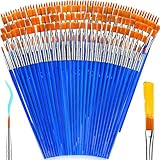
- 【162-Piece Bulk Set | Dual Brush System】Maximize versatility with 81 flat brushes (0.59 inch edge for bold strokes) and 81 round brushes (0.39 inch tips for details) – 3X more tools than standard kits! Pre-sorted in labeled compartments for instant access during painting sessions. Ideal for art classrooms, mural projects, and multi-artist households.
- 【Pro-Grade Durability | Zero Shedding Guarantee】 "Engineered with triple-crimped nylon bristles (43% higher resilience vs. standard) and aerospace aluminum ferrules tested for 10,000+ flex cycles. Lab-verified 0.01% shedding rate even with heavy impasto techniques – outperforms flimsy bristles in budget brushes."
- 【Multi-Scenario Readiness | Event & Daily Use】 Optimized for: Thanksgiving/Christmas face designs classroom projects ceramic decorating fabric printing and model painting; Lightweight plastic handles each reduce hand fatigue during prolonged sessions
- 【Effortless Maintenance | Long-Term Durability】 Clean with warm soapy water in 10 seconds; Reshape tips and air-dry vertically to preserve bristle integrity,After use, air-dry brushes thoroughly and store upright in the provided case to preserve bristle shape. The premium nylon filaments naturally regain their original form after each stroke. For cleaning, simply rinse in warm soapy water and gently reshape bristles with fingertips."
- 【Multiple Application】These acrylic paint brushes can be applied for most occasions,such as:watercolor,oil, gouache paint,face paint, acrylic paint, suitable for Thanks Giving Day, Christimas, Halloween face and body painting, canvas painting, fabric, rock, miniature, model, ceramics, arts and crafts painting, etc.
End by distinguishing what the strip does from what your evidence can prove. A well-supported critique can show how a sequence guides inference, how publication conditions shape its design and how social meanings are invited or contested. It need not claim a single final interpretation.
Further reading for studying comic form
Scott McCloud’s Understanding Comics: The Invisible Art is a useful entry point for readers who want a sustained discussion of panels, closure and the medium’s vocabulary. Read it alongside the definition debate rather than treating its account as the final boundary of comics; the scholarly discussion of competing definitions explains both its value and its limits (“Defining Comics?”).
Frequently Asked Questions
Do I need to read an entire comic-strip run before writing criticism?
Not always. For a short formal essay, a carefully identified strip plus nearby installments can establish a pattern; for claims about character development or recurring jokes, explain your sampling method and include enough dated examples to show that the pattern is not accidental.
Crashes, No Sound, or Screen Glitches?
Random freezes, missing sound and display glitches usually trace back to one bad driver. Find and replace yours safely.Free scan · under a minuteWindows Errors? Fix Them Before They Spread
Repair common Windows errors and clear accumulated junk for a smoother, more stable PC - no reinstall needed.Free scan · no reinstallCan a strip without speech balloons still be a comic strip?
Yes, depending on the scope you define. Silent sequences, caption-led strips and image-dominant newspaper formats challenge definitions that make balloons or a fixed image-to-text balance mandatory, so describe the work’s actual communication system rather than excluding it automatically.
How should I cite a newspaper comic strip?
Give the strip title, creator, original publication date, newspaper or syndicate when known, page or section, and the archive or edition you consulted. If you read a reprint, identify the reprint date and note changes such as recoloring, cropping or altered lettering.
How do I discuss offensive stereotypes in an older strip?
Name the stereotype and show how the drawing, wording, panel position and joke structure produce it. Then situate the image in its publication history and explain who benefits from the humor; historical context should clarify reception without treating harm as harmless or assuming every contemporary reader responded alike.
Quick Recap


