The Tool Desk
Do these 3 things before closing this tab:
1Clear out junk files and repair common Windows errors2Fix the driver behind crashes, sound loss and screen glitches3Repair Windows errors before they cause bigger problemsOutbyte PC Repair FREERepair Windows errors before they cause bigger problemsFix Now →Outbyte Driver Updater FREEFix the driver behind crashes, sound loss and screen glitchesFind Drivers →
ThatPainter is reader-supported. When you buy through links on our site, we may earn an affiliate commission. Learn More
The safest way to hang wall decor is to match the hanging method to the item’s complete installed weight and the wall behind the paint. Removable strips and hooks suit lightweight pieces on smooth, clean, fully cured, sound paint. Medium loads can use a picture hook or screw where a small hole is acceptable. Heavy frames, mirrors, shelves, and objects that project from the wall need a correctly rated screw and anchor, preferably into framing. No method guarantees a mark-free result on weak, old, chalky, damp, textured, or uncured paint, so inspect the surface before you attach anything.
Which hanging method is least likely to damage painted walls?
For a lightweight frame or poster on smooth, cured paint, a removable picture strip or hook creates no intentional nail hole and can be removed by stretching the adhesive. That convenience depends on the wall and the product rating. A medium frame is more predictable on a picture hook or screw, while heavy or high-leverage objects need a mechanical connection to framing or a load-rated anchor.
As an Amazon Associate I earn from qualifying purchases.
Recommended Free Tools
| Situation | Preferred method | Main reason | Limits and risks |
|---|---|---|---|
| Lightweight frame or poster on smooth cured paint | Removable picture strips or hooks | Reversible and avoids a nail hole | Must stay within the package weight limit; unsuitable for rough, textured, dirty, damp, weak, or uncured paint |
| Medium frame where a small hole is acceptable | Picture hook or screw into framing | Predictable mechanical support | Leaves a hole and can chip paint if drilled carelessly |
| Heavy frame, mirror, shelf, or high-leverage object | Stud-mounted screw or load-rated anchor | Provides a better load path than adhesive | Requires correct wall diagnosis, drilling, and hardware selection |
| Frequent rearrangement | Picture rail or wall track | Allows repositioning without patching a new hole each time | Initial installation is more involved and still needs secure attachment |
How do I know whether painted walls are suitable for removable strips?
Adhesive hangers need a surface that is smooth, clean, dry, and firmly bonded to the wall. Run your hand over the proposed area and look for bubbling, flaking, powdery chalk, dampness, or edges that are already lifting. Those conditions mean the paint itself may release before the adhesive does.
Wait for paint to cure
3M’s current Command instructions say to wait at least seven days after painting before applying its products. “Dry to the touch” is not the same as a cured coating; follow the manufacturer’s waiting period for the exact product and paint condition.
Popular on Amazon
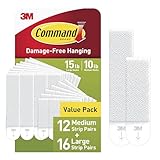
- DAMAGE-FREE PICTURE HANGERS: Includes 12 pairs (24 strips) of White Command Medium (10lb) and 16 pairs (32 strips) of White Command Large (15lb) Picture Hanging Strips, unique hassle-free wall hangers for hanging pictures without nails or damage
- WORKS ON A VARIETY OF SMOOTH SURFACES: Wall hanging strips work on a variety of smooth surfaces, including painted walls, finished wood, painted concrete cinder blocks, laminate, glass, metal and tiles
- SURFACE PREP: Clean the desired surface with rubbing alcohol to remove grime and dust to allow the no damage wall hangers to bond to the surface; the indoor temperature must be between 50 degrees Fahrenheit and 105 degrees Fahrenheit
- USAGE TIPS: Wait seven days after painting before using the Command Picture Hangers to allow paint to cure; do not hang over beds or on wallpaper
- EASY CLEAN REMOVAL: Lightly hold the top of the removable adhesive strips and slowly pull straight down towards the floor to remove and prevent damage of walls and surfaces
Check texture, dirt, and moisture
Removable strips and hooks are intended for suitable smooth painted surfaces. Textured walls reduce contact, while dust, grease, household-cleaner residue, condensation, and damp paint weaken the bond. If the wall is rough, chalky, damp, or otherwise unsound, use a mechanical method that matches the substrate instead of trying to compensate with more adhesive.
Keep the environment within the product instructions
The 2026 Command instructions specify an indoor operating range of 50–105°F. Installation outside that range is outside those instructions, so wait for conditions that meet the package guidance rather than relying on a promise of damage-free removal.
Quick wins for a faster PC:
Clear out junk files and repair common Windows errorsFree Scan →Fix the driver behind crashes, sound loss and screen glitchesFind Drivers →Repair Windows errors before they cause bigger problemsFix Now →How do I identify the wall before choosing hardware?
Look beyond the paint. The substrate determines how a fastener carries weight and which anchor can expand or grip safely.
- Determine whether the wall is drywall, plaster, masonry, plywood, or framed construction. Hollow drywall behaves differently from brick, stone, poured concrete, or a solid timber stud.
- Locate framing when practical. A stud finder can indicate where a screw may enter framing, but it does not select the screw or prove that the complete installation meets the load.
- Plan for the installed load and the force on the wall. Include the frame, glazing, hardware, contents, and any leverage created when a shelf or mirror projects from the surface.
- Choose hardware rated for both the wall and that load. A fastener’s package rating applies only when installed in the stated substrate and in the specified manner.
The Canadian Conservation Institute advises that hollow-core walls such as drywall and hollow block use drilled holes with wall plugs or expandable wall anchors. Brick, plaster, stone, and poured concrete require a drilled hole lined with a compatible wall plug and threaded hook or screw. A hook intended for drywall is not automatically suitable for masonry, and a masonry plug does not turn an unverified drywall installation into a safe one.
Also popular on Amazon

- Hanging Adhesive Strips: Picture Hanging strips (20 Pairs/40 Strips, L2.6in x W0.8in) can replace nails or liquid adhesives. Wall hanging strips are backed with high-quality adhesive backing, compared with ordinary double-sided adhesive, stronger adhesion for photos, artwork, or Christmas decorations without damaging the wall
- Works On Most Smooth Surfaces: Summerbrite Wall hanging strips work on a variety of smooth surfaces, including painted walls, finished wood, painted concrete cinder blocks, laminate, tile, glass, marble, metal, wood, and plastic. Not suitable for wet or rough surfaces
- Removes Cleanly And Quickly: To remove the universal hook and loop strips, simply hold the top of the removable adhesive strips and pull it slowly and straight toward the ground. There will be no residue on the flat surface for complete removal
- Damage Free Hanging: The flat surface of used wall hanging strips will not be damaged after removal, leaving any holes, marks, or sticky residue, and will not prevent the flat surface from being used again. Suitable choice for renovating or organizing your space
- Easy To Use: Clean the surface first and keep the picture hanging kit dry when using. Stick two picture hanging strips together, then stick the Picture Hangers to your target object, finally stick to a flat surface, press firmly and it will work properly
How do I hang a light frame with removable strips or hooks?
Use the exact product size and quantity specified for the item’s complete installed weight. The following sequence follows 3M Command’s published picture-strip instructions; other products can differ, so read their package before starting.
- Weigh the assembled piece. Include the frame, glass, backing, hanging hardware, and anything that will remain in it. Do not estimate from the empty frame or from the artwork alone.
- Confirm the wall is suitable. The paint should be cured, smooth, clean, dry, and sound. Do not install over bubbling, flaking, chalky, damp, textured, or recently painted areas.
- Clean with isopropyl rubbing alcohol. 3M instructs users to wipe the wall with isopropyl alcohol rather than household cleaners or water, then allow the surface to dry completely.
- Use the specified strip size and number. Weight limits vary by product and strip size. 3M says to use only the number of strips stated in the instructions; adding extra pieces is not an automatic capacity upgrade.
- Attach the strips as directed. Pair the matching sides, place them where the package shows, and press each strip firmly against the wall for 30 seconds.
- Allow the adhesive to build its bond. For the Command picture-strip procedure, wait one hour before reattaching the frame. Keep the item within the stated weight limit after it is hung.
- Load the hanger gently. Set the frame onto the attached strips without sliding it sideways or using it as a handle. If the product has a separate hook-and-loop or tab arrangement, follow its own package sequence.
Removable products are best for pieces whose weight is modest and whose shape does not create substantial leverage. A shelf, deep shadow box, large mirror, or anything people may bump places forces on the wall that are not equivalent to a flat, lightweight frame.
Free tools Windows power users keep installed
One-click scans. No signup required.
How do I remove adhesive strips without lifting paint?
Removal technique matters as much as installation. Support the decor, expose the pull tab, and stretch the strip slowly straight down along the wall instead of pulling it toward yourself.
- Take the load off first. Remove the frame or accessory so the tab is not carrying weight while you pull it.
- Hold the mount steady. Keep the hook or wall-side piece from levering away from the paint.
- Pull the exposed strip downward. 3M says to pull its easy-off stretch strips slowly down against the wall at least 15 inches (38 cm) to release them.
- Keep the pull parallel to the wall. Do not yank toward yourself, pry outward, twist the hook, or stop halfway and restart at an angle.
- Inspect the paint afterward. If the strip will not stretch or the coating begins to move, stop rather than applying more force. Weak, old, uncured, or damaged paint can come away with the adhesive even when the product is used as directed.
There is no universal zero-damage guarantee. Paint adhesion, age, texture, humidity, temperature, load, and removal technique all affect the outcome, so a removable label describes the intended release method, not an assurance for every wall.
Also popular on Amazon

- WORKS ON A VARIETY OF SMOOTH SURFACES: Wall hanging strips work on a variety of smooth surfaces, including painted walls, finished wood, painted concrete cinder blocks, laminate and tiles so you can create a festive winter wonderland in your space
- SURFACE PREP: Clean the desired surface with rubbing alcohol to remove grime and dust to allow the wall hangers to bond to the surface; the indoor temperature must be between 50 degrees Fahrenheit and 105 degrees Fahrenheit
- USAGE TIPS: Wait seven days after painting before using the Command Picture Hanger Strips to allow paint to cure; do not hang over beds or on wallpaper; do not use the wall hanging strips to hang valuable items
- EASY CLEAN REMOVAL: Lightly hold the top of the wall adhesive strips and slowly pull straight down towards the floor to remove Christmas decorations and prevent damage of walls and surfaces
- DAMAGE FREE HANGING: Wall hanger strips work without leaving holes, marks or sticky residue on a variety of surfaces and remove cleanly when you want to redecorate or reorganize your space during the holidays without tools
When should I use a picture hook or screw instead?
Choose mechanical hardware when the load is beyond an adhesive product’s rating, when the object has leverage, or when the paint or texture is unsuitable for adhesive. A small, deliberate hole is usually easier to control and repair than a failed heavy installation.
For a medium frame
A picture hook or screw into framing gives a direct load path. Mark the location, drill only as needed for the selected hardware, and keep the tool square to the wall so the hole does not chip a large paint edge. The hook or screw must be rated for the complete installed weight.
Do these 3 things before closing this tab:
1Repair Windows errors before they cause bigger problems2Scan for outdated or missing drivers - takes under a minute3Clear out junk files and repair common Windows errorsFor hollow drywall
If a stud is not available at the desired location, use a wall plug or expandable anchor rated for the load. Drill the diameter and depth specified by that anchor, insert it fully, and pair it with the compatible screw or threaded hook. The anchor’s stated capacity assumes the wall is sound and the installation follows its instructions.
For plaster, brick, stone, or concrete
Use a drill bit and plug designed for the masonry or plaster system, then install a compatible threaded hook or screw. The Canadian Conservation Institute specifically describes drilled holes lined with wall plugs for these substrates. Do not substitute a drywall-only anchor simply because the surface is painted.
Also popular on Amazon

- Includes: 60 pairs of large, white picture hanging strips (120 strips total). Four adhesive strip pairs hold up to 15 pounds
- Holds strong: Ensure to match different A/B (hook/loop) sides and avoid putting the same sides together. Double-sided adhesive strips lock together to prevent shifting or slipping
- No tools required: Hang frames and decorations without nails or a hammer
- VERSATILE: Works on a variety of smooth surfaces, including glass, tile, metal, painted concrete blocks, laminates, and finished wood (such as painted or varnished shiplap, cabinets, and doors). Not suitable for painted/textured walls, wallpaper, fabrics, or rough surfaces
- Removes cleanly: No holes, marks or sticky residue. Easy to remove whenever you want a change
How do I hang a heavy frame, mirror, or shelf safely?
Heavy or projecting objects need a mechanical connection designed around the wall’s load path. Adhesive strips are not a fallback for a weight or leverage problem.
- Measure the complete installed weight. Include glazing, backing, brackets, contents, and anything that may be added later.
- Map the support points. Determine whether the hardware can enter a stud, another solid framing member, plywood, drywall, plaster, or masonry. Plan every attachment point rather than relying on one convenient hole.
- Prefer framing when available. A stud-mounted screw transfers force into the building structure. Select a screw length and head that work with the bracket and do not bottom out before the bracket is tight.
- Use a load-rated anchor where framing is unavailable. Match the anchor to the wall type and follow its drilling, insertion, and tightening instructions. The wall and the hardware both need adequate capacity.
- Keep the object close to the wall. The farther a shelf or mirror projects, the more leverage it applies. Use brackets and attachment points intended for that geometry, not just its static weight.
- Protect the paint while drilling. Mark accurately, drill at controlled speed with the correct bit, and avoid enlarging the hole by wobbling the tool. Chipped edges are more likely when the bit skates or the fastener is forced.
- Check the finished installation. Confirm every screw or hook is fully seated, the bracket is stable, and the object cannot rock or pull away before placing valuable contents on it.
A stud finder helps locate framing but cannot verify hidden wiring, plumbing, timber condition, or the rating of the chosen hardware. For unusually heavy mirrors, shelves, or installations over occupied areas, follow the hardware maker’s load data and local building guidance.
Is a picture rail or wall track worthwhile for frequent rearranging?
A picture rail or wall track is useful when artwork changes often. Instead of drilling a new hole for every position, you secure one rail or track and move hooks or cords along it. The trade-off is an initial installation that still requires solid, correctly rated attachment to the wall.
Choose the rail’s fasteners from the wall construction and total load, not from the rail’s appearance. A track mounted only to weak paint or an unsuitable anchor simply concentrates many future items on one failed connection. Once the rail is secure, rearrangement can happen without adding a new hole for each frame, but the hanging cords, hooks, and rail rating still govern each piece.
Also popular on Amazon

- MAXIMUM FRAME SIZE 24 X 36 INCHES: One package includes eight pairs (sixteen strips total) of the Command 20 lb X-Large Heavyweight Picture Hanging Strips; four wall adhesive strip pairs (eight strips) holds 20 pounds; maximum frame of 24 x 36 inches
- WORKS ON A VARIETY OF SMOOTH SURFACES: X-large wall hanging strips bond to a variety of smooth surfaces that include painted walls, painted cinderblock and concrete surfaces for damage free hanging
- SURFACE PREP: Clean the desired surface with rubbing alcohol to remove grime and dust to allow the no damage wall hangers to bond to the surface; the indoor temperature must be between 50 degrees Fahrenheit and 105 degrees Fahrenheit
- USAGE TIPS: Wait seven days after painting before using the Command Picture Hangers to allow paint to cure; do not hang over beds or on wallpaper; do not use the wall hanging strips to hang valuable items
- EASY CLEAN REMOVAL: Lightly hold the top of the removable adhesive strips and slowly pull straight down towards the floor to remove and prevent damage of walls and surfaces
What mistakes cause cracks, chips, or paint marks?
- Underestimating the installed weight: glass, hardware, and contents can move an item beyond a strip or hook’s rating.
- Ignoring the substrate: drywall, plaster, masonry, plywood, and framing need different fasteners and drilling methods.
- Applying adhesive to uncured or weak paint: seven days is the 3M Command waiting period after painting, and a longer delay may be needed if the coating remains soft or unstable.
- Skipping surface preparation: dust, grease, water, cleaner residue, dampness, and texture reduce reliable contact.
- Assuming extra strips create unlimited capacity: use only the quantity and size specified for the product.
- Loading before the bond develops: Command picture-strip instructions call for firm 30-second pressing and a one-hour wait before the frame is reattached.
- Pulling an adhesive tab outward: the release motion is a slow, straight-down stretch along the wall.
- Drilling without a plan: a hole in the wrong place can chip paint, miss framing, or leave an anchor that does not match the wall.
- Using adhesive for high leverage: shelves, deep frames, and mirrors can impose forces that a flat lightweight poster does not.
What does “damage-free” realistically mean?
In this context, “damage-free” describes the intended removal method for a suitable surface and a correctly loaded product; it is not a guarantee that every painted wall will remain perfect. A sound, smooth coating that has cured, an accurately selected product, proper pressing, the manufacturer’s wait time, and a slow downward removal all improve the odds. Old, chalky, bubbling, damp, textured, or uncured paint can fail because the coating is weaker than the adhesive bond.
If a small hole is acceptable, a correctly installed mechanical hanger is often the more predictable choice for a medium load. If the object is heavy or projects from the wall, use framing or a rated anchor and accept that a secure installation may require drilling. The goal is to control the type and location of any mark rather than promise that no mark is possible.
Free tools Windows power users keep installed
One-click scans. No signup required.
Which method should I choose for my wall decor?
Use removable strips or hooks only for lightweight decor on smooth, clean, dry, cured, sound paint and only within the package rating. Use a picture hook or screw when a medium load needs predictable support and a small hole is acceptable. For heavy, deep, or high-leverage pieces, identify the substrate and install a stud-mounted screw or correctly rated anchor. A picture rail or track makes sense when frequent rearrangement justifies a more involved first installation.
Frequently Asked Questions
Can I hang on a wall that was patched and repainted?
Only if the repaired area is fully cured, smooth, clean, dry, and firmly bonded. A patch that still powders, flakes, bubbles, or feels soft is not a sound base for a removable adhesive, regardless of the product’s stated weight limit.
Why can a strip remove paint even when the frame is within its weight limit?
The weight rating assumes a suitable surface and the specified installation and removal technique. If the coating is weak, old, uncured, damp, or damaged, its bond to the wall can fail before the stretch strip releases.
Is a stud finder enough preparation for a heavy mirror?
No. It can help locate framing, but you still need hardware rated for the complete installed load and a screw or bracket compatible with that framing. The tool does not assess wiring, plumbing, timber condition, or the final load path.
Crashes, No Sound, or Screen Glitches?
Random freezes, missing sound and display glitches usually trace back to one bad driver. Find and replace yours safely.Free scan · under a minuteWindows Errors? Fix Them Before They Spread
Repair common Windows errors and clear accumulated junk for a smoother, more stable PC - no reinstall needed.Free scan · no reinstallWhat should I do if the paint starts lifting during removal?
Stop pulling and keep the mount supported instead of levering it outward. Paint movement is a warning that the coating is releasing; continuing to yank can enlarge the damaged area, so reassess whether the surface was suitable and whether the strip is being stretched straight down.
Quick Recap


