Windows Errors? Fix Them Before They Spread
Do these 3 things before closing this tab:
1Clear out junk files and repair common Windows errors2Scan for outdated or missing drivers - takes under a minute3Repair Windows errors before they cause bigger problemsRepair common Windows errors and clear accumulated junk for a smoother, more stable PC - no reinstall needed.Free scan · no reinstall
Outdated Drivers Are Slowing You Down
One free scan finds every outdated or missing driver and matches the right update for your exact hardware.Free scan · exact hardware match
ThatPainter is reader-supported. When you buy through links on our site, we may earn an affiliate commission. Learn More
For a reliable foaming volcano, use an open plastic bottle, 2 teaspoons of baking soda, 2 tablespoons of ordinary household vinegar, and 1 drop of liquid dish detergent. Put the bottle on a tray, surround it with an optional clay or paper mountain, pour the vinegar mixture into the baking soda, and watch carbon dioxide push colored foam out of the opening.
This is a low-risk home demonstration when performed in small quantities with goggles, adult supervision, and an uncovered opening. The foam is not molten lava, and the bottle must never be capped or sealed.
As an Amazon Associate I earn from qualifying purchases.
Safety first
- Children should perform the activity with an adult supervising.
- Wear properly fitting safety goggles, especially while pouring vinegar.
- Keep the bottle opening completely unobstructed. Never cap, cork, or seal it.
- Do not taste the ingredients or the resulting foam.
- Use ordinary food-grade vinegar, usually around 4% to 7% acetic acid in the United States, rather than concentrated cleaning or horticultural vinegar.
- Use plain liquid dish detergent. Never substitute bleach or mix vinegar with chlorine bleach; that combination can release irritating chlorine gas. Poison Control explains the vinegar and bleach hazard.
- Keep the experiment away from eyes, food preparation areas, pets, and surfaces that may stain.
Vinegar can sting the skin and eyes, and stronger vinegar products can cause burns. The USDA warns that vinegar containing 11% or more acetic acid can burn skin and cause severe eye injury, so stronger weed-control vinegar does not belong in a children’s volcano. USDA information on vinegar strength.
#1 Best Overall
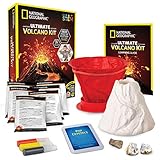
- MORE ERUPTIONS EQUALS MORE FUN – This kids science kit packs more eruption powder than ever before! You get 3x the eruption powder, plus pop crystals which add an exciting sound to your eruptions. Science kits like this are fun for everyone!
- UNFORGETTABLE SCIENCE EXPERIMENTS – This is a great hands-on experiment kit for any science fair; the updated mold and instructions make it easy to assemble a sturdy volcano form and realistic paint colors give the volcano a lifelike look.
- YOU GET REAL VOLCANIC ROCKS – Includes a pumice and a geode specimen so your kids can see real rocks created by a volcano! A full-color learning guide teaches about each rock and provides a wealth of educational information on volcano science.
- HOME SCHOOL CLASSIC – This is a classic STEM project that teaches kids about chemistry, geology, and earth science. Plus, the volcano mold is reusable, and the learning guide provides tips on different eruptions to try with common household items!
- AWARD-WINNING PRODUCTS - Blue Marble, winner of the Toy Association's prestigious Toy of the Year Award, proudly develops products that foster education, imagination, and creativity, with a U.S. support team to ensure a stellar experience!
Materials
- 1 clean 10- to 12-ounce plastic water or juice bottle, preferably with a narrow body and wide enough opening for easy pouring
- 1 tray, baking sheet, plastic bin, or cookie sheet with raised edges
- 2 teaspoons baking soda
- 2 tablespoons vinegar
- 1 drop liquid dish detergent
- Optional red or orange food coloring
- Measuring spoons
- A cup for mixing the liquid
- Modeling clay, play dough, sand, dirt, or cardboard for the outer volcano
- Safety goggles
- Paper towels and water for cleanup
The outer mountain is decorative. The chemistry works just as well in an uncovered bottle, cup, or measuring container, which is often the easiest arrangement for a classroom investigation.
Quick wins for a faster PC:
Clear out junk files and repair common Windows errorsFree Scan →Fix the driver behind crashes, sound loss and screen glitchesFind Drivers →How to build the volcano
Option 1: Clay or play-dough mountain
- Place the empty plastic bottle upright on a tray.
- Mold clay or play dough around the bottle to form a mountain. Leave the neck and opening exposed.
- Do not let clay fall into the bottle, and do not build a closed crater over the opening. The foam needs a clear exit.
- If you want to paint or decorate the mountain, do that before the experiment and allow it to dry. Keep paint, clay, and decorations out of the bottle opening.
The American Chemical Society volcano activity likewise uses a plate and clay or dough while warning users not to cover the opening.
Option 2: Cardboard or paper cone
- Place the bottle on the tray.
- Cut a circular opening in cardboard or poster board large enough for the bottle neck to pass through.
- Roll the cardboard into a cone and tape it to a base.
- Position the cone around the bottle, leaving the bottle opening exposed at the top.
- Decorate the cone after it is stable. A paper cone is quicker and generally cleaner than sculpting a full mountain, but it may soften if it becomes soaked.
The Natural History Museum’s bottle-and-cardboard-cone design is a useful model for this construction.
Option 3: Bottle-only demonstration
Skip the model entirely and place the open bottle in a tray. This is the best version when the goal is to measure foam height, compare recipes, or reduce the amount of wet material in a decorative model.
How to make the baking soda volcano erupt
- Protect the area. Put the bottle on a tray or baking sheet near a sink, or work outdoors on a stable, level surface. Put on goggles.
- Add the baking soda. Measure 2 teaspoons of baking soda into the empty bottle.
- Mix the liquid. In a separate cup, combine 2 tablespoons of vinegar with 1 drop of dish detergent. Add a few drops of red or orange food coloring if desired.
- Pour. Pour the vinegar mixture into the bottle in one motion, keeping faces and hands away from the opening.
- Observe. Carbon dioxide bubbles will form rapidly. The detergent holds the bubbles in a thicker foam, which rises and flows over the model.
- Wait. Allow bubbling to finish before moving the bottle or beginning another trial. Do not put a cap on it at any point.
With ordinary household ingredients, the visible result should be a fast, foamy overflow rather than a high-pressure blast. The amount and shape of the foam depend on the vinegar’s acidity, the container’s opening, the detergent, the temperature, and how the ingredients are mixed.
What’s actually slowing this PC down?
Pick the symptom - the matching free tool is one click away.
What is happening chemically?
Vinegar contains acetic acid dissolved in water. Baking soda is sodium bicarbonate. When they meet, the acid-bicarbonate reaction produces sodium acetate, water, and carbon dioxide gas:
NaHCO3 + CH3COOH → CH3COONa + H2O + CO2
The American Chemical Society’s chemistry explanation identifies these reactants and products.
Why does the mixture foam?
The reaction produces carbon dioxide bubbles. Without detergent, many of those bubbles burst quickly, so the result is mostly fizzing liquid. Dish detergent surrounds and stabilizes the bubbles, allowing them to collect into a longer-lasting foam.
Rank #2

- MASSIVE SCIENCE KIT FOR CURIOUS KIDS - More than 15 experiment activities including dueling water tornadoes, building an erupting volcano, growing a crystal, two geologic dig kits, and more!
- ENOUGH TO GO AROUND - This science lab allows kids to conduct multiple experiments and is great to share with family, friends, or classmates. Enjoy the magic of discovery together!
- THE SECRET IS THE SCIENCE - A detailed, full-color Learning Guide teaches the science at work in the experiments, allowing your child to develop a deep, lasting appreciation for a variety of Earth sciences.
- HASSLE-FREE EXPERIMENTS - Clear, easy-to-follow instructions build young scientists' confidence as they experiment, allowing them to focus on the joy of exploration and discovery.
- AMAZON EXCLUSIVE - Blue Marble has developed this product exclusively for Amazon.
Dish soap therefore makes the eruption look larger and last longer; it does not create extra carbon dioxide and does not make the acid-bicarbonate reaction chemically stronger.
Why does the eruption stop?
The reaction fades when one reactant has been used up. If the vinegar’s acid is exhausted first, adding more baking soda cannot produce more carbon dioxide. If the baking soda is exhausted first, adding more vinegar cannot produce more gas. This is the limiting-reactant idea: the available amount of the scarcer reacting ingredient controls how much gas can form.
Gas also escapes from the open bottle as it is produced, so the visible foam eventually collapses even though a little dissolved gas may remain. The ACS lesson plan includes limiting-reactant and repeat-trial guidance.
How to make the eruption smaller or larger
For a smaller, lower-mess eruption
- Use 1 tablespoon of vinegar, 1 teaspoon of baking soda, and 1 drop of detergent.
- Use a larger container or a tray with raised sides.
- Pour more slowly if you want to observe the foam developing rather than getting an immediate overflow.
- Reduce the detergent if you want less persistent foam.
The smaller amounts are suggested by the ACS for foam that may reach the top of the container without overflowing. The result varies with the bottle and ingredients.
For a foamier-looking eruption
- Keep a small amount of dish detergent in the liquid.
- Use a relatively narrow opening so foam rises before spreading outward.
- Add food coloring for contrast. Coloring changes appearance, not the chemistry.
- Use a tray with raised edges and keep paper towels ready.
Do not assume that continually adding baking soda will make the eruption continually larger. Once the vinegar is the limiting reactant, extra baking soda cannot create more carbon dioxide.
A larger published variant
For a more dramatic but messier setup, the Natural History Museum publishes this larger-format recipe:
- 1 tablespoon baking soda
- 1 tablespoon washing-up liquid, equivalent to liquid dish detergent
- 2 tablespoons water
- ½ cup vinegar
- 1 tablespoon red food coloring
- 1 200-mL plastic bottle
Mix the baking soda, detergent, and water in the bottle, then pour in the colored vinegar. This is a published variant, not a universal perfect ratio. Use a much larger tray or work outdoors, because the mixture can overflow quickly. View the Natural History Museum instructions.
Recipes published by reputable organizations vary substantially. The small ACS recipe uses 2 teaspoons of baking soda and 2 tablespoons of vinegar, while the museum version uses larger quantities and additional water and coloring. Container geometry, vinegar concentration, detergent, and the limiting reactant all affect the result, so there is no single ratio that guarantees the biggest eruption in every setup.
Rank #3

- ERUPTION-READY EXPERIMENTS: Kids discover the science of fizzy, foamy chemical reactions with this 13-piece deluxe science kit for kids, hands on science toys and preschool science tools for kids
- REAL SCIENCE SKILLS: As they follow along with the full-color guide's 10 fun science experiments for kids, little ones build observation, experimentation, and other STEM skills with this science kit
- KID-SIZED LAB TOOLS: Designed for little hands, this science kit's color lenses, test tube, beaker, funnel, and dropper help kids build fine motor skills as they experiment, hands on science toys too
- AGES AND SKILLS: Specially designed with little ones in mind, this preschool science lab helps kids as young as 4 build essential STEM skills through hands on volcano science experiments for kids
- EASY STORAGE AND CLEANUP: When the volcanic experiments are done, the pieces fit inside the Fizzy Volcano Preschool Science Lab for easy storage, a hands on science kit for the classroom or home too
What if I want to test the chemistry?
A fun eruption is a demonstration. A science-fair project needs a question, a controlled method, repeated trials, measurements, and a conclusion based on the results.
Example testable question
How does the amount of vinegar affect maximum foam height when the bottle, baking soda, detergent, temperature, and mixing method remain constant?
Variables
- Independent variable: the amount of vinegar.
- Dependent variable: maximum foam height, time to maximum height, time until bubbling stops, overflow or no overflow, or approximate runoff volume.
- Controls: same bottle, same vinegar brand and concentration, same baking soda, same detergent amount, same temperature, same order of mixing, and the same waiting time between trials.
Change one variable at a time. Rinse the bottle thoroughly between trials so residue from the previous reaction does not affect the next one. Record the results instead of judging which eruption looks biggest.
| Trial | Vinegar volume | Foam height | Time to peak | Time until bubbling stopped | Overflow? |
|---|---|---|---|---|---|
| 1 | |||||
| 2 | |||||
| 3 |
For a geology-focused project, NASA’s Make a Volcano activity uses a paper cup, cardboard or a cookie sheet, play dough, colored layers, repeated eruptions, and lava-flow mapping. NASA lists it as a 1- to 2-hour activity, largely because of the model-building and mapping work.
Optional quantitative chemistry
Assuming 5% acetic acid vinegar, the theoretical balance is approximately 7.3 grams of baking soda per 100 mL of vinegar. This is chemistry context, not a replacement for the kitchen recipe. Spoonfuls vary depending on how densely the powder is packed, vinegar products vary in acidity, and the tallest foam is not necessarily the experiment that produces the greatest total amount of gas.
The calculation uses a molecular weight of 84.0066 g/mol for sodium bicarbonate from NIST, approximately 60.052 g/mol for acetic acid from NIST, and the usual household-vinegar assumption. Treat the result as an estimate rather than a guaranteed recipe ratio.
Troubleshooting
Almost nothing happens
- Confirm that you used baking soda, not baking powder.
- Check that the liquid is vinegar, not plain water.
- Make sure the vinegar reaches the baking soda rather than pooling somewhere else in the model.
- Check that clay, dough, or paper has not blocked the opening.
- Use ordinary food-grade vinegar rather than an unusually diluted product.
Baking powder is a different formulation: it contains sodium bicarbonate plus dry acidic ingredients and is not an equivalent substitute for the stated recipe. Poison Control discusses baking soda and baking powder.
It fizzes but does not make flowing foam
- Add the recommended small amount of dish detergent.
- Try a container with a narrower opening.
- Reduce extra water.
- Repeat with 2 teaspoons of baking soda, 2 tablespoons of vinegar, and 1 drop of detergent.
Visible foam depends on bubble stability and container shape. A weak-looking eruption can still be producing carbon dioxide.
Rank #4
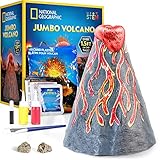
- OUR BIGGEST VOLCANO EVER - This jumbo volcano kit is our biggest yet at nearly 2 feet tall! Astound friends, family, and classmates with the stunning size and exciting eruption experiments! It's the perfect hands-on experiment for any science fair.
- EASY SETUP - Kid-friendly instructions make this jumbo volcano easy to make and erupt. Layer the plaster wrap over the frame, add plaster, and once it's dry, paint it and erupt it again and again!
- MORE ERUPTIONS, MORE FUN – This kids science kit comes with 3 packets of eruption powder plus pop crystals that add exciting crackling sounds. Instructions for more eruptions from household materials are also included.
- EVERYTHING KIDS NEED - Our jumbo volcano kit has everything kids need for an amazing science project, including the volcano mold, plaster mix and tint, two paint colors, paintbrush, and more. Genuine geode and pumice specimens are also included!
- AWARD-WINNING PRODUCTS - Blue Marble, winner of the Toy Association's prestigious Toy of the Year Award, proudly develops products that foster education, imagination, and creativity, with a U.S. support team to ensure a stellar experience!
The eruption is too messy
- Use half the baseline quantities.
- Move the activity outdoors or use a larger tray.
- Keep faces, hands, children, and pets away from the overflow.
- Do not try to control the mess by capping the bottle.
The model collapses or blocks the crater
Switch to a paper cone, or place a small disposable cup inside the clay mountain and use the cup as the open reaction container. The eruption source should remain separate and unobstructed.
The Tool Desk
Outbyte PC Repair FREEClear out junk files and repair common Windows errorsFree Scan →Outbyte Driver Updater FREEScan for outdated or missing drivers - takes under a minuteDriver Scan →Repeated trials are inconsistent
- Measure every ingredient rather than estimating.
- Use the same vinegar brand and baking soda for every trial.
- Keep the amount of detergent constant.
- Use the same container, temperature, mixing order, and timing.
- Rinse the bottle thoroughly between trials and record each result.
Cleanup and first aid
Cleanup
Wait until bubbling has stopped. Remove the clay, sand, paper, and other solids from the tray separately. Rinse the bottle and tray with water, then wipe the work surface with paper towels. Small quantities of the simple vinegar, baking soda, water, and detergent mixture can be rinsed down the drain, consistent with the ACS activity instructions. Do not wash clay, sand, plaster, paper, or other solids into the drain.
The ACS volcano guide recommends having water or a bucket available for cleanup.
If vinegar or foam gets in an eye
- Remove contact lenses.
- Rinse the eye immediately with plenty of room-temperature water.
- Encourage blinking while rinsing.
- If pain, redness, irritation, or blurred vision persists, contact Poison Control or seek medical care.
In the United States, call Poison Control at 1-800-222-1222 or use webPOISONCONTROL. Outside the United States, contact the local poison center or emergency service.
If baking soda is swallowed
A small food-level exposure is different from swallowing a large quantity, but excess baking soda can cause dangerous sodium and gas-related effects. Do not guess at treatment; contact Poison Control for specific advice. Poison Control’s baking soda guidance explains the risk.
Free tools Windows power users keep installed
One-click scans. No signup required.
Alternatives and variations
Lemon juice
Lemon juice can replace vinegar because citric acid also reacts with baking soda to release carbon dioxide. The quantities and strength of the eruption will differ, so treat it as a separate experiment rather than a one-for-one substitution. Science Buddies’ lemon volcano activity provides one alternative.
No clay or model
Use an open clear plastic cup, tray, or measuring cylinder. This makes the foam easier to see and measure. Other decorative options include a paper cone, sand or dirt outdoors, a cardboard box with a crater cut into it, or a disposable cup placed inside a model.
How this differs from a real volcano
The household demonstration creates carbon dioxide through an acid-bicarbonate chemical reaction. The colored foam is water-based foam containing gas bubbles, not molten rock.
Best Value

- GET MORE ERUPTIONS FUN - there are 6 experiments to do by use 2 volcanoes. A plastic volcano, a gemstone dinosaurs fossil dig volcano, plastic dinosaurs, for volcano and snow eruption chemistry experiments ingredient.
- DIG REAL STONES - Includes 4 gemstones, so your kids can see real rocks and dinosaur skeletons excavate from a volcano!
- RED LAVA VOLCANO AND SNOW-CAPPED VOLCANO - This is a classic S.T.E.M project that teaches kids about chemistry, geology, and earth science.
- UNFORGETTABLE SCIENCE EXPERIMENTS – This is a great hands-on experiment kit for any science lesson. Perfect opportunity for kids to learn science while having fun.
- HIGH-QUALITY EDUCATIONAL TOYS - All you need to conduct your experiments are included in our all-inclusive kit. keep kids busy for hours.the volcano mold is reusable.
Real volcanic eruptions involve magma, underground volcanic plumbing, heat, and gases coming out of magma as pressure changes. The National Park Service compares the baking-soda demonstration with Mount Rainier and makes this distinction clear.
Recommended Free Tools
The model can still illustrate useful visual ideas such as material flowing from an opening, the effect of container shape, and how repeated flows can be mapped. It should not be presented as a physical simulation of magma, lava temperature, volcanic pressure, or a true eruption mechanism.
Frequently Asked Questions
Can I use baking powder instead of baking soda?
Not for the same recipe. Baking powder contains baking soda plus dry acidic ingredients, so it has different proportions and behavior. Use sodium bicarbonate labeled baking soda for the baseline volcano.
Does more dish soap make more gas?
No. Dish soap stabilizes carbon dioxide bubbles and creates longer-lasting foam, but it does not produce carbon dioxide. Too much detergent can add cleanup without making the chemical reaction stronger.
Can I use lemon juice instead of vinegar?
Yes, lemon juice contains citric acid and can react with baking soda. The acidity and quantities differ, so expect a different result rather than an identical eruption.
Can I use a glass bottle?
A clean, open plastic bottle is the recommended choice, particularly for children, because it is lightweight and less likely to break. Do not cap or seal any container, and do not use a narrow or fragile container that could make cleanup or overflow hazardous.
Can I cap the bottle to make the eruption bigger?
No. The normal activity is an open-container foam demonstration. Sealing it allows gas pressure to build and turns it into a pressure-propulsion activity with a different risk profile. Keep the opening unobstructed.
Is the foam real lava?
No. It is colored liquid foam containing carbon dioxide bubbles. It resembles lava visually, but real volcanic eruptions are driven by gases and pressure changes in magma.
Why did adding more baking soda not make the eruption bigger?
The vinegar may have become the limiting reactant. Once its available acetic acid has been consumed, additional baking soda cannot produce more carbon dioxide.
Free tools Windows power users keep installed
One-click scans. No signup required.
The Bottom Line
The dependable home volcano is simple: put 2 teaspoons of baking soda in an open plastic bottle, mix 2 tablespoons of ordinary vinegar with 1 drop of dish detergent, pour, and observe the carbon-dioxide foam. Use goggles, a tray, adult supervision, and food-grade vinegar. Keep the opening open: the goal is a controlled foaming demonstration, not a sealed pressure experiment.
Quick Recap

Product prices and availability are accurate as of the date/time indicated and are subject to change. Any price and availability information displayed on Amazon at the time of purchase will apply.




