Recommended Free Tools
Windows Errors? Fix Them Before They Spread
Free scan · no reinstall
Crashes, No Sound, or Screen Glitches?
Outdated Drivers Are Slowing You Down
One free scan finds every outdated or missing driver and matches the right update for your exact hardware.Free scan · exact hardware matchWindows Errors? Fix Them Before They Spread
Repair common Windows errors and clear accumulated junk for a smoother, more stable PC - no reinstall needed.Free scan · no reinstallFree scan · under a minute
PC Slower Than It Used to Be?
Free scan · Windows 10 & 11
ThatPainter is reader-supported. When you buy through links on our site, we may earn an affiliate commission. Learn More
A Broken Dishes quilt block is usually a four-patch made from four half-square triangles (HSTs). Its HSTs are arranged so their diagonal seams point toward the block’s outer edges, creating a design that can resemble a pinwheel but reads differently when the units are oriented and the fabrics are chosen deliberately. Choose a target finished size first, then follow one pattern’s cutting and trimming measurements from start to finish.
As an Amazon Associate I earn from qualifying purchases.
What’s actually slowing this PC down?
Pick the symptom - the matching free tool is one click away.
What a Broken Dishes block looks like
The basic block is a two-by-two arrangement of four HST units. Each HST contains one triangle of each fabric in its pair. The contrast between those triangles, and the direction each unit faces, creates the block’s larger geometric pattern.
There is not one universal arrangement for every pattern called Broken Dishes. In Elizabeth DeCroos’s Epida Studio tutorial, the diagonal seams point toward the block’s outer edges. This is a useful layout cue, but check the specific pattern you are following rather than relying on the name alone.
#1 Best Overall

- Good Value:Quilting rulers includes 5 quilting square rulers (2-1/2",3-1/2",5",6",8")to meet your different needs.The non-slip rings keep the quilting templates in place to ensure cutting accuracy
- Easy to read:Please remove the film on the quilt rulers to see the number clearly.If you find the numbers printed backward on your side,please turn to the other side,and pull off the film to see the numbers clearly.Each fabric ruler has clear,accurate markings for precise cutting
- Easy to Use:The quilting rulers are suitable for both beginners and experienced quilters. The lines are visible on all fabrics,allows its accuracy in measurements and cutting
- Enduring Material: Made from high-quality acrylic,these quilt rulers are 3mm thickness and sturdy.The square rulers for quilting is easy to store with the hanging hole
- Versatile Tool:The quilting rulers make cutting squares so easy.Not just for quilting! These quilting rulers and templates can also be used for various crafting projects,including sewing,scrapbooking,and paper crafting
Broken Dishes versus a pinwheel
Both blocks use HSTs and can look similar at a glance. Compare the direction of the HST seams and the way the units meet: in DeCroos’s Broken Dishes layout, the diagonals go toward the outside; in the pinwheel arrangement she contrasts it with, they lead toward the center. Fabric placement and rotation can make the distinction more or less obvious.
Before sewing, lay the four units out and inspect the whole design. If the arrangement does not match the pattern’s diagram, rotate the HSTs until the seam directions and fabric shapes align.
Rank #2

- COMPREHENSIVE SET: This Quilting rulers includes 4 quilting square rulers in different sizes (3.5” x 3.5”, 5” x 5”, 6.5” x 6.5”, 10.5”x 10.5”) to meet your different needs.
- ENDURING MATERIAL: The quilt rulers Made from high-quality transparent acrylic material,3mm/0.12" thick durable enough,laser-cut for a cleaner edge.
- EASY TO USE: The clear quilting templates allows you to see your fabric beneath the ruler make cutting squares so easy.The quilting rulers are suitable for both beginners and experienced quilters.
- NON-SLIP GRIPS: These Non-Slip Grips can prevent sliding during use to ensure cutting accuracy. High quality material, Semi-Transparent.
- VERSATILE TOOL: Not just for quilting! These quilting rulers and templates can also be used for sewing, quilting, measuring, drawing, handicraft and other DIY projects!
Choose one size and cutting method
Cutting sizes vary with the intended finished block size and the method. Do not combine one tutorial’s cut sizes with another tutorial’s trimming dimensions. The examples below are separate recipes; choose the one that suits your project and follow its measurements throughout.
| Pattern example | Fabric and starting squares | HST and block dimensions |
|---|---|---|
| American Patchwork & Quilting Editors | Two 3-inch dark green squares, one 3-inch blue square, and one 3-inch light green square | Make four HSTs measuring 2-5/8 inches square, including seam allowance. The joined unit measures 4-3/4 inches square including seam allowances; the pattern labels the finished block 4-1/4 inches. |
| Elizabeth DeCroos, Epida Studio | Two 7-inch background squares and one 7-inch square in each of two feature fabrics | Trim four HSTs to 6-1/2 inches square. The sewn block measures 12-1/2 inches square before it is finished into a quilt; the tutorial targets a 12-inch finished block. |
| Scissortail Quilting Company | Three fabrics; consult its chart for the starting-square size for the chosen block | The chart provides HST-square cut sizes for finished blocks of 6, 8, 9, 10, 11, 12, and 15 inches. Use the chart directly; its separate 6-inch unfinished-size example conflicts with the standard half-inch difference implied by quarter-inch seams. |
| Kirsty, Bonjour Quilts | Paired 5-inch squares | Trim the resulting HSTs to 4-1/2 inches. The documented baby quilt uses 120 HSTs in a 10-by-12 layout and finishes at 40-1/2 by 48-1/2 inches. |
For blocks pieced with quarter-inch seams, an unfinished block is generally one-half inch larger than its finished size because the seam allowance is taken up on all four sides. Treat that as a check, not a substitute for the pattern’s own chart: methods and instructions differ, and the Scissortail chart’s separate 6-inch example is internally inconsistent.
Rank #3

- Tips:Please remove the film on the quilt rulers to see the number clearly.If you find the numbers printed backward on your side,please turn to the other frosted side,and pull off the film
- Comprehensive Set:Our quilting rulers includes 3 quilting square rulers (2-1/2",3-1/2",5")to meet all your patchwork needs.The non-slip rings keep the quilting templates in place to ensure cutting accuracy
- Enduring Material: Made from high-quality acrylic material,these quilt rulers are sturdy,ensuring a long lifespan for your crafting needs.The square rulers for quilting is easy to store with the hanging hole,keeping your workbench neat
- Easy to Use:The quilting rulers are suitable for both beginners and experienced quilters. The clear acrylic allows you to see your fabric beneath the ruler for accurate placement and cutting
- Versatile Tool: Not just for quilting! These quilting rulers and templates can also be used for various crafting projects, including sewing, scrapbooking, and paper crafting
Make the four HSTs
Use the steps that match your chosen pattern. The American Patchwork & Quilting Editors’ small-block method and DeCroos’s 12-inch method share the same general sequence—pair squares, sew around marked diagonals, cut, and trim—but their measurements are not interchangeable.
American Patchwork & Quilting Editors’ 4-1/4-inch finished example
- Cut two 3-inch dark green squares, one 3-inch blue square, and one 3-inch light green square.
- Mark a diagonal on each dark green square and pair each with one of the other colors, right sides together, as directed in the pattern.
- Sew a scant quarter-inch on both sides of each marked diagonal.
- Cut on the marked lines to make four triangle-squares. Press and trim each HST to 2-5/8 inches square.
- Arrange the four HSTs as a Broken Dishes four-patch, then sew them together. The joined unit measures 4-3/4 inches square including seam allowances, for a 4-1/4-inch finished block.
Epida Studio’s 12-inch finished example
- Pair each of two 7-inch background squares with a 7-inch square of a feature fabric.
- On each pair, sew a quarter-inch from both sides of the diagonal line, then cut along the line to make four HSTs.
- Press toward the dark side and trim the HSTs to 6-1/2 inches square.
- Arrange the units with their diagonal seams pointing toward the outside of the block.
- Sew the HSTs into two pairs, then join the pairs. The sewn piece measures 12-1/2 inches square before finishing.
Arrange, sew, and press
Lay out all four trimmed HSTs before joining them. Check both the diagonal direction and the light-dark placement against the pattern. Sew two units together to make each row or pair, then join the pairs. Consistent quarter-inch seams and accurately squared HSTs help the corners meet cleanly.
Quick wins for a faster PC:
Fix the driver behind crashes, sound loss and screen glitchesFind Drivers →Clear out junk files and repair common Windows errorsFree Scan →Scan for outdated or missing drivers - takes under a minuteDriver Scan →Rank #4

- Easy to Read: Our quilting ruler are made from high-transparency acrylic, double color print marker to see through the sewing ruler for a precise cutting. ensuring accuracy for years will not turn yellow. Remember to peel off the protective film before use for optimal visibility. Non slip ring help to catch the fabric without slip
- Time Saving for Quilting: The quilting ruler features 22 grooves for cutting, each solts is in 1/2 inch width, allowing for faster, more accurate cutting of fabric pieces without removing the ruler. It is smooth and easy for rotating cutter to go through , 45MM and 60MM rotary cutter suggested
- Straight Edge: Compared with old round edge soltted ruler option, right angle will be more convenient to draw ,measure and cutting
- Shape Cutting: The quilting tools feature alignment lines for 30°, 45°, and 60° angles, making it easy to create various geometric shapes like triangles, squares, rectangles, and diamonds from your fabric strips
- User-Friendly Design for All: Our quilt rulers for quilting are designed to be friendly for both left-handed and right-handed users, making them an essential tool for sewing suppliers and quilting enthusiasts alike
For a larger quilt, the Bonjour Quilts baby project alternates the pressing direction of seams in adjoining rows so they can nest, then presses the seams open when sewing the rows together. That is one documented approach, not a requirement for every block or quilt; follow your pattern’s pressing directions when they differ.
Independent reader supportYour contribution helps us test, update, and keep practical guides available for everyone.Choose fabrics that make the geometry clear
Use enough value contrast for the HST shapes to remain legible. The examples range from three distinct prints or values to a light background with two feature fabrics, and from dark solids paired with low-volume prints to scrappy combinations. Scraps can work when you can cut enough matching-size squares and maintain visible contrast between the triangles.
Best Value
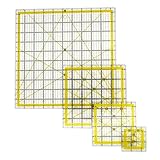
- All in one 4 piece quilting ruler kit for quilting sewing patchwork fabric cutting measuring and pattern making.
- COMPLETProfessional clear permanent scales deliver precise cutting accurate patchwork and high standard craft projects.E SET:Quilting rulers, perfect for various quilting projects
- Shatter resistant durable acrylic ensures stable rotary cutting repeated use and long lasting accuracy.
- Perfect for quilt block making patchwork assembly fabric trimming DIY sewing and home decoration projects.
- Necessary quilting tools sewing supplies fabric cutting tools and accessories for hobbyists and professionals.
- Three-fabric approach: Use light, medium, and dark values to make the four-patch structure easy to see.
- Two-color approach: Repeat two contrasting colors across the HSTs for a simpler, graphic effect.
- Scrappy approach: Vary prints while keeping a consistent light-dark distinction so the layout does not disappear.
Tools and project planning
A rotary cutter, cutting mat, and square quilting ruler are practical for cutting squares and trimming HSTs accurately; the cited tutorials do not require a particular brand or model. Use suitable tools you already have. Fabric requirements depend on the number and size of blocks, so use the chosen pattern’s quantities for yardage, fat quarters, or scraps.
For scale, Bonjour Quilts documents a 10-by-12 baby-quilt layout using 120 HSTs, finishing at 40-1/2 by 48-1/2 inches. Its page also describes a paid pattern with baby, throw, twin, queen, king, and table-runner instructions; check the page for current availability and price.
Free tools Windows power users keep installed
One-click scans. No signup required.
Quick Recap
Common sizing and layout mistakes
- Mixing recipes: Do not use starting-square sizes from one pattern with another pattern’s trim dimensions.
- Confusing finished and unfinished measurements: A block’s in-progress size includes seam allowances. Keep those measurements distinct, as in the American Patchwork & Quilting example.
- Skipping the trim: Square each HST to the specified size before assembling the four-patch.
- Trusting the block name alone: Confirm the diagonal orientation against the pattern’s layout; Broken Dishes and pinwheel arrangements can look alike.
- Following an inconsistent chart example: The Scissortail pattern’s general chart lists seven finished sizes, but its separate 6-inch unfinished-size example is inconsistent. Use its chart and confirm the block dimensions in the instructions rather than relying on that sentence.

Product prices and availability are accurate as of the date/time indicated and are subject to change. Any price and availability information displayed on Amazon at the time of purchase will apply.




