Windows Errors? Fix Them Before They Spread
Repair common Windows errors and clear accumulated junk for a smoother, more stable PC - no reinstall needed.Free scan · no reinstall
Outdated Drivers Are Slowing You Down
One free scan finds every outdated or missing driver and matches the right update for your exact hardware.Free scan · exact hardware match
ThatPainter is reader-supported. When you buy through links on our site, we may earn an affiliate commission. Learn More
For easier movement, arrange the living room around traffic routes before arranging it around the walls. Measure the room and every piece, mark door swings and everyday paths, choose one focal point, then place the largest item first. Build the seating group around it while keeping roughly 30–36 inches for major walkways, 14–18 inches between a sofa and coffee table, and a clear route to each door.
Those measurements are adjustable design targets, not building-code or accessibility certification. Lowe’s (2025), West Elm (page accessed 2026), Homes & Gardens (2025), iTechGuides and Stanford/UC Berkeley research all emphasize testing the arrangement in the actual room: outline footprints, open doors, walk the busiest route and sit in every seat before committing.
Quick wins for a faster PC:
Scan for outdated or missing drivers - takes under a minuteDriver Scan →Repair Windows errors before they cause bigger problemsFix Now →As an Amazon Associate I earn from qualifying purchases.
Why does furniture flow matter more than putting everything against a wall?
A room feels easy to use when people can enter, cross it and reach seats, windows, storage and tables without weaving through the conversation area. A wall-hugging arrangement can leave a large empty center yet force every trip between doorways through the sofa and coffee table. Start by protecting movement; use the remaining space to create a comfortable seating zone.
Think of the room as two overlapping systems:
- Circulation: the routes from the entry to other doors, seating, storage, windows and frequently used controls.
- Activity: the area where people sit, talk, watch television, read, play or work.
When possible, run the busiest route around the outside of the seating group. In an open plan, a floated sofa can separate the path behind it from the conversation area. In a compact room, a single clear route may have to pass beside the seating rather than behind it. The best arrangement is the one that supports the household’s main activity without making routine movement awkward.
Popular on Amazon

- Great Value Paint Brush Set: Soucolor 20 acrylic paint brushes come in 10 different sizes, making them ideal for fine detailing, model painting, rock painting, nail art, face painting, DIY crafts, and general art projects. The varied brush sizes give you better control for both delicate lines and broader color coverage, while the soft bristles deliver smooth, consistent results on acrylic, oil, watercolor, canvas, wood, ceramic, and more.
- Awesome Set of Paint brushes: Professional paint brushes can cover all of your needs. The multi-purposed brushes are ideal for Watercolor, Oil, Gouache, enamel, Acrylic Painting, Body, Nail, Face Painting, Miniature, Model, Wood, Glass, Cup, Ceramic, Fine work, Art class, Craft Art Painting, DIY Art Crafts etc.
- Soft and long-lasting: The bristles are soft and strong, with nickel metal ferrules and blue wooden handles. After cleaning, the bristles will become soft and fluffy again and will not fall off.
- Easy to clean: it’s very convenient to Wash well in soap and water. Retain shape after drying. the brushes hold up very well. Nice selection to beginners and professionals. Keep them clean and they last a long time.
- Perfect for All Painters & Occasions: Suitable for art beginners, hobbyists and professional artists. Great for art class, home creation, travel painting and DIY handmade projects. A practical art gift for students, teachers, family and craft lovers.
How do I measure a living room before moving anything?
Make a measured plan before lifting furniture. Lowe’s recommends drawing the room and making furniture templates; iTechGuides recommends outlining footprints with painter’s tape and walking the route. Either method exposes conflicts that are hard to see from a doorway.
Record the fixed features
- Measure the length and width of the room, including alcoves and bay windows.
- Mark every doorway, the direction each door swings and the width of the opening.
- Note windows, radiators, vents, outlets, switches, built-in shelves and columns.
- Record the height and projection of sills, radiators and trim where they affect furniture placement.
- Mark the paths to adjoining rooms, the front entry, storage and the most-used window or balcony door.
Measure each movable piece
- Measure the sofa or sectional at its widest and deepest points, including arms and chaise ends.
- Measure chairs, ottomans, coffee tables, side tables, media units, bookcases and floor lamps.
- Measure the rug and note which sides have a finished edge or pattern direction.
- Record clearance needed to open recliners, drawers, cabinets and storage benches.
Include the real footprint, not just the cushion or tabletop. A chair that appears narrow can block a path once its arms, legs or reclining mechanism are included.
Make movable templates
Draw the room to scale on paper and cut paper shapes for the furniture, or mark each footprint on the floor with painter’s tape. Label every template. Include door swings as taped arcs. A template lets you try several layouts without repeatedly dragging heavy pieces across painted floors or walls.
How do I map the routes people actually use?
Stand at each entrance and trace where people go during a normal day. Identify the busiest doorway-to-doorway line first, then routes to seats, windows, storage, lighting controls and adjacent rooms. West Elm describes a 3-foot main walkway and 2 feet for less-used routes; Lowe’s gives about 30–36 inches for major traffic paths.
- Mark the main route from the room’s primary entrance to the most-used exit or adjoining room.
- Mark secondary routes to windows, shelves, media controls and storage.
- Note where two people may pass or turn. A route with several turns needs more practical width than a straight line.
- Keep the route outside the seating group when the room allows. If it must pass through the group, place the least disruptive edge of a sofa or chair along it and avoid putting the coffee table in the path.
These are design guidelines rather than guaranteed clearances. Household mobility, children, pets, furniture depth and door hardware can require more space. If someone uses a mobility aid, follow the applicable accessibility standard and professional advice instead of relying on decorating targets.
Where should the sofa go for better flow?
Choose the focal point and the room’s primary purpose first, then test the sofa in the position that supports both while leaving the mapped routes open. The sofa is usually the largest movable piece, so placing it first prevents smaller items from dictating a layout that later blocks circulation.
Choose one focal point
A fireplace, a significant view or a television can orient the seating group. Face most seats toward that point, but do not sacrifice every route to achieve a perfectly symmetrical view. If the room serves several activities, decide which one has priority and let the others use flexible pieces such as an occasional chair or ottoman.
Try a floated sofa
In a larger room, pull the sofa away from the wall so people can pass behind it. West Elm and iTechGuides both identify floating furniture as a way to keep traffic from cutting through the conversation area. Leave enough space behind the sofa for the actual route; a narrow leftover strip that forces people to turn sideways is not a useful walkway.
Also popular on Amazon
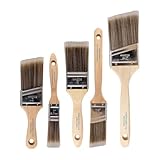
- COMPLETE 5-PIECE BRUSH SET FOR EVERY PAINTING TASK — Includes 1 Inch Flat, 1.5 Inch Angle, 2 Inch Flat, 2 Inch Angle Stubby, and 2.5 Inch Angle brush giving you every size professional painters use daily. Get all 5 for less than the price of a single brush from hardware store brands — professional grade performance at a fraction of the cost. Perfect for walls, trim, cabinets, doors, furniture, and detailed cutting-in work on any project.
- ZERO BRISTLE LOSS — GUARANTEED BY PRECISION ADHESIVE BONDING — Every bristle is locked in place with precision-set adhesive that keeps them in the brush — not in your paint job. The coated steel ferrule provides structural support while the adhesive bond ensures clean performance on every stroke. Premium SRT synthetic filaments load more paint and release it evenly for a smooth streak-free finish on walls, ceilings, and trim. Works with latex, oil-based paint, primer, sealer, and wood stain.
- INCLUDES THE ANGLE STUBBY MOST SETS LEAVE OUT — Professional painters know the 2 Inch Angle Stubby is the go-to brush for tight cabinet interiors, window sashes, inside corners, and detailed trim where standard angle brushes are too long. Combined with the 1.5 and 2.5 inch angle sash brushes you have precision cutting-in covered at every scale — baseboards, crown molding, door casings, and ceiling lines.
- FLAT BRUSHES FOR BROAD SMOOTH COVERAGE ON ANY SURFACE — The 1 and 2 inch flat brushes deliver even coverage on walls, furniture, shelving, doors, fences, decks, and wood surfaces. Ideal for applying primers, stains, varnishes, polyurethane, and specialty coatings. Solid wood handles provide all-day comfort and control for both professional contractors and weekend DIY homeowners tackling interior or exterior painting projects.
- TRUSTED BY PROFESSIONAL PAINTERS AND CONTRACTORS NATIONWIDE — Pro Grade delivers professional-grade results at a price that makes sense for crews who go through brushes on every job. Ideal for property managers, remodeling contractors, apartment turnover crews, maintenance teams, and commercial painting operations. Backed by thousands of verified reviews from working painters. Washable and reusable for multiple projects.
Use a wall when the room is tight
A sofa can sit against a wall when floating it would eliminate the only practical route or make the seating area too small. Keep its arms and back from covering radiators, outlets or door trim, and check that the nearest doorway still opens fully.
How should I arrange chairs and other seats for conversation?
Face chairs toward the sofa or angle them inward instead of lining every seat along the perimeter. Lowe’s advises keeping conversation seats within about 8 feet where possible; Homes & Gardens also recommends orienting seats toward one another rather than simply toward the walls.
Build the group around the sofa
- Place the sofa in relation to the focal point and the main route.
- Add the primary chair opposite or perpendicular to the sofa so faces meet naturally.
- Add a second chair or ottoman only if it leaves the mapped paths clear.
- Angle chairs slightly inward when a straight-on position would block a doorway or window.
Conversation distance is not a rigid rule. Deep sofas, high-backed chairs and loud rooms can make a slightly closer arrangement feel better, while a household that values broad access may prefer more separation. Sit in every seat and check whether people can see one another without twisting.
How much space should I leave between a sofa and coffee table?
Start with about 14–18 inches between the sofa edge and coffee table. Homes & Gardens reports an 18–20-inch designer target, while Lowe’s gives 14–18 inches. Adjust within that range, or beyond it, according to legroom, table depth and how easily people can reach drinks or books.
| Zone | Practical target | How to apply it |
|---|---|---|
| Main walkway | About 30–36 inches | Use for the busiest route; West Elm describes 3 feet and Lowe’s 30–36 inches. |
| Less-used route | About 2 feet | West Elm’s guidance for occasional paths; increase it if people must turn or pass one another. |
| Sofa to coffee table | About 14–18 inches | Lowe’s target; Homes & Gardens cites 18–20 inches as a designer target. |
| Facing conversational seats | Within about 8 feet where possible | Lowe’s guidance for comfortable conversation; test sightlines in the actual room. |
| Tight gap between sofas | Approximately 30 inches can work | A Mansion Global designer example says this may suit a tight room when it matches real traffic; do not use it as a universal rule. |
Measure from the finished edge of the sofa or chair to the finished edge of the table, not from the cushion center. Check knee room, the swing of cabinet doors and the route around the table. A round or oval table can reduce sharp corners in a narrow passage; a smaller table may improve flow more than a larger one that provides extra surface.
What’s actually slowing this PC down?
Pick the symptom - the matching free tool is one click away.
How should a rug be placed so furniture feels connected?
Use the rug to define the seating group without closing the room’s perimeter. West Elm and Homes & Gardens recommend placing at least the front legs of major seating on the rug when the room allows. This visually links separate pieces while leaving a usable border for circulation.
- In a large room, place the sofa and chairs fully or mostly on a large rug if doing so does not cover a route.
- In a small room, put the front legs of the sofa and chairs on the rug and keep the back edges near the wall or path.
- Keep the rug edge out of door swings and away from places where it can bunch under a moving chair.
- Center the rug on the seating group, not automatically on the room, when those centers differ.
Tape the proposed rug outline before moving furniture. A rug that looks centered on paper may make one side of the room feel cramped once the actual sofa depth is included.
How do I arrange a small living room without blocking doorways?
In a small room, preserve one dependable route and reduce the number of pieces before trying to fit a complete suite. The goal is not to maintain a miniature version of a large-room layout; it is to keep entry, seating and the primary activity usable.
Also popular on Amazon

- 【All sizes of art brushes】: The 10 sizes of multi-functional brushes have various shapes, making the mixing color easier, which is very suitable for artists, students, teenagers, children and painters at all levels. Wonderful Present ideas for friends and family who like painting!
- 【general brush set】: Professional paint brush can meet all your needs. Multifunctional brush is very suitable for watercolor, oil, gouache, acrylic painting, body, nail, face painting, miniature, model, ceramics, arts and crafts painting, etc.
- 【high quality process】: It is designed with anti falling bristles, anti-rust nickel ferrule and solid wood handle. You can use the brush to focus on the painting and always be creative.
- 【easy to maintain】: After using the brush, it is very convenient to clean the brush with warm soapy water and reshape the tip of the brush. Air dry the brush and place it on top of the top for long use.
- 【100% satisfaction guarantee - buy now】1 packs of set brushes, you can also get friendly customer service, any questions feel free to contact us, within 24 hours to help you! There is no risk in buying our paint brush kit.
Prioritize the main route
Map the doorway-to-doorway line and keep it as straight as the room permits. Put the sofa parallel to that route when possible, with chairs or an ottoman on the opposite side. Avoid placing a coffee table where everyone must walk around it to enter or leave.
The Tool Desk
Outbyte Driver Updater FREEFix the driver behind crashes, sound loss and screen glitchesFind Drivers →Outbyte PC Repair FREERepair Windows errors before they cause bigger problemsFix Now →Choose flexible pieces
An ottoman can serve as a footrest, extra seat or movable table. Nesting tables can be separated when needed and stacked when the route is busy. A chair that can turn toward the television or conversation area is more useful than one fixed at an awkward angle.
Use corners carefully
A corner can hold a chair, lamp or compact side table, but check the diagonal path from the door. Corners are often where a chair leg or table edge creates an unexpected trip point. Tape the complete footprint, including the chair’s usable turning space, before committing.
How should furniture work in an open-plan living room?
Use the sofa, rug and chairs to create a visual room inside the larger room while keeping a perimeter route. Floating the sofa can separate living-room circulation from a dining or kitchen path, but the back of the sofa should not become an obstacle at a narrow transition.
- Align the seating group with one focal point rather than trying to face every direction.
- Leave the main route continuous from the entry to the next zone.
- Use the rug to show where the living area begins and ends.
- Check sightlines from the kitchen and dining area so the television or fireplace does not dominate every activity.
Compare the number of turns as well as the width of each path. A route that technically measures enough but requires repeated sharp turns may feel less convenient than a slightly longer, straighter route.
Recommended Free Tools
What changes when the room has a fireplace, television or major window?
Each focal point creates a different trade-off between sightline, glare, heat, access and circulation. Treat the focal point as an orientation aid, not a reason to block a door or maintenance area.
Fireplace
Face the primary seats toward the fireplace while leaving the hearth and any required service access clear. Avoid placing a chair where it narrows the approach to the fireplace or creates a hot, enclosed corner.
Television
Orient seats toward the screen, then check glare from windows and whether the route crosses directly in front of viewers. Keep media equipment accessible for cables, ventilation and controls; do not let a low console project into the main path.
Also popular on Amazon

- 【KIDS PAINT BRUSHES SET】Anezus paint brushes for kids come with 10 pcs paint brushes of 5pcs round paintbrushes and 5 flat paint brushes with colorful handles, good for the young artist to explore their creativity in painting and crafting
- 【HIGH QUALITY PAINT BRUSHES FOR KIDS】These toddler paint brushes made of soft hog bristle, bright colored handles and rust proof ferrules. The bristles are firmly fixed in the kids paint brushes and no shedding. Each children paint brush measure 6 1/4 inches (16cm) in length and ferrules 1/2"(1.3cm) diameter, large enough for the little hand to grip and control
- 【WIDE APPLICATIONS】With combination of round and flat craft paint brushes for kids, work great with washable paint, tempera paint and acrylic paint. Great for arts and craft, rock, leather, gesso and ceramic, or body, nail and face art painting.
- 【EASY TO CLEAN 】After using paint brushes for acrylic, oil or watercolor painting, it’s very convenient to clean them with warm soapy water and reshape the paint brush tips. Keep these craft paint brushes clean and they last a long time.
- 【GREAT GIFT IDEA】Perfect for students, teens, kids, children and painters of all levels. Wonderful gift idea for girls, boys and kids who love painting! These all-purpose paint brushes for kids are ideal for kids' school projects, birthday parties, painting parties, art parties, back to school supplies, classroom decoration and more.
Window or view
Use a chair angled toward the view if a sofa facing it would block light or access. Keep curtains, blinds and window hardware reachable, and avoid trapping a radiator behind deep furniture.
Do these 3 things before closing this tab:
1Repair Windows errors before they cause bigger problems2Fix the driver behind crashes, sound loss and screen glitches3Clear out junk files and repair common Windows errorsHow can I compare two possible layouts?
When both arrangements appear workable, score them against the same criteria instead of choosing by symmetry alone. Stanford/UC Berkeley research notes that interior guidelines can conflict, so iterative trade-offs are normal.
| Criterion | Questions to ask | Preferred result |
|---|---|---|
| Route quality | How wide is the main path, and how many turns does it require? | A continuous route with fewer obstacles and turns. |
| Focal-point view | Can most seats see the fireplace, view or television without twisting? | Clear sightlines from the seats used most often. |
| Conversation | Do facing seats point toward one another and feel naturally close? | Faces meet without forcing occupants to turn their bodies. |
| Access | Can people reach doors, windows, storage, outlets and tables? | Routine tasks do not require moving furniture. |
| Rug and balance | Does the rug connect the group without narrowing the perimeter? | A visually unified group with a usable edge. |
| Primary activity | Does the layout support conversation, television, reading, play or mixed use? | The household’s stated priority works first. |
How do I test a layout before lifting or buying furniture?
Testing prevents the common mistake of judging a plan from a static doorway view. Use tape or paper templates, then simulate the room’s busiest moments.
- Tape every furniture footprint, including the coffee table, chair swing and rug edge.
- Open every door, drawer, cabinet and window that people use.
- Walk the main route carrying a basket or bag if that reflects daily life.
- Walk the secondary routes and make the turns you expect visitors or children to make.
- Sit in each seat, look toward the focal point and check whether people can see one another.
- Reach for the coffee table, side tables, switches and storage without leaning into a path.
- Leave the tape in place for a day if possible and observe where household members naturally walk.
- Adjust one piece at a time, then repeat the route check.
Move heavy furniture with another person and use appropriate floor protection. Do not drag a piece against a painted wall; the scrape can damage both the wall finish and the furniture.
What are the most common flow problems and fixes?
The main path cuts through the seating group
Move the sofa or chairs so the route runs behind or beside the group. If the room is too small, remove or replace the piece nearest the path rather than narrowing every gap.
The coffee table is the obstacle
Reduce its size, change to a round shape or shift it within the sofa-to-table target after checking legroom. A table that cannot be reached comfortably is not earning its floor space.
One chair blocks a door or window
Rotate the chair inward, move it to the opposite side or use an ottoman. Check the full door swing and the route to the window, not just the chair’s front edge.
The room feels divided despite clear paths
Bring the front legs of major seats onto one rug, align tables with the seating group and orient chairs toward the same focal point. Visual connection can improve without reducing circulation.
Also popular on Amazon

- 【162-Piece Bulk Set | Dual Brush System】Maximize versatility with 81 flat brushes (0.59 inch edge for bold strokes) and 81 round brushes (0.39 inch tips for details) – 3X more tools than standard kits! Pre-sorted in labeled compartments for instant access during painting sessions. Ideal for art classrooms, mural projects, and multi-artist households.
- 【Pro-Grade Durability | Zero Shedding Guarantee】 "Engineered with triple-crimped nylon bristles (43% higher resilience vs. standard) and aerospace aluminum ferrules tested for 10,000+ flex cycles. Lab-verified 0.01% shedding rate even with heavy impasto techniques – outperforms flimsy bristles in budget brushes."
- 【Multi-Scenario Readiness | Event & Daily Use】 Optimized for: Thanksgiving/Christmas face designs classroom projects ceramic decorating fabric printing and model painting; Lightweight plastic handles each reduce hand fatigue during prolonged sessions
- 【Effortless Maintenance | Long-Term Durability】 Clean with warm soapy water in 10 seconds; Reshape tips and air-dry vertically to preserve bristle integrity,After use, air-dry brushes thoroughly and store upright in the provided case to preserve bristle shape. The premium nylon filaments naturally regain their original form after each stroke. For cleaning, simply rinse in warm soapy water and gently reshape bristles with fingertips."
- 【Multiple Application】These acrylic paint brushes can be applied for most occasions,such as:watercolor,oil, gouache paint,face paint, acrylic paint, suitable for Thanks Giving Day, Christimas, Halloween face and body painting, canvas painting, fabric, rock, miniature, model, ceramics, arts and crafts painting, etc.
Seats are too far apart for conversation
Angle chairs inward or move them closer while preserving the main route. If the sofa faces the focal point and chairs face the sofa, the group may feel more connected without adding furniture.
Free tools Windows power users keep installed
One-click scans. No signup required.
The layout works on paper but feels uncomfortable
Check sightlines, turning space and the actual depth of arms, legs and table edges. Guidelines are starting points; the Stanford/UC Berkeley findings emphasize resolving conflicts through iteration in the specific room.
How can I rearrange furniture safely after painting?
Plan the layout before a fresh coat of paint cures fully, and protect the finished surfaces while testing. Use clean painter’s tape for temporary outlines, lift rather than drag furniture, and place protective pads under legs. Keep furniture slightly clear of a newly painted wall until the finish has cured according to the paint manufacturer’s instructions. This protects the paint while you make the final adjustments.
What is the final checklist for a better-flowing living room?
- Every room dimension, opening, swing and furniture footprint is measured.
- The busiest route is identified and remains clear enough for the people who use it.
- The sofa supports one focal point and does not block a doorway, window, radiator or outlet.
- Chairs face the sofa or angle inward for conversation.
- The sofa-to-coffee-table gap provides legroom and reach without narrowing a path.
- The rug connects the seating group while leaving a usable perimeter.
- Doors, drawers, windows, storage and controls open without moving furniture.
- Each seat has an acceptable sightline and a comfortable way in and out.
- The taped or templated plan has been walked and adjusted before heavy pieces are moved permanently.
Use the measurements as a disciplined starting point, then let real routes, sightlines and household needs decide the final positions. A successful arrangement makes the next movement obvious without calling attention to the furniture.
Frequently Asked Questions
Can a sofa sit in front of a window?
It can, provided the back does not block the opening, radiator, blinds or required access. Measure the sill and furniture height, check how the window operates, and test whether the sofa makes the route to the window awkward.
Free tools Windows power users keep installed
One-click scans. No signup required.
How do I arrange furniture when a doorway opens directly into the room?
Map the complete door swing first and keep its opening zone empty. Start the seating group beyond that arc, then walk from the doorway to the room’s primary destination to verify that the entry does not funnel visitors through the coffee table.
What should I do if my living room has two equally important focal points?
Choose one orientation for the main sofa and use movable chairs to address the second point. A swivel chair, lightweight occasional chair or reversible ottoman can change direction without forcing the whole group into a compromise.
How often should I reconsider the furniture layout?
Revisit it when the room’s use changes, such as after adding a desk, changing the television location or accommodating a new mobility need. Seasonal sunlight, a new rug or a freshly painted wall can also reveal a route or sightline that deserves another tape test.
Quick Recap


