Quick wins for a faster PC:
What’s actually slowing this PC down?
Pick the symptom - the matching free tool is one click away.
Repair Windows errors before they cause bigger problemsFix Now →Scan for outdated or missing drivers - takes under a minuteDriver Scan →Clear out junk files and repair common Windows errorsFree Scan →
ThatPainter is reader-supported. When you buy through links on our site, we may earn an affiliate commission. Learn More
Yes, you can hang many pictures, mirrors and other objects without finding a stud, but the fastener must be matched to the load and the way the object pulls on the wall. Drywall itself is a thin gypsum panel on paper, not solid structural material. A wall anchor works by expanding, threading into the board, or clamping a broad area behind it. For the strongest attachment, drive a suitable screw into a stud or solid blocking. Between studs, use a manufacturer-rated hollow-wall anchor; reserve stronger molly or toggle designs for heavier or more leveraged loads.
Ratings on packages are product- and installation-specific. Treat published ultimate loads as limits for comparison, not as a promise, and use a conservative working load—TOGGLER cites an industry recommendation of one-quarter of an anchor’s ultimate load.
As an Amazon Associate I earn from qualifying purchases.
PC Slower Than It Used to Be?
A free scan shows the junk files, broken settings and background clutter dragging Windows down - then fixes them in one click.Free scan · Windows 10 & 11Outdated Drivers Are Slowing You Down
One free scan finds every outdated or missing driver and matches the right update for your exact hardware.Free scan · exact hardware matchWhy does drywall need an anchor?
Drywall is a compressed gypsum core covered with paper. A plain nail or screw has only a small area bearing against that relatively soft panel, so the head can pull through or the hole can enlarge under load. An anchor changes the load path: it creates more bearing area in the board, clamps the front and back surfaces, or both.
The correct fastener depends on more than the object’s mass. A flush picture mostly pulls downward and slightly outward. A shelf, cabinet, coat rack or articulated television mount creates leverage because its load sits away from the wall. TOGGLER warns that moving an object away from the wall “significantly increases the effective weight” and reduces the allowable load of an anchor. A sound anchor for a small frame may therefore be unsuitable for a shelf carrying the same nominal weight.
Popular on Amazon

- TOGGLER SNAPTOGGLE Drywall Anchor – 1/4"-20 UNC Zinc-Plated Snaptoggle Anchors – Holds 265 lbs on Drywall, 802 lbs on Concrete Block – Toggle Bolts for Mounting Cabinets and TV – 20 Pack (With Bolts)
- VERSATILE INSTALLATION – TOGGLER Snaptoggle Drywall Anchor fits 3/8" to 3-5/8" hollow materials, including gypsum board, drywall, and concrete block. Suitable toggle bolts for drywall TV mount, shelving, and fixtures.
- EASY ONE-PERSON SETUP – TOGGLER Drywall Anchor attaches to the wall before inserting the bolt and fixture, allowing convenient one-person installation and fixture changes. Ideal snap toggle drywall anchors for home and office use.
- MADE IN USA – Manufactured in the USA, TOGGLER Snaptoggle Anchors are compatible with 1/4"-20 UNC-threaded metal bolts (sold separately). Durable anchor bolts for drywall and concrete block mounting applications.
- LOAD CAPACITY – TOGGLER Snap Toggle Drywall Anchors have an ultimate tensile strength of 265 lbs in 1/2" drywall and 1,080 lbs in concrete block when used with a 1/4"-20 UNC bolt. Follow safe working load guidelines.
How do the main drywall anchors work?
Ribbed plastic expansion anchors
You drill a pilot hole, insert the ribbed sleeve, and drive a screw into it. The screw forces the plastic to expand and bear against the gypsum. This is a simple option for light, flush-mounted objects, but the holding value depends heavily on the hole size, board condition and the particular anchor.
Self-drilling plastic or metal anchors
The pointed body cuts its own threads into the drywall as you drive it. Some designs split or expand inside the cavity. They are convenient because they can reduce drilling, but they still rely largely on the panel rather than a broad rear clamp. Use the exact screw supplied or specified by the maker.
Molly, or hollow-wall, anchors
A molly uses a metal sleeve that spreads behind the face of the board when the screw is tightened. The sleeve provides more rear engagement than a basic plastic plug and can be removed or left in place depending on the design. Installation generally requires a larger, accurately sized hole and careful tightening.
Toggle bolts and toggle-style anchors
A traditional toggle has spring-loaded wings that fold through the hole, open behind the drywall and clamp the panel when the bolt is tightened. A channel-style toggle uses a metal channel that pivots into position behind the board; the bolt then draws the channel against the back. These designs provide a broad bearing area and are common choices for heavier loads, provided there is enough empty cavity for the wings or channel to open.
Also popular on Amazon

- Superior Holding Power – Supports up to 238 lbs in 1/2" drywall and 802 lbs in concrete, ensuring a secure, vibration-resistant hold for TVs, shelves, grab bars, and heavy-duty fixtures.
- Fast & Easy Installation – Installs in seconds with a simple drill and snap process. Just drill a pilot hole, insert, tighten, and mount. Works in hollow walls, plaster, tile, and concrete blocks.
- No Stud Required – Mount fixtures anywhere, even between studs. The pre-installed screw won’t spin inside the wall, providing a solid, flush fit with ultimate stability and strength.
- Versatile & Reusable Anchor – Perfect for TV mounts, curtain rods, cabinets, handrails, and more. Toggle bolt remains in place even when the bolt is removed, allowing for easy reuse.
- Troubleshooting - If using bolts not provided by TOGGLER, ensure length and threading accuracy prior to installation. Please consult packaging for ultimate tensile load.
Picture hooks and nail hangers
A picture hook is designed for a light, flush load. Its angled nail or hook transfers force into the face of the drywall rather than relying on a screw head alone. Specialty picture-hook anchors add a rear-clamping feature; TOGGLER describes one built-in-hook design as carrying the application weight on the screw and helping prevent pull-out. Follow that product’s stated capacity rather than treating every picture hook as equivalent.
How much weight can a drywall anchor hold?
There is no single “drywall anchor capacity.” The rating changes with anchor design, drywall thickness, installation quality, load direction and the condition of the wall. Use the rating for the actual product and wall thickness, and distinguish an ultimate failure value from a sensible working load.
| Anchor family | Published example | How to read it |
|---|---|---|
| Expanding plastic sleeve | Up to 20 lb in the North American Hardware and Paint Association’s 2019 guide | Broad example, not a universal rating for every plastic anchor |
| Molly bolt | About 50 lb in the same 2019 guide | General reference value; product instructions control |
| Toggle bolt | Up to 100 lb in the same 2019 guide | Depends on the toggle, board and installation |
| Winged plastic anchor | 35–65 lb estimated ultimate range in Lowe’s 2026 guide | Comparison range, not a guaranteed working load |
| Self-drilling anchor | 50–75 lb estimated ultimate range in Lowe’s 2026 guide | Varies by product and wall |
| Molly bolt | 25–95 lb estimated ultimate range in Lowe’s 2026 guide | Wide spread reflects different products and conditions |
| Pop toggle | 40–155 lb estimated ultimate range in Lowe’s 2026 guide | Use the package rating for the specific model |
| Wing toggle | 140–150 lb estimated ultimate range in Lowe’s 2026 guide | Requires adequate hollow clearance and correct installation |
| Channel toggle | 160–265 lb estimated ultimate range in Lowe’s 2026 guide | Highest listed range, but still product- and wall-dependent |
The Lowe’s figures are estimated ultimate ranges from its 2026 guide, accessed in 2026; the page does not display a publication date. The North American Hardware and Paint Association figures are broad examples from its 2019 guide. Neither table replaces the manufacturer’s instructions for your anchor.
TOGGLER states that industry safety standards recommend using one-quarter of an installed anchor’s ultimate load as a reasonably safe working load. For example, an anchor advertised at a 100-pound ultimate value would be treated conservatively as a 25-pound working load per anchor, before accounting for leverage, wall damage or uneven load sharing.
Also popular on Amazon

- Superior Holding Power – Supports up to 238 lbs in 1/2" drywall and 802 lbs in concrete, ensuring a secure, vibration-resistant hold for TVs, shelves, grab bars, and heavy-duty fixtures.
- Fast & Easy Installation – Installs in seconds with a simple drill and snap process. Just drill a pilot hole, insert, tighten, and mount. Works in hollow walls, plaster, tile, and concrete blocks.
- No Stud Required – Mount fixtures anywhere, even between studs. The pre-installed screw won’t spin inside the wall, providing a solid, flush fit with ultimate stability and strength.
- Versatile & Reusable Anchor – Perfect for TV mounts, curtain rods, cabinets, handrails, and more. Toggle bolt remains in place even when the bolt is removed, allowing for easy reuse.
- Premium Durability – Made from high-strength zinc-plated steel for corrosion resistance & longevity. Resists shock, vibration & shear force, making it the ideal choice for heavy-duty applications.
Which anchor should I use for a picture, mirror or shelf?
| Application | Preferred support | Why and cautions |
|---|---|---|
| Small, flush picture | Picture hook, nail hanger or light-duty plastic anchor | Low leverage; choose a rating above the complete framed weight |
| Large or heavy flush picture | Stud screw if a stud aligns; otherwise a rated molly or toggle | Wide rear engagement gives more margin than a plain nail |
| Mirror with two mounting points | Studs or solid blocking where possible; otherwise appropriately rated toggles or mollys | Account for the mirror, hardware and any installation movement |
| Shelf or cabinet | Studs, blocking or structural mounting rail | Depth creates leverage; hollow-wall anchors may be inadequate even when their nominal rating looks high |
| Articulated TV or swing-out mount | Studs or blocking are normally the safer choice | The extended arm greatly increases effective load; do not size it like a flush picture |
If a stud is available at the required location, fastening into that framing is stronger than relying on hollow drywall. A toggle needs the opposite condition: an unobstructed cavity. Lowe’s installation guidance specifically says to verify that the intended toggle location is not in a stud, because the wings or channel must open behind the board.
Can I hang a picture without finding a stud?
Yes. For a light, flush picture, a properly installed picture hook or light-duty anchor is often sufficient. For heavier frames or mirrors, select a molly or toggle whose manufacturer rating covers the complete load and whose body fits the drywall thickness. Do not substitute a high-rated anchor merely because it fits the hole; the wall must also be sound and the cavity must permit the mechanism to deploy.
How do I install a drywall anchor correctly?
- Determine the real load. Weigh the item and include anything it will carry, such as books on a shelf or equipment on a bracket. Compare that total with the anchor’s specified working guidance, not just an advertising maximum.
- Check for framing and services. Scan for studs and concealed wiring before drilling. Use a stud when the mounting point and hardware allow it. Keep a toggle location clear of studs and other obstructions.
- Lay out the mounting points. Mark the locations with a level. For a framed picture, account for the wire, D-rings or hanger position rather than marking only the frame’s visual center.
- Drill the specified hole. Use the exact pilot-hole diameter in the anchor instructions. Toggle and steel hollow-wall anchors commonly require larger holes than plastic expansion anchors, and an oversized hole can prevent a secure clamp.
- Seat the anchor. Insert or drive it until the flange is flush with the drywall. Do not bury the head or leave a gap that allows the anchor to rock.
- Install the hook, screw or bracket. Use the specified screw or bolt and tighten until the hardware is secure. Stop before overtightening; crushing the gypsum or deforming the anchor reduces holding strength.
- Hang and inspect. Place the item evenly on its hardware and look for movement, a widening hole or a dented wall surface. Correct any problem before adding the full load.
How should I use two or more anchors?
Use every mounting point on the item so the load is distributed across the bracket or frame. Keep the anchors level and positioned where the hardware manufacturer permits. Two anchors do not automatically provide twice the capacity: uneven tightening, flexible brackets, different distances from the load and local drywall damage can leave one anchor carrying most of the force. Apply the manufacturer’s multi-anchor guidance and keep a conservative margin.
What changes when the drywall is damaged or unusually loaded?
Cracked, patched or water-damaged board
Do not rely on an anchor in cracked, loosely patched or water-damaged drywall. The panel may fail around the anchor even when the hardware itself is rated for the load. Move the attachment to sound board, a stud or repaired blocking, and replace compromised hardware.
Also popular on Amazon

- TOGGLER SNAPTOGGLE Drywall Anchor – 1/4"-20 UNC Zinc-Plated Snaptoggle Anchors – Holds 265 lbs on Drywall, 802 lbs on Concrete Block – Toggle Bolts for Mounting Cabinets and TV – 100 Pack (W/O Bolts)
- VERSATILE INSTALLATION – TOGGLER Snaptoggle Drywall Anchor fits 3/8" to 3-5/8" hollow materials, including gypsum board, drywall, and concrete block. Suitable toggle bolts for drywall TV mount, shelving, and fixtures.
- EASY ONE-PERSON SETUP – TOGGLER Drywall Anchor attaches to the wall before inserting the bolt and fixture, allowing convenient one-person installation and fixture changes. Ideal snap toggle drywall anchors for home and office use.
- MADE IN USA – Manufactured in the USA, TOGGLER Snaptoggle Anchors are compatible with 1/4"-20 UNC-threaded metal bolts (sold separately). Durable anchor bolts for drywall and concrete block mounting applications.
- LOAD CAPACITY – TOGGLER Snap Toggle Drywall Anchors have an ultimate tensile strength of 265 lbs in 1/2" drywall and 1,080 lbs in concrete block when used with a 1/4"-20 UNC bolt. Follow safe working load guidelines.
Loads that project from the wall
Measure the distance from the drywall to the object’s center of gravity. A shelf loaded at its far edge or a TV mount swung outward multiplies the pull on the upper anchors. Use structural framing or blocking whenever possible; if hollow-wall hardware is the only option, follow the anchor maker’s leverage limits rather than the simple hanging weight.
Thin or unknown drywall
Anchor ratings are tied to a stated wall thickness. If the thickness is unknown, identify it before selecting hardware or choose a product whose instructions cover the measured board. A design rated for one thickness should not be assumed to perform the same way in another.
Crashes, No Sound, or Screen Glitches?
Random freezes, missing sound and display glitches usually trace back to one bad driver. Find and replace yours safely.Free scan · under a minutePC Slower Than It Used to Be?
A free scan shows the junk files, broken settings and background clutter dragging Windows down - then fixes them in one click.Free scan · Windows 10 & 11What are the common failure modes?
- Anchor spins while the screw turns: the hole may be oversized, the anchor may not be seated, or the gypsum may be damaged. Remove it and install the correct size in sound material.
- Anchor pulls out with a cone of drywall: the load exceeded the board’s capacity or the anchor was too close to damaged material. Move to framing or use a properly sized rear-clamping anchor in an undamaged location.
- Toggle will not open: the hole may be too small, a stud or obstruction may block the wings, or the cavity may be too shallow. Stop forcing it; verify clearance and the manufacturer’s hole size.
- Wall dents when tightening: the anchor is being over-compressed or the flange is not bearing correctly. Back off, inspect the hole and reinstall according to the instructions.
- Picture slowly tilts or drops: the hanger may be carrying an uneven share of the load, or the frame may be exerting leverage. Re-level the hardware and use both mounting points where provided.
What tools and checks make the job safer?
- Electronic stud finder or another reliable method of locating framing
- Level for marking and aligning hooks or brackets
- Drill and the bit diameter specified for the anchor
- Tape measure, pencil and a scale for the actual item weight
- Manufacturer instructions for the anchor, screw length and drywall thickness
After installation, recheck shelves, mirrors and moving mounts periodically. Any new crack, looseness, sagging or water damage is a reason to unload the object and reassess the attachment.
Frequently Asked Questions
How can I tell whether a stud is behind my planned hanger?
Use an electronic stud finder and confirm the result with the surrounding layout before drilling. A stud is useful for a direct screw, but it prevents a toggle’s wings or channel from opening, so choose the fastener after confirming the location.
Also popular on Amazon
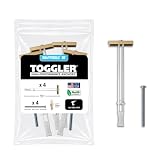
- TOGGLER SNAPTOGGLE Drywall Anchor – 5/16"-18 UNC Zinc-Plated Snaptoggle Anchors – Holds 265 lbs on Drywall, 802 lbs on Concrete Block – Toggle Bolts for Mounting Cabinets and TV – 2 Pack (With Bolts)
- VERSATILE INSTALLATION – TOGGLER Snaptoggle Drywall Anchor fits 3/8" to 3-5/8" hollow materials, including gypsum board, drywall, and concrete block. Suitable toggle bolts for drywall TV mount, shelving, and fixtures.
- EASY ONE-PERSON SETUP – TOGGLER Drywall Anchor attaches to the wall before inserting the bolt and fixture, allowing convenient one-person installation and fixture changes. Ideal snap toggle drywall anchors for home and office use.
- MADE IN USA – Manufactured in the USA, TOGGLER Snaptoggle Anchors are compatible with 1/4"-20 UNC-threaded metal bolts (sold separately). Durable anchor bolts for drywall and concrete block mounting applications.
- LOAD CAPACITY – TOGGLER Snap Toggle Drywall Anchors have an ultimate tensile strength of 265 lbs in 1/2" drywall and 1,080 lbs in concrete block when used with a 1/4"-20 UNC bolt. Follow safe working load guidelines.
Can I reuse a drywall anchor after removing a picture?
Reuse is only appropriate when the anchor and surrounding drywall remain undamaged and the manufacturer allows it. A visibly bent molly, a deformed toggle, a loose plastic sleeve or an enlarged hole should be replaced rather than trusted for another load.
Why does the same anchor hold less on one wall than another?
Drywall thickness, moisture, previous repairs, hole accuracy and the distance of the load from the wall all change the force on the anchor. Published capacities assume the installation conditions stated by the manufacturer, not every wall that looks similar.
Should a heavy mirror use one large anchor or several smaller ones?
Follow the mirror’s mounting hardware and the anchor maker’s multi-point guidance. Several anchors can distribute a load, but they do not multiply capacity automatically if the bracket is flexible or the holes are unevenly loaded.
Quick Recap


