Crashes, No Sound, or Screen Glitches?
Free tools Windows power users keep installed
One-click scans. No signup required.
Random freezes, missing sound and display glitches usually trace back to one bad driver. Find and replace yours safely.Free scan · under a minute
PC Slower Than It Used to Be?
A free scan shows the junk files, broken settings and background clutter dragging Windows down - then fixes them in one click.Free scan · Windows 10 & 11
ThatPainter is reader-supported. When you buy through links on our site, we may earn an affiliate commission. Learn More
Irish Chain quilts are built from repeated pieced squares arranged in diagonal chains, with plain or low-contrast squares creating a checkerboard of negative space. Choose a single chain for the most open layout, a double or triple chain for denser geometry, then use contrast, accurate cutting and careful block placement to keep the diagonals continuous. The same structure works for a beginner-friendly rotary-cut project or a historically informed reproduction.
What an Irish Chain quilt pattern looks like
An Irish Chain is a grid design in which pieced units form diagonal lines separated by plain squares. The International Quilt Museum describes the visual effect as diagonal emphasis against checkerboard negative space; fabric contrast and blending determine how sharply the chain appears.
| # | Preview | Product | Price | |
|---|---|---|---|---|
| 1 |

|
Irish Chain in a Day: Single and Double | $21.95 | Buy on Amazon |
| 2 |

|
Irish Chain Quilts: A Workbook of Irish Chains and Related Patterns | $29.41 | Buy on Amazon |
| 3 |

|
Time for a Chain: The Irish Chain Updated | $44.95 | Buy on Amazon |
| 4 |

|
Triple Irish Chain Quilts | $15.84 | Buy on Amazon |
| 5 |
|
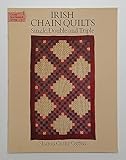
Irish Chain Quilts: Single, Double and Triple (Dover Quilting) | $941.99 | Buy on Amazon |
As an Amazon Associate I earn from qualifying purchases.
Most modern patterns use rotary cutting and machine piecing. Historical quilts also demonstrate hand piecing and elaborate hand quilting, so the design is not tied to one method.
Single Irish Chain
A single layout has the widest open spaces and the lightest chain density. In some historical and Colonial Revival usage, Double Nine Patch is called Single Irish Chain. The International Quilt Museum notes this naming overlap, so check the block diagrams in a pattern rather than relying on the title alone.
#1 Best Overall
- Used Book in Good Condition
Double Irish Chain
Double layouts place two parallel chain systems in the repeating field. They read as a stronger lattice while retaining substantial background space. A United States example cataloged by the International Quilt Museum dates to about 1840–1860, when the design was becoming increasingly popular.
Triple Irish Chain
Triple layouts carry three chain lines and therefore more pieced units and more opportunities for a misplaced block to interrupt a diagonal. Museum records include examples from northeastern Ohio dated 1880–1900 and an Amish-associated Holmes County, Ohio, quilt dated 1975.
Rank #2
- Used Book in Good Condition
Single, double or triple: how to choose
| Layout | Chain density | Color approach | Planning considerations |
|---|---|---|---|
| Single | Most open | High contrast gives a clean, graphic chain; blended or scrappy fabrics soften it | Fewer repeated chain lines and simpler visual checking |
| Double | Medium | Two-color schemes show the lattice clearly; controlled scrappiness adds movement | More units and alignment checks than a single layout |
| Triple | Densest | Strong value separation is especially useful for keeping three lines readable | Highest unit count and the greatest need to lay out the full quilt before joining rows |
Any of the three can be drafted for a wall quilt, baby quilt, twin, queen or larger bed quilt. The Irish Chain Quilt reference book specifically includes wall, baby and bed sizes.
Fabric and color planning
Start by deciding which fabric will make the chain and which will form the background. A two-color, high-contrast pairing makes the diagonals easiest to see. Similar values, prints with scattered light and dark areas, or a scrappy selection produce a softer chain and require more attention to value than to hue.
Rank #3
- color photographs
- Chain fabric: choose a consistent value if you want uninterrupted diagonal lines.
- Background: plain or low-contrast fabric preserves the checkerboard openings.
- Scrappy option: keep a common value or color family so individual patches do not erase the chain.
- Scale: small repeated squares make seams and pressing more visible; larger units reduce the number of pieces.
How to make an Irish Chain quilt
- Select the layout. Use a single, double or triple diagram and decide the finished block and quilt dimensions before cutting.
- Cut repeated units. Rotary-cut the squares or strip-set components specified by the pattern. Label piles immediately; chain and background pieces can look interchangeable once cut.
- Piece the chain blocks. Sew with a consistent seam allowance and press each sub-unit the same way. A small difference repeated across many units can change the diagonal alignment.
- Prepare plain blocks. Cut and press the background squares so their finished size matches the pieced blocks.
- Lay out the complete design. Arrange every pieced and plain block on a design wall or clean floor. Trace each diagonal visually from edge to edge before sewing rows.
- Join rows. Pin intersections, keep the row order marked, and recheck the chain after each row is added.
- Add borders. A plain border frames the grid; a more decorative treatment can echo the chain. Measure the quilt center before cutting border strips to avoid wavy edges.
- Quilt the surface. Use quilting lines that support the diagonals and a separate motif in the open squares if desired.
- Bind the quilt. Square the quilted layers, attach the binding evenly and finish the join securely.
The Irish Chain pattern company Sandi Irish describes its patterns as rotary cut and machine pieced for beginners through advanced quilters. That describes the format of those patterns, not a guaranteed result; accuracy still depends on cutting, sewing and pressing.
The Tool Desk
Outbyte PC Repair FREEClear out junk files and repair common Windows errorsFree Scan →Outbyte Driver Updater FREEFix the driver behind crashes, sound loss and screen glitchesFind Drivers →Beginner checkpoints that prevent common errors
- Test the seam allowance: sew a small sample, press it and measure the finished unit before cutting the full batch.
- Control sub-unit size: trim only when the pattern allows it; inconsistent trimming can distort the diagonal rhythm.
- Press consistently: choose pressing directions that let seams nest at intersections, or press open when the pattern specifies it.
- Use labels: number rows and mark the top of blocks so a rotated square does not reverse the chain.
- Inspect in stages: photograph or step back from the layout; diagonal breaks are easier to spot from a distance.
Quilting and border ideas
Quilting can make the chain more dimensional rather than merely securing the layers. Jane Valentine’s quilt uses diagonal grid quilting along the chain and a floral motif in the plain blocks. That approach can be adapted with walking-foot lines, hand quilting or free-motion motifs suited to the maker’s method.
Rank #4
- Used Book in Good Condition
The Irish Chain Quilt by Blanche Young and Helen Frost (C&T Publishing, 1987) describes double, triple and quadruple chains, six border treatments, and quilting patterns for the spaces between chains. Possible border directions include a quiet plain frame or a more decorative treatment such as a sawtooth edge. Choose a border that does not compete with the primary diagonals.
Independent reader supportYour contribution helps us test, update, and keep practical guides available for everyone.What the historical record shows
Early nineteenth-century origins
The Smithsonian National Museum of American History states that “The ‘Irish Chain’ pattern was in use in the early 1800s and may have been adapted from weaving patterns.” Jane Valentine’s quilt was begun in 1825 and completed in 1830. Its documented construction includes 348 white blocks, 348 pieced blocks and 10,092 small segments; the pieced segments are 5/8-inch squares.
Nineteenth-century popularity
The International Quilt Museum catalogs a United States Double Irish Chain made about 1840–1860 and notes increasing popularity after 1840. Another museum record identifies Rhoda E. Smith Nutt’s 1853 Double Irish Chain, made in Benton, New York, as 102 by 82 inches, with hand piecing, hand applique and corded or stuffed work.
Do these 3 things before closing this tab:
1Scan for outdated or missing drivers - takes under a minute2Repair Windows errors before they cause bigger problems3Fix the driver behind crashes, sound loss and screen glitchesIrish and American examples
The Ulster Folk Museum records an Irish Chain made around 1891 in County Antrim. It measures 192 by 195 cm and combines red sprigged printed cotton with plain white cotton and hand quilting. These examples show that the same grid could be interpreted with different fabrics, techniques and quilting textures.
Pattern books and sources for a project
The Irish Chain Quilt
Blanche Young and Helen Frost’s book, published by C&T Publishing in 1987, is a 56-page trade paperback (ISBN 9780914881148). The publisher description lists clear cutting, piecing, assembly and finishing instructions; double, triple and quadruple chains; wall, baby and bed sizes; six border treatments; and quilting patterns. It is a useful single reference when you want several chain densities and finished-size options in one volume. Verify current retailer price, stock and edition details before buying.
Contemporary pattern catalogs
Sandi Irish’s Irish Chain pattern company offers traditional and contemporary patterns, templates, kits and fabrics, and says the business began in 2003. Its stated audience ranges from beginner to expert. Compare the block diagram, fabric requirements and finished dimensions of any individual pattern before substituting materials.
Quick Recap
Choosing a practical first project
- Pick a single chain if you want the most open field and the fewest diagonal lines to monitor.
- Pick a double chain for a classic, prominent lattice with a manageable increase in piecing.
- Pick a triple chain when dense geometry is the goal and you are comfortable organizing many repeated units.
- Use a two-color, high-contrast palette for the clearest first attempt; experiment with scrappy or blended fabrics after you can reliably match intersections.
- Decide the finished size before cutting, because changing dimensions mid-project changes the number of blocks and border lengths.

Product prices and availability are accurate as of the date/time indicated and are subject to change. Any price and availability information displayed on Amazon at the time of purchase will apply.




