What’s actually slowing this PC down?
Pick the symptom - the matching free tool is one click away.
ThatPainter is reader-supported. When you buy through links on our site, we may earn an affiliate commission. Learn More
As an Amazon Associate I earn from qualifying purchases.
Common shovel types are designed for different jobs: a round-point digging shovel is the most useful general-purpose choice, while square-point and scoop shovels move loose material, garden spades cut sod and roots, trenching spades open narrow channels, and snow tools clear paved areas. Choosing by blade shape, capacity, handle fit and the material you are moving prevents wasted effort and damaged tools.
Recommended Free Tools
The names are not standardized across retailers, so look at the blade and bowl as well as the label. This guide explains what each type does, when to choose it, how to size one to your strength and workspace, and how to use and maintain it safely.
Popular on Amazon

- Great Value Paint Brush Set: Soucolor 20 acrylic paint brushes come in 10 different sizes, making them ideal for fine detailing, model painting, rock painting, nail art, face painting, DIY crafts, and general art projects. The varied brush sizes give you better control for both delicate lines and broader color coverage, while the soft bristles deliver smooth, consistent results on acrylic, oil, watercolor, canvas, wood, ceramic, and more.
- Awesome Set of Paint brushes: Professional paint brushes can cover all of your needs. The multi-purposed brushes are ideal for Watercolor, Oil, Gouache, enamel, Acrylic Painting, Body, Nail, Face Painting, Miniature, Model, Wood, Glass, Cup, Ceramic, Fine work, Art class, Craft Art Painting, DIY Art Crafts etc.
- Soft and long-lasting: The bristles are soft and strong, with nickel metal ferrules and blue wooden handles. After cleaning, the bristles will become soft and fluffy again and will not fall off.
- Easy to clean: it’s very convenient to Wash well in soap and water. Retain shape after drying. the brushes hold up very well. Nice selection to beginners and professionals. Keep them clean and they last a long time.
- Perfect for All Painters & Occasions: Suitable for art beginners, hobbyists and professional artists. Great for art class, home creation, travel painting and DIY handmade projects. A practical art gift for students, teachers, family and craft lovers.
What is the difference between a shovel and a spade?
A shovel generally has a curved or cupped blade intended to dig, scoop or carry material. A spade usually has a flatter, straighter and often sharper blade intended to cut soil, turf or roots. Retailers sometimes use the two words interchangeably, so the blade profile and stated task are more reliable than the name alone; The Home Depot’s digging-tools guide notes that brands may label similar tools differently.
For a practical distinction, choose a rounded, pointed blade when you need to penetrate intact soil and a flat, sharp blade when you need a clean cut. A deeper bowl is optimized for carrying loose material, while a narrow blade removes a controlled strip for a trench.
Which shovel should you use for each job?
Match the tool to the material and motion: penetrate, cut, transfer, carry or push. The table gives a quick reference; the sections that follow explain the trade-offs.
Crashes, No Sound, or Screen Glitches?
Random freezes, missing sound and display glitches usually trace back to one bad driver. Find and replace yours safely.Free scan · under a minuteWindows Errors? Fix Them Before They Spread
Repair common Windows errors and clear accumulated junk for a smoother, more stable PC - no reinstall needed.Free scan · no reinstall| Type | Blade and shape | Best uses | Important trade-off |
|---|---|---|---|
| Round-point digging shovel | Rounded blade with a slight point | Garden beds, planting holes and ordinary digging | Versatile, but less efficient than specialized blades for carrying or precision cuts |
| Pointed digging shovel | Pronounced penetrating point | Hard or heavy soil, roots and jobs needing extra penetration | Point enters soil well but carries less than a broad scoop |
| Square-point or transfer shovel | Flat, squared leading edge; usually a shallow-to-moderate bowl | Scraping, scooping and transferring loose soil or compost | Good for moving material, not for breaking undisturbed ground |
| Scoop shovel | Wide, deep bowl | Sand, mulch, snow and other loose materials | High capacity also means a heavy load and greater lifting effort |
| Garden or edging spade | Flat, sharp-edged blade | Slicing sod, edging beds, cutting roots and dividing clumps | Cuts cleanly but is not intended to carry a large volume |
| Trenching or drain spade | Long, narrow blade | Irrigation, drainage and other narrow, deeper trenches | Precise in tight spaces but slow for broad excavation |
| Snow shovel | Scoop-shaped lifting blade | Lifting and throwing snow from steps, paths and small areas | Loaded snow can be heavy; repeated lifting is tiring |
| Snow pusher | Broad blade designed to stay near the ground | Moving snow across larger paved areas | Pushes rather than lifts; less useful for throwing piles |
| Hand trowel | Small pointed or narrow hand blade | Bulbs, bedding plants, small holes and weeds | Precise but unsuitable for full-size digging |
When is a round-point shovel the right choice?
A round-point shovel is the best starting point for most general landscaping and planting. Its rounded blade with a slight point penetrates soil and can then lift it; Virginia Cooperative Extension describes this shape as “a general-purpose shovel” used for digging and lifting in its Hand Tools Safety guide. The University of Guam’s home vegetable-gardening guide likewise identifies a long-handle round-point shovel as a basic tool for beds and plant holes.
Use it to open planting holes, turn soil, dig out a small shrub or loosen a bed. Step on the blade when the soil allows, keep the shaft aligned with your body and lift manageable loads. It is a compromise: a scoop shovel carries more loose material, and a garden spade makes a cleaner vertical cut, but neither is as broadly useful for ordinary digging.
Should you choose a pointed digging shovel for hard soil or roots?
Choose a more distinctly pointed digging shovel when penetration is the priority. The point concentrates force at a small area, helping start a hole in compacted soil or work around roots. Virginia Tech distinguishes pointed blades as primarily for digging.
Also popular on Amazon

- COMPLETE 5-PIECE BRUSH SET FOR EVERY PAINTING TASK — Includes 1 Inch Flat, 1.5 Inch Angle, 2 Inch Flat, 2 Inch Angle Stubby, and 2.5 Inch Angle brush giving you every size professional painters use daily. Get all 5 for less than the price of a single brush from hardware store brands — professional grade performance at a fraction of the cost. Perfect for walls, trim, cabinets, doors, furniture, and detailed cutting-in work on any project.
- ZERO BRISTLE LOSS — GUARANTEED BY PRECISION ADHESIVE BONDING — Every bristle is locked in place with precision-set adhesive that keeps them in the brush — not in your paint job. The coated steel ferrule provides structural support while the adhesive bond ensures clean performance on every stroke. Premium SRT synthetic filaments load more paint and release it evenly for a smooth streak-free finish on walls, ceilings, and trim. Works with latex, oil-based paint, primer, sealer, and wood stain.
- INCLUDES THE ANGLE STUBBY MOST SETS LEAVE OUT — Professional painters know the 2 Inch Angle Stubby is the go-to brush for tight cabinet interiors, window sashes, inside corners, and detailed trim where standard angle brushes are too long. Combined with the 1.5 and 2.5 inch angle sash brushes you have precision cutting-in covered at every scale — baseboards, crown molding, door casings, and ceiling lines.
- FLAT BRUSHES FOR BROAD SMOOTH COVERAGE ON ANY SURFACE — The 1 and 2 inch flat brushes deliver even coverage on walls, furniture, shelving, doors, fences, decks, and wood surfaces. Ideal for applying primers, stains, varnishes, polyurethane, and specialty coatings. Solid wood handles provide all-day comfort and control for both professional contractors and weekend DIY homeowners tackling interior or exterior painting projects.
- TRUSTED BY PROFESSIONAL PAINTERS AND CONTRACTORS NATIONWIDE — Pro Grade delivers professional-grade results at a price that makes sense for crews who go through brushes on every job. Ideal for property managers, remodeling contractors, apartment turnover crews, maintenance teams, and commercial painting operations. Backed by thousands of verified reviews from working painters. Washable and reusable for multiple projects.
Do not use the point as a pry bar. Twisting the shaft or levering aggressively can bend the blade, damage the handle or throw you off balance. For very large roots, use a purpose-made digging bar or saw rather than forcing a shovel beyond its design.
When is a square-point or transfer shovel better?
A square-point shovel is mainly a transfer tool. Its flatter front edge scrapes and gathers loose soil, compost, mulch, gravel or debris from a pile, wheelbarrow or driveway. The square edge leaves a relatively even surface and can shave material from a hard-packed pile more effectively than a rounded point.
Labels vary: some listings call this a transfer shovel, square shovel or square-point spade. Compare the edge and bowl rather than relying on the title. A shallow bowl is easier to control for spreading; a deeper bowl carries more but becomes heavier when full. Because the flat edge does not penetrate intact ground as readily, use a round-point shovel or spade to break soil first.
When does a scoop shovel make sense?
Use a scoop shovel when you repeatedly carry loose material and want maximum capacity per load. Its deeper, often wider bowl is suited to sand, mulch, compost, grain-like materials and snow. Manufacturer guidance summarized by Bully Tools’ shovel guide describes scoop shapes as useful for moving loose materials.
Capacity is also the main risk. A full scoop of wet soil or snow can exceed what you can safely lift, even if the empty tool feels light. Fill only as much as you can control, keep the load close to your body and consider a narrower blade when the material is dense. A square transfer shovel may be faster for scraping and spreading, while a scoop wins when carrying volume is the main task.
Free tools Windows power users keep installed
One-click scans. No signup required.
What is a garden or edging spade used for?
A garden spade has a relatively flat blade with a sharp, straight edge. It is the right tool for slicing sod, defining bed borders, cutting through roots and dividing established plant clumps. The University of Guam and Virginia Tech both identify this flat, sharp style for cutting work.
Also popular on Amazon

- 【All sizes of art brushes】: The 10 sizes of multi-functional brushes have various shapes, making the mixing color easier, which is very suitable for artists, students, teenagers, children and painters at all levels. Wonderful Present ideas for friends and family who like painting!
- 【general brush set】: Professional paint brush can meet all your needs. Multifunctional brush is very suitable for watercolor, oil, gouache, acrylic painting, body, nail, face painting, miniature, model, ceramics, arts and crafts painting, etc.
- 【high quality process】: It is designed with anti falling bristles, anti-rust nickel ferrule and solid wood handle. You can use the brush to focus on the painting and always be creative.
- 【easy to maintain】: After using the brush, it is very convenient to clean the brush with warm soapy water and reshape the tip of the brush. Air dry the brush and place it on top of the top for long use.
- 【100% satisfaction guarantee - buy now】1 packs of set brushes, you can also get friendly customer service, any questions feel free to contact us, within 24 hours to help you! There is no risk in buying our paint brush kit.
To edge a bed, mark the line, place the blade vertically and press down with your foot, then lift the short section of turf. For transplanting, use the spade to make clean sides around a root ball rather than chopping randomly. Its straight profile also makes it useful for square-sided holes and shallow trench sections. Because the blade is optimized for cutting, it is less comfortable for carrying a large load than a cupped shovel.
When should you use a trenching or drain spade?
A trenching or drain spade has a long, narrow blade that removes a slim column of soil. Use it for irrigation lines, drainage channels, edging in tight borders and other places where a broad shovel would excavate too much. University of Guam and Virginia Tech guidance both describe narrow ditch or trench tools for this purpose.
Plan the trench width and depth before digging. Make several controlled passes rather than forcing the entire depth at once, and keep spoil placed on the side where it will be easiest to return. A narrow blade is slower for general bed preparation, and its shaft can be stressed if you swing it sideways or use it to pry.
The Tool Desk
Outbyte PC Repair FREERepair Windows errors before they cause bigger problemsFix Now →Outbyte Driver Updater FREEFix the driver behind crashes, sound loss and screen glitchesFind Drivers →Which snow tool is better: a shovel or a pusher?
Choose a snow shovel when you need to lift and throw snow from steps, thresholds or a short path. Choose a snow pusher when you need to move a broad area of snow along the ground. Manufacturer guidance distinguishes lifting/scooping tools from pushers intended for larger areas.
A pusher reduces lifting but may struggle with deep, compacted or icy snow. A lifting shovel handles piles and steps but places more load on your back and shoulders. Clear in layers during a heavy fall, keep each scoop modest and use a scraper or ice tool for bonded ice instead of twisting a plastic or aluminum shovel.
Is a hand trowel a type of shovel?
A trowel is a small hand-digging tool rather than a full-size shovel, but it fills the same role at a smaller scale. Use it for bulbs, bedding plants, container work and small weeds. Virginia Tech includes the trowel among hand tools for precise digging.
Also popular on Amazon

- 【KIDS PAINT BRUSHES SET】Anezus paint brushes for kids come with 10 pcs paint brushes of 5pcs round paintbrushes and 5 flat paint brushes with colorful handles, good for the young artist to explore their creativity in painting and crafting
- 【HIGH QUALITY PAINT BRUSHES FOR KIDS】These toddler paint brushes made of soft hog bristle, bright colored handles and rust proof ferrules. The bristles are firmly fixed in the kids paint brushes and no shedding. Each children paint brush measure 6 1/4 inches (16cm) in length and ferrules 1/2"(1.3cm) diameter, large enough for the little hand to grip and control
- 【WIDE APPLICATIONS】With combination of round and flat craft paint brushes for kids, work great with washable paint, tempera paint and acrylic paint. Great for arts and craft, rock, leather, gesso and ceramic, or body, nail and face art painting.
- 【EASY TO CLEAN 】After using paint brushes for acrylic, oil or watercolor painting, it’s very convenient to clean them with warm soapy water and reshape the paint brush tips. Keep these craft paint brushes clean and they last a long time.
- 【GREAT GIFT IDEA】Perfect for students, teens, kids, children and painters of all levels. Wonderful gift idea for girls, boys and kids who love painting! These all-purpose paint brushes for kids are ideal for kids' school projects, birthday parties, painting parties, art parties, back to school supplies, classroom decoration and more.
Its narrow blade lets you work between existing plants without disturbing nearby roots. For dozens of holes, however, a full-size shovel is safer for your posture and more efficient. Select a handle that gives you a secure grip and a blade width suited to the planting space.
Do these 3 things before closing this tab:
1Fix the driver behind crashes, sound loss and screen glitches2Repair Windows errors before they cause bigger problems3Scan for outdated or missing drivers - takes under a minuteHow do handle length, blade width and weight change the work?
Fit matters as much as blade type. Virginia Tech gives source-specific guidance of roughly 40–48 inches for long handles that provide leverage and reach for deeper holes, and about 26–30 inches for shorter handles used in confined spaces or precise work. These are useful ranges, not universal sizing rules; your height, strength, task and workspace still determine comfort.
A wider or fuller blade carries more material per pass but demands more force to load and lift. A narrower blade is easier to control in dense soil and tight beds. Shaft materials and handle styles affect weight, flex and grip; a D-shaped or other ergonomic grip may improve control, while a straight handle can offer more hand-position choices. The UC Master Gardeners’ maintenance-tools guide lists shaft length and material, handle style, blade thickness, foot step, weight, blade angle and intended use among the factors to compare.
Check the lift angle as well. A blade set at a useful angle lets you scoop without excessive wrist bending, but the best angle depends on whether you are digging, scraping or carrying. Hold the empty tool, then mimic the intended motion; if your shoulders rise, wrists bend sharply or the shaft feels unstable, choose a different size or shape.
Independent reader supportYour contribution helps us test, update, and keep practical guides available for everyone.How do you choose one shovel for general landscaping?
Start with the task you perform most often, then add a specialized tool only when it removes a recurring bottleneck.
Quick wins for a faster PC:
Scan for outdated or missing drivers - takes under a minuteDriver Scan →Clear out junk files and repair common Windows errorsFree Scan →- For intact soil and planting holes, start with a round-point digging shovel. Select a handle length you can control and a blade you can step on without straining.
- For loose material, decide whether you transfer or carry. Choose a square-point blade for scraping and spreading; choose a deeper scoop when carrying larger loads is the priority.
- For edges, sod and roots, choose a garden spade. Its flat, sharp edge makes a cleaner cut than a rounded shovel.
- For narrow utilities or drainage, choose a trenching spade. Match blade width to the planned trench so you do not remove unnecessary soil.
- For snow, choose by motion. Use a lifting shovel for steps and piles, or a pusher for broad paved areas.
- Add a trowel for small planting. It complements, rather than replaces, a full-size shovel.
If you can buy only one full-size tool, a round-point shovel is the most defensible default for ordinary garden digging. If your property is dominated by mulch delivery, snow clearing or bed edging, let that dominant task override the general-purpose choice.
Also popular on Amazon
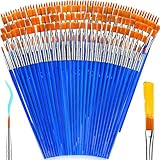
- 【162-Piece Bulk Set | Dual Brush System】Maximize versatility with 81 flat brushes (0.59 inch edge for bold strokes) and 81 round brushes (0.39 inch tips for details) – 3X more tools than standard kits! Pre-sorted in labeled compartments for instant access during painting sessions. Ideal for art classrooms, mural projects, and multi-artist households.
- 【Pro-Grade Durability | Zero Shedding Guarantee】 "Engineered with triple-crimped nylon bristles (43% higher resilience vs. standard) and aerospace aluminum ferrules tested for 10,000+ flex cycles. Lab-verified 0.01% shedding rate even with heavy impasto techniques – outperforms flimsy bristles in budget brushes."
- 【Multi-Scenario Readiness | Event & Daily Use】 Optimized for: Thanksgiving/Christmas face designs classroom projects ceramic decorating fabric printing and model painting; Lightweight plastic handles each reduce hand fatigue during prolonged sessions
- 【Effortless Maintenance | Long-Term Durability】 Clean with warm soapy water in 10 seconds; Reshape tips and air-dry vertically to preserve bristle integrity,After use, air-dry brushes thoroughly and store upright in the provided case to preserve bristle shape. The premium nylon filaments naturally regain their original form after each stroke. For cleaning, simply rinse in warm soapy water and gently reshape bristles with fingertips."
- 【Multiple Application】These acrylic paint brushes can be applied for most occasions,such as:watercolor,oil, gouache paint,face paint, acrylic paint, suitable for Thanks Giving Day, Christimas, Halloween face and body painting, canvas painting, fabric, rock, miniature, model, ceramics, arts and crafts painting, etc.
How should you use a shovel safely?
Safe technique begins before the blade enters the ground. Virginia Tech advises sizing the tool to the task and the user, maintaining balance, keeping the edge sharp and avoiding twisting.
- Check the work area. Identify irrigation, electrical, gas and communication lines before digging. In Virginia, the guide points readers to the state’s 811 service; elsewhere, contact your local utility-locate service and follow its timing and marking requirements.
- Set your stance. Keep feet apart, face the direction of the cut and place one foot near the blade without standing where the tool could slip.
- Cut or penetrate straight. Let the blade shape do the work. Do not wrench the handle sideways to free a stuck blade.
- Lift close to your body. Bend at the hips and knees, keep the load small enough to control and turn your whole body rather than twisting your spine.
- Use the correct motion. Scrape with a square point, scoop with a bowl, cut with a spade and push snow with a pusher. Forcing a tool into the wrong motion increases strain and damage.
How do you maintain shovels and spades?
Clean the blade after each use so wet soil and salts do not promote corrosion. Dry it before storage, and keep the tool in a dry location. Remove small burrs and maintain a sharp cutting edge on digging and edging blades according to the manufacturer’s instructions; a dull edge requires more force.
Inspect the shaft for cracks, splinters or looseness, and check that the handle, socket and fasteners are secure. Replace a damaged handle rather than wrapping a structural crack. Straighten or replace a badly bent blade instead of continuing to pry with it. Before seasonal snow storage, clean and dry the blade and check that the grip is firmly attached.
What mistakes make the wrong shovel feel ineffective?
- Using a scoop to break hard ground: a deep bowl is for carrying, not penetration. Start with a round-point shovel or spade.
- Using a spade to haul soil: the flat blade cuts well but offers little carrying capacity. Transfer the loosened soil with a square or scoop shovel.
- Overfilling a wide blade: the extra capacity can turn a manageable tool into an unsafe load, especially with wet soil or snow.
- Choosing a shaft that is too short: you may bend excessively; choosing one too long can reduce control in beds or trenches.
- Twisting to free a stuck blade: this stresses the shaft and your back. Withdraw, reposition and take a smaller cut.
- Ignoring utility markings: even a shallow-looking planting hole can reach buried services. Locate lines first.
How we organized the shovel types
The categories here are based on the task each blade is designed to perform—digging, cutting, transferring, carrying, trenching or clearing snow—along with the blade shape, bowl depth, handle fit and control requirements described by University of Guam Cooperative Extension, Virginia Cooperative Extension, The Home Depot, Bully Tools and UC Master Gardeners. Because names vary by manufacturer, the practical descriptions emphasize what the tool looks like and does rather than treating any label as a universal standard.
Frequently Asked Questions
Can one shovel handle every garden job?
A round-point shovel covers ordinary digging, planting holes and light lifting, so it is the best single full-size choice for many gardens. It cannot match a garden spade for clean edging, a trenching spade for narrow channels or a scoop for high-volume loose material, so frequent specialized work justifies adding those tools.
How sharp should a shovel blade be?
Keep digging and edging edges sharp enough to enter soil or turf without excessive force, but do not turn a general shovel into a knife edge. Remove burrs and follow the tool maker’s sharpening guidance; inspect the edge regularly, especially after striking stones.
What shovel is easiest for someone with limited lifting strength?
Favor a shorter or lighter tool that you can control, and choose a narrower blade so each load weighs less. A snow pusher can reduce lifting during snowfall, while partial scoops and frequent trips are safer than filling a large bowl.
Recommended Free Tools
Why do shovel names differ between stores?
Manufacturers and retailers do not use “shovel,” “spade,” “transfer” and “scoop” identically. Compare the leading edge, blade width, bowl depth and intended motion in the product description, then match those features to your task.
Should I use a shovel or a spade to remove a plant?
Use a sharp garden spade to cut a clean perimeter around the root ball and slice through small roots. Use a round-point shovel to loosen and lift the surrounding soil, switching tools rather than levering hard with the spade.
Quick Recap


