Quick wins for a faster PC:
The Tool Desk
Outbyte PC Repair FREEClear out junk files and repair common Windows errorsFree Scan →Outbyte Driver Updater FREEFix the driver behind crashes, sound loss and screen glitchesFind Drivers →Repair Windows errors before they cause bigger problemsFix Now →Scan for outdated or missing drivers - takes under a minuteDriver Scan →Clear out junk files and repair common Windows errorsFree Scan →
ThatPainter is reader-supported. When you buy through links on our site, we may earn an affiliate commission. Learn More
Choosing a substrate for a timber veneer project means matching the core panel to the finished surface, edge treatment, panel use and required performance—not simply selecting a timber species. The four established options are particleboard, MDF, plywood and blockboard. MDF is usually the practical starting point when edges will be moulded or left visible; particleboard suits smooth, consistent veneered panels; plywood is useful for special applications when its construction and grade fit the project; and blockboard is chiefly associated with solid-core doors. Confirm the exact board grade and environmental suitability with your panel supplier before ordering.
At a glance
| Name | Best for | Key spec | Checked |
|---|---|---|---|
| MDF | Moulded or exposed finished edges | Smooth surface and edge-finishing qualities | November 2026 |
| Particleboard | General veneered panels needing a smooth, stable core | Uniform thickness and properties; machinable and dimensionally stable | November 2026 |
| Plywood | Special veneer applications | Construction and grade must be selected for the project | November 2026 |
| Blockboard | Solid-core doors | Wood-strip core faced with veneer layers | November 2026 |
What is a substrate in a timber veneer panel?
A substrate is the board beneath the decorative timber veneer. The veneer supplies the visible species, colour and grain, while the substrate supplies most of the panel’s thickness, flatness, machinability and in-service support. A veneer panel is therefore a system: the face, adhesive, balancing layer (where used), core and edge treatment must work together.
As an Amazon Associate I earn from qualifying purchases.
The same veneer species can behave very differently when bonded to different cores. A cabinet door with a profiled edge has different needs from a large wall panel, a flush door or a furniture top. Panel size, thickness, one- or two-sided veneering, grain direction and the room’s environmental conditions all belong in the specification.
The Timber Veneer Association of Australia’s 2023 Product Manual identifies MDF, particleboard, plywood and blockboard as recognised substrate categories. It also makes clear that the appropriate choice depends on the application rather than on a universal league table.
Popular on Amazon

- Great Value Paint Brush Set: Soucolor 20 acrylic paint brushes come in 10 different sizes, making them ideal for fine detailing, model painting, rock painting, nail art, face painting, DIY crafts, and general art projects. The varied brush sizes give you better control for both delicate lines and broader color coverage, while the soft bristles deliver smooth, consistent results on acrylic, oil, watercolor, canvas, wood, ceramic, and more.
- Awesome Set of Paint brushes: Professional paint brushes can cover all of your needs. The multi-purposed brushes are ideal for Watercolor, Oil, Gouache, enamel, Acrylic Painting, Body, Nail, Face Painting, Miniature, Model, Wood, Glass, Cup, Ceramic, Fine work, Art class, Craft Art Painting, DIY Art Crafts etc.
- Soft and long-lasting: The bristles are soft and strong, with nickel metal ferrules and blue wooden handles. After cleaning, the bristles will become soft and fluffy again and will not fall off.
- Easy to clean: it’s very convenient to Wash well in soap and water. Retain shape after drying. the brushes hold up very well. Nice selection to beginners and professionals. Keep them clean and they last a long time.
- Perfect for All Painters & Occasions: Suitable for art beginners, hobbyists and professional artists. Great for art class, home creation, travel painting and DIY handmade projects. A practical art gift for students, teachers, family and craft lovers.
When should I choose MDF for timber veneer?
Choose MDF when the design calls for a smooth, high-grade veneer surface combined with moulded, machined or exposed edges. Its consistent fibre composition makes it a practical base for routing, profiling and edge finishing, provided the specified panel is suitable for those operations.
MDF is widely used where a door, drawer front, panel or furniture component will not be hidden by a separate solid-wood lipping. The WoodSolutions guide to timber in internal design describes MDF’s smooth surface and edge-finishing qualities as useful for high-grade veneer work. The TVAA manual likewise points to moulded and exposed-edge applications as a reason to select MDF.
Do not treat “MDF” as a complete specification. Confirm thickness, face quality, density, moisture resistance, emissions classification and any machining limits with the supplier. Fire-retardant MDF is discussed in the TVAA material, but that reference does not certify every fire-retardant-labelled panel for your building’s required fire performance. A project requiring a fire rating needs the exact tested board-and-assembly data and the applicable local code.
Is particleboard suitable for veneering?
Yes. Particleboard is a common substrate for veneered products, especially where a smooth, uniform and dimensionally stable panel is required and the edges will be treated in a conventional way.
Also popular on Amazon

- COMPLETE 5-PIECE BRUSH SET FOR EVERY PAINTING TASK — Includes 1 Inch Flat, 1.5 Inch Angle, 2 Inch Flat, 2 Inch Angle Stubby, and 2.5 Inch Angle brush giving you every size professional painters use daily. Get all 5 for less than the price of a single brush from hardware store brands — professional grade performance at a fraction of the cost. Perfect for walls, trim, cabinets, doors, furniture, and detailed cutting-in work on any project.
- ZERO BRISTLE LOSS — GUARANTEED BY PRECISION ADHESIVE BONDING — Every bristle is locked in place with precision-set adhesive that keeps them in the brush — not in your paint job. The coated steel ferrule provides structural support while the adhesive bond ensures clean performance on every stroke. Premium SRT synthetic filaments load more paint and release it evenly for a smooth streak-free finish on walls, ceilings, and trim. Works with latex, oil-based paint, primer, sealer, and wood stain.
- INCLUDES THE ANGLE STUBBY MOST SETS LEAVE OUT — Professional painters know the 2 Inch Angle Stubby is the go-to brush for tight cabinet interiors, window sashes, inside corners, and detailed trim where standard angle brushes are too long. Combined with the 1.5 and 2.5 inch angle sash brushes you have precision cutting-in covered at every scale — baseboards, crown molding, door casings, and ceiling lines.
- FLAT BRUSHES FOR BROAD SMOOTH COVERAGE ON ANY SURFACE — The 1 and 2 inch flat brushes deliver even coverage on walls, furniture, shelving, doors, fences, decks, and wood surfaces. Ideal for applying primers, stains, varnishes, polyurethane, and specialty coatings. Solid wood handles provide all-day comfort and control for both professional contractors and weekend DIY homeowners tackling interior or exterior painting projects.
- TRUSTED BY PROFESSIONAL PAINTERS AND CONTRACTORS NATIONWIDE — Pro Grade delivers professional-grade results at a price that makes sense for crews who go through brushes on every job. Ideal for property managers, remodeling contractors, apartment turnover crews, maintenance teams, and commercial painting operations. Backed by thousands of verified reviews from working painters. Washable and reusable for multiple projects.
The TVAA describes particleboard as strong, stable and inexpensive in general terms, and calls it an excellent substrate for veneered products. WoodSolutions highlights the characteristics that matter in production: a smooth surface, surface integrity, uniform thickness, uniform properties, machinability and dimensional stability. Those qualities help the veneer adhesive achieve consistent contact across the panel.
“Inexpensive” is a qualitative description, not a current price comparison. Board prices vary by region, thickness, grade, certification and order volume, so obtain a current quotation rather than assuming a fixed cost advantage.
Particleboard can be a sensible choice for carcasses, shelving, furniture panels and architectural joinery where the board remains within its intended dry-service conditions. Specify the edge detail at the same time: a profiled exposed edge, a solid-wood lipping, a veneer return or a separate edging strip may each change the practical choice. The core’s exact grade also matters for screw holding, moisture exposure and load requirements; none of those properties can be inferred from the word “particleboard” alone.
When is plywood the better veneer substrate?
Plywood is appropriate for special veneer applications when its layered construction and selected grade provide the performance the project needs. It should be chosen as a particular plywood product, not as a blanket guarantee that every plywood panel is stronger, more moisture tolerant or more stable than every MDF or particleboard panel.
Also popular on Amazon

- 【All sizes of art brushes】: The 10 sizes of multi-functional brushes have various shapes, making the mixing color easier, which is very suitable for artists, students, teenagers, children and painters at all levels. Wonderful Present ideas for friends and family who like painting!
- 【general brush set】: Professional paint brush can meet all your needs. Multifunctional brush is very suitable for watercolor, oil, gouache, acrylic painting, body, nail, face painting, miniature, model, ceramics, arts and crafts painting, etc.
- 【high quality process】: It is designed with anti falling bristles, anti-rust nickel ferrule and solid wood handle. You can use the brush to focus on the painting and always be creative.
- 【easy to maintain】: After using the brush, it is very convenient to clean the brush with warm soapy water and reshape the tip of the brush. Air dry the brush and place it on top of the top for long use.
- 【100% satisfaction guarantee - buy now】1 packs of set brushes, you can also get friendly customer service, any questions feel free to contact us, within 24 hours to help you! There is no risk in buying our paint brush kit.
Plywood is made from bonded veneer plies, but species, core construction, thickness, glue class, face grade and manufacturing quality differ widely. A decorative interior panel, a curved component, a lightweight panel or a component subject to greater handling may each call for a different plywood specification. The TVAA guidance identifies plywood as an option for special veneer applications and advises selecting the relevant construction and grade for the project.
Ask for the technical data sheet and verify the panel’s intended service environment, allowable defects, thickness tolerance, flatness and edge appearance. If the panel will be visible at an edge, decide whether the layered edge is part of the design, will receive a lipping, or must be concealed. Veneering both faces may be necessary to balance appearance and movement, depending on the panel design and supplier’s system.
What’s actually slowing this PC down?
Pick the symptom - the matching free tool is one click away.
What is blockboard used for?
Blockboard has a core made from wood strips faced with veneer layers. In the TVAA references, its principal application is solid-core door manufacture, rather than general-purpose furniture or every veneered panel.
That application focus is important. A blockboard door specification may rely on a particular core thickness, face construction, edge detail and hardware preparation. A generic blockboard sheet may not meet the requirements of a fire door, acoustic door, exterior door or heavily loaded panel. Obtain the door manufacturer’s or supplier’s complete assembly specification, including any required lippings and face balancing.
Also popular on Amazon

- 【KIDS PAINT BRUSHES SET】Anezus paint brushes for kids come with 10 pcs paint brushes of 5pcs round paintbrushes and 5 flat paint brushes with colorful handles, good for the young artist to explore their creativity in painting and crafting
- 【HIGH QUALITY PAINT BRUSHES FOR KIDS】These toddler paint brushes made of soft hog bristle, bright colored handles and rust proof ferrules. The bristles are firmly fixed in the kids paint brushes and no shedding. Each children paint brush measure 6 1/4 inches (16cm) in length and ferrules 1/2"(1.3cm) diameter, large enough for the little hand to grip and control
- 【WIDE APPLICATIONS】With combination of round and flat craft paint brushes for kids, work great with washable paint, tempera paint and acrylic paint. Great for arts and craft, rock, leather, gesso and ceramic, or body, nail and face art painting.
- 【EASY TO CLEAN 】After using paint brushes for acrylic, oil or watercolor painting, it’s very convenient to clean them with warm soapy water and reshape the paint brush tips. Keep these craft paint brushes clean and they last a long time.
- 【GREAT GIFT IDEA】Perfect for students, teens, kids, children and painters of all levels. Wonderful gift idea for girls, boys and kids who love painting! These all-purpose paint brushes for kids are ideal for kids' school projects, birthday parties, painting parties, art parties, back to school supplies, classroom decoration and more.
How do I match the substrate to the edge treatment?
Start with the finished edge, because it often narrows the substrate choice faster than the veneer species does.
- Moulded or routed edge: MDF is a logical starting point because its smooth, homogeneous edge can be machined and finished consistently. Confirm the manufacturer’s machining guidance.
- Exposed veneered edge: Decide whether the veneer wraps the edge, a separate lipping is applied, or the core remains visible. MDF, particleboard and plywood will present different edge textures and construction lines.
- Solid-wood lipping: Several cores may work, but the lipping, adhesive and veneer system must accommodate movement and produce a flush, durable transition.
- Layered plywood edge: This can be intentional in a contemporary design, but the selected plywood must have an edge appearance and ply quality acceptable to the client.
- Door edge: Follow the door system’s requirements for lippings, hardware machining, impact resistance and any fire or acoustic certification.
Draw a full-size edge section before ordering. It should show the substrate, veneer thickness, adhesive line, balancing face (if required), edge band or lipping, finished dimensions and any radius or chamfer. This simple detail prevents a substrate that works on the face from failing at the edge.
How should I compare substrates for a particular project?
Use four decision filters in order: appearance and edge treatment, intended application, required physical performance, and the exact panel grades available locally.
- Define the panel’s job. Record whether it is a cabinet component, furniture panel, wall lining, door, ceiling element, work surface or another use. Note panel dimensions, span, fixings and handling.
- Define the visual result. Choose veneer species and cut, face quality, matching method, grain direction and whether one or both faces are visible.
- Define the edge. Identify moulding, routing, lipping, veneer return, exposed plywood layers or a concealed edge.
- Set environmental conditions. State whether the panel is in a dry interior, a periodically humid area, near water, in an unconditioned space or subject to unusual temperature changes. Do not assume a standard interior board is suitable for a wetter location.
- Set performance requirements. Check structural loading, screw holding, impact, acoustic, fire, emissions and dimensional tolerances as applicable. The sources do not establish one universally superior substrate for these properties.
- Shortlist locally available grades. Compare the supplier’s actual technical sheets, not just the generic names MDF, particleboard, plywood or blockboard.
- Confirm the complete assembly. Ask the supplier to review the core, veneer, adhesive, balancing, edge treatment and intended conditions together.
What should I include in a veneer-panel order?
Supplier guidance treats substrate selection as one part of a complete veneer specification. The veneer specification guidance from Sharp Panels identifies the details that should accompany the material request.
Also popular on Amazon
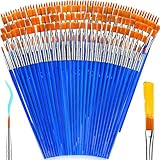
- 【162-Piece Bulk Set | Dual Brush System】Maximize versatility with 81 flat brushes (0.59 inch edge for bold strokes) and 81 round brushes (0.39 inch tips for details) – 3X more tools than standard kits! Pre-sorted in labeled compartments for instant access during painting sessions. Ideal for art classrooms, mural projects, and multi-artist households.
- 【Pro-Grade Durability | Zero Shedding Guarantee】 "Engineered with triple-crimped nylon bristles (43% higher resilience vs. standard) and aerospace aluminum ferrules tested for 10,000+ flex cycles. Lab-verified 0.01% shedding rate even with heavy impasto techniques – outperforms flimsy bristles in budget brushes."
- 【Multi-Scenario Readiness | Event & Daily Use】 Optimized for: Thanksgiving/Christmas face designs classroom projects ceramic decorating fabric printing and model painting; Lightweight plastic handles each reduce hand fatigue during prolonged sessions
- 【Effortless Maintenance | Long-Term Durability】 Clean with warm soapy water in 10 seconds; Reshape tips and air-dry vertically to preserve bristle integrity,After use, air-dry brushes thoroughly and store upright in the provided case to preserve bristle shape. The premium nylon filaments naturally regain their original form after each stroke. For cleaning, simply rinse in warm soapy water and gently reshape bristles with fingertips."
- 【Multiple Application】These acrylic paint brushes can be applied for most occasions,such as:watercolor,oil, gouache paint,face paint, acrylic paint, suitable for Thanks Giving Day, Christimas, Halloween face and body painting, canvas painting, fabric, rock, miniature, model, ceramics, arts and crafts painting, etc.
- Veneer species and cut (for example, the chosen method of slicing).
- Face quality and whether the panel is veneered on one or two sides.
- Grain direction and the matching or sequencing requirement.
- Finished panel length, width and thickness, plus acceptable tolerances.
- Substrate type, exact grade and intended service conditions.
- Edge treatment, including moulding, lipping, veneer return, edging or exposed core.
- Surface finish, sheen, colour control and sample-approval procedure.
- Any fire, acoustic, moisture, emissions or certification requirement that applies to the installation.
Grain-direction conventions can vary by country. The Sharp Panels guidance notes that the convention it describes is Australian practice, so clarify orientation with the supplier when a drawing, local standard or overseas manufacturer uses a different convention.
What are the main mistakes to avoid?
- Choosing by species alone: A beautiful veneer cannot compensate for an unsuitable core, edge or service rating.
- Treating a material name as a grade: “Plywood” and “MDF” cover products with different constructions and properties.
- Ignoring the back face: A visible or unbalanced panel may require a specified reverse face and grain direction.
- Leaving edges until fabrication: Routing, lipping and veneer returns can alter the required panel dimensions and core choice.
- Assuming generic moisture or fire performance: Verify the exact board and complete tested assembly against local requirements.
- Using outdated price assumptions: Particleboard may be described as inexpensive, but current costs depend on local supply, grade and thickness.
- Skipping a sample or edge mock-up: Face colour, grain matching and edge appearance should be approved before a production order.
How we picked the substrate guidance
The recommendations above follow the four substrate categories and application notes in the TVAA manuals, the surface and machining characteristics described by WoodSolutions, and the ordering details in Sharp Panels’ specification guidance. They distinguish broad material tendencies from project-specific performance claims. Because the sources do not provide comparable current prices or a universal ranking for strength, moisture resistance, fire performance or cost, those factors must be verified from the selected supplier’s current technical data.
What is the safest final decision?
For a moulded or exposed edge, begin with a suitable MDF grade. For a smooth, consistent general panel, investigate veneer-grade particleboard. For a special application, select plywood by its construction and grade; for a solid-core door, investigate the specified blockboard door system. In every case, send the supplier the complete panel, edge and environment requirements and obtain written confirmation that the proposed board is suitable.
Frequently Asked Questions
Can I veneer both sides of the same substrate panel?
Often, yes, but the veneer system may require a specified reverse face or balancing layer to help control movement and appearance. Confirm the supplier’s recommended construction for the panel size, thickness and conditions rather than adding a second face without design review.
Which substrate is best for a bathroom or other humid room?
The general categories alone do not answer that question. Check the exact board’s moisture classification, adhesive system, edge sealing and installation conditions, then verify compliance with local requirements and the supplier’s technical data.
Does a thicker substrate always make a better veneer panel?
No. Thickness must suit the span, hardware, edge detail and finished dimensions. A thicker board can still be unsuitable if its grade, flatness, moisture performance or construction does not match the application.
Do these 3 things before closing this tab:
1Fix the driver behind crashes, sound loss and screen glitches2Clear out junk files and repair common Windows errors3Scan for outdated or missing drivers - takes under a minuteShould veneer grain run along the long or short side of a panel?
There is no universal rule for every project. Grain direction depends on the design, veneer cut, panel proportions and local specification convention, so state the intended orientation on drawings and confirm it with the supplier.
Quick Recap


