Do these 3 things before closing this tab:
The Tool Desk
Outbyte PC Repair FREEClear out junk files and repair common Windows errorsFree Scan →Outbyte Driver Updater FREEScan for outdated or missing drivers - takes under a minuteDriver Scan →1Clear out junk files and repair common Windows errors2Fix the driver behind crashes, sound loss and screen glitches3Repair Windows errors before they cause bigger problems
ThatPainter is reader-supported. When you buy through links on our site, we may earn an affiliate commission. Learn More
A seam allowance is the fabric between the stitching line and the cut edge. It gives you material to join and finish two pieces of fabric. The stitching line shapes the finished piece; the seam allowance lies beyond that line.
How to identify a seam allowance
Look at a sewn seam or a pattern piece and find the stitching line and the raw, cut edge. The strip of fabric between those two is the seam allowance. On a pattern, the stitching line may be marked or implied by the pattern instructions; the outer cutting line accounts for any included allowance.
As an Amazon Associate I earn from qualifying purchases.
Free tools Windows power users keep installed
One-click scans. No signup required.
How wide should a seam allowance be?
Use the width specified in the pattern instructions. There is no single width for every pattern or sewing project. The American Sewing Guild describes 5/8 inch as the most common allowance included in garment patterns and notes that some pattern companies use 3/8 inch (American Sewing Guild, 2020). FreeSewing describes 1 cm as common in some patterns and 5/8 inch (15 mm) as common in the US, and advises checking the pattern’s default (FreeSewing). A Utah State Board of Education curriculum also describes 5/8 inch as standard for commercial patterns (Utah State Board of Education). These are examples of conventions, not a universal rule.
Check whether the pattern includes the allowance
Before cutting, read the pattern instructions to find out whether seam allowances are already included and what width to use. Some patterns include them; others expect you to add them. Adding an allowance to a pattern that already includes one changes the cut dimensions and can make the pieces too large to match as intended.
#1 Best Overall
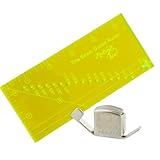
- SET STITCHES ACCURATELY - Use any sewing machine with the Madam Sew Sewing and Quilting Seam Guide Ruler. Performing the duties of several sewing rulers and guides, it helps you measure seam allowances from 1/8” up to 2”. A wonderful sewing accessory to any sewing machine.
- 16 INCREMENTAL HOLES - Will let you create accurate, consistent seams and hems at 1/8”, 1/4",3/8”, 1/2", 5/8”, 3/4", 7/8”, 1”, 1-1/8”, 1-1/4”, 1-3/8”, 1-1/2”, 1-5/8”, 1-3/4”, 1-7/8” and 2”. It is a must-have addition to your quilting supplies and would make a great gift for any enthusiast.
- MULTIFUNCTIONAL QUILTING RULER – This also includes a 1/4" pivot marking point for binding and a 45-degree line for trimming half-square triangles. At 2.5” x 5.5”, this sewing ruler also measures small pieces for home decor projects.
- MAGNETIC SEWING GUIDE - Ensures sewists and quilters of all skill levels can create long straight seams on quilts and garments. A strong anti-slip magnet affixes the magnetic stitch guide to your machine’s needle plate in seconds.
- UNIVERSALLY COMPATIBLE – Our Madam Sew Seam Allowance Rule and Magnetic Seam Guide can be used with all popular brands and models of quilting and sewing machines. Our sewing seam guide and magnet seam guide can be used with Janome, Brother, Singer, Husqvarna, Viking, Kenmore, Babylock and others.
What can affect the choice?
When a pattern leaves the width to you, consider how the seam will be constructed and finished, the fabric’s weight and tendency to fray, and whether you deliberately want extra fabric for a fitting alteration. Seam design depends on factors such as stitch type, seam configuration, thread, and fabric; ASTM’s public listing for its seam practice does not set one general allowance width (ASTM International, D6193). Follow a pattern’s directions where provided rather than assuming one width suits every fabric or finish.
Seam allowance is not wearing ease
Wearing ease is room in the finished garment. Seam allowance is construction margin outside the stitching line. The allowance does not by itself make the finished garment larger: the stitching line determines where the pieces join.
Rank #2

- ACCURATE STITCHES: It helps you measure seam allowances,create accurate, consistent seams and hems,performing the duties of several sewing rulers and guides.Seam allowances from 1/8”, 1/4", 3/8”, 1/2", 5/8”, 3/4", 7/8”, 1”, 1-1/8”, 1-1/4”, 1-3/8”, 1-1/2”, 1-5/8”, 1-3/4”, 1-7/8” to 2”
- HOW TO USE: 1. Place your ruler under your presser foot 2. Position the mark under the needle 3. Lower your needle + foot to keep the ruler in place 4. Put the magnetic seam guide against the ruler 5. Remove the ruler 6. Put the edge of your fabric against the magnetic seam guide 7. Run the fabric through your machine 8. EXACT SEAM
- MULTIFUNCTIONAL: It also includes a 1/4" pivot marking point for binding and 15/30/45-degree line for trimming triangles, and it can measure other items through the side measurements
- MAGNETIC SEWING GUIDES: We attached 1 sewing guide to ensure you can creat long and straight seams.They are strong, anti-slip and magnetic, can be fixed on your machine quickly
- UNIVERSALLY: Compatible with all popular brands and models of quilting and sewing machines, our sewing seam guide and magnet seam guide can be used with Janome, Brother, Singer, Husqvarna, Viking, Kenmore, Babylock and others
Do you need a seam gauge?
No. A seam gauge is an optional small ruler with a sliding marker that helps measure or mark a consistent allowance. It can be useful if you want repeatable measurements, but the pattern’s stated width is the key reference (iFixit sewing glossary).
Independent reader supportYour contribution helps us test, update, and keep practical guides available for everyone.What sewing standards do—and do not—say
ASTM International’s Standard Terminology of Seams and Seam Finishes in Home Sewing (D4965-96(2002)) says its terminology provides “a common base for use in the preparation of educational materials and pattern guide sheets for home sewing” (ASTM International, D4965). The listing also says the home-sewing terms are not necessarily applicable to apparel manufacturing. It is a terminology reference, not a universal industrial seam-allowance width standard.
Quick Recap
Best Value

- SEWING AND QUILTING RULER: Large acrylic ruler for precise measurement, with highlighted seam allowances, easy-to-read measurement lines, and broken grid lines for fabric edge visibility
- PRECISION ART SUPPLIES: Ideal for measuring and making precise cuts through fabric; Bold 3" x 18" measuring grid makes measurements easy to read with speed and accuracy; Non-slip vinyl feet can be removed or added for secure cuts
- LONG LASTING AND RELIABLE: Thick acrylic material for lasting durability after sustained use; Fiskars craft supplies and materials are built to last
- QUALITY TOOLS FOR ARTS AND CRAFTS: From scissors and cutting mats, rotary and paper cutters, to classroom essentials, scissors for kids, and quilting and scrapbooking supplies, Fiskars crafting tools are designed to help you express yourself
- INCLUDES: 1 Fiskars 3" x 18" Acrylic Sewing Ruler; Full lifetime warranty
Rank #4
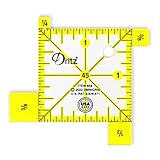
- Easy-to-see markings for light and dark fabrics
- Includes edge markings for accuracy and printing on bottom of ruler provides no distortion
- Laser cut, durable 1/8″ acrylic with hang hole for easy storage
- Size: 2" with 1/4", 3/8", 1/2" and 5/8" edge extensions
- How to Use Technique Tutorial available for gauge
Rank #3

- Wide application:This Sewing Machine Accessories Set is widely applied in the clothing industry and home sewing work, working well with most sewing machines or low shank domestic sewing machine on the market, such as Janome, Brother, Singer, Husqvarna, Viking, Kenmore, Babylock and so on,it improves the efficiency of clothing making,and helps organise the fabric for straighter, more exact, uniform seam lines.
- Reliable quality:The material of the magnetic seam guide is magnet and metal, the extremely powerful built-in magnet permits ready mounting and dismounting, no tools or screws needed,helpful for setting seam allowances and sewing straight line.The seam guide ruler is made of acrylic, which is sturdy and easy to clean.High quality premium sewing feet is made of metal.(Tip: When using the sewing ruler, please tear off the protective stickers)
- Simple to use:Magnetic guide helps you sew a straight line or circle line track to reduce mistakes and uneven stitching.Seam allowance ruler with 16 incremental holes to help you measure 1/8" to 2" seam edges. This sewing ruler includes 1/4" pivot points and a 45 degree trim line for binding and trimming shapes.The seam allowance foot has a “ruler” with an adjustable guide designed so you can place the guide anywhere you want.
- Package Include:You will receive 4 pieces seam guide,incloud a small magnetic seam gauge,one piece of MG1 high-strength magnetic gauge,one piece madam sew seam allowance rule and an adjustable guide foot,enough quantity to ensure your daily use or replacements.The smaller with angled magnetic seam guide is a good helper for sewing beginners and perfect for curved seams while the longer,straight MG1 strong magnetic gauge is more suitable for thick materials and perfect for long straight seams.
- Practical Presents:The perfect sewing thread positioning guide accessory is a must-have addition to your quilting supplies and a exquisite gift for your family and friends.It is very convenient to use, especially for those sewing lovers, it is a good tool to help you reduce errors or uneven sewing,allowing you to get a nice seam each time you use your sewing machine.

Product prices and availability are accurate as of the date/time indicated and are subject to change. Any price and availability information displayed on Amazon at the time of purchase will apply.




