Recommended Free Tools
PC Slower Than It Used to Be?
Free scan · Windows 10 & 11
Outdated Drivers Are Slowing You Down
Free scan · exact hardware match
Windows Errors? Fix Them Before They Spread
Free scan · no reinstall
ThatPainter is reader-supported. When you buy through links on our site, we may earn an affiliate commission. Learn More
The right ergonomic accent chair has to pass two separate tests: it must fit your body and your task, and it must deliver the expressive shape, color or upholstery you want. A sculptural back, oversized seat or dramatic arms says nothing by itself about comfort. Before buying, measure the usable seat height, depth and width; check the lumbar contour, armrest clearance, base and casters; then confirm that the chair suits the desk, table or studio surface where it will be used.
As an Amazon Associate I earn from qualifying purchases.
Free tools Windows power users keep installed
One-click scans. No signup required.
Start with ergonomic fit, not the silhouette
An accent chair is usually chosen for visual impact, but ergonomics is still a relationship between the person, the chair and the activity. UCLA Ergonomics advises considering “your work tasks, and your body size and shape, when choosing a chair.” A chair for occasional conversation can tolerate less adjustment than one used for writing, computer work, reading or detailed painting, yet the same basic fit checks apply.
Separate the buying decision into two questions:
- Does the chair support your body? Your feet, thighs, lower back, shoulders and arms should be supported without pressure or forced angles.
- Does the chair express the room you are designing? Bold upholstery, unusual geometry and sculptural arms can satisfy that brief only after the fit requirements are met.
OSHA describes a well-designed, appropriately adjusted chair as an essential part of a safe and productive computer workstation. A lounge-style accent chair may not provide the same adjustment range as a task chair, so the listing’s actual usable dimensions matter more than its overall width or a word such as “ergonomic” in the product name.
Popular on Amazon
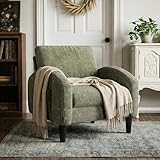
- 【6.3" Thick Cushion + 115° Backrest Angle – A Reading Chair That Won't Tire You Out】The seat cushion is a full 6.3" thick, filled with pocket coil springs and high-density foam. It gives you a comfortable, supportive feel without sinking down too far, and makes it easy to get back up. The 115° backrest angle provides strong lumbar support, relieving pressure on your lower back so you can read, binge-watch, or take a nap without straining.
- 【Mid‑Century Vintage Design – 29.2" Compact Size – Big Style Even in Small Spaces】 Corduroy fabric feels smooth and soft to the touch. Tapered legs give it that classic mid‑century look. At just 29.2" wide, it easily fits into a bedroom reading nook, apartment living room, or office lounge area – stylish without taking up too much floor space.
- 【Deep Side Pockets on Both Sides – Phone, Remote, Books Within Reach】Each side of the chair has a 8.7" deep pocket. No need to get up – put the remote on the left, charge your phone on the right, and save your book page without dog-earing it. Say goodbye to "losing things between the couch cushions." Real convenience means everything is just an arm's reach away.
- 【Wooden Frame + Reinforced Legs – Holds Up to 300 lbs – No Warping Over Time】 The chair frame is built from wooden, with reinforced legs for extra strength. The high-density foam has passed repeated resilience tests – it won't sag or flatten with long‑term use.
- 【All Tools Included – One Person Can Assemble in About 30 Minutes】All necessary assembly tools and a step‑by‑step illustrated manual are included in the box – no extra purchases needed. Follow the instructions and you'll finish in about 30 minutes. Having a second person to help hold the base in place makes it even easier.
Measure seat height against your legs and work surface
Seat height determines whether your feet are supported and whether your knees and hips can settle into a neutral position. Sit with your back against the chair. Both feet should rest firmly on the floor or on a stable footrest, and the front of the seat should not press into the underside of your thighs. If the chair is used at a desk or worktable, your forearms should be able to reach the surface without raising your shoulders.
Height adjustment is the easiest way to accommodate different users or surfaces. A fixed accent chair needs a more careful comparison between the measured seat height, the user’s lower-leg length and the height of the desk or table. Measure from the floor to the compressed top of the seat cushion, not merely to the highest point of the upholstery.
| Reference measurement | OSHA example | How to use it |
|---|---|---|
| Seat height | 15–22 inches | An example office-chair range, not a guarantee that a lounge-style accent chair will fit every body. |
| Seat-pan length | 15–17 inches | A reference for task seating; compare it with your usable depth and the required knee gap. |
| Seat width | At least about 18 inches | A minimum example for office seating; verify that hips and thighs have room without side pressure. |
| Back recline | At least 15 degrees | OSHA’s purchasing-checklist example for recline; a fixed decorative back may offer less movement. |
These figures come from the U.S. Occupational Safety and Health Administration’s purchasing checklist and are reference points rather than universal rules. Body proportions, footwear, cushion compression and the height of the work surface can change the practical result.
Check seat depth and the front edge
Seat depth is the distance from the front edge to the backrest, but the usable depth is what matters. A deep, generous-looking sculptural seat can leave a shorter user perched forward, with the lower back unsupported. A shallow seat can force a taller user into a cramped posture.
With your back supported, leave a visible gap between the seat edge and the backs of your knees. UCLA describes a gap of about 1–2 inches; other ergonomics guidance uses a fist-size or two-to-three-finger check. The exact distance varies with body size, but the principle is consistent: the edge should not compress the area behind the knees.
Look for a sliding seat or movable backrest when the chair will be shared by people of different heights. On a fixed chair, compare the listing’s usable depth with your own measurement rather than relying on the chair’s total front-to-back dimension. Cushions can make a nominally suitable depth feel deeper or shallower as they compress.
A rounded or “waterfall” front edge helps distribute pressure away from the thighs. Inspect the edge from the side: a sharply squared cushion, a rigid frame under the upholstery or a pronounced front lip can create pressure even when the overall depth appears correct.
Also popular on Amazon

- Adjustable Backrest: The accent chair is equipped with an adjustable backrest that adapts to your different seating positions, allowing you to find the perfect angle for reading, reclining, or napping
- Accent Chair with Ottoman: The matching ottoman is perfect for stretching out and relaxing. Use it as a footrest, extra seating, or even a stylish accent piece to complement the chair, making it a versatile addition to any room
- Tufted Crafted Chair: The tufted craft design adds a touch of sophistication to your room, allowing it to blend seamlessly with any decor. The chair is wrapped in corded fabric for a luxurious touch and stylish look. Not only is it soft to the touch, it's also hard-wearing
- Comfortable & Sturdy: The combination of thick upholstery and a sturdy frame make this chair durable. Soft cushion provides comfort, while the metal and solid wood frame construction provides stability and sturdiness. Accent Chair Dimension: 27.1"W x 27.1"D x 15.7"H, Ottoman Dimension: 25.6"W x 15.7"D
- Easy to Assemble: The wooden chair base and footrest base made of FSC-Certified wood. Comes with a detailed instruction manual and all necessary tools for quick and installation. Enjoy your new accent chair in just a few simple steps
Verify usable width, especially on oversized designs
Width should let your hips and thighs sit without side pressure while keeping your arms close enough to use the armrests. An extra-wide chair may look comfortable but can place the backrest too far away or make the armrests unusable. Conversely, a narrow chair with thick sculptural arms may leave less sitting room than its outside measurement suggests.
Ask the retailer for the clear distance between the arms, the cushion width and the width at the back of the seat. If those measurements are not stated, treat the omission as a reason to request them before ordering. Check the dimensions with any side bolsters, piping or fixed cushions included; decorative elements can reduce the space available to your body.
Find the lumbar curve and assess the whole backrest
The lower back has an inward curve. A backrest should support that curve without pushing the pelvis forward, and it should support the upper back while allowing the shoulders and arms to move. OSHA says the backrest should conform to the spine’s natural curvature and provide adequate lumbar support.
Outdated Drivers Are Slowing You Down
One free scan finds every outdated or missing driver and matches the right update for your exact hardware.Free scan · exact hardware matchWindows Errors? Fix Them Before They Spread
Repair common Windows errors and clear accumulated junk for a smoother, more stable PC - no reinstall needed.Free scan · no reinstallLook at the backrest in profile and from the front:
- Lower-back contour: The lumbar area should meet your lower back rather than leaving a large hollow or creating a hard pressure point.
- Upper-back support: The back should rise high enough for the activity, without a top edge that interferes with shoulder movement.
- Recline: A slight recline allows a more dynamic posture. OSHA’s purchasing checklist uses at least 15 degrees of back recline as an example for office seating.
- Adjustment: Height, angle or depth adjustment improves the chance of fitting different bodies. Fixed decorative backs offer fewer ways to correct a mismatch.
A fixed back can still be suitable for short sessions if its contour and dimensions fit you. A lumbar cushion is a reasonable retrofit when the seat height and depth already work, but it does not turn a non-adjustable chair into a fully adjustable one. Place the cushion so it supports the lower-back curve without pushing you so far forward that the knees lose their clearance.
Treat armrests as a clearance decision
Armrests should allow your shoulders to relax and your forearms to rest without forcing the elbows outward. Their shape is especially important on bold accent chairs: broad, fixed sculptural arms can consume seat width, block movement or prevent the chair from approaching a desk.
Check three relationships:
- Body to arm: When seated, your elbows should remain near your sides and your shoulders should not lift.
- Arm to surface: The armrests should clear the underside of the desk or table, or the chair should be able to sit far enough away for your forearms to reach the surface comfortably.
- Arm to movement: You should be able to enter, leave and change position without the arms trapping your hips or restricting normal shoulder movement.
Adjustable, pivoting or removable arms are easier to fit than fixed arms. If the chair will mainly be used away from a desk, arm height may be less critical, but the arms still need to avoid shoulder strain and side pressure.
Quick wins for a faster PC:
Clear out junk files and repair common Windows errorsFree Scan →Fix the driver behind crashes, sound loss and screen glitchesFind Drivers →Repair Windows errors before they cause bigger problemsFix Now →Also popular on Amazon

- SOFT & COMFORTABLE: The lazy chair is made of soft and comfortable PP cotton. It is fluffy and full, long sitting without collapse. The durable polyester fabric cover can also withstand daily wear and tear, ensuring lasting use.
- LAZY CHAIR WITH OTTOMAN: The lounge chair is equipped with a footstool on which you can rest and enjoy the extremely comfortable seating experience. And, you can also place the stool next to the sofa and end table in the living room as a foot pedal to relax your feet, or you can place it in the hallway or doorway and sit on a small stool while you change your shoes. What's more, the footstool can be quickly folded up for easy storage when not in use.
- ERGONOMIC ACCENT CHAIR: The curved backrest support ergonomically fits your back spine at the perfect angle. In addition, there is a side storage pocket for you to put books, cell phones and other items, reasonable storage and convenient
- STURDY & STABLE: The lazy sofa chair features the strong steel frame with powder spray coating. And it also has a middle tube to well support the whole chair. In addition, the lounge chair has a non-slip foot cover design, which not only protects your floor, but also enhances the overall stability, Allowing you to rest easily on it. Can hold up to 400lbs.
- MULTIPLE OCCASIONS: The cozy chair is an excellent choice for small Spaces, and it can be easily moved to the bedroom lounge area, living room, reading room, balcony and other places. The stylish design of this sofa chair can perfectly match your furniture and bring a modern feel to your home decor.
Inspect the base, swivel and casters
A rolling or swiveling accent chair needs a stable base as well as a comfortable seat. A five-leg base distributes load and reduces the risk of tipping compared with a smaller or decorative support arrangement. Check that the base is wide enough for the chair’s height and that the swivel mechanism does not create unwanted movement for the task.
Casters should match the floor:
- Carpet: Hard casters are generally suited to carpet, according to the Canadian Centre for Occupational Health and Safety (CCOHS).
- Wood, laminate or concrete: Softer rubber casters are generally more appropriate for hard surfaces.
- Floor protection: A chair mat should be large enough to keep all five wheels supported during normal movement.
For a stationary chair, inspect the feet or glides for stability and floor compatibility. A visually light pedestal or narrow splayed base may be part of the design language, but it should not wobble when you sit, turn or reach.
Compare bold designs on the same practical axes
Once several chairs pass the basic fit checks, compare them using identical information. This prevents a dramatic color or unusual outline from overshadowing a functional disadvantage.
| Comparison axis | Questions to answer |
|---|---|
| Measured seat | What are the usable height, depth and width after accounting for cushions, bolsters and arms? |
| Back support | Where is the lumbar curve, how high is the backrest, and can the angle or depth change? |
| Adjustment | Can you adjust height, tilt, seat depth or arm position for the intended user and surface? |
| Base and floor | Is the base stable, and are the casters or glides suitable for the actual floor? |
| Upholstery | Is the material breathable enough for the session length, easy to clean and resilient for the expected use? |
| Desk clearance | Will the arms, back shell or base let the chair approach the desk or table? |
| Return terms | Does the retailer currently accept returns when the fit is wrong, and who pays any return transport? |
Return policies are retailer-specific and can change, so verify the current terms before purchase. Do not treat a return window as a substitute for measuring; a large chair may be expensive or difficult to ship back.
The Tool Desk
Outbyte Driver Updater FREEFix the driver behind crashes, sound loss and screen glitchesFind Drivers →Outbyte PC Repair FREEClear out junk files and repair common Windows errorsFree Scan →Evaluate upholstery and bold visual details without losing function
Upholstery affects comfort, maintenance and how long the chair remains usable. For longer sessions, consider whether the material is breathable and whether its surface will become slippery or hot. For a painting studio, reading area or other space where dust and spills are possible, check the cleaning instructions and the resilience of seams, piping and textured surfaces.
Bold design elements deserve a functional inspection:
- Deep channeling or tufting: Confirm that the pattern does not create hard ridges under the thighs or lower back.
- Wraparound shells: Make sure the sides do not restrict shoulder movement or reduce usable width.
- Oversized cushions: Measure the compressed sitting area, not the decorative perimeter.
- Hard sculptural edges: Run a hand along the front edge, arm junctions and back shell for pressure points.
- High-contrast or delicate fabrics: Read the care instructions before assuming stains or artist materials can be removed easily.
The visual test is still legitimate: color, pattern, proportion and silhouette determine whether the chair works with the room. They simply come after the body-support checks, not before them.
Also popular on Amazon

- Timeless Midcentury Modern Style: Elevate any room with this chic lounge chair’s sleek silhouette, clean lines, and minimalist design. It blends effortlessly into living rooms, bedrooms, or offices, adding a sophisticated midcentury touch to your decor
- Elevated Comfort & Support: Sink into deep relaxation with an ergonomically angled seat, high-density foam, and supportive metal springs. OLIXIS designed for optimal back support and lasting comfort during extended lounging or reading
- Luxurious & Livable Upholstery: Experience soft, breathable comfort with the premium polyester fabric of the OLIXIS chair. This durable, wrinkle-resistant, and easy-care material maintains its refined look, offering lasting elegance for daily relaxation
- Built for Lasting Durability: Crafted with a robust solid Metal frame and elegant wood legs, this OLIXIS accent chair ensures exceptional stability and long-term reliability, confidently supporting up to 380 lbs for years of enjoyment in your home
- Easy Installation & Customer Service: Everything you need is in the box for a straightforward setup. With clear instructions and pre-packed hardware, you'll have your chair assembled and ready to relax in about 20 minutes
How to inspect a chair in person
OSHA recommends trying different chairs for comfort and fit before purchase. Use a structured trial rather than sitting briefly and judging the upholstery alone.
What’s actually slowing this PC down?
Pick the symptom - the matching free tool is one click away.
- Set the chair on the intended floor. If it rolls, confirm that the casters move as expected on that surface.
- Adopt the real posture. Use the desk, table, easel or reading position for which the chair is being considered.
- Check the feet. Place both feet flat or on a stable footrest. Look for pressure under the thighs.
- Check the knee gap. Keep your back against the backrest and verify the visible 1–2-inch or equivalent finger-width clearance.
- Check the lower back. The lumbar area should be supported without forcing your pelvis forward.
- Check the arms and surface. Relax your shoulders, rest your forearms and confirm that the arms do not prevent the chair from approaching the work surface.
- Change position. Recline slightly, turn or reach as the task requires. Notice whether the base remains stable and whether the backrest continues to support you.
- Measure the chair. Record usable seat height, depth, width, arm height and clearance before comparing it with another model.
How to buy when an in-person trial is impossible
Online listings often emphasize overall dimensions and photographs rather than the measurements that determine fit. Before ordering an ergonomic accent chair, record your own requirements and compare them with the manufacturer’s specification sheet.
- Measure your lower-leg length while seated and the height of the intended desk or table.
- Measure the sitting depth you can use while maintaining the knee gap and lower-back contact.
- Measure the minimum clear width you need at the hips and thighs, including normal clothing.
- Measure the available floor area and the underside clearance of the work surface.
- Ask for any missing usable dimensions, cushion-compression details, arm height and adjustment ranges.
- Confirm the base type, caster material and whether the chair is designed for carpet or hard flooring.
- Read the current return conditions for fit problems before payment.
If the listing provides only outside width, outside depth and a product photo, it does not provide enough information to establish ergonomic fit. A low price or striking render cannot fill in missing measurements.
Independent reader supportYour contribution helps us test, update, and keep practical guides available for everyone.Accessories that correct a specific mismatch
Accessories can solve a limited problem after the chair itself is fundamentally suitable. They should not be used to excuse a seat that is far too deep, a backrest that cannot support you or a base that is unstable.
Footrest for a high fixed seat
An adjustable under-desk footrest can support the feet when a fixed chair leaves them dangling. Set it high enough to provide firm contact without raising the knees so much that the thighs press into the seat edge. Recheck the desk height and arm position after adding it.
Recommended Free Tools
Lumbar cushion for a missing lower-back curve
A lumbar support cushion can fill a modest gap between your lower back and a backrest that otherwise fits. Position it low enough to support the natural curve, and confirm that it does not push you forward into the knee edge.
Chair mat or replacement casters
A chair floor mat can protect a hard floor and keep all five wheels supported. Replacement casters may correct a floor mismatch when the chair’s base accepts compatible parts; verify the stem size and load rating with the manufacturer before buying.
Also popular on Amazon

- ✅𝐄𝐫𝐠𝐨𝐧𝐨𝐦𝐢𝐜𝐬 𝐟𝐨𝐫 𝐀𝐥𝐥-𝐃𝐚𝐲 𝐂𝐨𝐦𝐟𝐨𝐫𝐭: For 8-hour workdays, this ergonomic office chair is a lifesaver: its curved mid-back design hugs your spine, preventing backaches during long periods of sitting. The sponge-padded back and seat cushion enhance comfort, making it the perfect desk chair for long typing marathons, virtual meetings, or reading binges.
- 🎁𝐄𝐥𝐞𝐠𝐚𝐧𝐭 & 𝐀𝐫𝐦𝐥𝐞𝐬𝐬 𝐌𝐨𝐝𝐞𝐫𝐧 𝐃𝐞𝐬𝐢𝐠𝐧: This mid-century modern office chair wraps you in smooth, stain-resistant faux leather—no more worries about coffee spills in morning work sessions! Elegant diamond stitching and walnut accents elevate your desk setup, blending style with daily durability for long-term use. Also, the armless design slides right under your desk, freeing up space for plants or storage bins.
- 👉𝐅𝐮𝐧𝐜𝐭𝐢𝐨𝐧𝐬 𝐟𝐨𝐫 𝐌𝐮𝐥𝐭𝐢-𝐒𝐜𝐞𝐧𝐚𝐫𝐢𝐨 𝐔𝐬𝐞: As a hardworking task chair, it simplifies home office life: its smooth 360° swivel lets you spin to grab files or toggle between your laptop and notebook, while the 90-120° rocking mode eases shoulder tension after online calls. The height-adjustable lever lets you tailor the adjustable rolling chair to your setup, ensuring an ergonomic fit for users of all heights.
- ⭐𝐒𝐭𝐮𝐫𝐝𝐲 𝐂𝐨𝐧𝐬𝐭𝐫𝐮𝐜𝐭𝐢𝐨𝐧 & 𝐃𝐮𝐫𝐚𝐛𝐢𝐥𝐢𝐭𝐲: Built to last, this durable computer chair features a reinforced steel chassis for up to 300lbs support, paired with certified class 3 gas cylinder that adjusts height smoothly within 5". The silent, wear-resistant casters glide quietly across all floor types (wood, carpet, tile), while eco-friendly walnut accents add warmth to your home/office. Note: Actual color may vary slightly under different lighting.
- 😊𝐑𝐞𝐥𝐢𝐚𝐛𝐥𝐞 𝐒𝐞𝐭𝐮𝐩 & 𝐀𝐟𝐭𝐞𝐫-𝐒𝐚𝐥𝐞𝐬 𝐒𝐞𝐫𝐯𝐢𝐜𝐞: You don't need to be a handyman to set this up: it comes with a step-by-step manual (with clear pictures!) and all the hardware you need. Most people finish assembly in 30 minutes or less, no extra tools required. If you run into any issues—whether it's a missing part or a question about setup—our after-sales team responds fast to help, so you can start using your new accent chair without delay.
What accessories cannot fix
- A seat that is so deep that the backrest cannot contact your lower back.
- A seat edge that creates persistent pressure behind the knees.
- Arms that prevent the chair from reaching the desk or force the shoulders upward.
- A narrow cushion that presses the hips or a back shell that restricts movement.
- An unstable base or a chair whose structure is not rated for the intended use.
Common buying mistakes
Choosing by overall dimensions
Outside measurements include arms, shells and decorative overhangs. They do not tell you how much room your body has. Request usable seat and back measurements.
Assuming “lounge” means comfortable for long sessions
A lounge profile can be pleasant for short conversations but place the pelvis, knees or arms poorly for desk work. Match the chair to the duration and posture of the actual task.
Confusing a soft cushion with support
Plush foam can feel comfortable immediately while allowing the pelvis to sink and the back to lose support. Evaluate the contour and dimensions after the cushion compresses.
Ignoring floor and desk relationships
A chair can fit your body yet fail in the room if its arms hit the desk, its casters drag on the floor or its base cannot move within the available space.
Using a cushion to rescue a fundamentally wrong chair
A lumbar cushion or footrest addresses one measured mismatch. It cannot replace correct seat depth, a suitable front edge, stable support and adequate clearance.
A practical decision checklist
Before placing an order, confirm each item:
- Measured seat height suits your lower legs and the intended work surface.
- Both feet can rest firmly on the floor or on a stable footrest.
- A 1–2-inch or equivalent finger-width gap remains behind the knees.
- Usable width accommodates hips and thighs without side pressure.
- The front edge is rounded or otherwise free of a hard pressure point.
- The lumbar area supports your lower-back curve.
- The backrest supports the upper back and permits a slight recline where needed.
- Armrests keep the shoulders relaxed and clear the desk or table.
- The base is stable; five-leg bases are the relevant reference for rolling chairs.
- Casters or glides match carpet, wood, laminate, concrete or the actual floor.
- Upholstery meets your breathability, cleaning and durability requirements.
- Current return terms cover a fit problem.
ISO 9241-5:2024 identifies seat height, seat depth, seat width, back support and arm support as seating-fit parameters. Those categories provide a useful final audit before visual preferences decide between chairs that already fit.
The bottom line for a bold ergonomic accent chair
Buy the chair that meets your measurements first, then choose the strongest shape and upholstery among the suitable options. Feet need firm support, the seat edge must clear the knees, the backrest should follow the lower-back curve and arms must work with the desk rather than merely look dramatic. A five-leg base and floor-appropriate casters matter for rolling models. Accessories can fine-tune a small mismatch, but no cushion or footrest can compensate for a fundamentally wrong seat or unstable frame.
Quick Recap


