Quick wins for a faster PC:
Recommended Free Tools
Clear out junk files and repair common Windows errorsFree Scan →Scan for outdated or missing drivers - takes under a minuteDriver Scan →
ThatPainter is reader-supported. When you buy through links on our site, we may earn an affiliate commission. Learn More
Short answer: In the December 16, 2024 comparison, iSANMATE (listed there as iMate) produced the most convincing wood texture; Bambu Lab offered the smoothest experience for Bambu owners; Amolen delivered attractive darker, silky colors; and SUNLU printed cleanly but looked least like natural wood. Those results came from one Bambu Lab X1 Carbon using a 0.4 mm nozzle and textured plate, so treat the ranking as a practical visual report—not a universal laboratory result.
Quick verdict
| Filament | Best fit | Reported appearance | Main trade-off | Official nozzle range |
|---|---|---|---|---|
| iSANMATE/iMate | Maximum grain realism | Most realistic texture in the test; noticeable burnt-wood scent | Some stringing; less complete slicer guidance | 190–220°C |
| Bambu Lab PLA Wood | Bambu Studio, AMS or AMS lite users | Strong wood appearance with minor surface flaws | US page showed “Notify me when available”; higher listed price | 190–240°C |
| Amolen | Color variety and smooth decorative finishes | Darker and silkier, but less naturally wood-like than iMate | Natural-wood realism ranked below iMate | 180–210°C |
| SUNLU | Clean, economical, widely available printing | Consistent, but judged closer to beige PLA than convincing wood | Weakest grain impression in the comparison | 200–220°C |
Source for the reported ranking and test observations: December 16, 2024 comparison.
As an Amazon Associate I earn from qualifying purchases.
The Tool Desk
Outbyte Driver Updater FREEFix the driver behind crashes, sound loss and screen glitchesFind Drivers →Outbyte PC Repair FREERepair Windows errors before they cause bigger problemsFix Now →What wood PLA actually is
Wood PLA is a PLA-based composite containing wood powder or wood fibers. It can reproduce a matte color, grain-like texture and, in some formulations, a wood-like scent, but it is not solid timber and should not be selected for structural or load-bearing parts.
Formulations differ substantially. iSANMATE states 20% wood fiber and 80% PLA, while SUNLU states 15% wood powder. Bambu Lab describes fine wood powder and Amolen describes real wood fibers without stating an equivalent percentage on the cited product pages. Particle size, distribution, pigment, base resin, moisture and slicer settings can matter as much as the percentage; a higher stated percentage is not proof of better realism, strength or fewer clogs.
#1 Best Overall

- ①【SUNLU PLA 3D Printer Filament】PLA material is the perfect choice for 3D printing enthusiasts! SUNLU PLA filament is reliable, versatile, and easy to use. No clogs, bubbles, or tangles, its excellent layer adhesion ensures high-quality prints every time. Ideal for beginners and experienced users.
- ②【Neatly Wound 3D Filament Spool】SUNLU's self-developed neat winding device ensures that the filament is easy to use, with a 100% neat rate that reduces the risk of tangles and jams, and provides a smoother and more efficient 3D printing experience.
- ③【PLA Filament 1.75 mm】SUNLU 3D printer filament dimensional Accuracy +/- 0.02mm. SUNLU filament has wide compatibility due to the small diameter error, making it suitable for almost all 1.75mm FDM 3D printers.
- ④【Filament Spool Diameter】Spool Diameter: 8.00", Spool Width: 2.50", Spool Hub Hole Diameter: 2.20". The size of the SUNLU filament spool is suitable for hanging on a lot of FDM 3D printers.
- ⑤【PLA Recommend Settings】To achieve the best printing results with SUNLU PLA filament, we recommend printing at a nozzle temperature of 200-230°C, a bed temperature of 50-65°C, and a printing speed of 50-100mm/s.
- iSANMATE material information
- SUNLU material information
- Bambu Lab PLA Wood specifications
- Amolen PLA Wood specifications
What the four-brand test did—and did not—measure
The published comparison used a Bambu Lab X1 Carbon, 0.4 mm nozzle and textured build plate. It examined visual appearance, texture, surface quality, stringing and practical printing behavior, including decorative multicolor models using AMS. It did not publish a complete, repeatable protocol.
There is no reported control for spool batch or age, starting moisture, drying procedure, exact temperatures, flow ratio, maximum volumetric speed, retraction values, model geometry, print duration, repeated-print count, objective color or roughness measurements, strength testing, or cost per successful print. Consequently, the iMate result is best read as “winner in that creator’s setup,” not a guarantee for every printer, color or batch.
What’s actually slowing this PC down?
Pick the symptom - the matching free tool is one click away.
Brand-by-brand results and use cases
iSANMATE (iMate): best reported wood realism
The comparison gave iMate the strongest wood texture and noted a burnt-wood scent, with some stringing. The official iSANMATE page identifies 20% wood fiber, 1.75 mm diameter, 190–220°C nozzle temperature, 45–60°C bed temperature and ±0.03 mm stated tolerance. Listed variants include ebony, rosewood, box wood, vera wood and multicolor wood; spools are vacuum sealed with desiccant.
“iMate” appears to refer to iSANMATE, but verify the spelling and formulation on the spool, packaging and retailer listing. Choose it for decorative models when grain realism outweighs plug-and-play convenience. Dry it, tune retraction and use conservative speeds before judging the material.
Rank #2
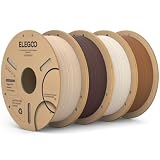
- Natural Wood-Like Finish: ELEGOO Wood PLA enhanced with real wood powder, giving your prints a natural wood-like colour and matte finish. Easy to print and perfect for decorations, architecture models, and artistic designs that need a warm, organic feel
- Dimensional Accuracy & Consistent Quality: Manufactured with strict tolerances, ELEGOO PLA filament maintains a 1.75 mm diameter with high precision, providing smoother and more reliable printing. Universally compatible with most FDM 3D printers
- Tangle-Free & Easy to Use: Professionally wound by precision machinery and thoroughly inspected to ensure neat, low-tangle filament that helps prevent snapping or clogging
- No Clogging & Bubble-Free: Complete dried before packaging and vacuum sealed well to protect the filament from moisture, no clogging and bubbling problems
- Wide Compatibility: Compatible with most 1.75mm FDM 3D printers. A reliable choice for smooth printing—no fuss, just consistent results. It’s recommended to print wood pla with harden steel nozzle and size larger than the standard 0.4 mm
Bambu Lab PLA Wood: easiest Bambu workflow
Bambu Lab’s product page documents RFID-loaded settings, AMS and AMS lite compatibility, 190–240°C nozzle temperature, 35–45°C bed temperature with glue, drying at 55°C for eight hours and storage below 20% RH. It lists 1.75 mm ±0.03 mm diameter, 1.21 g/cm³ density, 57°C HDT and 26 ±5 MPa tensile strength. A 0.2 mm stainless-steel nozzle is not recommended; hardened-steel 0.4, 0.6 and 0.8 mm nozzles are listed as compatible.
The US page displayed $24.99 for a 1 kg spool with spool, but also showed “Notify me when available,” so check live regional stock. In the comparison it had a convincing wood appearance with minor surface defects. Its practical advantage is automatic material recognition and a documented Bambu workflow, not proof that it prints best on every machine.
Amolen: color and finish flexibility
Amolen recommends drying at 55 ±5°C for 6–8 hours, humidity below 20% RH, 180–210°C nozzle temperature, 30–65°C bed temperature, speeds below 250 mm/s, 1.0–1.5 mm retraction at 35–45 mm/s and active cooling. Its listed density is 1.23 ±0.02 g/cm³, HDT 57–60°C, tensile strength 30 ±3 MPa and flexural strength 60 ±4 MPa.
The test found a darker, silkier appearance that was attractive but less naturally wood-like than iMate. It suits ornaments, painted props and projects where walnut- or ebony-like color matters more than irregular grain. A four-pack page listed four 200 g spools for $29.99 when accessed; prices and stock can change.
Rank #3

- 【20% Real Wood Fibers】SUNLU 1.75mm PLA filament contains 20% wood fiber instead of wood flour. This ensures the real wood structure and texture. Satisfy the demand for wooden printing models.
- 【1KG Spool Diameter】Spool Diameter: 8.00", Spool Width: 2.50", Spool Hub Hole Diameter: 2.20". The size of the SUNLU filament spool is suitable for hanging on many FDM 3D printers.
- 【PLA 1.75mm Diameter】Dimensional Accuracy +/- 0.02mm. SUNLU filament has wide compatibility due to the small diameter error, it's suitable for almost all 1.75mm FDM 3D printers.
- 【Recommend Settings】We recommend printing at a Nozzle/Extrusion temperature of 200-220°C and Bed/Platform temperature of 50-65°C.
- 【Professional Team】SUNLU is a high-tech enterprise specializing in R&D, production and sales of 3D printing filament, 3D printer, 3D pen and 3D resin. SUNLU has a professional team.
SUNLU: clean printing and broad selection
SUNLU lists 15% wood powder, 200–220°C nozzle temperature, 50–60°C bed temperature, 0.8–1.2 mm retraction at 30–40 mm/s, 33 ±6 MPa tensile strength, 1.17 g/cm³ density and 55 ±3°C HDT. The current page lists 1.75, 2.85 and 3.00 mm options, multiple spool weights and colors. Its separate wiki advertises different high-speed guidance, so do not transfer a maximum-speed claim directly into a quality profile.
In the reported test SUNLU was clean and consistent, but the tester considered it closer to beige PLA than convincing wood. It is a sensible choice when availability, size selection or a tidy decorative print matters more than pronounced grain. The official page does not expose a dependable current US price.
Free tools Windows power users keep installed
One-click scans. No signup required.
Safe starting profiles
Use these as calibration baselines, not universal presets. Start near the middle of the applicable manufacturer range, then change temperature in 5°C steps. A 0.4 mm nozzle was used in the comparison; a 0.6 mm nozzle is a useful fallback when extrusion is inconsistent. Avoid 0.2 mm nozzles for wood-filled material.
| Setting | Starting guidance |
|---|---|
| Nozzle | 0.4 mm minimum for the comparison; try 0.6 mm for persistent partial clogs |
| Layer height | 0.16–0.24 mm |
| Speed | Begin conservatively; maximum advertised speed is not quality speed |
| Cooling | Fan on, subject to layer time and printer requirements |
| Retraction | Use the product’s published range, then print a retraction tower |
| Surface pattern | Concentric for rounded or cylindrical forms; conventional patterns for flat surfaces |
| Drying | Dry before printing and again after prolonged exposure |
Appearance-focused slicer choices
Concentric top or surface patterns can make grain direction follow a rounded form. Reduce unnecessary wall crossings, use steady extrusion and slow enough travel and print speeds to avoid inconsistent lines. Tune flow after drying; a wet spool can make a good profile appear defective.
Rank #4

- 【More Colors for More Projects】 Multiple compact 250g mini spools provide practical amounts of different colors for small prints, multicolor models, accent parts, and test prints. Explore more colors without filling your shelf with full 1kg spools or leaving large amounts of rarely used colors behind
- 【Authentic Wood Look and Texture】 Blended with 20% real wood fibers to create a naturally textured surface, subtle wood grain, and warm handcrafted appearance. Ideal for sculptures, architectural models, planters, ornaments, and decorative prints that look more like carved wood than conventional plastic
- 【Neatly Wound for Reliable Feeding】 Precision winding supports smooth, consistent feeding and helps reduce snags and mid-print interruptions. Keep light tension on the filament end while loading or unloading, and secure it before storage to prevent loose loops
- 【Consistent Diameter and Steady Extrusion】 A consistent 1.75mm ±0.02mm diameter supports stable flow, even layers, and clean detail from the first layer to the final layer. Reliable extrusion means less time troubleshooting and more time printing
- 【Fits Most FDM Printers】 Designed for most 1.75mm FDM printers with external, top-mounted, or open spool holders. Each spool measures 140mm in diameter and 36mm in width, with a 53mm center hole. For Bambu Lab AMS or AMS lite, search MakerWorld for a compatible 250g spool adapter before use
Drying, storage and AMS use
Wood components make these filaments moisture-sensitive. Popping, sizzling, bubbles, foamy extrusion, whitening, rough surfaces, increased stringing, weak layer bonding and unstable flow all justify drying before further diagnosis. Follow the product guidance: Bambu Lab specifies 55°C for eight hours; Amolen specifies 55 ±5°C for 6–8 hours and below 20% RH storage. Seal cooled spools with desiccant and, where possible, print from a dry box.
Bambu Lab explicitly documents AMS and AMS lite compatibility. That does not establish equivalent RFID recognition or feeding reliability for third-party wood PLA. For SUNLU, iSANMATE or Amolen, verify spool fit, manufacturer guidance, dust accumulation and feeding behavior on your particular AMS before committing to a long multicolor job.
Recommended Free Tools
Troubleshooting
Stringing
- Dry the spool.
- Print a retraction tower.
- Tune temperature before making extreme retraction changes.
- Reduce wall crossings and unnecessary travel.
- Slow travel or print speed if flow is unstable.
- Remove residual strings carefully with brief heat, avoiding surface scorching.
Clogs or partial clogs
- Stop the print and check for wet filament.
- Lower temperature if the wood component is charring.
- Try a 0.6 mm nozzle for troublesome material.
- Purge thoroughly before switching back to ordinary PLA.
- Inspect extruder gears and the filament path for ground-down material.
Rough, weak or discolored layers
Re-dry, then repeat temperature and flow calibration. Check that the bed is clean and that the selected bed temperature suits your plate and adhesive; published ranges are not directly comparable because manufacturers assume different hardware and conditions. If the print still looks like uniform colored PLA, change the surface pattern, reduce gloss through controlled temperature and plan for sanding or finishing.
Sanding, staining and painting
Sand progressively rather than aggressively: heavy abrasion can erase shallow grain and expose uneven filler. Use a compatible filler or primer for deep layer lines, test stain on a scrap section, and expect batch-to-batch color differences. Stain can emphasize layer direction, but a printed composite will not absorb or behave exactly like solid wood. Paint and clear coats should likewise be tested on a sample first.
Alternatives not included in the four-brand test
- Elegoo PLA Wood: the cited US page listed $18.99 for 1 kg and $135.99 for 10 kg, subject to changing stock and shipping.
- Snapmaker Wood PLA: lists RFID for Snapmaker U1, 55°C drying for eight hours and a warning against hotends 0.2 mm or smaller; the page showed unavailable when accessed.
- Sakata 3D PLA Wood: provides technical documentation and stated wood-fiber and mechanical data.
- MG Chemicals Wood: recommends a nozzle of at least 0.5 mm.
Recommendations by project
- Most convincing texture: iSANMATE/iMate, according to the cited comparison; accept tuning and stringing work.
- Best Bambu workflow: Bambu Lab, when RFID, AMS or AMS lite integration is worth the price and availability check.
- Best color experimentation: Amolen, especially its small variety pack.
- Clean, broadly available option: SUNLU when realistic grain is less important.
- Lower-price alternative: Elegoo, which was not part of the original test.
None of these materials should be treated as automatically food-safe, structurally equivalent to timber or compostable in ordinary household conditions. For mechanical comparisons, manufacturer tensile and flexural figures are not directly comparable without identical specimens, print orientation, conditioning and test standards.
Quick Recap

Product prices and availability are accurate as of the date/time indicated and are subject to change. Any price and availability information displayed on Amazon at the time of purchase will apply.
Free tools Windows power users keep installed
One-click scans. No signup required.




