Quick wins for a faster PC:
Scan for outdated or missing drivers - takes under a minuteDriver Scan →Clear out junk files and repair common Windows errorsFree Scan →Fix the driver behind crashes, sound loss and screen glitchesFind Drivers →
ThatPainter is reader-supported. When you buy through links on our site, we may earn an affiliate commission. Learn More
The Cyclostyle was not a photocopier. It was a late-19th-century stencil duplicator: the operator wrote on treated stencil paper with a small perforating wheel, then forced ink through the resulting pattern of holes onto blank sheets. The reusable stencil made it possible for an office, school, club, church, or small business to produce multiple copies without hiring a commercial printer.
David Gestetner’s key invention was the wheel-pointed Cyclostyle pen, patented in Britain in 1881. Later hand-operated machines, the Neo-Cyclostyle, and a partially mechanized “Automatic Cyclostyle” developed that basic idea into a practical office-copying system.
What was the Cyclostyle?
“Cyclostyle” can mean two closely related things in historical sources:
Recommended Free Tools
- The Cyclostyle pen: a pen-like tool fitted with a small toothed or perforating wheel. It created a stencil by puncturing treated paper as the operator wrote.
- The Cyclostyle duplicating system: the pen, stencil material, ink, rollers, frames, and presses used to turn that stencil into multiple copies.
The Science Museum Group describes a Gestetner Cyclostyle apparatus as a stencil-duplication device equipped with a wheel pen for writing on stencils. Its catalog records an example made around 1880 and patented in 1881. A 1907 British trade-mark decision likewise explained that the essential early component was a wheel-pointed pen for perforating waxed stencil paper. The name was first applied mainly to the pen and was later extended to the ink, paper, and other parts of the system.
#1 Best Overall

- BOLD, VIBRANT COLOR – Combination Ink Cartridge Prints High Quality Full Color Photographs; Compatible With Kodak Dock Printer
- UNIQUE D2T2 INNOVATION – Advanced Dye Diffusion Transfer Technology Applies Colors Quickly & Evenly; Maximum Gradation Reduces Blurring & Distortion
- LONG LASTING PRINTS – Unique 4th Layer Overcoat Laminates Paper to Preserve Image Quality; Creates Humidity & Fingerprint Resistant Finish That Won’t Fade
- EASY MAINTENANCE – Simple Cartridge Refills are Effortless to Remove & Replace; Pull With Two Fingers to Eject, Then Insert New Cartridge to Resume Printing
- MULTIPLE REFILL PACKS – Choose From Photo Increments of 40, 80, or 120; Great for Printing Portrait Photos, Landscapes, Family Pictures, Greeting Cards & More
For historical accuracy, it is best to call the Cyclostyle a stencil duplicator, stencil-copying machine, or duplicating press—not a photocopier. A modern photocopier creates an image through optical and electrostatic processes; a Cyclostyle reproduced a physical master by pushing ink through holes.
Why people needed a copying machine in the 19th century
Before office copiers, making a packet of identical documents was difficult and expensive. A clerk could copy text by hand, use a copying press to transfer writing into a bound copy book, or send the work to a commercial printer. Each option had limitations.
Hand copying consumed time and introduced variations. A copying press generally produced a bound record rather than a convenient stack of separate circulars. Commercial printing was effective for larger jobs but less convenient when a small organization needed a few dozen notices, forms, letters, or meeting papers.
The Cyclostyle addressed this gap. Once an operator had prepared a stencil, the same master could be used repeatedly. The equipment was comparatively portable and suited to the everyday work of offices and other organizations that needed modest runs rather than thousands of professionally printed copies.
That practical change mattered as much organizationally as mechanically. Copying became something a small office, school, society, religious group, or business could do internally, with ordinary handwriting or a typewriter serving as the source for the master.
How the Cyclostyle worked
- Place the stencil. The operator laid a sheet of waxed or otherwise treated stencil paper over a supporting surface, sometimes with a file plate or similar backing.
- Write or draw the master. Instead of laying down ordinary ink, the Cyclostyle pen’s small wheel punctured the stencil. The holes formed the letters, lines, or drawing.
- Mount the stencil. The perforated master was fixed in a frame or printing arrangement above a blank sheet of paper.
- Apply ink. Ink was spread across the stencil’s surface and pressed through the perforations.
- Remove the copy and repeat. The ink passed through only where the stencil had been pierced, leaving an image on the sheet below. The process could be repeated for a run of copies.
The University of Illinois preservation material describes stencil duplication broadly as forcing ink through a stencil with equipment such as a squeegee, roller, flat-bed press, or drum. That description helps explain why the Cyclostyle should be understood as a process and system rather than only as a writing instrument.
Why the pen was important
The crucial advantage was that the master could be made directly in handwriting. The operator did not need to engrave a plate or prepare type for every short run. A typewriter could also be used once stencil-compatible typing methods became available.
Gestetner’s later U.S. Patent No. 434,331, granted on August 12, 1890, describes an improvement intended to make the pen easier to use and less likely to tear the stencil. Earlier arrangements placed the perforating wheel to the side of the holder, requiring a particular grip. The improved arrangement placed the wheel in front of a pen-like fitting and oriented it to follow the direction of writing more naturally. In practical terms, the change was meant to reduce faulty writing and stencil damage while giving the operator more freedom of movement.
Rank #2

- Original HP Ink is engineered to work with HP printers to provide consistent quality, reliability and value
- These cartridges work with: HP OfficeJet 9012e; HP OfficeJet Pro 9010, 9010e, 9014e, 9015, 9015e, 9016, 9018, 9018e, 9019, 9019e, 9020, 9020e, 9022e, 9025, 9025e, 9028e
- Cartridge yield (approx.): 2,000 pages black, 700 pages per color
- Up to 2x more prints with Original HP Ink vs. non-Original HP Ink
- 82% of HP ink cartridges are manufactured with recycled plastic
The stencil itself was delicate. Excessive pressure, an awkward angle, or a damaged surface could enlarge holes, tear the sheet, or produce an unclear copy. The pen’s mechanical design therefore mattered directly to the quality of the finished documents.
David Gestetner and the 1881 patent
David Gestetner was a Hungarian-born inventor who established his business in London. His British patent for the wheel-pointed Cyclostyle pen is dated June 3, 1881, and is commonly identified as British Patent No. 2450. The Science Museum Group independently records a Gestetner apparatus as patented in 1881, while a retrospective from the Olivetti Historical Archive describes the same foundational invention as a perforating pen that created a stencil during handwriting.
Patent dates sometimes appear inconsistent because they refer to different national filings or later improvements. Gestetner’s 1890 U.S. patent specification refers back to an earlier Gestetner patent dated November 28, 1882. The 1907 trade-mark record also documents commercial use of the Cyclostyle name by that period.
A careful chronology is therefore:
| Date | Development | What it means |
|---|---|---|
| 1881 | British patent for the wheel-pointed Cyclostyle pen | The foundational, commercially important stencil-writing invention |
| 1882 | Earlier patent referenced in Gestetner’s later U.S. specification | A related patent date, not necessarily a contradiction of the 1881 British date |
| 1884 onward | Manual Cyclostyle, Neo-Cyclostyle, and related Neostyle systems appear in equipment histories and catalogs | The pen develops into a wider duplicating system |
| 1888 | Neo-Cyclostyle duplicating machine recorded by the Science Museum Group | A developed machine rather than merely the writing pen |
| 1890 | U.S. patent for an improved Cyclostyle pen | A refinement intended to improve handling and reduce stencil tearing |
| 1894 | Gestetner introduces an “automatic” stencil duplicating press | Partial mechanization of inking and roller movement, not unattended copying |
The important distinction is that the 1881 patent should not be described as the patent for the complete automatic press. It covered the key wheel-pointed pen; the larger machines and later mechanisms came afterward.
The Neo-Cyclostyle: from pen to machine
The Neo-Cyclostyle represented a more developed apparatus. The Science Museum Group records a Neo-Cyclostyle duplicating machine made in London by David Gestetner in 1888. The object is described as a printing-and-writing duplicating machine and is constructed largely from paper and wood, illustrating that early duplicators could be relatively compact and manually operated rather than massive industrial presses.
Surviving records indicate that the system was not confined to one experimental object. Museum Wales catalogs a Neo-Cyclostyle duplicating apparatus, and the German Museum Foundation for Post and Telecommunications records a hand-operated Neo-Cyclostyle in a wooden case dating to approximately 1890.
These machines combined the prepared stencil with a more convenient arrangement for holding paper and distributing ink. The operator still supplied much of the labor, but the apparatus made repeated copying more controlled than simply manipulating a loose stencil and a hand tool.
What “Automatic Cyclostyle” really meant
In 1894 Gestetner introduced an “automatic” stencil duplicating press, marketed as the Automatic Cyclostyle until approximately 1900. The label should not be interpreted by modern standards.
Rank #3
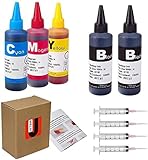
- JETSIR ink refill kit is designed for use with a wide range of compatible ink cartridges, including 950, 951, 952, 902, 901, 60, 61, 62, 63, 21, 22, 564, 920, 940, 932, 933, 711, 970, 971, 92, 94, 95, 96, and 97. Suitable for refillable cartridges, remanufactured cartridges, and continuous ink supply systems (CISS). Please confirm your cartridge type before purchase.
- The JETSIR refill kit includes 5 bottles of dye ink (2 Black, 1 Cyan, 1 Magenta, 1 Yellow), each 100ml. Also included are 4 syringes, refill tips, sealing plugs, and step-by-step instructions—everything you need for a smooth and efficient refill experience.
- Each 100ml bottle provides multiple refills, making this kit ideal for home, office, or small business use. Print more and refill less while reducing overall printing costs.
- JETSIR ink is formulated to deliver vibrant color and crisp black text for documents, photos, reports, and graphics. Enjoy consistent, reliable print quality with every refill.
- Designed for easy refilling, even for first-time users. Refilling your cartridge is quick and easy. Simply draw ink into the syringe, slowly inject it into the cartridge through the refill hole, then seal it securely with the provided plug. For best results, refill gradually to avoid overfilling and allow the cartridge to rest for a few minutes before printing. Following these steps helps ensure smooth ink flow and prevents leakage.
According to the Early Office Museum’s reconstruction, the press used three rollers:
- ink was supplied to a middle roller;
- an upper roller helped spread the ink; and
- a lower roller transferred ink through the stencil onto the paper.
The machine mechanized the inking process and the movement of the inked roller across the stencil. However, the operator still had to feed sheets into the machine and remove them afterward. “Automatic” meant that part of the printing cycle was mechanically assisted, not that the machine could copy unattended from start to finish.
This is a useful example of incremental technological development: first the perforating pen, then a hand-operated duplicating arrangement, then improved machines, and finally a press with partial automation.
Do these 3 things before closing this tab:
1Repair Windows errors before they cause bigger problems2Scan for outdated or missing drivers - takes under a minute3Clear out junk files and repair common Windows errorsCyclostyle versus mimeograph
Cyclostyle and mimeograph are closely related, but they are not exact synonyms.
The Cyclostyle is associated particularly with Gestetner’s wheel-pointed pen and the stencil system built around it. The Edison Mimeograph followed a related stencil-copying principle but developed through a different commercial and patent history. The Typewriter Museum identifies both Gestetner’s Cyclostyle and Edison’s Mimeograph as early stencil duplicators.
“Mimeograph” is therefore best treated as a broader family or tradition of stencil duplicating, one strongly associated with Edison and later manufacturers. The Cyclostyle was one important early system within that larger history. Calling every Cyclostyle a mimeograph can blur the difference between Gestetner’s brand and mechanism and the wider category of stencil duplicators.
The distinction also matters chronologically. Later mimeograph machines became associated with newsletters, classroom papers, political publications, and small-circulation literature. Those later uses should not automatically be projected backward as though the original 1881 Cyclostyle already had the same cultural role or distribution.
Free tools Windows power users keep installed
One-click scans. No signup required.
What could it copy?
A Cyclostyle master could contain handwriting, lettering, forms, notices, and drawings. Its usefulness depended on the operator’s ability to create a clean perforated stencil and on the machine’s ability to distribute ink evenly.
Rank #4

- HP Ink Cartridges for HP printers are engineered to provide consistent quality, reliability and value
- Works with these HP Printers: OfficeJet 8122e; OfficeJet Pro 8135e, 8138e, 8139e
- Cartridge yield (approx.): 500 pages black, 400 pages per color
- Trusted HP Printer Ink Cartridges for every printing need: HP 923 Ink Cartridges are perfect for everyday home, office, and small business printing needs
- HP has kept over 2,300 metric tons of plastic out of our world’s oceans to be upcycled into HP 923 color ink cartridges for HP printers and other everyday products
In a small office, possible jobs included circular letters, internal notices, duplicated forms, instructions, and meeting documents. Schools and clubs could produce handouts; churches and associations could prepare announcements; businesses could make short runs of routine paperwork. The advantage was not necessarily speed or visual polish. It was the ability to make separate, repeatable copies locally and at modest scale.
The method also created a bridge between handwriting and printing. A person could prepare a master without sending the document to a typesetter, while the resulting copies were more uniform than individually handwritten sheets.
Using modern materials with an antique Cyclostyle
Modern readers sometimes look for a surviving machine or materials to recreate the process. The historically relevant consumable is treated stencil material, commonly described in connection with mimeograph or stencil duplication as waxed stencil paper.
Windows Errors? Fix Them Before They Spread
Repair common Windows errors and clear accumulated junk for a smoother, more stable PC - no reinstall needed.Free scan · no reinstallOutdated Drivers Are Slowing You Down
One free scan finds every outdated or missing driver and matches the right update for your exact hardware.Free scan · exact hardware matchmimeograph stencil paper may help readers understand the material category or explore supplies for a demonstration, but modern paper should not be assumed to fit a particular antique Gestetner Cyclostyle or Neo-Cyclostyle. Dimensions, coating, thickness, frame design, ink chemistry, and the condition of the machine can all affect compatibility. No specific modern retail product has been verified here as a safe or historically compatible replacement.
Collectors should avoid forcing a contemporary consumable into a surviving machine. For an authentic object, documentation, photographs, and consultation with a museum or specialist are safer first steps than experimentation with an irreplaceable stencil frame or roller.
Independent reader supportYour contribution helps us test, update, and keep practical guides available for everyone.Surviving examples and how to study them
Museum collections are especially valuable because they show that the Cyclostyle was a tangible office apparatus, not merely a trade name for an abstract copying method. The Science Museum Group holds an early Gestetner Cyclostyle apparatus with a steel stylus and file plate, cataloged as made around 1880. Its collection also includes the 1888 Neo-Cyclostyle machine.
Museum Wales and the German Museum Foundation for Post and Telecommunications provide additional evidence of Neo-Cyclostyle equipment, including a hand-operated example in a wooden case dated approximately 1890. These records help establish the spread and physical variety of the system by the end of the 19th century.
The Tool Desk
Outbyte Driver Updater FREEScan for outdated or missing drivers - takes under a minuteDriver Scan →Outbyte PC Repair FREEClear out junk files and repair common Windows errorsFree Scan →When examining a surviving machine, useful questions include:
Best Value

- PACKAGE CONTENT: Includes 1 x 950XL Black, 1 x 951XL Cyan, 1 x 951XL Magenta, 1 x 951XL Yellow, fully compatible as replacement for HP 950 951 XL ink cartridges combo pack (Non-OEM)
- HIGH YIELD PERFORMANCE: Up to 2,300 pages per 950XL black ink cartridge, 1,600 pages per 951XL color ink cartridge (cyan, magenta, yellow) at 5% coverage on A4 paper, ideal for high-volume home and office printing
- COMPATIBLE PRINTERS: These 950xl 951xl ink cartridges combo pack works seamlessly with HP OfficeJet Pro 8100, 8600, 8610, 8615, 8616, 8620, 8625, 8630, 8640, 8660, OfficeJet 251dw, 271dw, 276dw printers. For older printers on this compatibility list, please reinstall the cartridge firmly or restart your device if you encounter recognition prompts to achieve stable identification
- ANTI-CLOGGING PREMIUM INK: Specially formulated ink prevents print head clogging, delivers consistent high-quality printing, and reduces streaks or blurring for both text and images
- LATEST CHIP VERSION: Our 950XL 951XL ink cartridges combo pack comes with the newest chip version, ensuring smooth recognition, stable performance, and crisp, clear prints for all compatible printers
- Is the object the Cyclostyle pen itself, or a complete duplicating apparatus?
- How is the stencil held in place?
- What kind of roller, squeegee, or flat-bed mechanism applies the ink?
- Which operations remain manual?
- Does the catalog date the object by manufacture, patent, acquisition, or estimated design period?
Those distinctions prevent a common mistake: treating every object bearing the Cyclostyle name as the same machine or assigning the date of a later press to the original pen invention.
Why the Cyclostyle mattered
The Cyclostyle helped move document duplication away from specialist printing shops and toward ordinary administrative and community settings. Its master could be created locally, reused, and distributed as separate sheets. That made short-run communication more practical for organizations that did not need—or could not afford—a full commercial print job.
Its importance lies less in resemblance to a modern copier than in the organizational possibility it created. A reusable stencil gave small groups a low-cost way to standardize and repeat information. The Cyclostyle was an early step in the long development of office duplicators that eventually included more automated stencil machines and, much later, photocopiers.
What’s actually slowing this PC down?
Pick the symptom - the matching free tool is one click away.
In short, the 19th-century Cyclostyle was a wheel-pointed pen and the duplicating system built around it. It wrote by perforating a treated stencil, copied by forcing ink through those perforations, and evolved from a hand tool into increasingly mechanized presses. It was not the photocopier—but it helped establish the idea that copying could happen inside an ordinary office rather than only in a printing establishment.
Further reading and collection research
Readers who want more context should look for histories of mimeographs, Gestetner duplicators, stencil printing, and office technology. Museum collection records are particularly useful because they distinguish the pen, the stencil apparatus, and later presses. They also provide the surviving-object evidence needed to understand how these systems looked and operated.
Frequently Asked Questions
Was the Cyclostyle a photocopier?
No. It was a stencil duplicator. The operator perforated a treated stencil with a wheel-pointed pen and then forced ink through the holes onto blank paper.
Who invented the Cyclostyle?
David Gestetner, a Hungarian-born inventor who established his business in London, patented the key wheel-pointed Cyclostyle pen in Britain in 1881. Later patents and machines improved and expanded the system.
What’s actually slowing this PC down?
Pick the symptom - the matching free tool is one click away.
What is the difference between a Cyclostyle and a mimeograph?
The Cyclostyle is specifically associated with Gestetner’s wheel-pointed pen and duplicating system. Mimeograph is a broader term for stencil duplicating and is also strongly associated with Edison and later manufacturers.
Did the Automatic Cyclostyle operate without an operator?
No. Its 1894-era mechanization assisted inking and roller movement, but the operator still had to feed paper into the press and remove the finished sheets.
The Bottom Line
The Cyclostyle was an 1880s stencil-copying system, not a modern photocopier: write a master by perforating treated paper, press ink through it, and repeat. David Gestetner’s 1881 wheel-pointed pen supplied the essential breakthrough, while the Neo-Cyclostyle and later Automatic Cyclostyle turned it into a more practical office duplicator.
Quick Recap

Product prices and availability are accurate as of the date/time indicated and are subject to change. Any price and availability information displayed on Amazon at the time of purchase will apply.




