Do these 3 things before closing this tab:
1Clear out junk files and repair common Windows errors2Scan for outdated or missing drivers - takes under a minute3Repair Windows errors before they cause bigger problems
ThatPainter is reader-supported. When you buy through links on our site, we may earn an affiliate commission. Learn More
Sailing ships are easiest to distinguish by their rig: the way their sails are arranged on their masts. Square-rigged vessels carry sails across the ship, fore-and-aft rigs run along its length, and some vessels combine both. Those labels describe rig, not a ship’s whole identity: sailing vessels also differed by hull, size, period, region, and work, from coastal fishing to cargo transport and naval convoy service.
How to distinguish sailing ships
Start with the rig, then consider the vessel’s work, time, and place. A name such as “schooner” or “barque” points to a sail arrangement, but it does not guarantee that every vessel with that name had precisely the same design. Museum objects may also record different kinds of evidence: a contemporary document, a later model, or a scholarly interpretation.
As an Amazon Associate I earn from qualifying purchases.
Crashes, No Sound, or Screen Glitches?
Random freezes, missing sound and display glitches usually trace back to one bad driver. Find and replace yours safely.Free scan · under a minutePC Slower Than It Used to Be?
A free scan shows the junk files, broken settings and background clutter dragging Windows down - then fixes them in one click.Free scan · Windows 10 & 11- Square rig: sails are carried across the vessel, generally on horizontal yards.
- Fore-and-aft rig: sails are set along the vessel’s length.
- Mixed rig: a vessel combines square and fore-and-aft sails.
The examples below come from Smithsonian and Royal Museums Greenwich collections. They illustrate useful distinctions, not a complete chronology or universal catalogue of sailing vessels.
Common sailing-ship types and their rigs
| Type or example | Rig and identifying point | Documented role and context |
|---|---|---|
| Ketch | A small, two-masted craft. The Smithsonian says New England ketches are believed to have used fore-and-aft rigs, which made handling easier; the rig is presented as probable, not certain. | Local coastal trade and fishing in 17th-century New England. The type disappears from records in the early 18th century, according to the Smithsonian. |
| Schooner | There was more than one developmental line: one included square topsails with a fore-and-aft mainsail; another led to the fully fore-and-aft schooner. | Royal Museums Greenwich associates the fully fore-and-aft form with North America and Atlantic-colony coastal trade. “Schooner” does not mean one identical rig in every period. |
| Brig and hermaphrodite brig | The 1814 articles for Prince de Neufchatel call it a brig and describe a two-masted, square-rigged vessel. Its model instead shows a hermaphrodite brig: a square-rigged foremast and a fore-and-aft mainsail on the mainmast. | The Smithsonian record notes that scholars disagree about the exact arrangement of this rare, short-lived mixed rig. The documents and model are not interchangeable evidence. |
| Barque | Square sails on the foremast and mainmast; fore-and-aft sails on the mizzenmast. | Royal Museums Greenwich’s example is a merchant barque model dated circa 1880. The collection record also notes later iron and steel barques, including larger four- and five-masted vessels. |
| London, later Grasshopper | A three-masted, square-rigged merchant vessel. | Built in New York in 1770 or 1771; purchased by the Royal Navy in 1776, renamed Grasshopper, and used as a convoy escort, according to the Smithsonian. |
| Coca-type cargo vessel | A Royal Museums Greenwich model represents a vessel circa 1450 with one square sail. | Used to transport cargo. The record concerns a reconstructed model and identifies its original as a rare contemporary model. |
What is the difference between a schooner and a brig?
The most helpful distinction is their rig, while remembering that historical usage and individual configurations can vary. A schooner could have fore-and-aft sails throughout, or, in one earlier form described by Royal Museums Greenwich, square topsails with a fore-and-aft mainsail. The Smithsonian’s account of Prince de Neufchatel describes a brig as a two-masted vessel with both masts square-rigged.
#1 Best Overall

- Difficulty Level: Primary skill level required for assembly, suitable for beginners starting their model building journey
- Finished Dimensions: Length measures 440 mm with deck length of 308 mm when fully assembled
- Complete Model Kit Contents: Includes ship model kits and upgrade accessories for enhanced building experience
- Premium Upgrade Accessories: Features brass cannons, lifeboat model kits and other detailed brass parts for authentic detailing
- Scale Replica Design: 1/96 scale model of the Harvey 1847 classic antique wooden sailboat for historical accuracy
The same ship illustrates why labels need context. Its 1814 agreement calls it a brig, but its model depicts a hermaphrodite brig with a mixed rig. Since scholars disagree over the precise layout of this rare rig, the safest explanation is to state which source describes which configuration rather than treat the model or label as definitive for all brigs.
How did sailing ships work?
Sails captured wind to move a vessel, while rigging supported and controlled the sails. The arrangement mattered for how the ship could be handled, but the records here do not establish a single operating method or performance figure for every type. The Smithsonian says fore-and-aft sails are believed to have helped New England ketches with easier handling; that is a qualified claim about those vessels, not a rule for all sailing craft.
Rank #2
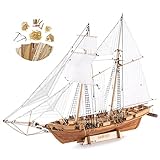
- Teak Deck, Cherry wood, Basswood material
- Metal assemble accessories, color instructions and 1 set 1/96 lifeboat included
- Accurately laser cut wooden parts, upgrade accessories like metal anchors, brass rings
- 1847 Harvey trading ship model, great gift for ship enthusiasts
Ships also had different jobs. The cited records document coastal trade and fishing for the New England ketch, cargo transport for the medieval coca-type vessel and merchant barque, and naval convoy escort for Grasshopper. A rig alone therefore cannot tell you whether a ship was a merchantman, fishing vessel, or naval craft.
Independent reader supportYour contribution helps us test, update, and keep practical guides available for everyone.How to read historic ship plans
Plans can help researchers understand a vessel’s form, but the contents and purpose of a plan matter. Royal Museums Greenwich describes a lines plan as three views: a profile (side view), a half-breadth view (hull shape at waterlines), and a body plan (half-hull shapes at measured points). Its collection page reports more than one million original plans dating from the early 18th century; its Admiralty Collection holds around 8,000 plans representing approximately 10,000 ships. These figures describe that museum’s collections, not all surviving ship plans.
Rank #3

- Highly Detailed: Meticulously crafted 1:70 scale model of the historic ENDURANCE
- Authentic Materials: Constructed from high-quality wood and die-cast metal to create a beautiful display model.
- Intricate Design: Features intricate details like rigging, sails, ladders, cannons and deck elements, with 3,292 parts
- Adult Assembly Required: Engaging project for hobbyists and model enthusiasts, this is Medium difficulty build, model ship build required, Average build time: 480 hrs.
- Impressive Scale; dimensions 29.68" inches long x 17.5 " tall X 8.5 " wide when fully assembled.
The Smithsonian’s National Museum of American History says many plans in its watercraft collection are field documentation rather than original builder plans. They may omit complete construction details and tables of offsets, and the museum explicitly does not warrant the seaworthiness or safety of vessels built from its study plans. A historical drawing is research material, not automatically a construction-ready or safe specification.
For further reading on American vessels, the Smithsonian’s ship-plan resource names Howard I. Chapelle’s The History of American Sailing Ships.
Quick wins for a faster PC:
Fix the driver behind crashes, sound loss and screen glitchesFind Drivers →Clear out junk files and repair common Windows errorsFree Scan →Quick Recap
Best Value
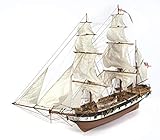
- Highly Detailed: Meticulously crafted 1:60 scale model of the historic HMS BEAGLE
- Authentic Materials: Constructed from high-quality wood and die-cast metal to create a beautiful display model.
- Intricate Design: Features intricate details like rigging, sails, ladders, cannons and deck elements.
- Adult Assembly Required: Engaging project for hobbyists and model enthusiasts, this is Medium difficulty build, model ship build required
- Impressive Scale; dimensions 28.4" inches long x 18.9 " tall X 9 " wide when fully assembled.
Rank #4

- Historical Naval Warship Replica: USS Constitution known as old Ironsides, is a three-masted wooden-hulled heavy frigate of the United States Navy, She is the world's oldest commissioned naval warship still afloat
- Premium Construction Materials: Model built plank-on-frame hull in basswood and hand stitched sails rigging
- Easy Assembly Process: Not a kit, only need to assemble the sails and mast
- Impressive Display Dimensions: Assembled dimension 26 inches length x 5.9 inches width x 18 inches height
- Nautical Home Decoration: Attractive decoration for your nautical theme house and suitable for gifting
Sources and collection records
- Smithsonian National Museum of American History: Ship Plans
- Smithsonian Institution: Ship Model, Ketch
- Smithsonian National Museum of American History: Rigged Model, Privateer Prince de Neufchatel
- Royal Museums Greenwich: Cargo vessel; Schooner
- Royal Museums Greenwich: Cargo vessel; Barque
- Royal Museums Greenwich: Ship plans collection
- Smithsonian National Museum of American History: Ship Model, Ship London
- Royal Museums Greenwich: Merchant vessel; Cargo vessel; Cocca

Product prices and availability are accurate as of the date/time indicated and are subject to change. Any price and availability information displayed on Amazon at the time of purchase will apply.




