Windows Errors? Fix Them Before They Spread
Repair common Windows errors and clear accumulated junk for a smoother, more stable PC - no reinstall needed.Free scan · no reinstall
Crashes, No Sound, or Screen Glitches?
Random freezes, missing sound and display glitches usually trace back to one bad driver. Find and replace yours safely.Free scan · under a minute
ThatPainter is reader-supported. When you buy through links on our site, we may earn an affiliate commission. Learn More
A practical home quilting space needs three things: a comfortable sewing station, a usable cutting area, and a place to press. Arrange them around your normal cut-sew-press workflow, fit each surface to the task and your body, and keep the tools you reach for most close at hand. You can do this in a dedicated room or a shared space; no single layout or room size suits every quilter.
Plan the work zones around your quilting routine
Start by identifying where you will sew, cut and lay out fabric, and press. Keeping these jobs near one another reduces unnecessary trips, but safe movement and enough room for the project matter more than achieving a perfect triangle. The American Sewing Guild describes the relationship among cutting, sewing, and pressing as a sewing room triangle; use that as a workflow idea, not a rigid floor plan.
Quick wins for a faster PC:
Scan for outdated or missing drivers - takes under a minuteDriver Scan →Repair Windows errors before they cause bigger problemsFix Now →Fix the driver behind crashes, sound loss and screen glitchesFind Drivers →As an Amazon Associate I earn from qualifying purchases.
- Sewing: Position the machine where you can sit comfortably and manage fabric without crowding your work area.
- Cutting and layout: Allow enough surface for the pieces or quilt currently in progress. A nearby design wall can help with arranging blocks if you have room.
- Pressing: Place the ironing board and iron close enough to the machine that pressing seams fits naturally into your routine.
For ideas on combining these stations and organizing supplies, see Missouri Star Quilt Co.’s sewing room organization guide.
Set up the sewing station for your body and machine
Adjust the chair and sewing surface while the machine is in its actual working position. A machine placed on top of a table raises the needle area above the tabletop, so choosing a table by its nominal height alone can leave the work too high. The Sewing & Craft Alliance recommends fitting the chair and table to the individual; test the arrangement at the needle rather than relying on a generic measurement formula.
#1 Best Overall

- EXTRA LARGE CUTTING SURFACE: Perfectly sized for cutting full widths of fabric, extra-large squares, and long strips with ease
- SELF-HEALING DESIGN: Durable mat with a double-sided, self-healing surface for extended use and precise measurements
- EASY-TO-READ GRIDS: Features measuring grids and 30, 45, and 60-degree bias lines for accurate angle cutting
- PROTECTS WORK SURFACE: Ideal for sewing, quilting, scrapbooking, and gift wrapping while keeping your work area safe
- QUALITY CRAFT TOOLS: Designed to enhance your creativity with reliable and long-lasting materials
OSHA’s workplace sewing guidance offers useful general principles for a home setup: “Tables should be adjusted so the work is at elbow height and wrists are kept straight.” Its sewing-station guidance also calls for leg clearance and suggests padded or rounded edges where forearms rest. OSHA’s recommendations address workplace operations, not a medical assessment or a guarantee against injury; adapt them to your body, chair, and machine.
For fine work that is difficult to see, OSHA’s fine-work guidance discusses raising the work 2 to 4 inches above elbow height. That applies to the close-visual-work context, not to every quilting station. Raising the work can also make the shoulders or forearms uncomfortable, so support your arms and use a position you can maintain comfortably.
Choose a cutting surface you can work over comfortably
AllPeopleQuilt suggests starting with a cutting table at waist height or slightly below, but waist height varies from person to person. Try the surface with your usual cutting mat and posture before settling on a height. An adjustable-height table can make it easier to find a workable position or share the station with someone of a different height; its value depends on how well it adjusts, how stable it is, and whether its footprint fits the room. See AllPeopleQuilt’s sewing-room upgrade suggestions.
Rank #2
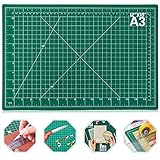
- 【SEWING CUTTING MAT】Aneuzs self-healing cutting mat protects your work surface. Compatible with rotary cutters and straight blades, won't hurt the cutter blade and keep the blade sharpness. Ideal for artist, crafters, quilters, engraver and hobbyists
- 【SELF HEALING CUTTING MAT】Made of 5-layer PVC material, the white hardness PVC in the middle help to prevent cutting through. Special finish reseals surface cuts, providing a continually smooth surface for all cutting projects
- 【ROTARY MAT SIZE】Rotary cutting mat measures approx.12 x 18 inches (A3 size), durable and reusable. Perfect for small, medium and large craft and sewing projects
- 【DOUBLE SIDE CRAFT CUTTING MAT】This double side sewing mat with measurements is printed clearly with both inches, metric grid lines and angles help to cut precisely
- 【MULTIPURPOSE SEWING BOARD CUTTING MAT】Great for sewing, crafts, model, quilting, fabric, scrapbooking project cutting projects
Keep the mat and rotary cutter near the cutting area, and leave enough clear space for the fabric you are handling. A large dedicated surface is convenient when the room and project call for it; a smaller or fold-away surface may be the more practical choice in a shared room.
Light the needle and other detail work
Use general room lighting for safe movement, then add an adjustable task light that can be aimed at the needle, cutting surface, or other detail area. OSHA states: “At the workstation, adjustable task lighting must shine on the work area to make it easier for the worker to see the product.” The agency’s fine-work guidance notes that insufficient light can make work difficult to see and contribute to eye fatigue and headache. These sources support lighting the task directly; they do not establish a particular bulb temperature or color-accuracy specification for quilting.
Do these 3 things before closing this tab:
1Repair Windows errors before they cause bigger problems2Fix the driver behind crashes, sound loss and screen glitches3Clear out junk files and repair common Windows errorsStore tools where you use them
Keep frequently used notions within easy reach of the station where you need them. Drawers, bins, pegboards, and rolling carts can organize tools while keeping the main work surface clear. Open storage makes visible supplies easy to grab; closed drawers or a closet conceal clutter and can suit a multipurpose room better. Put bulky or infrequently used materials elsewhere when that frees up valuable working space.
Rank #3

- Smooth & Stable Cutting Surface: Provides a smooth, stable workspace for fabric cutting, paper trimming, card making supplies, scrapbooking supplies, and other creative hobbies.
- Clear Double-Sided Grids: Printed on both sides with inch grids, angle lines, and guides for precise alignment. Perfect for sewing supplies, quilting supplies, and detailed crafting projects.
- High-Quality Self-Healing Layer: Self-healing surface absorbs light cuts to stay smooth over time, compatible with rotary cutter for fabric, straight blades, and other crafting supplies.
- Sturdy Multi-Layer Construction: Thick PVC layers with a firm core provide stable cutting support, protect blades, and prevent table damage. Works as a reliable craft mat or fabric cutting mat.
- Versatile for Various Projects: Ideal for sewing, quilting, paper crafts, card making supplies, modeling, and other creative projects. Also functions as a large cutting board for home or professional workshops.
AllPeopleQuilt’s sewing-room organization ideas include examples of storage and multi-use arrangements. Choose the approach that gives you convenient access without letting supplies take over the area needed for your current project.
Independent reader supportYour contribution helps us test, update, and keep practical guides available for everyone.Make a shared or small room do more
A quilting area does not have to occupy a dedicated room. Fold-away or movable tables, wall storage, closet storage, and a sturdy multi-use surface can let one area serve several purposes. A rolling cart can bring tools to the work and move out of the way when the room changes use. If one surface must serve multiple tasks, plan how you will clear or reconfigure it between cutting, sewing, and pressing.
Prioritize enough clear area for the fabric or quilt you are working on, plus safe access to the stations. The cited guidance does not establish a universal minimum room size, so choose the layout based on your projects, furniture, movement needs, and available footprint.
Rank #4

- SELF HEALING ROTARY MAT - Our rotary mat is self-healing, it reseals surface cuts for a continually smooth cutting surface. Using a self-healing cutting mat extends the life of your blade and protects the surfaces of your work area.
- DOUBLE SIDED - Our double-sided rotary mat has one side with grid lines and one side without grid lines. Grid lines help with easy measuring and accurate cutting of straight lines and precise angles. The solid color side is used for general cutting.
- 24 INCH BY 36 INCH MAT - This rotary cutting mat is 24"x36" and 1.5mm thick. The large size makes it perfect for most crafting projects. Great for cutting multiple layers of fabric into bias strips, squares, triangles, and squaring up blocks.
- PROTECT YOUR ROTARY MAT - Our professional quality cutting mat is designed for use with rotary cutters only. Not for use with fixed blade utility knives. To prevent warping, store it flat and out of direct sunlight.
- THE OLFA STANDARD - As the inventor of the Rotary Cutter in 1979, OLFA has maintained a standard of cutting excellence for our quality and durability. Pairing OLFA brand rotary cutter, blades and cutting mats together will provide optimal results.
Decide what is worth buying—and what can wait
Furniture and accessories are options, not prerequisites. A dedicated cutting table may make sense if you cut large pieces often and have room to leave it set up. A folding or multi-use surface may be a better fit if the room is shared. Likewise, fixed-height furniture can work when it fits your posture, while adjustable furniture offers more flexibility at the cost of additional space or complexity.
| Choice | Consider it when | Check before choosing |
|---|---|---|
| Dedicated versus fold-away surface | You want a station that stays ready, or need to reclaim the room between sessions. | Project size, storage needs, setup effort, and available floor space. |
| Fixed versus adjustable-height cutting table | A fixed surface already suits your posture, or you need to tune the height for your body or shared users. | Stability, usable surface area, adjustment range, and footprint. |
| Open versus closed storage | You want tools visible and accessible, or prefer supplies out of sight. | How often you use the items and how much clear work surface you need. |
| Room light versus task light | Overhead lighting does not adequately illuminate the needle or detail work. | Whether an adjustable light can be aimed where you work without obstructing the station. |
A suitable chair, cutting mat and rotary cutter, adjustable task light, and rolling cart can all be useful depending on your setup. Compare items for personal fit, adjustability, stability, usable surface area, and the room they occupy. The sources cited here do not rank named products or report comparative product testing.
Quick Recap

Product prices and availability are accurate as of the date/time indicated and are subject to change. Any price and availability information displayed on Amazon at the time of purchase will apply.




